



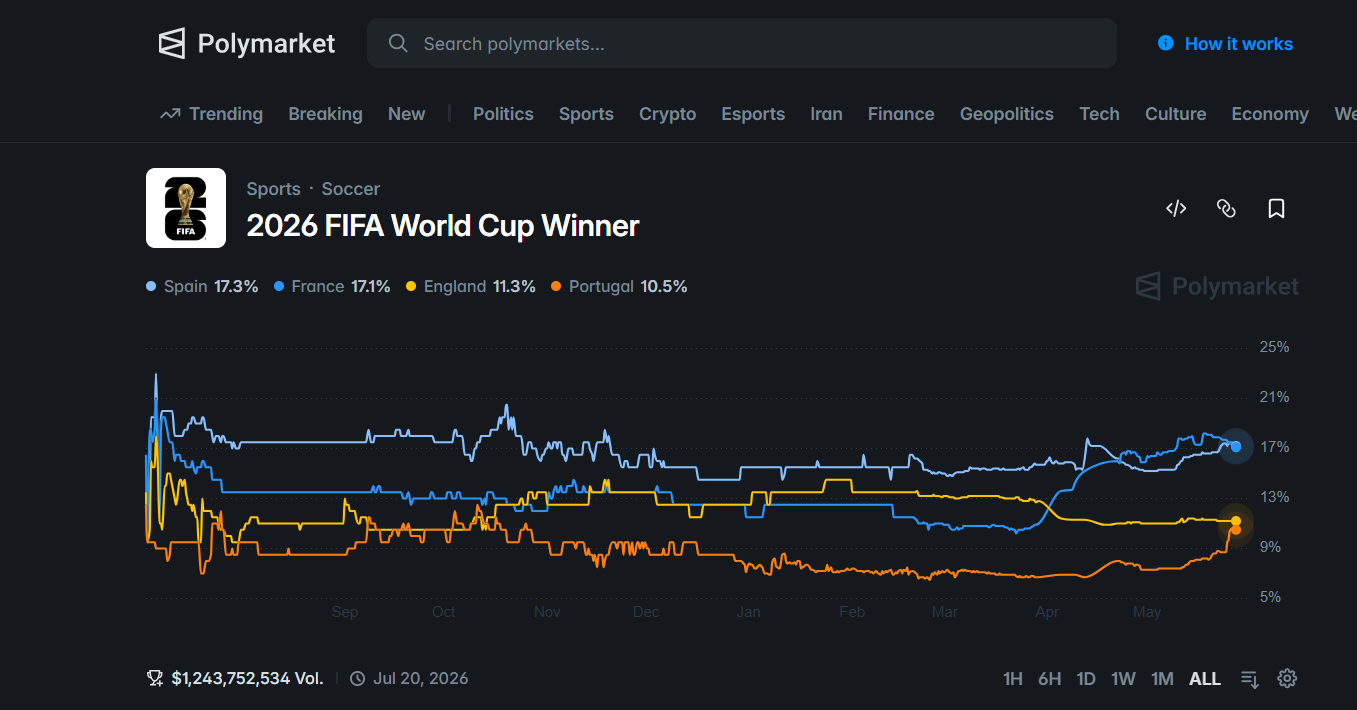
The 2026 FIFA World Cup kicks off June 11 — the first tournament in history where prediction markets operate as full-scale financial infrastructure. The winner contract on Polymarket has already accumulated $1.2B in trading volume since it launched in July 2025 — the largest single-event prediction market ever. Kalshi and Polymarket are projected to process a combined $2.4B across the tournament. That is one contract and one tournament on a market that didn’t exist at this scale two years ago.
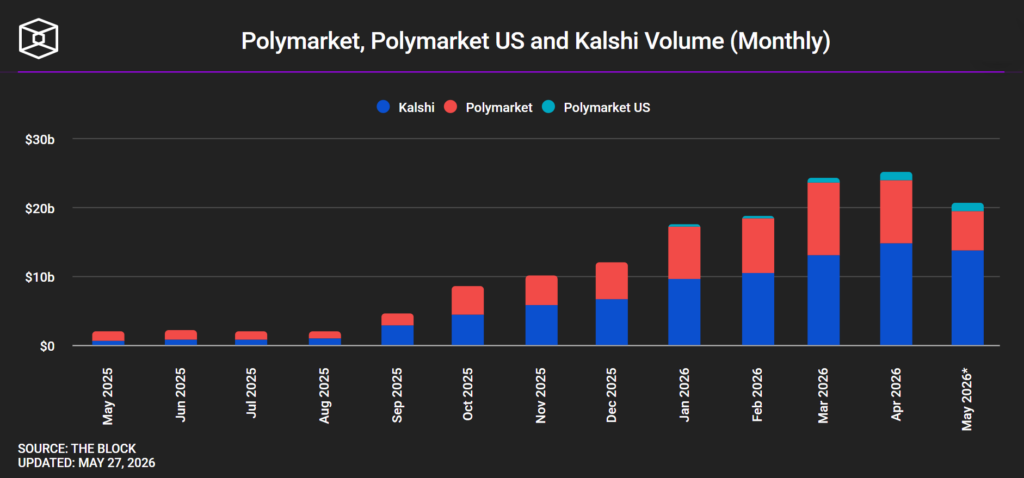
The market behind it grew 4× in 2025 to $63.5B in notional volume. In March, Polymarket crossed $10.57B in a single month for the first time. Kalshi closed a $1B Series F at a $22B valuation — double what it was worth five months earlier. Over 1M traders are now accessing prediction markets through Robinhood’s Kalshi integration. This is not a betting niche anymore.
No team in the 48-team field trades above 20% to win. In a tournament with no clear favourite, that compression is exactly what keeps volume flowing for eleven months before the first whistle — and will keep it flowing for 35 days after June 11. The full tournament — 104 matches, 12 group stages, final on July 19 — runs $2.4B in projected volume across both platforms. Each game is a separate traffic spike and a separate acquisition moment. This is the first World Cup where prediction markets operate as a full layer on top of every game — not a single hype contract, but continuous pricing infrastructure from group stage through the final on July 19.
Where the $2.4B Goes — and Who Captures It
The tournament starts June 11. The marketing window started already. FIFA doesn’t create a single marketing moment — it creates a rolling 35-day window of compounding user intent. The platforms that get the most out of it are the ones that start each channel at the right time, not the ones with the biggest budgets.
KOLs & Streamers
Before a major match, users search for platforms, read reviews, and decide where to deposit. During the match, they’re watching. KOL campaigns need to land in that pre-match window — not during it.
The channel mix follows match timing: Telegram and X run throughout the tournament and spike hardest during games; YouTube does its heaviest lifting in the T-14 to T-7 window before the tournament opens, when pre-match analysis and platform walkthroughs drive first-deposit decisions; Twitch and Kick co-streams during live matches collapse the distance between content and conversion — the viewer is already watching the game, the streamer’s running commentary on odds or predictions is the shortest path to action.
KOL agreements, content briefs, and seeding timelines require 2–3 weeks of lead time before the campaign goes live. Platforms that start discussions when the tournament opens are already losing ground to competitors who seeded their audience in the group stage.
This applies across every sector in play — prediction platforms activating new traders, fan token exchanges retaining tournament-period volume, sportsbooks repositioning for crypto-native audiences, Web3 gaming capturing sports fans who’ve never touched a Web3 product.
For Banana Gun, a Telegram-based trading bot competing in one of crypto’s most crowded verticals, we synchronized 77 KOL publications across 5 regions into a 72-hour window — timed to a hard exchange deadline, the same way a match window works. Full case →
Paid Traffic
104 matches means 104 moments of spiking intent — and most platforms run the same generic tournament creative across all of them. That’s the gap.
Google search volume for individual player names rises 300–600% during major matches and tournament milestones. Queries like “Mbappé goals total,” “Vinicius odds,” “Bellingham FIFA prediction” represent high-intent users in a decision-making moment — emotionally activated, primed to act. A prediction platform or iGaming product that intercepts that search with a timely, match-specific ad captures a user that audience-based targeting misses entirely.
On Meta and programmatic networks, campaigns built around match schedules — with creative refreshed per fixture — consistently outperform evergreen tournament creatives. A user watching England vs France is in a different mindset than a user browsing three days after the match.
The timing structure matters as much as the targeting:
| Phase | Window | What to Run |
|---|---|---|
| Warm-up | T-30 to T-14 | Audience building, creative testing, baseline CPMs before tournament inflation |
| Pre-registration | T-14 to kickoff | Scale winning creatives, early deposit window |
| Group stage | Match days | Event-triggered ads, player-level and match-level targeting — highest intent, CPMs run 2–4× above baseline |
| Knockouts & final | Through July 19 | Retarget group stage engagers who didn’t convert — FOMO framing, higher emotional stakes |
Platforms that haven’t pre-built their audiences and creative by the group stage are paying premium rates for cold traffic.
For a crypto casino entering Asian markets — one of the most restricted verticals in paid advertising — we ran compliant Meta campaigns across 5 geos, scaling from a $250 test budget to a full campaign while maintaining positive ROI throughout. The same compliance-first infrastructure applies directly to FIFA-period iGaming campaigns. Full case →
ORM
Most platforms running FIFA campaigns won’t think about ORM until their ads are already live. By then the cost is already paid.
During the tournament, acquisition volume increases across every sector. KOL campaigns are running. Ads are converting. And then users do what users always do before depositing real money: they Google the platform name and check Trustpilot and Reddit.
What they find on most prediction platforms right now is a problem. Polymarket and Kalshi — the dominant names in the space — carry Trustpilot profiles that reflect the industry’s default posture toward reputation management: largely absent. For a user arriving through a FIFA-period KOL campaign or paid ad, this is the last friction point before conversion. A platform that runs a $200K KOL campaign without addressing a 2.1-star Trustpilot rating is paying to drive users to a page that turns them away.
Reddit compounds this. Threads ranking in Google for queries like “best FIFA prediction platform” or “is [platform] legit” are often months old and unmonitored. A single high-ranking complaint in a gambling or crypto subreddit redirects thousands of potential signups to a competitor by default.
ORM has to run first — because it fixes what users find when they search the platform name before depositing. The minimum window is 30–90 days. A campaign briefed today has 14 days before the group stage opens.
For a new iGaming platform with no prior reputation, we built Trustpilot and CasinoGuru presence from scratch — the result was a direct lift in user acquisition. The mechanism was simple: fix what users find when they search the platform name before depositing. Full case →
The Window Is Narrower Than It Looks
June 11 is the visible deadline. The actual marketing deadline is earlier — and different for each channel.
ORM takes 30–90 days to move the needle on review platforms and search results. A platform that starts today is working with a realistic 14-day window before the group stage opens — enough to make progress, not enough to build from zero. Platforms that started in March are already ahead.
KOL campaigns need 2–3 weeks of lead time for agreements, briefs, and content production before the first post goes live. A campaign briefed on June 1 goes live at best on June 15 — four days into the group stage, after the first wave of user acquisition has already happened.
Paid traffic is the most flexible channel, but even here the warm-up phase matters: cold audiences built during the tournament cost 2–4× more per impression than audiences pre-built before it. The platforms scaling into the knockouts on pre-warmed audiences will have a structural cost advantage over everyone who started late.
The tournament runs 35 days. For most platforms, the realistic acquisition window is the group stage — the first 18 days, before casual interest fades and only the committed audience remains. Knockout rounds are for retargeting and conversion, not for building new audiences from scratch.
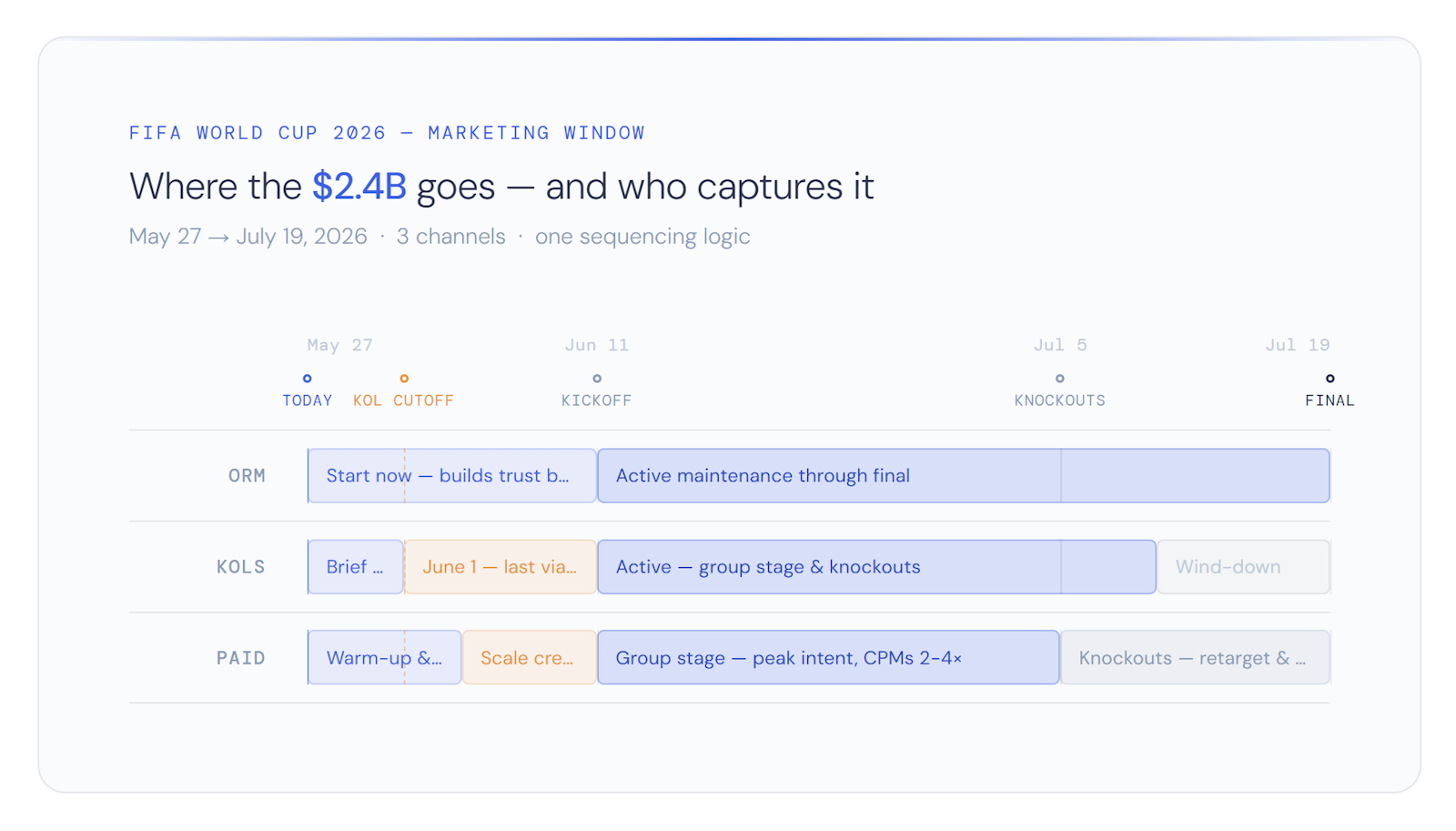
| Channel | Latest Viable Start | Active Window | Primary Outcome |
|---|---|---|---|
| ORM | Now — every week matters | 30–90 days | Conversion rate protection, trust signal, AI Overview positioning |
| KOLs & Streamers | June 1 at the absolute latest | 30 days | Awareness, first deposit, community growth |
| Paid Traffic | T-14 for warm-up · T-7 to scale | 30–60 days | Acquisition, retargeting, event-triggered conversion |
The sequencing is the strategy. ORM builds the floor. Paid traffic scales the volume. KOLs drive the quality and emotional engagement that converts a sports fan into a platform user. Running all three without ORM in place first is the most common and most expensive mistake in a tournament marketing cycle.
After July 19
The World Cup ends. The prediction market doesn’t.
The platforms that use this tournament to build an audience, establish a reputation, and prove their product to a new demographic will exit July 19 with a user base they didn’t have on June 11. The user who deposited for the first time during the group stage, had a good experience, and found the platform through a KOL they already trusted — that user doesn’t disappear when the final whistle blows.
Every major sporting event produces the same pattern for platforms that ran KOLs, paid acquisition, and ORM before it started: the tournament onboards more users in 35 days than the rest of the year combined. The $2.4B projected volume is where that happens.
Prediction markets grew 4× in 2025. June 11 is the first World Cup they’ve ever had.
Frequently Asked Questions
Wash trading inflates volume on some contracts, but the evidence on World Cup markets specifically doesn’t support calling the whole number fake. Polymarket’s winner contract has sustained open interest and price movement across dozens of teams for nearly a year — that’s not consistent with coordinated wash trading, which tends to cluster on a few illiquid contracts. Kalshi, being CFTC-regulated, faces stricter surveillance that makes systematic wash trading harder. The volume is real enough to matter; whether it reflects “genuine” conviction or hedging activity by sophisticated traders is a separate question.
Users Google the platform name before depositing real money — that’s documented behavior, not a theory. A 2.1-star Trustpilot page doesn’t kill awareness; it kills conversion at the exact moment a user is deciding whether to fund their account. The problem is compounded on Reddit, where threads ranking for “is [platform] legit” are often months old, unmonitored, and full of unresolved complaints. A $200K KOL campaign funnels users to those pages. Platforms that run acquisition without addressing what users find when they search the platform name are paying to lose customers at the last step.
A sportsbook sets lines and takes the other side of your bet; a prediction market lets you trade against other users, and the price reflects crowd-sourced probability rather than a house margin. The practical difference matters: on Polymarket or Kalshi, you can exit a position before the tournament ends if you change your mind — you’re not locked in. The tradeoff is that prediction markets have less liquidity on individual match markets compared to established sportsbooks, and resolution disputes (what counts as a “win,” how injury-related walkovers are handled) can be messier. For casual sports fans, a sportsbook is simpler. For people who want to trade probabilities across 35 days, a prediction market is the better tool.
The platforms grew on crypto-native audiences and political events — demographics that already knew what a prediction market was. The World Cup is the first time they’re trying to convert casual sports fans who have never used a crypto wallet or traded a contract. That gap between product complexity and audience familiarity is the actual marketing problem — not budget. Kalshi solved part of it through the Robinhood integration (over 1M users), which removes the wallet friction entirely. Polymarket is still working through that barrier for non-crypto users. The platforms with the smoothest onboarding and the clearest “here’s how to trade in 90 seconds” content will capture the most of the $2.4B window.
Review platforms like Trustpilot apply velocity filters — a sudden surge of positive reviews from new accounts triggers suppression, not publishing. Building a credible review presence means spreading activity over time, from accounts with history on the platform. Sixty days of consistent review-building moves a rating meaningfully; two weeks of rushed reviews often disappears entirely. The 30–90 day window isn’t conservatism — it’s the actual timeline the platform’s algorithms require. A platform briefing ORM on June 1 is working with 10 days before the group stage, which is not enough to move a 2-star rating to a credible 3.8+.
Share with


Rate the article