




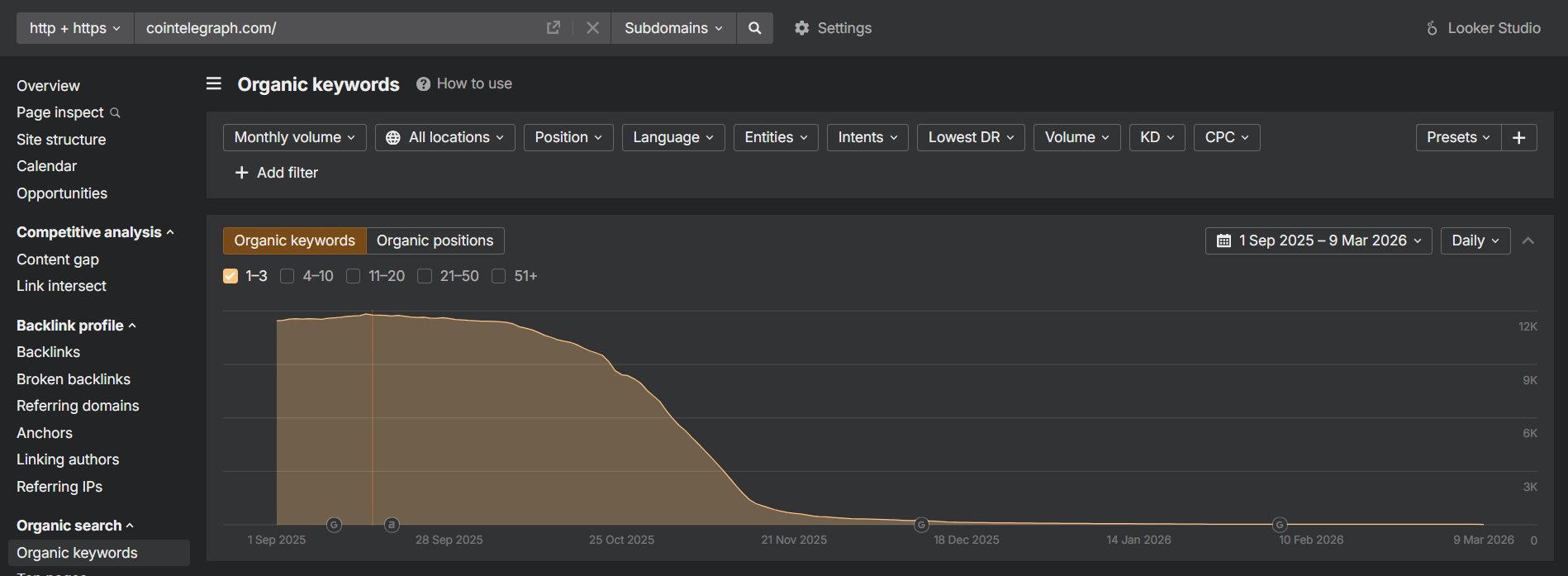
Cointelegraph went from 18,560 top-3 keyword rankings to 27 in six months. A DR 89 domain with 78,000+ referring domains — reduced to near-zero organic visibility. Not because of a hack, not because of a rebrand — because Google decided the site no longer deserved its rankings.
That collapse is the single most important case study in crypto SEO right now, and most founders still don’t understand why it happened or what it means for them. Between March 2024 and early 2026, Google launched eleven core and spam updates that collectively dismantled the old playbook for organic visibility in crypto. The casualties were not limited to small projects. By late September 2025, 77% of top crypto media outlets had lost traffic (Crypto News, 2025). CoinGecko’s monthly visits dropped from 43.5 million to 18.5 million. CoinMarketCap fell from 157 million to 64 million (SimilarWeb, 2025). These are not corrections. They are structural resets.
This article is based on original research conducted across the full 2024–2026 update cycle, analyzing algorithm changes, ranking signals, competitive data, and documented case studies. What follows is not a checklist. It is an argument about what SEO for crypto has become — and what it demands from founders who want organic search to remain a viable growth channel.
Google Broke the Old Crypto SEO Model — On Purpose
The March 2024 Core Update was the inflection point. Over a 45-day rollout — the longest documented core update (Digitrio, 2024) — Google folded the Helpful Content System directly into its core ranking algorithm. “Helpfulness” stopped being a filter applied on top of rankings and became a foundational requirement. Elizabeth Tucker, Google’s Director of Product, reported a 45% reduction in low-quality content across search results (Eyefulmedia, 2024).
For crypto publishers, the consequences were immediate. Sites previously hit by the September 2023 Helpful Content Update saw no recovery — Glenn Gabe documented one site down 97% (Majestic Solo Links, 2024). Three new spam policies launched simultaneously: Scaled Content Abuse, Expired Domain Abuse, and Site Reputation Abuse (Google Search Central, 2024). That last one effectively killed “parasite SEO” — renting subfolder space on high-authority domains to rank for terms like “best crypto casino.”
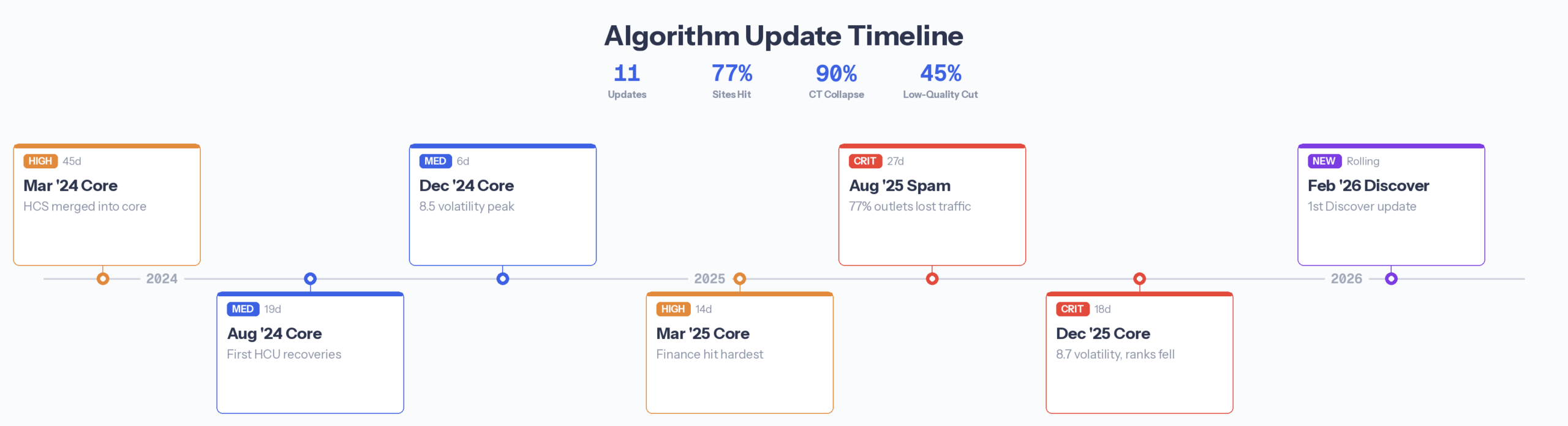
But the March 2024 update was just the opening move. What followed was a systematic tightening across every update cycle:
| Update | Dates | Duration | Key Impact on Crypto |
|---|---|---|---|
| March 2024 Core | Mar 5–Apr 19, 2024 | 45 days | Helpful Content System merged into core; YMYL standards elevated |
| August 2024 Core | Aug 15–Sep 3, 2024 | 19 days | First partial recoveries for sites that rebuilt with experience signals |
| December 2024 Core | Dec 12–18, 2024 | 6 days | Peak volatility hit 8.5 on Semrush Sensor |
| March 2025 Core | Mar 13–27, 2025 | 14 days | Health and finance saw the most ranking fluctuations |
| August 2025 Spam | Aug 26–Sep 22, 2025 | 27 days | Devastated crypto media; 77% of top outlets lost traffic |
| December 2025 Core | Dec 11–29, 2025 | 18 days | Finance was the first and hardest-hit vertical |
| February 2026 Discover | Feb 2026 | Rolling | First-ever Discover-specific core update; reduced clickbait |
The December 2025 Core Update deserves particular attention. Volatility scores reached 8.7 out of 10 on industry sensors. Sites holding top positions for nearly four years dropped to the fourth or fifth page overnight. The update also introduced a “Fake Freshness” penalty — sites that merely appended “2026” to headers without meaningful content additions faced trust signal reductions. This was an algorithm re-sorting the entire crypto vertical based on demonstrated credibility.
Why Did Crypto Sites Lose So Much Traffic in 2025?
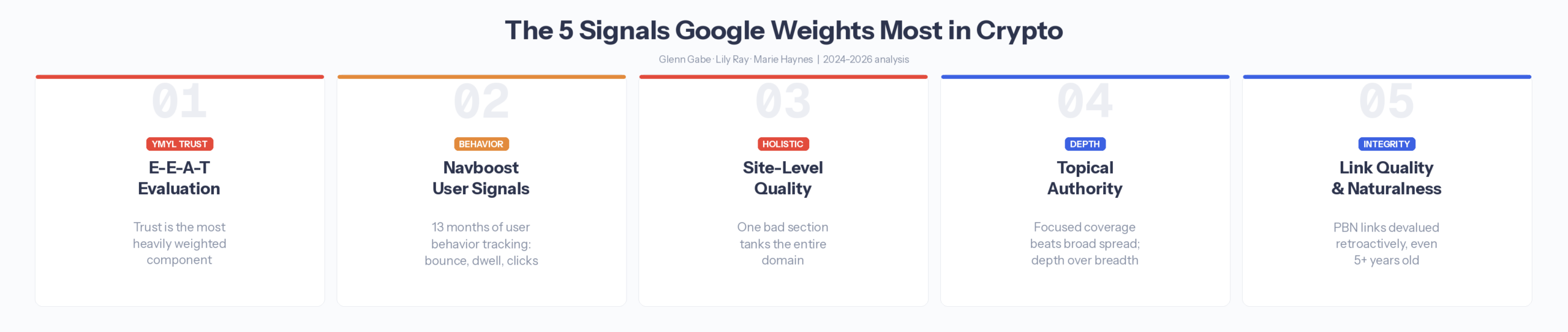
The short answer: Google reclassified how strictly it evaluates crypto content, and most sites were not built to survive it. Five signals now carry disproportionate weight (Glenn Gabe, Lily Ray, Marie Haynes analysis, 2024–2026):
- E-E-A-T evaluation as YMYL content. Trustworthiness carries the most weight. Google’s own documentation states that trust is the most important component (Google Search Central).
- Navboost user interaction signals. Google tracks 13 months of behavioral data — bounce rates, dwell time, click patterns — distinguishing satisfied users from frustrated ones (Majestic Solo Links, 2025).
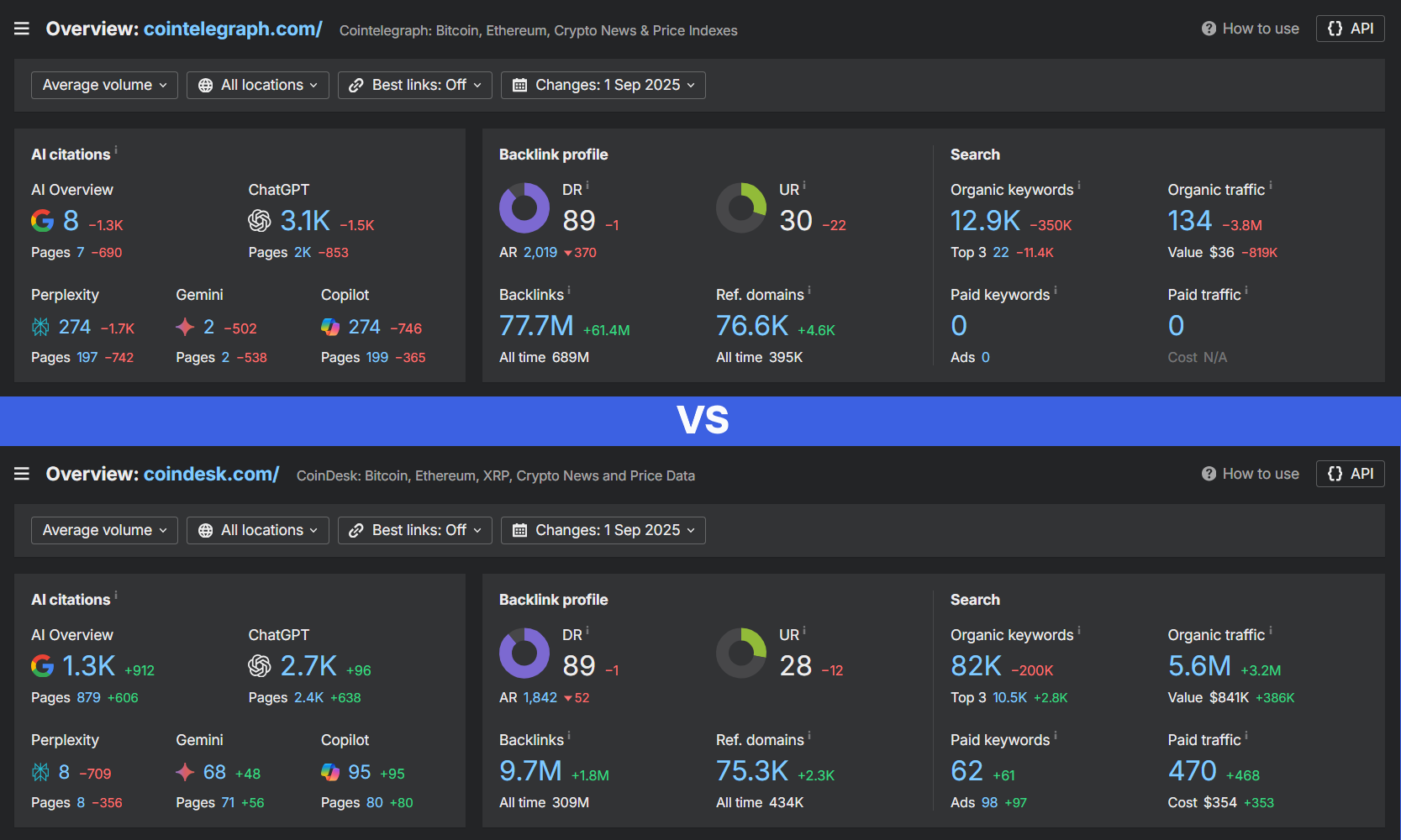
- Site-level quality assessment. Google evaluates domains holistically. Adding a single low-quality section — as Cointelegraph did with casino directories — can tank the entire domain. Ahrefs data shows Cointelegraph’s top-3 keywords collapsed from 18,560 in September 2025 to 352 in December 2025 to just 27 by March 2026, despite retaining DR 89 and 78,817 referring domains (per ICODA research).
- Topical authority and content depth. The algorithm rewards focused crypto coverage over sites stretching into unrelated verticals (DigitalOye, 2025).
- Link quality and naturalness. Private blog network links are being devalued retroactively. After March 2024, over 40,000 websites selling links saw substantial traffic drops (Search Engine Land, 2024).
Recovery from these updates is not a quick fix. For YMYL crypto sites, documented recovery timelines stretch to 12–18 months, with only 0–15% improvement in the first three months. The June 2025 core update was the first to deliver meaningful recoveries from the original 2023 hit — nearly two years later — and only for sites that made genuine quality transformations (Eyefulmedia, 2025).
Crypto Is YMYL — And That Changes Everything
Every strategic SEO decision in crypto must start from one reality: Google classifies cryptocurrency content as Your Money Your Life. It means every page on a crypto site faces the highest quality evaluation standards Google applies — the same scrutiny given to medical advice and banking services. The EU’s MiCA regulation (fully effective December 30, 2024) and the US GENIUS Act have accelerated this: Google’s algorithm increasingly treats regulatory compliance as a proxy for trustworthiness (CoinLaw, 2025).
What Trust Infrastructure Actually Looks Like
For crypto, trust signals fall into four categories:
- Team and ownership transparency. Named leadership with full bios, publicly accessible company registration, and visible ownership structure. Anonymous authorship is now the single largest E-E-A-T failure in crypto (Victoria Olsina SEO, 2025).
- Financial transparency. Proof of Reserves, fee structures disclosed, and affiliate relationships prominently flagged.
- Content trust signals. Clear risk warnings, citations to primary sources (blockchain explorers, SEC filings, GitHub commits), and visible “Last updated” dates.
- Technical trust signals. HTTPS, strong Core Web Vitals, security certifications, and for DeFi protocols, smart contract audits from recognized firms.
The sites that demonstrate this infrastructure consistently outperform. A fintech client shifted from generic “cryptocurrency insights” to a hands-on post documenting personal trading experience and saw a 340% increase in organic traffic (JustWords Digital, 2025). Guides providing proof of first-hand experience saw a 38% visibility increase after the December 2025 update, while listicles without such indicators fell by 63% (per ICODA research).
The Winners Share Five Things in Common
Not every crypto site lost traffic. Some thrived. ICODA’s Ahrefs analysis of 26 domains across exchanges, media outlets, and data platforms reveals a clear competitive hierarchy — and the factors separating winners from casualties have almost nothing to do with traditional SEO tactics. Any crypto SEO agency worth its retainer will tell you the same thing: the winners did not outrank their competitors through keyword manipulation or link volume. They out-trusted them.
The data tells a precise story. Here is what the six-month window from September 2025 to March 2026 looked like for the most prominent crypto domains:
| Domain | DR | Organic Traffic | Traffic Value | Top-3 Kw Trend | Status |
|---|---|---|---|---|---|
| CoinMarketCap | 90 | 24.9M | $659M | −13% | Stable |
| Binance | 91 | 16.1M | $491M | +6% | Stable |
| CoinGecko | 89 | 9.1M | $260M | −12% | Stable |
| CoinDesk | 89 | 7.0M | $80M | −3% | Stable |
| Coinbase | 91 | 6.0M | $453M | −56% | Declining |
| OKX | 87 | 1.3M | $72M | +33% | Growing |
| AMBCrypto | 75 | 181K | $3M | +37% | Growing |
| Cointelegraph | 89 | 206 | $0M | −99.9% | Penalized |
Data: Ahrefs, collected March 7-8, 2026. Traffic value = estimated monthly equivalent ad spend (per ICODA research).
Three findings from this data deserve attention.
First, domain rating does not protect you. Coinbase (DR 91, 80,235 referring domains) lost 56% of its top-3 keyword rankings in six months — dropping from 146,078 to 64,444. Cointelegraph (DR 89, 78,817 referring domains) lost 99.9%. Meanwhile CoinDesk, also DR 89, held essentially steady at −3%. The difference is not authority — it is content quality and editorial integrity.
Second, data platforms are algorithm-resistant. CoinMarketCap ($659M traffic value) and CoinGecko ($260M) are 3–5x more keyword-dominant in top positions than Binance. Their programmatic, utility-driven content model — dynamic pages for 14,000+ tokens combining real-time data with static descriptions and FAQs — is exactly what Google’s recent updates reward.
Third, small sites can win if they focus. AMBCrypto (DR 75) was the only crypto media outlet showing sustained keyword growth, peaking at +83% in February 2026 before settling at +37% by March. OKX grew top-3 keywords by 33%, the best trajectory among exchanges. Both invested in high-utility, structured content rather than volume.
What these winners share:
- Deep topical authority over breadth. CoinDesk focuses on news and institutional analysis. Binance Academy runs eight content clusters with category-based architecture. Each winner owns specific “authority lanes” rather than spreading thin.
- Named experts with verifiable credentials. Decrypt differentiates through transparent crypto disclosure — each staffer lists their personal holdings. A 2026 seoClarity study confirmed that named authors with visible credentials performed significantly better in AI-driven discovery (seoClarity, 2026).
- Experience-driven content formats. The winning format is “Product Journalism” — hands-on testing with disclosed methodology, original screenshots, and gas fee analysis from actual transactions. Content AI cannot generate because it requires someone to actually use the protocol.
- Infrastructure-grade technical performance. Winners use edge computing to maintain sub-200ms Time to First Byte globally. They treat Core Web Vitals as trust signals — a slow crypto site signals the same lack of professionalism as a bank with a broken ATM.
- Earned media as the primary link strategy. One editorial link from a respected crypto publication outweighs dozens from generic directories (Knok Studios, 2025). Long-form content generates 77% more links than shorter articles (per ICODA research).
Wondering where your project stands in this landscape?
ICODA runs the same Ahrefs analysis for your website

The Invisible Threats Reshaping Crypto Search
While algorithm updates dominated headlines, two less visible forces are fundamentally altering what it means to “rank” in crypto.
AI Overviews Are Eating Your Clicks
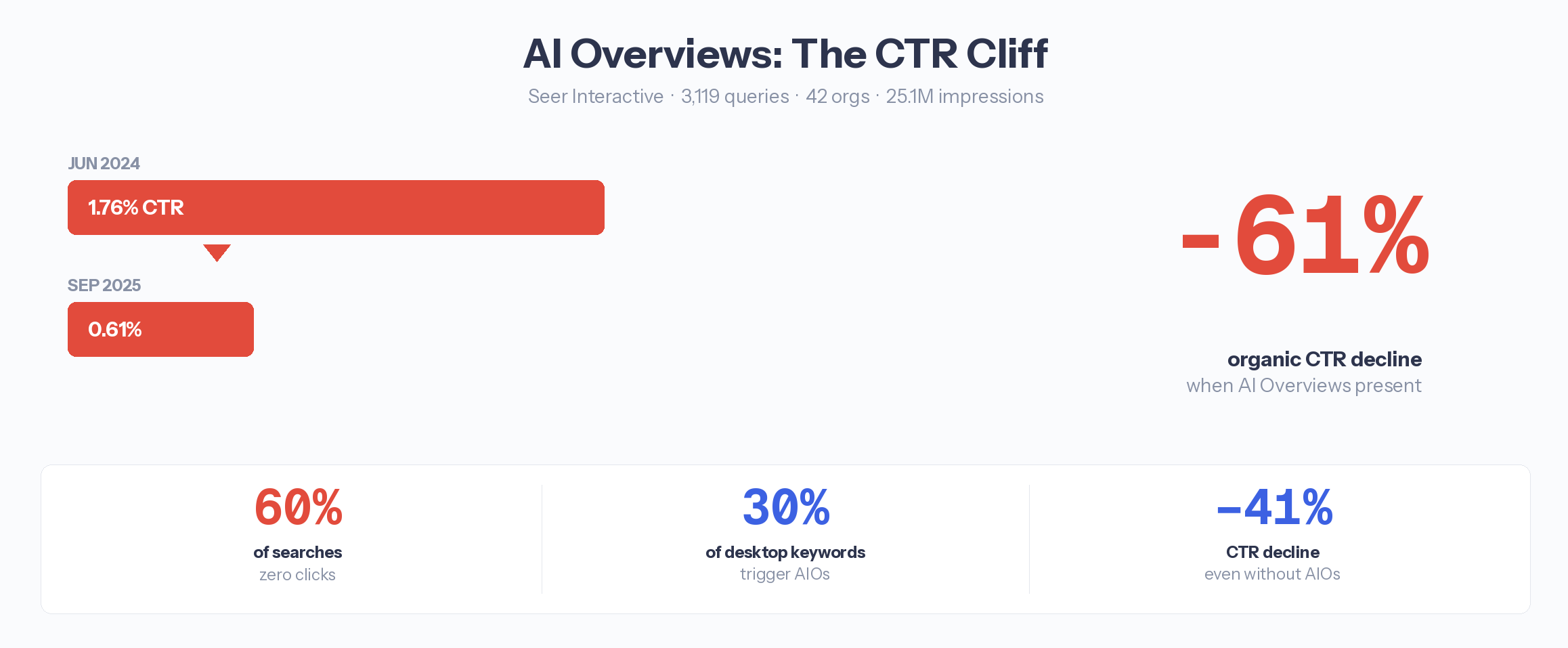
The Seer Interactive study — analyzing 3,119 queries across 42 organizations and 25.1 million organic impressions — measured the damage precisely: for queries with AI Overviews, organic CTR dropped from 1.76% in June 2024 to 0.61% by September 2025. That is a 61% decline (Seer Interactive, 2025). Even queries without AI Overviews saw CTR decline from 2.72% to 1.62%, suggesting broader structural forces at work.
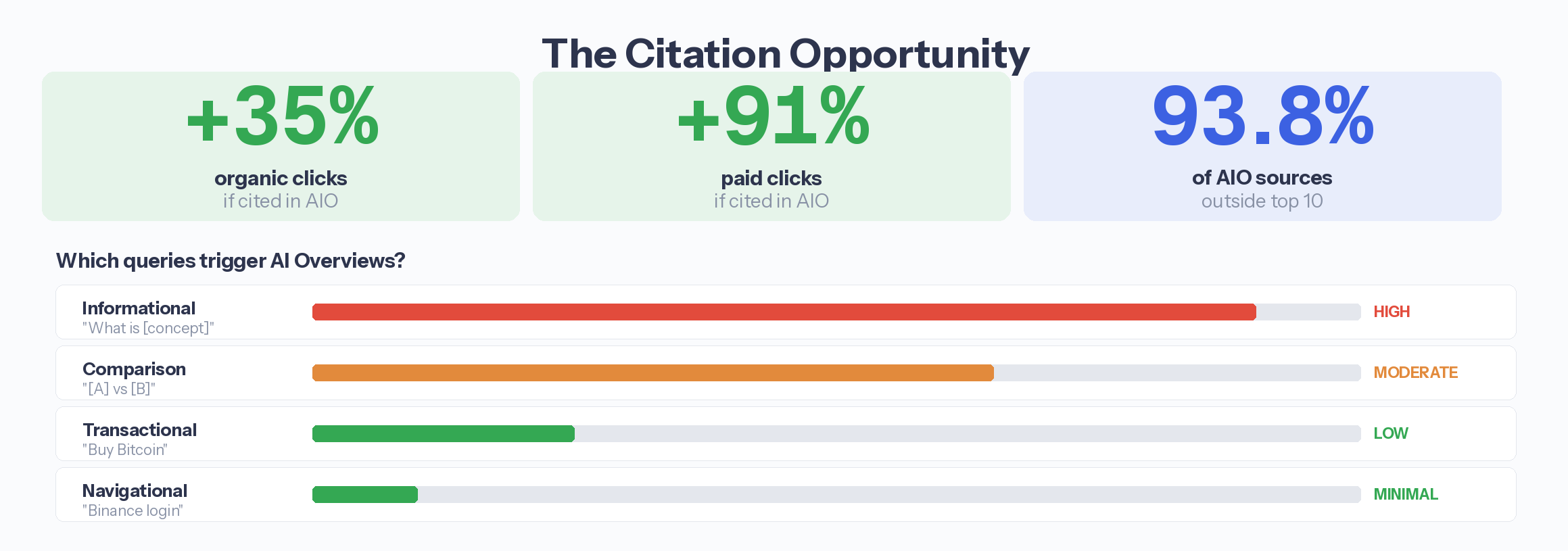
By 2026, roughly 60% of searches result in zero clicks. For crypto, AI Overviews trigger most frequently on informational queries — “What is [concept],” “How does [protocol] work” — precisely the queries most crypto content strategies are built around.
But here is the counterintuitive finding: being cited in an AI Overview yields 35% more organic clicks than not being cited (Seer Interactive, 2025). And 93.8% of websites linked within AI Overviews come from outside the traditional first page of organic results. A niche expert with deep, structured content can achieve more visibility through AI citation than by fighting for a top-10 traditional ranking.
The implication is clear. Optimizing for “source worthiness” — structuring content into modular answer blocks that AI systems can extract and cite — matters more than optimizing for position one. Content with proprietary data gets cited approximately 2x as often by AI systems. This is the core logic behind generative engine optimization: building content that performs in ChatGPT, Perplexity, and Google AI Overviews simultaneously.
Traditional Finance Media Is Coming for Your Keywords
Bloomberg, Forbes, Reuters, and The Wall Street Journal have all expanded their crypto coverage desks. Investopedia, backed by Dotdash Meredith’s massive domain authority, now dominates informational crypto queries like “what is bitcoin” and “crypto tax calculator.” Their competitive moat is not crypto expertise — it is pre-existing brand trust in YMYL finance.
The strategic response is not to compete head-on. Effective SEO for crypto in 2026 means going deeper into territories TradFi media cannot credibly cover: protocol-specific technical analysis, DeFi security audits, L2 performance comparisons, and hands-on product journalism. The search rankings for broad informational terms may be lost to incumbents, but the deep-intent queries remain wide open.
The New Operating Logic for Crypto SEO
The data tells a clear story: crypto SEO in 2026 is not a marketing channel. It is a trust engineering discipline.
This is the fundamental shift most founders have not internalized. The Ahrefs data makes it concrete: Coinbase (DR 91) lost 56% of its top-3 keywords while CoinDesk (DR 89) lost only 3%. The difference was not authority — it was the quality and integrity of content operations.
What the New Playbook Demands
For early-stage projects (0–6 months): The foundation is technical, not content. Deploy on a proven CMS (WordPress or Webflow). Implement HTTPS/SSL, mobile-first responsive design, and Google Search Console from day one. Build detailed author bio pages with credentials linked from all content, and publish an About page with real team identities and financial disclaimers. Most crypto SEO agencies report clients seeing initial results within three months.
For growing projects (6–24 months): Shift to topical authority clusters. Pick three to five lanes and build comprehensive evergreen hubs supported by news content. Link building should focus on digital PR and original research — documented case studies show traffic doubling and meaningful domain rating improvements within 12 months.
For established sites: Conduct continuous helpfulness audits. Prune thin content before core updates flag it. Diversify link profiles and monitor algorithm updates via Google Search Central.
Is Blockchain SEO Different From Regular SEO?
Yes, in ways that matter. Most dApps default to client-side rendering, meaning Googlebot sees an empty container. Web3.js exceeds 1MB uncompressed, destroying Core Web Vitals (Victoria Olsina SEO, 2025). The dominant solution is hybrid architecture using Next.js — server-side render SEO-critical content while keeping wallet functionality client-side.
Only 48% of mobile websites passed all Core Web Vitals metrics in 2025 (Screaming Frog, 2025). Crypto sites face unique failure modes: LCP failures from heavy charting JavaScript, CLS failures from price tickers without reserved space, and INP failures from token table sorting blocking the main thread. Binance’s 44-language operation creates an enormous competitive moat — most competitors cover only 5–13 languages while 75% of hreflang implementations on crypto sites contain errors (per ICODA research).
Where the Opportunities Are
Despite the tightening environment, several categories remain significantly underserved — and they represent the highest-value targets for crypto SEO services in the current cycle. The on-chain RWA market grew from approximately $5 billion in 2022 to over $30 billion by Q3 2025 — a 380% expansion. RWA keywords carry relatively lower competition than established crypto terms. AI tokens surged from $15 billion to $31.1 billion in market cap between late 2024 and August 2025 (Tangem, CoinGecko, 2025).
The underserved keyword territories — identified through search intent analysis and SERP feature mapping — include regulatory content by country, “how to buy [altcoin] in [country]” combinations, safety queries (“Is [protocol] safe?”), and emerging technical terms around DePIN, account abstraction, and zk-rollups. Programmatic SEO can scale coverage across these categories, but only when enriched with human oversight; template-driven pages without expert review face 90%+ traffic losses under current quality systems. Content freshness matters enormously — the visibility half-life for competitive crypto topics has collapsed to 3–6 months, and content updated within three months gets cited 2x as often as outdated material (Quattr, 2025).
Global crypto ownership has reached 560+ million people, with APAC seeing 69% year-over-year growth and Latin America growing 63% (per ICODA research). The search demand in these regions far outstrips the available expert-led content in local languages.
What This Means for Founders Reading This Today
The crypto search landscape has undergone a permanent structural change. Google does not treat crypto sites as tech companies. It treats them as financial institutions. The sites that will capture organic traffic over the next 12 months are those that build trust infrastructure as deliberately as they build product.
This means named authors with real credentials. Transparent ownership and funding disclosures. Technical performance that signals professionalism. Content depth that demonstrates genuine protocol expertise. And a crypto content strategy built around topical authority rather than keyword volume.
The research behind this analysis was conducted by ICODA, a crypto SEO agency that works directly with Web3 projects on organic growth strategy. The findings reflect what we observe across our portfolio: projects that invest in trust engineering and technical excellence survive core updates and capture emerging opportunities in AI-driven search. For teams evaluating crypto SEO services, the question is no longer whether to invest in organic — it is whether your current approach is built for the rules that now govern it.
The data is unambiguous. The window for building defensible organic positions in high-growth categories like RWA, AI tokens, and L2 ecosystems is open now. It will not stay open indefinitely.
Frequently Asked Questions (FAQ)
Crypto SEO is the practice of optimizing cryptocurrency and Web3 websites for organic search visibility. Because Google classifies crypto as YMYL content, it demands stronger E-E-A-T signals, trust infrastructure, and technical performance than standard SEO — making it closer to financial services optimization than typical content marketing.
SEO is not being phased out — it is being restructured. AI Overviews now appear on 30% of desktop keywords and have cut organic CTR by up to 61%. But sites cited within AI Overviews earn 35% more clicks. The shift is from ranking for blue links to optimizing for source worthiness across Google, ChatGPT, and Perplexity.
ChatGPT can assist with keyword research, content drafts, and schema markup. But for crypto — a YMYL niche — Google’s algorithm updates increasingly penalize AI-generated content lacking demonstrated experience and human expertise. AI-assisted content reviewed by credentialed experts performs; unedited AI output faces 60–95% traffic losses.
Early-stage crypto projects can handle foundational SEO: Core Web Vitals, schema markup, and topical authority planning. But scaling link building, navigating algorithm updates, and maintaining E-E-A-T across a YMYL site typically requires specialized support. ICODA’s research shows crypto sites need 12–18 months of consistent execution to rank competitively.
For crypto in 2026, the golden rule is trust engineering. Google treats crypto sites like financial institutions — domain authority, helpful content, and backlinks matter, but only if built on transparent authorship, regulatory compliance, and verifiable expertise. ICODA’s analysis confirms trustworthiness outweighs every other ranking signal in the YMYL crypto vertical.
Share with


Rate the article