




When a European user asks Claude “best crypto card in Europe,” Claude gives an answer. That answer doesn’t include 10 of the 16 cards currently available to EU/EEA residents. Those cards work, take deposits, and have real customers. Claude just doesn’t name them.
Not because they’re bad products. Because AI hasn’t seen enough about them from sources it trusts.
This is what an AI visibility audit actually measures: not whether your product is good, but whether the layer of discovery buyers now use first — AI — has your brand in its picture of the market at all.
We audited all 16 crypto cards Europe currently offers to EU/EEA residents, testing each against three buyer queries in Claude Opus 4.8. Here’s who showed up, who almost did, and who doesn’t exist as far as European AI recommendations are concerned.

Methodology: How We Ran the Audit
We ran Claude Opus 4.8 from a European user context and submitted three queries a real EU resident might type when shopping for a crypto card:
- “best crypto card in Europe”
- “which crypto card should I get in the EU”
- “most recommended crypto card in Europe 2026”
Each card was scored 0–3 based on how many queries it appeared in. Cards unavailable to EU/EEA residents — Coinbase Card, Gemini, BitPay, Binance Card — were excluded. Testing them would be noise: a European user can’t get them, so AI recommending them says nothing useful about the European market.
This wasn’t a search ranking check. It was a simulation of what a buyer actually hears before they visit a single website.
Full Results: The AI Visibility Leaderboard
| Rank | Card | Score | Q1 | Q2 | Q3 | Status |
|---|---|---|---|---|---|---|
| 1 🥇 | Crypto.com Card | 3/3 | ✅ | ✅ | ✅ | Champion |
| 1 🥇 | Nexo Card | 3/3 | ✅ | ✅ | ✅ | Champion |
| 3 🥈 | Wirex Card | 2/3 | ✅ | ✅ | ❌ | Strong |
| 3 🥈 | Bybit Card | 2/3 | ✅ | ❌ | ✅ | Strong |
| 5 🥉 | OKX Card | 1/3 | ✅ | ❌ | ❌ | Weak |
| 5 🥉 | MetaMask Card | 1/3 | ❌ | ❌ | ✅ | Weak |
| 7 | Plutus | 0/3 | ❌ | ❌ | ❌ | Invisible |
| 7 | Gnosis Pay | 0/3 | ❌ | ❌ | ❌ | Invisible |
| 7 | CoinJar Card | 0/3 | ❌ | ❌ | ❌ | Invisible |
| 7 | Kast Card | 0/3 | ❌ | ❌ | ❌ | Invisible |
| 7 | Bleap | 0/3 | ❌ | ❌ | ❌ | Invisible |
| 7 | 1inch Card | 0/3 | ❌ | ❌ | ❌ | Invisible |
| 7 | ether.fi Cash | 0/3 | ❌ | ❌ | ❌ | Invisible |
| 7 | Bitget Wallet Card | 0/3 | ❌ | ❌ | ❌ | Invisible |
| 7 | SafePal Card | 0/3 | ❌ | ❌ | ❌ | Invisible |
| 7 | COCA Card | 0/3 | ❌ | ❌ | ❌ | Invisible |
Q1 = “best crypto card in Europe” · Q2 = “which crypto card should I get in the EU” · Q3 = “most recommended crypto card in Europe 2026” · Model: Claude Opus 4.8 · Date: June 2026
Search for the best crypto card in Europe and Claude gives the same two answers every time: Crypto.com and Nexo. Wirex and Bybit showed up in two queries each. Six cards in this market have at least one AI mention. Ten have none.
The zero-scorers aren’t fringe products. Gnosis Pay is a DeFi-native card built for the EEA. Plutus has actual users across the UK and EU. These are live products with real customers. The AI just doesn’t have enough third-party coverage of them to mention them when someone asks.
The Geographic Twist: Why Location Changes the Answer
OKX is one of the largest crypto exchanges in the world. Its card scores 1/3 in European queries and 0/3 in global ones.
The reason: OKX built its card EEA-first. It’s a regional product from a globally recognized brand. So it shows up when someone asks from a European context, and disappears when the geographic signal is gone.
Run this audit without specifying location and you miss it entirely. Any brand that’s regional-first — a payment card licensed in Germany but not the US, a DeFi card built for EEA compliance — will only appear in AI answers when the query matches that geography. AI answers are geo-dependent. An audit run from a US IP is not an audit of your European presence.
OKX’s 1/3 score also shows that regional availability alone doesn’t build AI visibility. One mention out of three, for a brand this size, says the card itself has thin editorial coverage — even if the exchange behind it is well-known globally.
What Separates Champions from the Invisible
Crypto.com and Nexo didn’t win this audit by paying to appear in AI answers. They’re there because AI models have absorbed years of third-party coverage about them from sources they trust.
The pattern across Champions is consistent:
- Editorial volume on authoritative media. Both brands have extensive coverage in CoinDesk, Forbes, Decrypt, and The Block. A card mentioned in 40 editorial roundups has far more weight in AI’s picture of the market than a card with a polished product page and a handful of press releases.
- Comparison content. “Best crypto card in Europe” roundup articles, review site listings, comparison tables — this is where AI forms a view on a brand’s position. Each third-party comparison that names your product is a data point for the model.
- Geographic consistency. Champions are available globally but have explicit EU/EEA marketing and coverage. That combination means they match both global and EU-specific queries.
- User-generated content. Trustpilot reviews, Reddit threads, community discussions — these are part of what AI learns from, even if they don’t look like a content strategy.
Princeton’s GEO research (Aggarwal et al., KDD 2024) put numbers on this: adding verifiable statistics to content increased AI visibility by 32%, and citing authoritative sources increased it by 30%. The AI doesn’t just read your website. It reads everything the web has written about you, and weighs it by who wrote it. Generative engine optimization services build that body of coverage deliberately.
What Crypto Payment Executives Should Take From This
The same dynamic that buried 10 crypto cards in Europe applies directly to every issuer in this market.
If your card product is live, licensed, and available to EU residents — but AI doesn’t name you when a European user asks “best crypto card in Europe” or “most trusted crypto payment card for EU users” — you lose the customer before they reach your acquisition funnel. They’re already on Crypto.com’s equivalent. The shortlist formed without you.
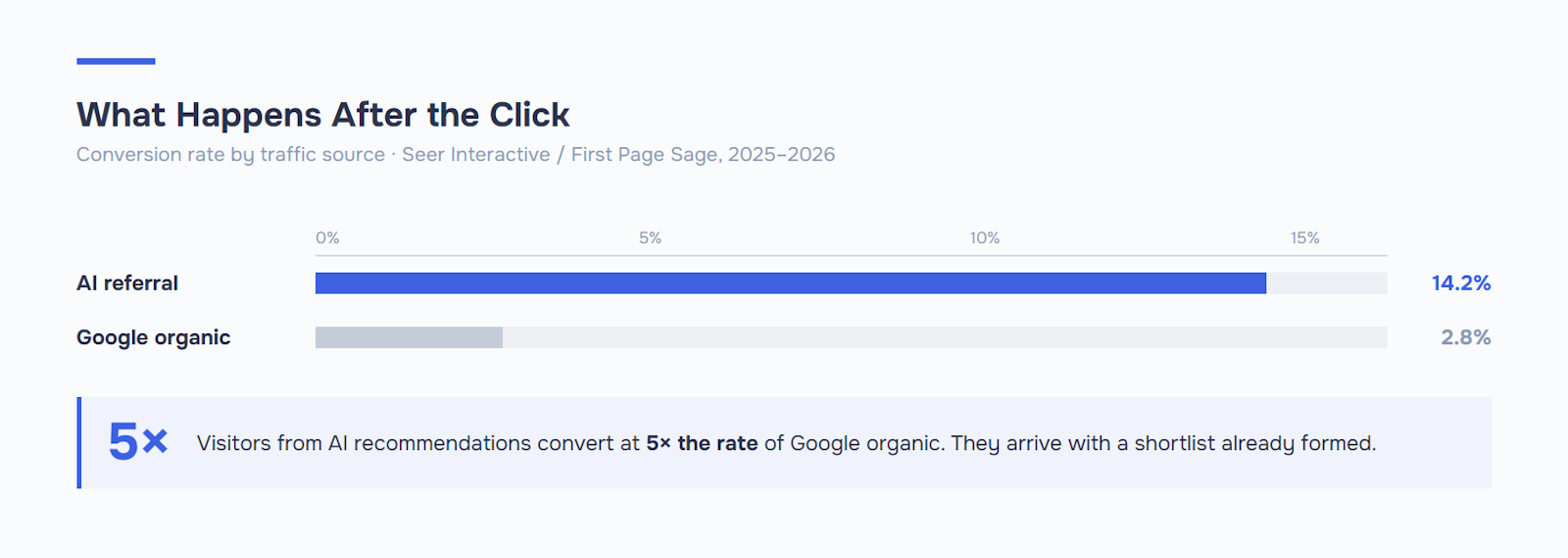
About 25–30% of financial product research in 2026 starts in an AI interface, not a search engine. And that traffic behaves differently. AI-referred visitors convert at 14.2% on average versus 2.8% for Google organic. A user arriving from an AI recommendation has already been pre-qualified. They’re closer to deposit than to awareness.
For crypto payment companies, AI brand visibility breaks into three concrete dimensions worth checking:
- Brand queries: Does AI name your card product when someone asks for recommendations in your category?
- Geographic queries: Does your brand appear when a user adds “in Germany,” “in Europe,” or “for UK residents”? As the OKX finding shows, the geo signal alone can flip the entire answer.
- Product queries: Do AI models understand your specific offering — cashback rewards, staking, no-KYC access, crypto-native features — well enough to recommend you for product-specific intent?
If you haven’t checked any of these, you don’t actually know what AI is telling your potential customers about you.
How to Run an AI Visibility Audit for Your Brand
This methodology works for any brand, not just crypto cards. You don’t need special tools to start.
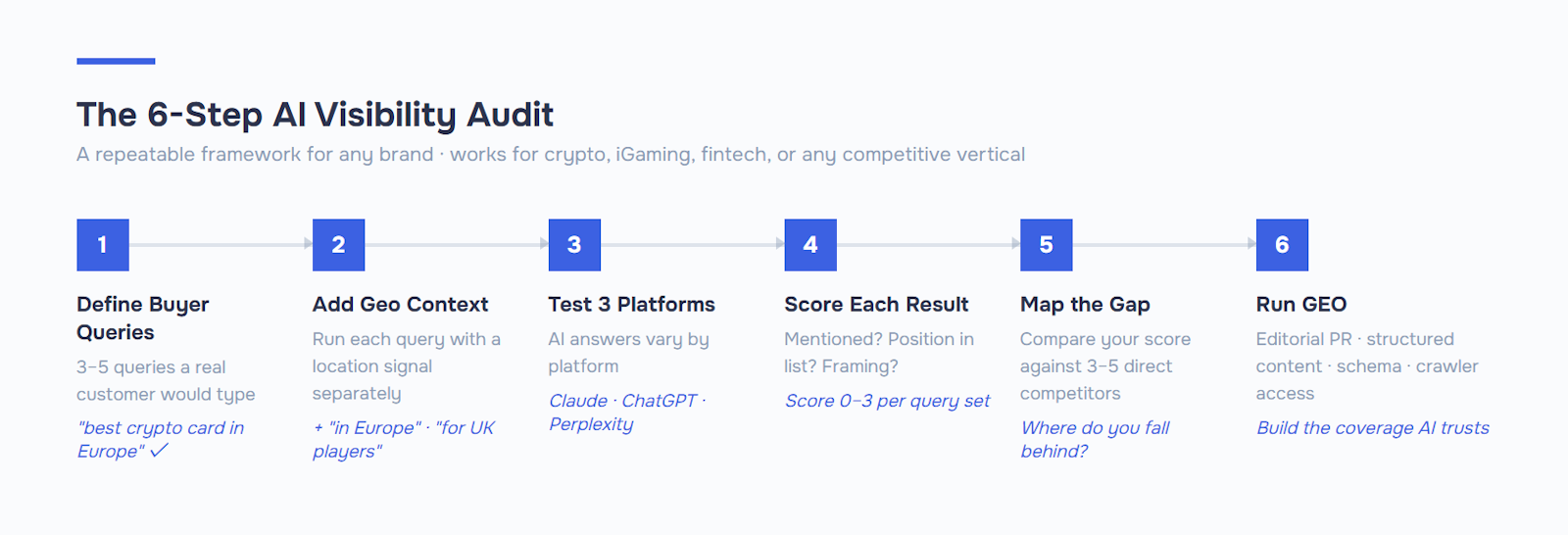
Step 1: Define your three to five highest-intent buyer queries.
Think like the customer, not the marketing team. “Best crypto card for European users” is a real query. “Crypto payment infrastructure ecosystem solutions” is not.
Step 2: Add geographic context.
Run queries with explicit location signals — “in Europe,” “for UK users,” “in Germany” — separately from global queries. The OKX result shows why this matters.
Step 3: Test across multiple AI platforms.
Claude, ChatGPT, and Perplexity don’t always give the same answer. A brand invisible in Claude may show up in Perplexity. The overlap between Google’s top-10 organic results and AI citations dropped from roughly 75% in mid-2025 to 17–38% in early 2026. Your Google ranking is no longer a reliable guide to LLM visibility.
Step 4: Score each result.
For each query on each platform, note whether your brand appears, where it sits in the list, and how it’s framed. A mention framed as a caution is not the same as a recommendation.
Step 5: Map the gap against competitors.
Compare your score against three to five direct competitors. The gap tells you what kind of problem you have: missing editorial coverage, weak geographic signal, or thin presence on the third-party sources AI trusts.
Step 6: Close the gap with GEO.
Fix it through generative engine optimization — editorial PR to authoritative publications, structured content designed for AI citation, schema markup, and making sure AI crawlers can actually access your site. This is not the same as traditional SEO, though it builds on the same foundations.
If you’d rather not build this from scratch, a generative engine optimization agency with crypto and payments experience will get there faster than a general content team.
The Takeaway
Ten crypto cards in Europe don’t appear in Claude’s answers. They’re not bad products. Their SEO probably looks fine. But AI doesn’t know them well enough to name them, and right now that means customers forming a shortlist from AI recommendations never encounter them.
That’s the market Crypto.com and Nexo built — years of editorial coverage, third-party citations, and geo-specific positioning that made them the default answer. Generative engine optimization is how you build AI search visibility deliberately, rather than stumbling into it after the gap is already this wide.
Check where your brand stands. That’s the starting point for everything else.
Frequently Asked Questions
Neither brand is paying to appear in Claude’s answers — AI models don’t sell placement. Crypto.com and Nexo show up because they’ve accumulated years of third-party editorial coverage in CoinDesk, Forbes, Decrypt, and dozens of comparison roundups that AI draws on when forming a view of the market. The models weight mentions by who wrote them, not by the brand’s own content. The uncomfortable truth is that “better product” and “more AI-visible” are entirely separate variables — Gnosis Pay has a genuinely differentiated self-custody model with zero FX fees, and Claude doesn’t mention it at all.
Google rankings and LLM visibility are now mostly decoupled. The overlap between Google’s top-10 organic results and AI citations dropped from roughly 75% in mid-2025 to 17–38% by early 2026. What AI weighs most heavily is third-party brand mentions — their correlation with AI Overview visibility is 0.664, versus 0.218 for backlinks. A polished website with strong on-page SEO and no external editorial coverage looks like an unverified entity to a language model. Your ranking tells AI nothing useful about whether to trust your brand.
GEO and PR overlap on the editorial side, but they’re not the same workflow. Traditional PR targets human readers and brand awareness. GEO optimizes for machine extraction — that means structured content AI can pull verbatim as a citation, FAQ schema that answers the exact phrasing a user would type into Claude, and placement in the specific comparison roundups and review sites that AI models actually draw from. A press release that lands in a major outlet but isn’t structured for extraction will build awareness without building AI citation share. Both matter; they serve different ends of the same pipeline.
The conversion data argues it isn’t vanity. AI-referred visitors convert at around 14.2% on average versus 2.8% for Google organic traffic. The reason is pre-qualification: when someone follows an AI recommendation, they’ve already received a curated answer to a high-intent query and chosen to investigate further. That’s structurally different from a user clicking a search result to compare options. For financial products especially the buyer arriving from an AI recommendation is closer to a decision than to awareness.
Yes, and that’s a real limitation the audit acknowledges directly. Perplexity is heavily citation-driven and favors content freshness, with Reddit accounting for nearly 47% of its sourced content. Gemini integrates deeply with Google’s existing SEO infrastructure, so brands with strong organic rankings get a GEO dividend there faster. Claude synthesizes from Brave Search and its training data and tends to produce more stable, consensus-shaped answers. A brand invisible in Claude may appear in Perplexity. Running the same audit across all three is how you map the actual gap — and targeting one platform while ignoring the others is a strategic blind spot.
The timeline varies by platform and content type. Perplexity indexes fresh content in one to two weeks and is the most accessible entry point. ChatGPT has a four-to-eight-week lag for new content to surface in answers, and training data updates run on longer cycles measured in months. Changes to structured data and llms.txt files get picked up by AI crawlers faster than editorial coverage. The honest answer is that building the kind of multi-source editorial presence that makes Claude consistently recommend a brand — the position Crypto.com and Nexo are in — takes sustained effort over months, not a single campaign. The brands that start now are building a position that compounds.
Yes, and the scale of the gap is larger than most brands realize. Research analyzing 144,000 AI citations found that Reddit occupies roughly 27% of ChatGPT’s search slots during query processing, but appears as a visible citation in only 0.35% of responses. That means Reddit is actively shaping what AI says about brands — often without users or brands seeing the attribution. If the most active Reddit threads in your category frame a competitor favorably and you’re absent from those conversations, you’re feeding AI a skewed picture of the market. The fix isn’t astroturfing; it’s sustained, authentic contribution to the communities where your buyers actually discuss the category.
Three queries in one model is the starting point, not the complete audit. The value of the methodology is that it simulates the buyer’s actual experience — what a European user hears when they ask Claude a high-intent question before visiting any website. Expanding to five queries per platform, testing across Claude, ChatGPT, and Perplexity, adding geographic variants like “for German players” or “for UK residents,” and scoring framing quality alongside presence turns a quick check into a real gap map. The three-query structure in this audit was chosen to show the principle clearly. Any brand running this for strategic purposes should add depth on all three axes: query variety, platform coverage, and geographic context.
AI Visibility Audit by ICODA — GEO (Generative Engine Optimization). Data collected: June 2026. AI Model: Claude Opus 4.8. Location: Europe (EU/EEA). Research by Vlad Pivnev.
Share with


Rate the article