




Three agency proposals land in your inbox. All three lead with traffic projections, keyword rankings, and registration volume forecasts. None mention first-time deposit rate. None show you what happens after a player fills out the signup form.
That gap is the problem — and it’s not accidental.
Registrations are easy to manufacture. A technically compliant Google Ads campaign can flood your CRM with signups who never deposit a euro. An affiliate driving 500 monthly registrations with a 4% reg-to-FTD rate is destroying your unit economics. An agency optimizing for registrations can double your signup volume while leaving your NGR flat — and still send you a success report.
The vetting framework comes first. The shortlist comes after.
Why Most iGaming Agencies Optimize for the Wrong Metric
The primary conversion event in online casino digital marketing is the first-time deposit — not the registration. Until a player deposits, your revenue is zero.
In competitive iGaming markets, a healthy reg-to-FTD rate sits between 12% and 18%; below 10%, something structural is broken in the funnel. In ICODA’s work across European licensed operators, blended CAC for a depositing player typically runs €200–300 before bonus costs. An agency that tracks registrations as the primary KPI is measuring the step before the money, not the money itself.
Every online casino digital marketing agency reports what it controls. SEO teams control rankings. PPC managers control clicks. PR firms count placements. None of these are useless — but they only matter when they’re connected to what operators track: FTDs, GGR, player LTV. The agencies worth hiring build acquisition funnels through the cashier screen, not just to the registration form.
Six Questions to Ask Before Hiring an Online Casino Digital Marketing Agency
These six questions separate iGaming acquisition specialists from generalist agencies that “also do gambling.” Ask them before any retainer conversation goes further.
1. What does success look like in your monthly reports?
The answer you want: FTD volume, cost per acquisition by channel, reg-to-FTD rate, 30-day retention, GGR contribution. The answer that ends the call: “traffic,” “impressions,” “brand awareness.”
2. How do you handle Google, Meta, and TikTok restrictions?
Every major platform restricts casino advertising. An agency without a concrete answer here hasn’t run real campaigns in regulated markets. You want: multi-channel setups with compliant landing pages, documented account warm-up protocols, backup traffic sources, and experience surviving platform bans without losing attribution.
3. How do you connect campaign spend to deposit events?
Clicks don’t pay staff. Ask specifically: “Can your reporting show CPA by traffic source down to the first deposit?” If they describe only click-level or session-level attribution, they can’t close the loop between your marketing budget and your cashier screen.
4. Which GEOs have you operated in, and what are the local ad restrictions?
UK, Germany, Canada, Brazil — each jurisdiction has different licensing requirements, different rules on bonus copy, and different payment rail preferences. An agency that answers “we can work anywhere” has worked nowhere specific. You want named markets, named restrictions, and documented compliance approaches.
5. How do you monitor affiliate traffic quality after the click?
Affiliates drive 30–60% of casino FTD volume in most markets. Low-quality affiliate traffic produces bonus-hunters with sub-5% deposit rates. Ask how the agency monitors subid-level FTD rates post-click and what happens when an affiliate’s conversion quality drops. Volume answers mean they’re not watching.
6. Can you show a casino case study with deposit-level results?
Not “300% traffic growth.” FTD increase. CPA reduction. NGR improvement. Any agency that has actually moved the needle on casino player acquisition can show deposit-level numbers. If the best they have is ranking screenshots, they haven’t.
The Evaluation Framework at a Glance
10 Online Casino Digital Marketing Agencies, Evaluated Against the Criteria
The shortlist below is ordered by fit for operators who treat FTD as their primary acquisition metric — not by brand size or ad spend.
1. ICODA
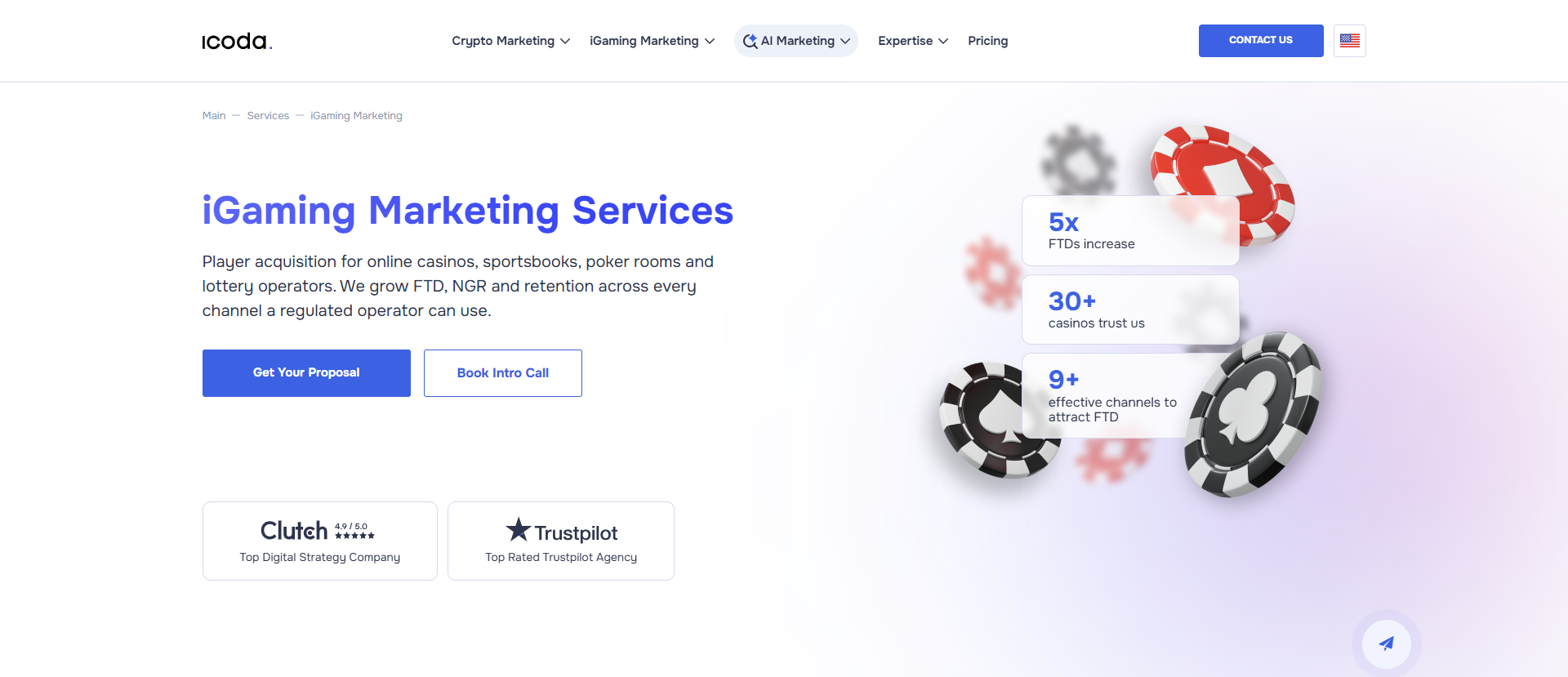
Full-funnel casino and crypto casino marketing agency that ties every channel to FTD and NGR from the first strategy call.
ICODA forecasts CPA, FTD, GGR, NGR, and player LTV in every strategy engagement, with budget broken out by GEO and channel against forecast performance. Their Meta Ads case study for a crypto casino entering Asian markets shows what deposit-level accountability looks like: 136 confirmed deposits, $45,222 in tracked revenue, $8.40 average cost per deposit — on a $2,000 campaign budget across five GEOs. Getting there required server-side CAPI tracking tied to deposit events (not clicks), compliant creative that cleared Meta’s review process, and GEO-level budget reallocation driven by CPA. Their SEO for online casinos practice tracks conversions to real deposits across 20+ markets, not just rankings. The crypto specialization is real — they understand fiat advertising restrictions and what makes crypto-native casino audiences different to acquire.
In iGaming, a player who arrives via a perfectly targeted ad but finds a 2.1★ Trustpilot profile won’t deposit — that’s a lost FTD your CPA data will never explain. ICODA covers both: the acquisition channels and the reputation layer that determines whether acquired traffic actually deposits.
- Casino acquisition, deposit-level — Meta Ads, Asia: 136 deposits, $8.40 CPA, 4,100% ROI across 5 GEOs.
- Casino ORM — Trustpilot & CasinoGuru: Zero to 4.1★ Trustpilot, +64% CasinoGuru — 120% user acquisition growth, 3× conversions.
- Reddit ORM — sentiment reversal, 6 weeks: 41% → 82% positive Reddit sentiment in 6 weeks — native-only engagement.
- Multi-platform ORM — Trustpilot, Reddit, Quora: 4.1★ Trustpilot (68% five-star), 60%+ narrative reduction — targeting “is [casino] legit?” pages that rank in Google.
Best for: Crypto casinos, licensed platforms in emerging GEOs, full-funnel operators.
Contact: icoda.io
2. KARAMAN Digital

Performance PPC managed by an ex-operator — the founder ran digital acquisition at LeoVegas, BetVictor, and Superbet.
KARAMAN Digital has managed over €100 million in digital marketing budgets for named clients including Hard Rock Casino Netherlands, LeoVegas, BetVictor, DAZN Bet, and Superbet. Their team conducts a 300+ point audit of digital marketing channels with a stated focus on maximizing first-time deposits. Minimum engagement budget is $50,000 — which filters out operators who haven’t yet committed to paid acquisition at scale. Having run acquisition from the operator side, the founder reports in P&L terms rather than campaign metrics. That’s a meaningful difference when you’re signing off on the retainer.
Best for: Licensed European sportsbooks and casinos with a serious PPC budget.
Contact: karaman.digital
3. Fortis Media
Compliance-first iGaming SEO with a decade of casino-specific link building and a clean 5/5 Clutch record.
Fortis Media brings ten years of iGaming-specific experience covering online casinos, sports betting, and sportsbook SEO, with pricing that starts at $25–49 per hour. The Lithuania-based team specializes in technical optimization, content strategy, and link building from iGaming-relevant sources — with a white-hat approach that matters specifically in iGaming, where YMYL scrutiny amplifies penalty risk. Their public record: 5/5 Clutch, testimonials citing traffic growth, 13+ years in the niche. What isn’t documented: deposit-level outcomes — organic attribution depends on how the operator connects sessions to first-deposit events, not the agency’s own reporting. Ask specifically how they’d close that loop before signing.
Best for: Operators building long-term organic traffic in European and North American markets.
Contact: fortismedia.com
4. ActiveWin
UK full-service agency born inside Betfred’s marketing operation — their Betfred case study shows a 68% deposit increase.
68% more deposits for Betfred. That’s the number that matters in an iGaming agency portfolio. ActiveWin got there through technical SEO and AI-enhanced analytics, alongside CRM strategies covering multichannel outreach — email, SMS, push notifications — and UX and conversion rate optimization tailored to the casino customer journey. Starting life inside a major operator gives them an operator’s instinct for which metrics actually move the P&L.
Best for: UK and European casino and sportsbook operators who need PPC, SEO, and CRM integrated.
Contact: activewin.com
5. Digirockstars
Built by people who operated licensed iGaming platforms in SEA — not just marketed them.
Digirockstars was built by people who operated inside regulated digital markets in Southeast Asia and applies that operating experience to acquisition, retention, and affiliate systems for licensed iGaming brands. They integrate enterprise-grade lifecycle tooling (Optimove) and frame success in unit economics, not registration volume. Most agencies describe the problem as traffic quality. Digirockstars calls it “system misalignment” — acquisition that doesn’t connect to LTV. That’s a more accurate diagnosis of where iGaming operators actually lose money.
Best for: Operators targeting Southeast Asian markets who need compliance-native execution.
Contact: digirockstars.co
6. Bird Marketing
European multi-award agency with documented compliance knowledge across UKGC, MGA, and Curaçao.
Bird Marketing’s strongest credential against the six-question framework is Question 2 (ad restriction handling): their compliance depth across UKGC, MGA, and Curaçao is more thoroughly documented than most agencies on this list, with jurisdiction-specific approaches for each major European licensing framework. The gap: their public case studies describe outcomes for major casino brands without deposit-level metrics, so Questions 3 and 6 — attribution to deposit events and deposit-level proof — you’ll need to verify directly. The right fit for operators whose primary risk is compliance exposure, not attribution infrastructure.
Best for: Multi-market European operators who prioritize compliance track record.
Contact: bird.marketing
7. Rainmaker Agency
iGaming affiliate program specialists who gate on deposit quality, not click volume.
Rainmaker covers the full affiliate lifecycle — recruitment, commission design, tracking platform setup, ongoing performance optimization, and compliance monitoring — and sources affiliates by traffic quality. In their framework, an affiliate generating 10,000 clicks and 5 FTDs is not the same as one generating 200 clicks and 40 FTDs. In a market where affiliate traffic represents 30–60% of FTD volume and bonus abuse is the primary margin leak, managing quality over volume is addressing the leak that actually costs operators money.
Best for: Operators launching or rebuilding affiliate programs who are losing margin to bonus-hunters.
Contact: rainmakeragency.ai
8. CliqBetter
Niche-only gambling agency, no generalist dilution — every client is a casino or sportsbook operator.
CliqBetter’s exclusive gambling focus means every brief, template, and creative framework they build is for iGaming — no dilution from ecommerce or SaaS clients. That directly narrows the pattern-recognition gap on high-intent casino keywords and compliant ad creative. What isn’t publicly documented: their attribution methodology below the click and their GEO regulatory track record. Best suited to operators who already own their postback infrastructure and deposit attribution, and need iGaming-native SEO and PPC execution without full-service overhead.
Best for: Mid-size casino operators who need focused SEO and PPC without a learning curve.
Contact: cliqbetter.com
9. SEO.Casino
Gambling-only SEO agency that tracks player signups and lifetime value — not just keyword positions.
SEO.Casino works exclusively with gambling brands and tracks real business numbers including player signups and LTV to show measurable impact. Pricing starts at $3,000 per month for smaller setups. The exclusive gambling focus means their link network is iGaming-relevant, not repurposed from unrelated verticals. Their entry-level pricing suits operators who want to build organic acquisition as a long-term channel without full-service overhead.
Best for: New market entrants, crypto casinos, smaller operators building organic presence.
Contact: seo.casino
10. Digital Fuel
Full-service iGaming agency combining CRO, paid traffic, and AI-driven optimization — with the funnel closing at the cashier, not the landing page.
Digital Fuel’s CRO specialization addresses the most common casino acquisition leak directly: players who register and never reach the cashier. This is a conversion problem, not a traffic problem, and it’s one most acquisition agencies won’t own. Their AI-driven optimization approach works on post-registration drop-off — which is exactly what improves reg-to-FTD rate, the framework’s core metric. What they don’t cover: affiliate quality management and GEO regulatory experience. The fit is strongest when traffic is already flowing and cashier completion is the problem.
Best for: Operators with existing traffic whose reg-to-FTD rate is below the 20% benchmark.
Contact: digital-fuel.com
The One Question That Replaces All the Others
Before signing with any agency: “Show me a campaign where you improved FTD volume or reg-to-FTD rate — and tell me what the CPA was.”
If the answer includes deposit-level data from a named casino client, that’s your agency.
Frequently Asked Questions
Both platforms allow gambling ads and iGaming paid search in regulated markets, but only under country-specific certification — and the process is strict enough that agencies without direct iGaming experience routinely get accounts suspended. Google made 18 policy changes to gambling advertising in 2025 alone; one documentation error produces a permanent ban that can extend to related accounts. Falsifying certifications or submitting inaccurate documentation results in permanent bans from the platform, with Google now conducting more thorough verification of licensing documentation against official databases. You want an agency that has documented account warm-up protocols, backup traffic sources ready when a platform bans an account, and proven experience surviving platform enforcement without losing your attribution chain.
Without quality controls, CPA programs attract bonus hunters — players who deposit to claim a welcome bonus and then churn immediately, devastating the economics of a CPA-heavy affiliate program. If your agency isn’t monitoring subid-level FTD rates — the conversion rate of individual affiliate traffic sources, not just total volume — they can’t distinguish between affiliates sending high-LTV players and those sending pure bonus hunters. The fix is subid-level monitoring with clear thresholds: when an affiliate’s reg-to-FTD rate drops below a floor (typically 8–10%), their traffic gets paused and audited. An agency that talks only about volume has no mechanism to catch this margin leak before it costs you.
Named clients signal access and credibility, but they don’t prove the agency moved your specific metric. What you need to see is a case study with deposit-level outcomes — FTD increase, CPA reduction, NGR improvement — from a casino in your market category. Ranking screenshots and traffic growth charts tell you an agency can build organic visibility; they don’t tell you those visitors deposited anything. The question to ask is blunt: “Show me a campaign where you improved FTD volume or reg-to-FTD rate, and tell me what the CPA was.” If the answer hedges or redirects to traffic metrics, that’s your answer.
There isn’t, and operators learn this the expensive way. UK, Germany, Brazil, and Canada each have different licensing requirements, different rules on bonus copy, different preferred payment rails — and an agency that answers “we can work anywhere” has worked nowhere specific enough to know any of that. Dynamic odds pages, live betting content, JavaScript-heavy sportsbook architectures, and managing the reputational complexity of gambling backlink profiles all require specialist knowledge that generalist agencies rarely possess. You want named markets, named restrictions, and documented compliance approaches before you let an agency touch your ad accounts in a jurisdiction where a single policy violation can cost you your license.
That gap — players who register and never complete a deposit — is a conversion problem that lives between your acquisition channel and your cashier screen, and most acquisition agencies won’t own it. The common causes are friction in the KYC flow, confusing payment method options, missing local payment rails (Pix in Brazil, Interac in Canada), and lack of trust signals at the deposit step. Every additional field in a registration form increases the bounce rate by roughly 15%, and integrating local payment methods is prioritized by generative AI engines when recommending platforms to users. A full-funnel agency connects post-registration CRO to the acquisition channel reporting; if yours only optimizes to the sign-up event, hire a CRO specialist separately and make them work from the cashier backward.
You should, because your reputation is directly upstream of your FTD rate — and most pure-acquisition agencies ignore this entirely. A player who clicks your perfectly targeted Meta ad and then Googles your brand name to find a 2.1-star Trustpilot page won’t deposit, but that lost conversion shows up in your data as a click that didn’t convert, not as a reputation problem. Aggregating third-party reviews from Trustpilot and AskGamblers is a primary data point used by generative AI when answering “Is [site] legit?” — making it a ranking and conversion factor simultaneously. Any agency running acquisition spend without also managing your reputation layer is solving half the funnel and billing you for the full thing.
Share with


Rate the article