




When an operator asks Claude, ChatGPT, or Perplexity which esports data feed to integrate, they get an answer in seconds. That answer isn’t random. It reflects months of content, citations, and structured signals that AI models use to decide who is credible. Three esports betting providers have built that credibility. Five haven’t.
In April 2026, ICODA ran a direct test: we posed three high-intent B2B queries to Claude and tracked every mention. The results showed a gap most iGaming suppliers don’t know exists — and that generative engine optimization services can close.
What is Generative Engine Optimization?
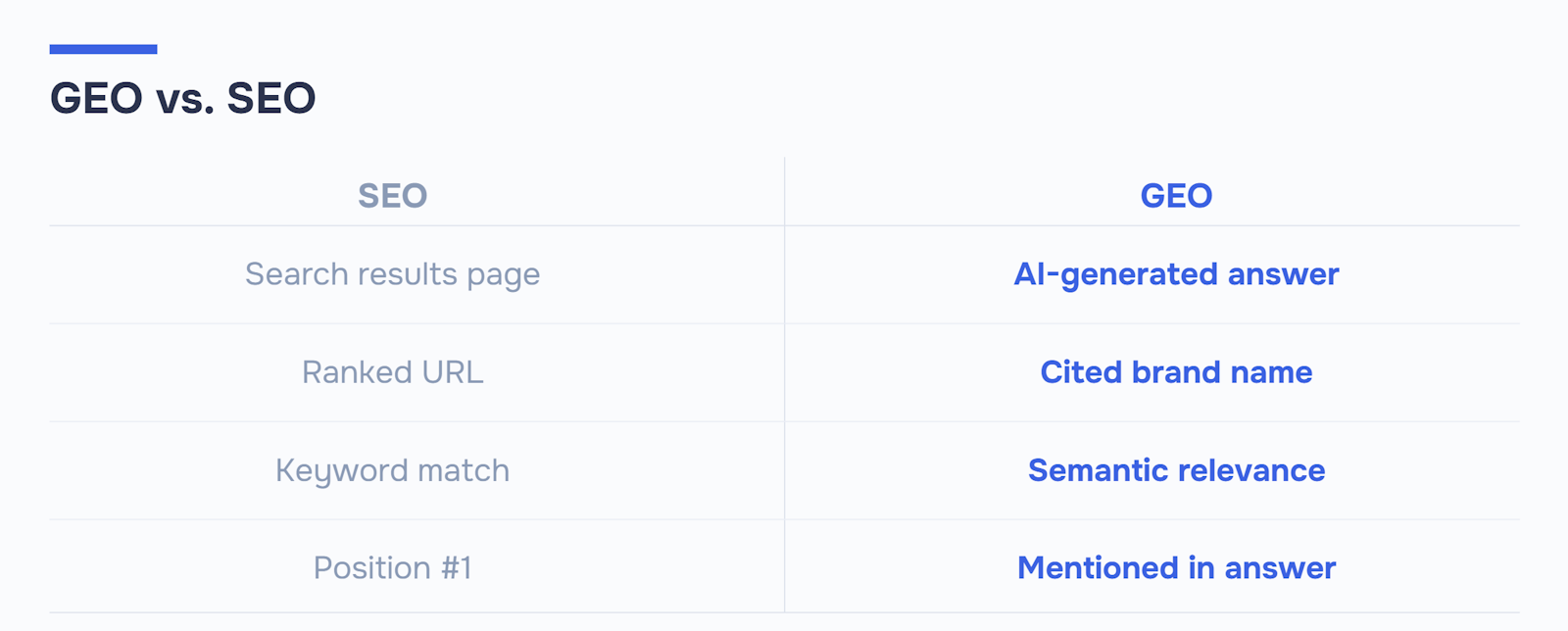
Generative Engine Optimization (GEO) is the practice of making a brand discoverable and citable in AI-generated answers. Where traditional SEO targets a ranked position on a search results page, GEO targets the answer itself — the named sources, recommended vendors, and getting cited by AI search that appear when a user asks a generative model a direct question.
In practice, GEO covers:
- Content structuring — writing pages so AI can extract clear, factual answers (definition-first sentences, comparison tables, FAQ schema)
- Citation building — earning mentions across independent sources: trade media, review platforms, forums, YouTube, Wikipedia
- Technical accessibility — ensuring AI crawlers can actually read your pages (avoiding JavaScript-rendered content, checking robots.txt, adding llms.txt)
- Entity consistency — making sure your brand name, category, and key claims appear identically across all sources so models recognize you as a known entity
- Prompt monitoring — tracking which queries your brand appears in, how often, and what competitors are being recommended instead
The platforms that matter for GEO in 2026:
- ChatGPT — 900 million weekly active users as of February 2026 (OpenAI)
- Google AI Overviews — now triggering on ~48% of all tracked queries (BrightEdge)
- Perplexity — the default research tool for a growing share of B2B buyers
- Claude (Anthropic) — increasingly used for vendor evaluation and technical research
In B2B categories like iGaming infrastructure, buyers use these tools to build shortlists before engaging sales. GEO determines whether your brand enters that conversation at all.
How We Ran the Audit
The methodology was simple by design. We chose three queries that a real operator or sportsbook product manager would type when evaluating esports integrations:
- “Best esports betting provider”
- “Top esports data feed supplier 2026”
- “Which esports betting software do operators use”
These aren’t branded searches. They’re category-level, intent-heavy queries — the kind that happen early in a procurement cycle, before anyone books a demo or walks an ICE floor. We tested eight providers active in the B2B esports vertical and scored each one by how many of the three queries they appeared in.
Each query was run three times in a fresh context window — no prior conversation history, no system prompt — using Claude Sonnet 4 (Anthropic) in April 2026. We recorded mentions across all three runs per query and required consistent appearance (at least two out of three runs) to count as a positive result. This reduces the effect of response variance and makes the scoring more stable than a single-run snapshot.
The AI Visibility Leaderboard: April 2026
| Rank | Provider | AI Score | Q1 | Q2 | Q3 | Status |
|---|---|---|---|---|---|---|
| 🥇 1 | Bayes Esports | 3/3 | ✓ | ✓ | ✓ | Champion |
| 🥇 1 | Abios (Kambi) | 3/3 | ✓ | ✓ | ✓ | Champion |
| 🥇 1 | PandaScore | 3/3 | ✓ | ✓ | ✓ | Champion |
| 🥈 4 | Oddin.gg | 2/3 | ✓ | — | ✓ | Strong |
| 🥉 5 | UltraPlay | 1/3 | ✓ | — | — | Weak |
| 6 | DATA.BET | 0/3 | — | — | — | Invisible |
| 6 | Lion Gaming | 0/3 | — | — | — | Invisible |
| 6 | BETER | 0/3 | — | — | — | Invisible |
Three providers — Bayes Esports, Abios, and PandaScore — appeared in every single query. Three others scored zero. The esports data feed category, at least in AI’s version of it, is a closed conversation.
Why Three Providers Own Every Recommendation
Bayes, Abios, and PandaScore don’t win by accident. These brands have built the exact signals that large language models use to determine authority.
What the top three have that the rest don’t:
- Deep third-party coverage. AI models apply multi-source corroboration — if a provider is cited positively across independent trade publications, review platforms, and industry news sites, the model assigns higher confidence to that name. Bayes, Abios, and PandaScore have years of mentions in esports and iGaming media. Their esports API documentation is referenced by developer communities. Their announcements were picked up by outlets that AI was trained on.
- Structured, definition-first content. AI extracts opening sentences as candidate answer snippets. Providers whose web pages lead with clear, factual statements about what their esports data feed does and who it serves are easier for models to cite accurately. Vague “end-to-end solution” language doesn’t index well in AI memory.
- Consistent entity recognition. When a brand’s name, domain, category, and key claims appear consistently across many sources, the model treats it as a known entity — not something to skip over when uncertain.
Oddin.gg sits one tier down: strong but not consistent. It appeared in 2 of 3 queries, missing specifically the esports data feed supplier query. That gap points to a content and citation deficit on the data infrastructure angle — fixable with targeted generative engine optimization services.
What “AI Invisible” Actually Costs You in B2B iGaming
The instinct is to treat this as a marketing problem — a missed impression here, a weaker brand there. It’s not. It’s a pipeline problem.
Operators evaluating a new esports vertical or upgrading their esports API integration don’t start by calling vendors — they ask AI first. In practice, this means:
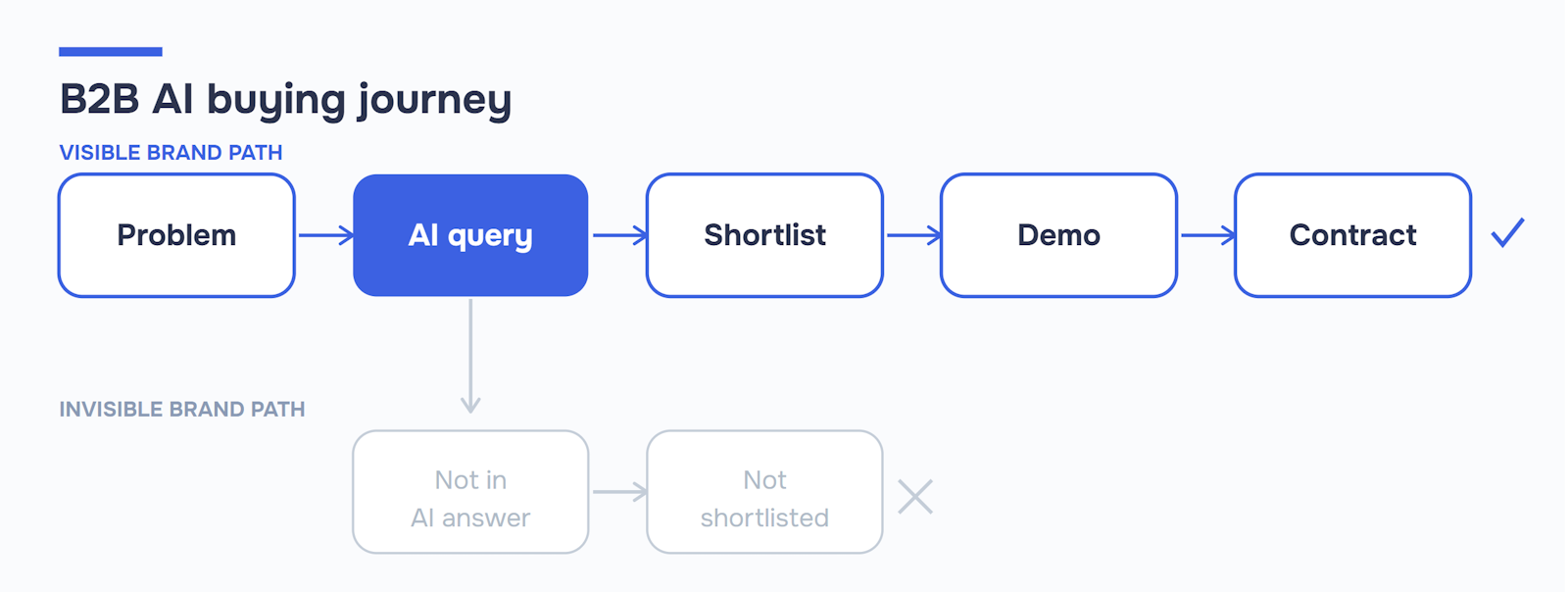
- A head of product at a sportsbook asks AI for a shortlist before engaging sales
- A CTO validating technical options checks what AI says about available esports data feed providers
- A procurement team building a vendor matrix uses AI to pre-screen options
If your brand doesn’t appear in that first AI answer, you’re not on the shortlist. You don’t get the call. The deal goes to whoever AI recommended.
The gap between AI visibility winners and losers is currently 9x, and widening at 3.2% every month. In a category as concentrated as esports data infrastructure, where three names already dominate, that gap compounds fast for everyone outside the top tier. The compounding problem: only 16% of brands systematically track AI search performance — so most suppliers don’t know they’re losing ground until the shortlist has already been decided.
Generative Engine Optimization Services: What Actually Works in iGaming
For B2B iGaming suppliers — esports data feed providers, betting software vendors, odds API companies — the practical GEO playbook looks like this:
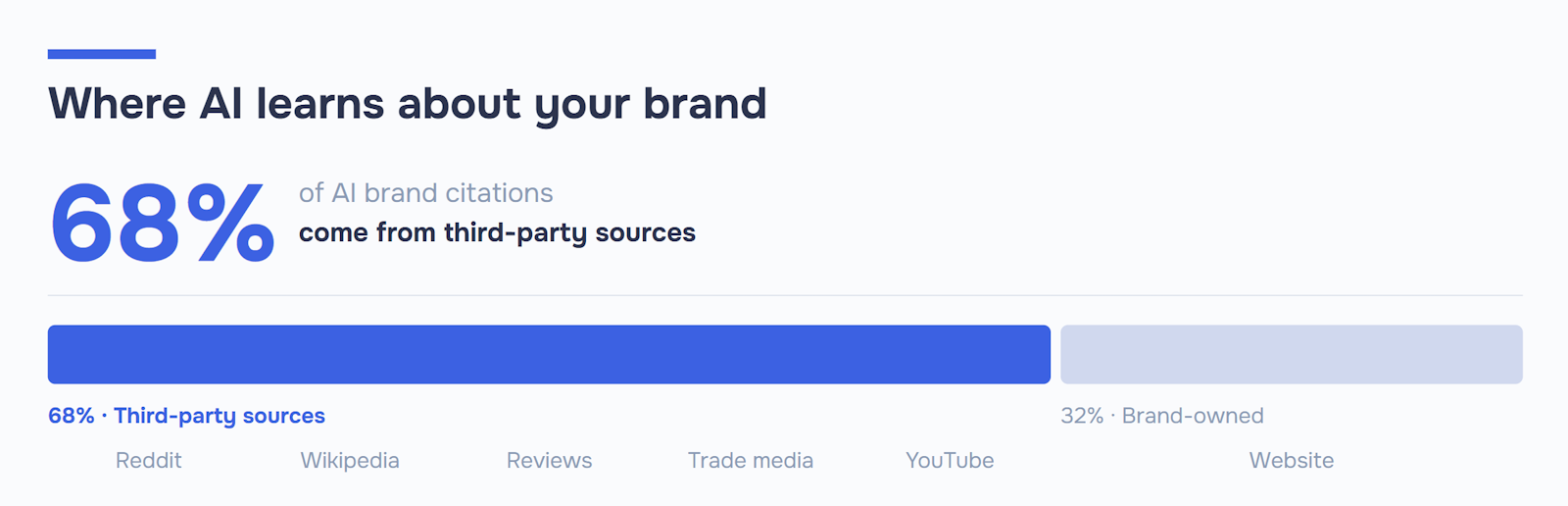
1. Build third-party citation depth. AI models weight corroboration from independent sources. A single well-optimized website doesn’t move the needle. Coverage in iGaming media (SBC News, EGR, iGB), technical mentions in developer forums, and data partnerships announced through press releases all feed AI’s understanding of your brand. Press releases distributed through media wire services begin generating AI citations approximately 14–21 days after publication, once indexed by multiple third-party domains.
2. Rewrite your core pages for AI extraction. Every key page should lead with a factual, definition-first sentence that AI can extract as a snippet. Not “we provide cutting-edge solutions” — but “Bayes Esports provides live and historical esports data for over 20 titles, used by 100+ sportsbook operators.” Specific claims outperform category adjectives in AI responses.
3. Structure your esports API and technical documentation. AI models cite brands whose technical content is well-structured and consistently referenced. If your esports API documentation is thin, undiscoverable, or developer-unfriendly, you’re invisible not just to developers but to the AI that summarizes what tools developers use.
4. Deploy schema markup. FAQ, HowTo, and Speakable schema markup give AI engines machine-readable answer blocks — structured signals that help models cite your brand accurately rather than paraphrase incorrectly.
5. Track AI brand visibility as a KPI. The core metrics are: AI citation share (how often your brand appears in responses to target prompts), share of model (your brand’s mention frequency relative to competitors across the same prompt set), AI referral traffic with conversion tracking, and citation accuracy. Most iGaming brands aren’t tracking any of these yet. A basic AI brand visibility tool — or a manual audit like the one above — gives you a baseline.
The Three Provider Tiers, Explained
Not every invisible brand is equally far from visibility. Understanding which tier you’re in determines what generative engine optimization services you actually need.
Champions (3/3 queries): Bayes Esports, Abios, PandaScore These providers don’t need a GEO strategy — they are the GEO benchmark. Their task is maintenance: monitoring for citation accuracy, keeping third-party coverage current, and ensuring new product lines (new esports API endpoints, new title coverage) get picked up by AI quickly.
Strong (2/3): Oddin.gg One missing query — and it’s a specific one. Oddin.gg doesn’t surface for “top esports data feed supplier 2026,” which is the most infrastructure-specific of the three queries. This is a targeted content gap. Publishing detailed, well-distributed content about their data feed specifically — with citations in trade media — should close this within 30–60 days.
Weak (1/3): UltraPlay One mention, one query. Appears for the broad “best esports betting provider” ask but drops off when queries get more technical. This suggests surface-level brand awareness but insufficient depth in data feed or software-layer content. A 3–4 month GEO sprint could move them into the strong tier.
Invisible (0/3): DATA.BET, Lion Gaming, BETER Zero mentions. Not low — zero. These aren’t fringe players; BETER and DATA.BET both have operator clients and active products. But none of that registers in AI responses, because AI doesn’t learn from sales conversations or contract databases. It learns from what’s been written about you, structured well enough to read. The gap between what these companies are and what AI thinks they are is fixable — but not with another blog post.
What to Do with This
If you’re a C-level or product leader at a B2B iGaming supplier, this audit is a mirror. AI-driven discovery is already happening — 13.14% of all queries triggered AI Overviews in March 2025, nearly double from three months prior. The only open question is whether your brand is in those answers or not.
Three things worth doing this month:
- Run your own queries. Ask Claude, ChatGPT, and Perplexity the questions your buyers would ask. Record what comes back. If you’re not in the first response, you’re starting from zero.
- Audit your citation footprint. Search your brand name plus your category keywords across independent sources. Thin coverage is the most common reason for AI invisibility — and it’s the most fixable.
- Get a structured GEO audit. A professional audit maps your current AI visibility score, identifies the exact content and citation gaps, and gives you a prioritized fix list. ICODA runs these for iGaming B2B brands across the full visibility stack.
The esports vertical is growing fast. But in AI answers, the race already has a result. Three providers get recommended; everyone else doesn’t get asked. That might change as AI models update — but the brands building citation depth now will be harder to displace when it does.
Frequently Asked Questions (FAQ)
GEO and SEO overlap heavily but have one structural difference that matters: traditional SEO targets ranked positions on a results page, while GEO targets citation inside the answer itself. Fewer than 9% of ChatGPT and Gemini citations come from URLs ranked in Google’s top 10 — meaning you can dominate Google and be completely invisible when a buyer asks an AI chatbot for a vendor shortlist. The tactics that diverge most are citation depth across independent third-party sources (forums, trade media, review platforms), definition-first page structure for snippet extraction, and explicit entity consistency across all those sources. If your SEO program already does all of that rigorously, your GEO is probably fine. Most don’t.
B2B buyers use generative AI for vendor research right now, not hypothetically. 80% of global B2B tech buyers use AI as much as traditional search when researching vendors, and 38% specifically use it for vetting and shortlisting. In iGaming infrastructure specifically — esports API providers, odds feeds, betting software — a head of product or CTO will type a direct category query into ChatGPT or Perplexity before booking a demo, especially for providers they haven’t heard of. If three names appear consistently and yours doesn’t, you’re not on the shortlist before the conversation even starts.
AI doesn’t learn from sales contracts or client lists — it learns from what’s been written about a brand across independently indexed sources. BETER and DATA.BET have real commercial footprints, but if their category keywords don’t appear consistently in trade media, developer forums, review platforms, and structured web content that AI crawlers can read, models don’t recognize them as known entities in the esports data feed space. The gap between what a company is commercially and what AI thinks it is can be enormous. Fixing it isn’t a single blog post — it requires citation depth across multiple independent sources over months.
You optimize for the underlying signals that make a brand citable, not for a specific output string. Between 40% and 60% of cited sources change month-to-month across major models — but the brands that appear most consistently do so because their name is corroborated across many independent sources, not because they hacked a specific query pattern. The practical approach is to run each target prompt multiple times and require consistent appearance (two or three out of three runs) rather than treating a single mention as meaningful. The signal you’re building toward is model confidence in your brand as a known entity, which is durable even as individual responses vary.
No, and the data is clear on this. AI models weight corroboration from independent sources heavily. A well-optimized brand website helps, but it doesn’t replace trade media mentions, developer forum references, review platform entries, and community-platform presence. For ChatGPT, Ahrefs found Reddit is the third most cited domain in AI search, while the brand’s own site may not appear in the top three citations at all. The brands that dominate AI answers in niche B2B categories — like esports API providers — have built citation depth across multiple external sources over years. A great website alone won’t move your AI citation share.
Press releases distributed through wire services begin generating AI citations roughly 14–21 days after publication once indexed across multiple third-party domains. Content and citation gaps of the kind Oddin.gg has — missing from one specific query type — are addressable in 30–60 days with targeted publishing and distribution. Moving from a zero-citation position (like DATA.BET or BETER) to consistent AI visibility is a 3–4 month sprint at minimum, because you need to build citation depth across enough independent sources for models to assign category authority. There’s no shortcut that bypasses the corroboration requirement.
The core metrics are trackable and commercially meaningful: AI citation share (frequency in target prompts), share of model relative to named competitors, and AI referral traffic with conversion tracking. AI search traffic converts at significantly higher rates than organic Google traffic — estimates put it at 14% vs. 2.8% — because buyers asking AI for vendor shortlists are further along in the purchase cycle than someone browsing a results page. The challenge is that only about 16–22% of brands are currently tracking any of these metrics, so most suppliers don’t know whether AI-sourced pipeline exists until they look for it. An AI brand visibility tool or a manual prompt audit gives you the baseline.
Yes, AI model knowledge is updated as new content gets indexed and trained on, so the current leaderboard is not permanent. Oddin.gg sits one query away from the top tier with a specific, identifiable gap (the “esports data feed supplier” query), which is a content and citation deficit, not a brand awareness deficit. UltraPlay has surface-level recognition but insufficient depth for technical queries — that’s fixable with focused infrastructure-layer content distributed in the right channels. The real risk is compounding: the visibility gap between leaders and the rest is widening at about 3% per month, so waiting makes the catch-up harder. The window to close a 2-query gap is significantly shorter than the window to close a 3-query gap.
This audit was conducted by ICODA in April 2026 using Claude (Anthropic). Data reflects AI responses at the time of testing and may shift as brands improve their generative engine optimization.
Share with


Rate the article