


Right now, someone is asking ChatGPT to recommend an rwa marketing agency. Someone else is asking Perplexity which tokenized treasury funds publish proof of reserve. A third person is deciding — based on what they find in the next ten minutes — whether your project is worth a $5 million allocation.
The market is here. It moved faster than almost anyone modeled.
And most RWA projects are still marketing like it’s a DeFi token launch in 2021. Same playbook: urgency, hype, a whitepaper nobody reads past page three. It’s costing them institutional capital, crypto community credibility, and AI search visibility. Three separate problems, one root cause. RWA is structurally different from every other crypto vertical, and the frameworks built for DeFi, NFTs, or L1s don’t just fit poorly. They send the wrong signals to both audiences that matter.
Why RWA Marketing Breaks Every Crypto Playbook
Here’s a useful exercise. Put the standard crypto marketing formula next to what RWA actually needs:
❓ What works in DeFi: Create urgency. Build FOMO. Compete on APY. Make the token feel scarce. Drive speculative demand through community momentum.
➡️ What RWA requires: Convince a family office compliance team that your legal structure is sound. Then also convince a DeFi power user that your protocol isn’t a wrapped TradFi product with no on-chain substance. At the same time. With the same website.
These aren’t just different goals. They’re almost opposite communication problems. The urgency mechanics that drive DeFi adoption read as red flags to institutional allocators. The compliance-first language that institutional audiences need reads as evasive and bureaucratic to crypto-native users.
There’s another structural difference that doesn’t get enough attention: the sales cycle. In DeFi, someone connects their wallet and puts capital in within minutes. In RWA, a fund manager considering a $5 million allocation spends weeks (sometimes months) in due diligence, legal review, relationship development. Marketing that tries to shortcut that process doesn’t just fail to convert; it signals that you don’t understand the space you’re operating in.
Compliance isn’t a footnote in RWA. It’s part of the product. An institutional allocator who can’t verify your regulatory structure won’t engage regardless of the yield you’re offering.
The Two Audiences You Can’t Merge — And Can’t Ignore
Picture two people landing on your project’s website right now.
The first is a portfolio manager at a European asset management firm. Under MiCA, fiduciary obligations, burned before by protocols that turned out to be less regulated than advertised. She’s reading your legal page before she reads your homepage. The second is a DeFi-native protocol researcher, skeptical of anything that smells like TradFi with a token wrapper. He’s checking your GitHub before he reads your docs.
These two people are turned off by exactly what the other needs to see. Here’s what that looks like in practice:
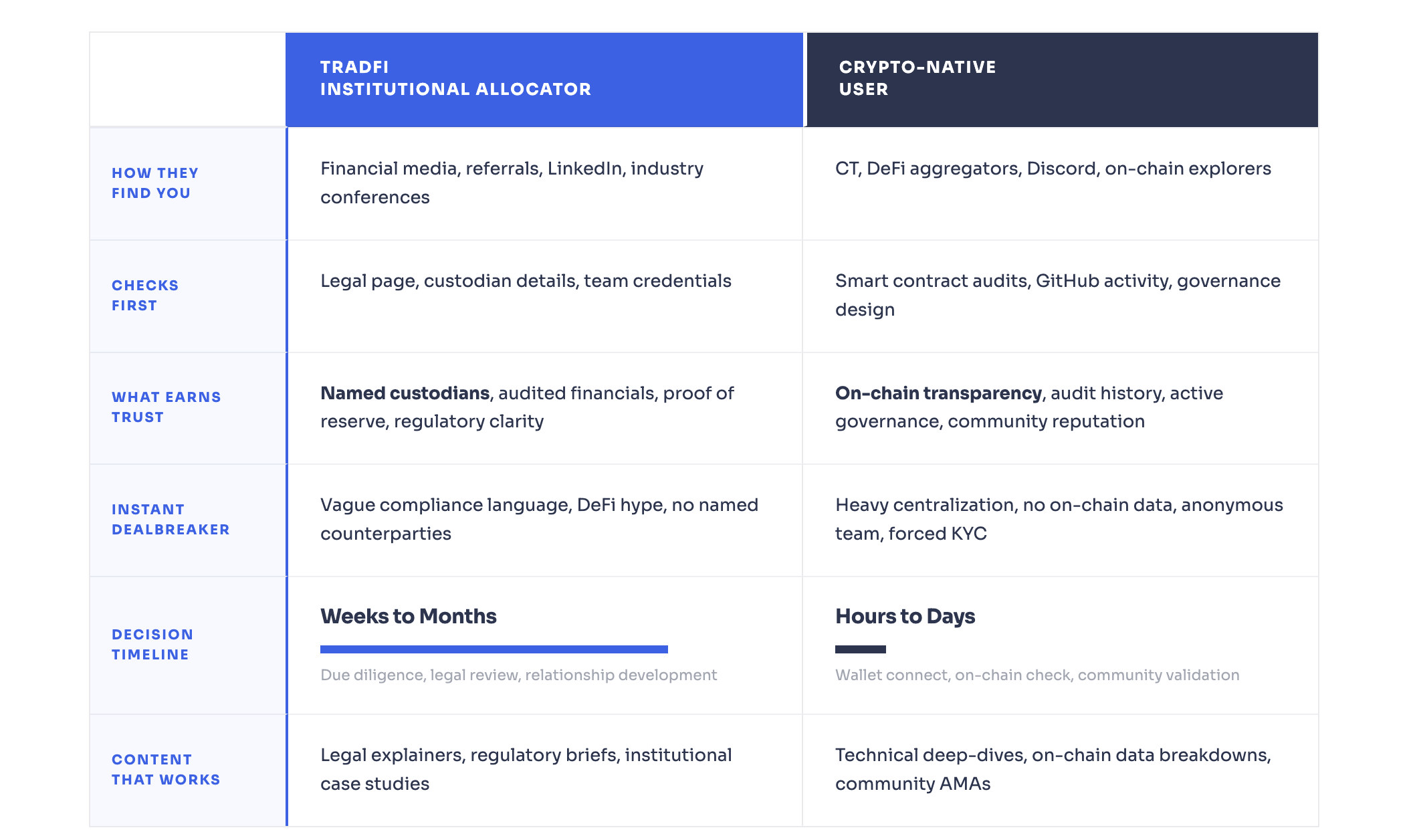
The portfolio manager sees DeFi hype and closes the tab. The protocol researcher sees a PDF-heavy compliance page with no on-chain data and assumes vaporware dressed in financial language. You lose both.
The only way through is two parallel tracks, calibrated separately, distributed through different channels, while the underlying facts stay consistent. Not two different stories. One story, told two different ways, to audiences who have no interest in each other’s version of it.
The AI Discovery Layer Nobody Is Optimizing For
Something shifted in 2026 that most projects haven’t caught up to yet. Both audiences (the institutional allocator and the crypto-native researcher) now begin their research by asking an AI.
Not Google. Not a forum. ChatGPT. Perplexity. Gemini.
“Which tokenized treasury funds have proof of reserve?” “What’s the most compliant RWA protocol for EU investors?” “Recommend an rwa marketing agency with institutional experience.” If your project doesn’t surface in those answers, it doesn’t exist for that person. They don’t know what they missed. They just see whoever did show up.
So what actually gets cited?
✅ Structured educational explainers — articles that answer one precise question clearly (“How does proof of reserve work in tokenized funds?” / “What makes tokenized private credit different from tokenized treasuries?”)
✅ FAQ pages structured the way people actually phrase queries to AI
✅ Factually grounded content with verifiable claims, named sources, clear authorship
✅ Third-party media coverage that includes specific, checkable data points about your project
❌ Token announcement posts
❌ Price speculation or yield marketing
❌ Whitepapers (too long, too dense, not indexed the way AI crawlers prefer)
❌ “We’re building the future of finance” — this phrase has never helped anyone get cited
The keyword competition window is still open. “rwa marketing agency” sits around KD≈5 as of mid-2026. In six months, when more projects figure this out, that changes. The projects building AI-visible content now will be very hard to dislodge later.

What AI Systems and Institutional Allocators Both Want (It’s the Same List)
Most RWA projects treat these as two separate problems. They’re not. The signals that make a TradFi allocator comfortable are the same signals that make AI systems willing to cite you. Same work, two payoffs.
Proof of reserve. Published, verifiable, regularly attested. For an institutional allocator: confirms the underlying assets match the token supply. For an AI system: a specific, checkable claim it can surface without hallucinating something false. Vague statements about “full backing” help neither.
Third-party audits. Smart contract security audits and financial statement audits. A report from a recognized firm is indexable, signed, attributable. Exactly the kind of structured fact AI retrieval systems want to pull. And it’s the first thing a compliance team asks for.
Regulatory specificity. Not “compliant with applicable regulations.” That phrase says nothing to anyone. “Regulated under MiCA (EU), available to accredited investors in [jurisdictions], assets held by [named custodian]” is citable by a compliance officer and by a language model. The same sentence does both jobs.
Named counterparties. Legal counsel, auditor, custodian. Name them. It compresses institutional due diligence and gives AI systems verifiable anchors to work from.
Specificity is trust. Vague compliance language signals immaturity, or something to hide. An RWA project that publishes proof of reserve, names its auditors, and writes a plain-language regulatory summary is doing institutional marketing and GEO simultaneously. Most projects don’t see it that way, which is why the gap between who shows up in AI answers and who deserves to remains wide.
How to Make Your RWA Project AI-Visible
Getting cited by ChatGPT or Perplexity is a content architecture decision. AI systems pull from what they can parse, verify, and attribute with confidence. Here’s what that means in practice:
Step 1 — Build pages around exact queries, not topics. AI retrieval works on question-answer matching. “Tokenized Assets in 2026” won’t surface when someone asks “how does a tokenized real estate fund handle redemptions?” But a page titled and structured around that exact question will. Map out the 15-20 questions your audiences are actually typing into ChatGPT and Perplexity. Build a dedicated page for each. This is the one GEO action most RWA projects haven’t done, and it has the most leverage.
Step 2 — Make proof of reserve a standalone indexed page. AI systems cite specific, verifiable claims, not general “we’re backed” statements buried in a whitepaper. A standalone page with your attestation methodology, named third-party firm, update frequency, and a direct link to the latest report gives AI systems a citable anchor. When someone asks “which tokenized funds publish proof of reserve?”, that’s the format that surfaces.
Step 3 —Use entity clarity throughout your content. AI retrieval relies on named entities: protocol name, jurisdiction, custodian, auditor, regulatory framework. Every key page should state these explicitly, not just once in a legal doc. If your smart contract is audited by a named firm, that name should appear in your docs, your blog, your FAQ, and your press coverage. Not locked in a PDF. The more consistently these entities appear across indexed content, the stronger the signal AI systems receive.
Step 4 — Get third-party coverage with hard data about your project. AI systems treat external citations as trust signals. Press releases don’t count. What counts: a journalist or analyst writing a specific, verifiable fact about your project (AUM, on-chain volume, audit results, named investors) in a publication with real domain authority. One article like that does more for AI visibility than ten generic mentions. Pitch data-forward angles, not announcements.
Step 5 — Publish comparison and explainer content at the category level. “Tokenized treasury vs tokenized private credit — what’s the difference?” “How MiCA affects RWA funds in 2026.” Category-level explainers get cited when AI answers broad sector questions, and they associate your project’s name with authoritative takes on the space rather than just self-promotion. Projects that own the explainer layer tend to own the AI-discovery layer.
How ICODA Approaches This Problem
Legal narrative, proof of reserve communication, regulatory documentation, placement in publications fund managers actually read. Reduces the due diligence friction that kills allocations before a conversation starts.
Protocol mechanics, smart contract transparency, governance engagement, on-chain data that holds up when someone checks. Not airdrop farming. Credibility that survives the “is this legit?” thread.
Content architecture built around the questions both audiences are asking AI right now, with the specificity retrieval systems require to cite confidently.
Worth thinking through why most agencies can’t solve this. A traditional financial PR firm knows how to place stories in Bloomberg, FT, Reuters. But it doesn’t build crypto communities. A crypto marketing agency knows DeFi launch mechanics, community growth, token demand. But it doesn’t understand the compliance narrative that moves institutional capital. A GEO content shop can optimize for AI visibility but often can’t write credibly about tokenized asset structures without getting details wrong in ways institutional readers immediately notice.
These aren’t three campaigns running in parallel. A well-structured proof of reserve explainer serves institutional credibility, crypto community trust, and AI visibility in one piece of content. The infrastructure is the same. Distribution and framing split by audience.
Where RWA Marketing Usually Goes Wrong
Most RWA go-to-market failures aren’t random. They cluster around the same mistakes, in the same order.
1) Amplifying before the credibility infrastructure exists. A project launches a PR push, runs paid distribution, drives traffic to a site that doesn’t yet have proof of reserve published, auditors named, or legal structure explained. Institutional allocators bounce. Crypto users dismiss it as another vaporware launch. You haven’t failed at marketing. You’ve succeeded at broadcasting that you’re not ready.
2) Treating both audiences as one. The instinct is to find a middle ground: messaging that’s “professional but accessible,” that “bridges TradFi and DeFi.” In practice, the middle ground convinces neither. Institutional allocators see enough DeFi energy to distrust the compliance claims. Crypto-native users see enough TradFi language to assume there’s no real on-chain substance. The answer isn’t a compromise message; it’s two separate ones, through the right channels for each.
3) Publishing content that AI won’t cite. Token announcements, yield marketing, generic thought leadership, press releases. None of it surfaces in AI-generated answers about the RWA space. The projects that get recommended by ChatGPT when someone asks “which tokenized credit funds have verified proof of reserve?” published a clean, specific, factually grounded explainer about exactly that question. Not the ones with the most Twitter impressions.
4) Letting compliance stay in the legal department. Your legal structure, regulatory status, and audit reports aren’t just risk management documents in RWA. They’re marketing assets. Proof of reserve published clearly on your site, with named auditors and attestation methodology, does more for institutional credibility than any press release. Most projects know this and still don’t do it until someone asks.
5) Expecting crypto community tactics to build institutional trust. AMAs, Discord campaigns, CT presence. These work for the crypto-native audience. They do nothing for institutional allocators, who don’t discover projects through these channels and won’t treat community hype as a due diligence signal. The effort isn’t wasted, but it has to be understood as one track of two, not a substitute for institutional-grade content.
The Window Is Still Open
The RWA space is past the “interesting experiment” phase. The capital is moving, the infrastructure is arriving, and the institutional allocators are paying attention. What hasn’t caught up is the marketing — most projects are either invisible to AI, unconvincing to institutions, or irrelevant to crypto-native users. Often all three.
That gap closes fast once a few projects get it right and set the reference point for what the category looks like. The ones building credibility infrastructure and AI-visible content now will be very hard to displace when it does.
Frequently Asked Questions (FAQ)
SEO optimizes for search engines — Google ranking, backlinks, keyword density. GEO optimizes for AI systems — the structured, specific, citable content that ChatGPT, Perplexity, and Gemini pull from when answering questions. Both matter in 2026, and they’re not alternatives. They share most of the same content infrastructure.
Structured explainers, FAQ pages, data-backed comparisons, content with clear organizational attribution. Whitepapers and token sale materials almost never appear. Vague positioning copy never appears.
Yes, and it’s usually the better time to start. The trust signals institutional allocators need take time to build. Starting pre-launch means you’re not scrambling to create credibility under live-sale pressure.
Amplifying before the credibility infrastructure exists. Projects run PR and drive traffic before proof of reserve is published, legal structure is explained anywhere findable, or audit reports are linked from the docs. The first 90 days should be foundation work. Amplification on top of that foundation compounds. Amplification without it mostly amplifies doubt.
An audit across three tracks: what the current content says to each audience (and how those messages conflict), where the project appears in AI-generated answers about the sector, and whether the compliance documentation is actually public. Most projects want to start with distribution. The audit almost always reveals the distribution problem is a content infrastructure problem.
Share with


Rate the article