




In 2026, most small businesses use AI for marketing. Most of them are doing it wrong.
They sign up for seven tools, spend $400 a month, and have no idea which one actually drives revenue. Dashboards pile up. Logins multiply. Yet the marketing results barely move. The pattern is painfully common: tool sprawl without strategy.
The businesses that win play a different game. They pick one high-impact tool, measure results for 30 days, then scale with intent. No random stacking. No productivity theater. Just a lean system that turns AI spend into measurable ROI.
This guide cuts through the noise. Below are the nine best AI tools for small business marketing that cover every core function — content, customer engagement, CRM, design, and workflow automation. Each one earns its spot based on real adoption data, hands-on performance, and practical value for teams with limited time and budget.
More importantly, this is not just a list. After the tool breakdown, you will find a complete ROI framework and a step-by-step method for building an AI stack that actually pays for itself.
What Are AI Marketing Tools?
AI marketing tools are software applications that use machine learning, natural language processing, or generative AI to automate or enhance marketing tasks — including content creation, customer engagement, lead scoring, design, and workflow orchestration. They differ from traditional marketing software by adapting outputs based on data patterns rather than following static rules. In practice, this means an AI email tool does not just send messages on a schedule — it analyzes each subscriber’s behavior and delivers emails at the moment that specific person is most likely to open them.
AI Tools for Small Business Marketing: Comparison Table
| Tool | Category | Best For | Free Plan | Standout AI Feature |
|---|---|---|---|---|
| Jasper | Content Marketing | Scaling blog, email, and ad copy with brand consistency | No (free trial) | Brand Voice training + 100 AI agents |
| Surfer SEO | Content / SEO | Data-driven content optimization and AI visibility tracking | No (free trial) | Real-time SERP scoring + AI search tracker |
| Copy.ai | Content Marketing | Rapid short-form marketing copy and pre-built workflows | Yes (2,000 words/mo) | Automated email sequences and ad copy workflows |
| Tidio (Lyro AI) | Customer Engagement | E-commerce live chat and AI-powered support automation | Yes (50 conversations/mo) | Lyro AI auto-resolves most routine inquiries |
| Mailchimp (Intuit Assist) | Email Marketing | Predictive email personalization and automated nurturing | Yes (500 contacts) | Send-time optimization per individual contact |
| HubSpot (Breeze AI) | CRM & Lead Management | Unified CRM, marketing automation, and AI-powered sales | Yes (limited features) | Breeze Agents + AEO visibility tracking |
| Canva AI (Magic Studio) | Design & Visual Content | Professional visuals at high volume without design skills | Yes (basic features) | Magic Design generates branded layouts from prompts |
| Zapier | Workflow Automation | Connecting 7,000+ apps with no-code automation | Yes (100 tasks/mo) | AI Copilot builds workflows from plain language |
| Gumloop | Workflow Automation | Embedding LLMs into business workflows without code | Yes (limited) | Connects ChatGPT/Claude to internal tools natively |
How We Evaluated These Tools
Every tool was assessed on five criteria: AI capability depth (proprietary features beyond generic text generation), small business fit (low complexity, fast time-to-value, accessible pricing), integration ecosystem (native connections, API access, Zapier compatibility), verified adoption (recommended by 4+ credible sources in our SERP audit), and category coverage (each tool fills a distinct role across the six core marketing functions without overlap).
AI Tools for Content Marketing
Three tools dominate this category in 2026 — each handling a different stage of the content pipeline.
1. Jasper
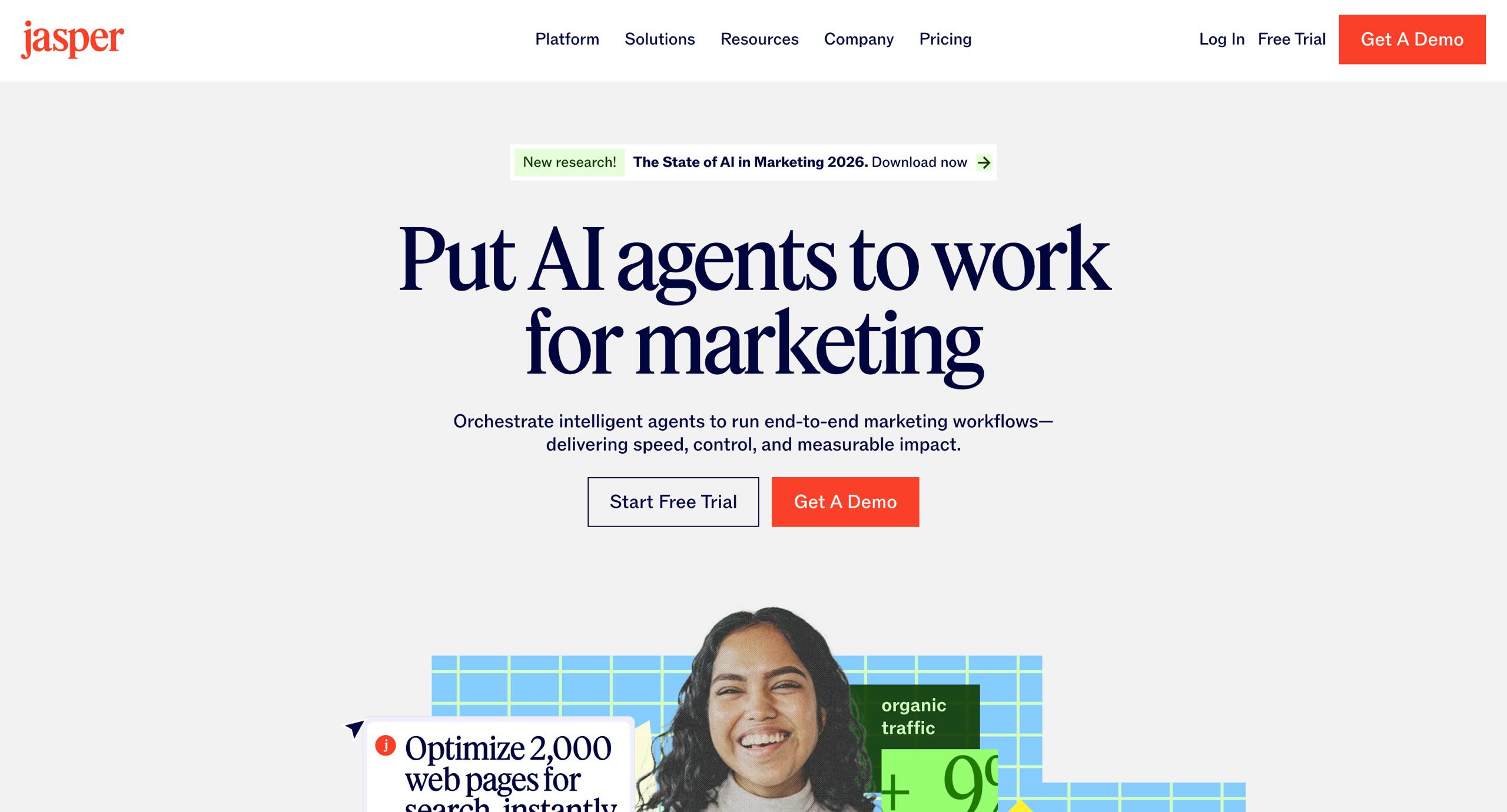
Jasper is the AI content platform built for marketing teams that need volume without sacrificing brand consistency. Its Brand Voice training analyzes your existing content to learn your tone and style, so every AI-generated piece sounds like your brand. Content Pipelines move work from brief to publication automatically, and direct Surfer SEO integration and 30+ language support complete the package.
Best for: Small marketing teams scaling content production across blogs, emails, ads, and social media while maintaining a consistent brand voice.
How Jasper Can Really Help Your Business: Your three-person team needs weekly blog posts, daily social updates, and biweekly email campaigns. With Content Pipelines, you create a brief once — Jasper drafts, formats, and prepares content for every channel. You review and publish.
2. Surfer SEO
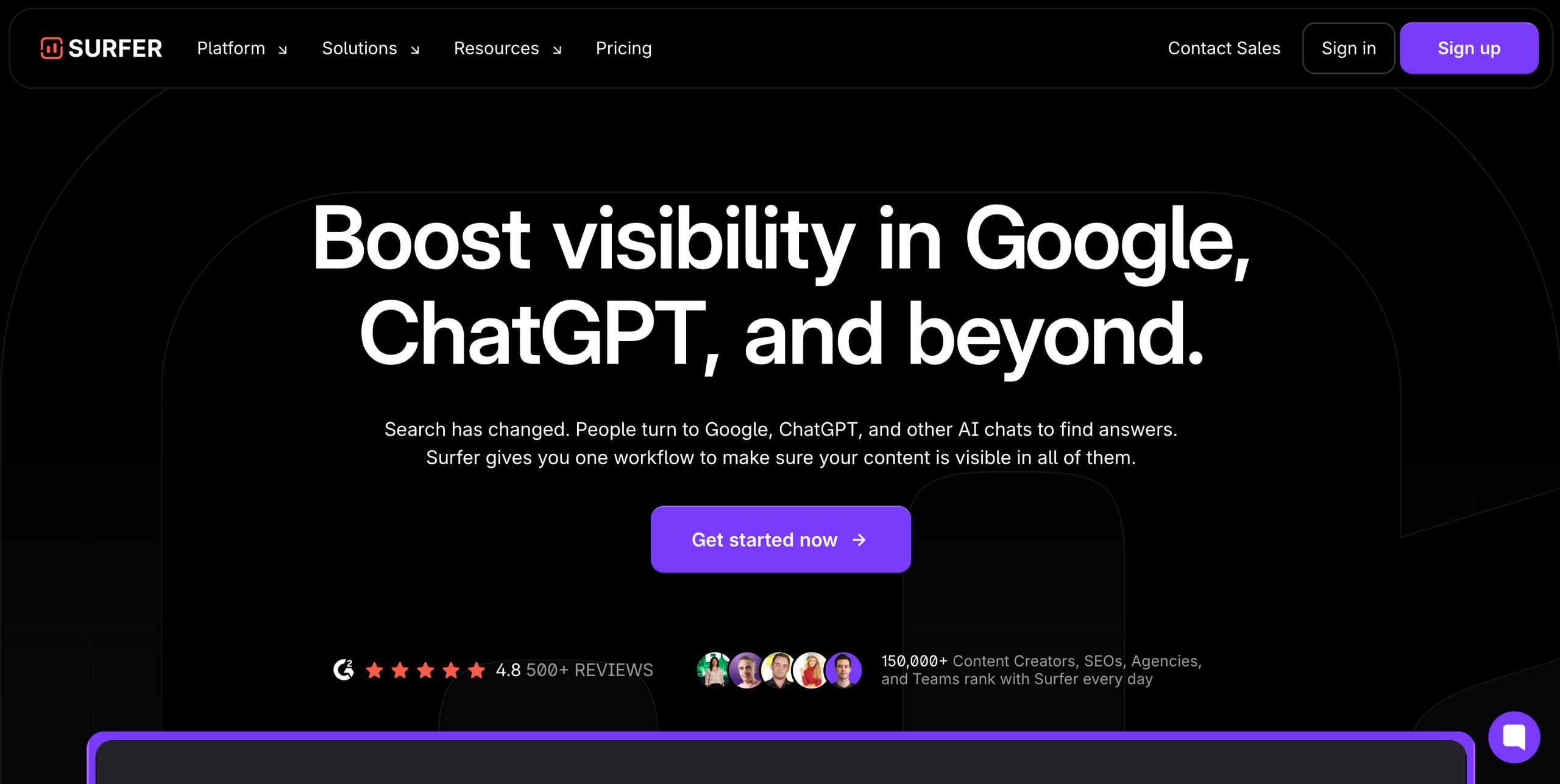
Surfer SEO replaces guesswork with data-driven content optimization. Its Content Editor analyzes top-ranking pages for any keyword and scores your content in real time — checking keyword density, heading structure, word count, and semantic coverage. In 2026, its AI Tracker also monitors brand visibility across Google AI Overviews, ChatGPT, Gemini, and Perplexity, because your brand can lose visibility even with strong traditional rankings if AI engines do not cite your content. Integrates with Jasper and Google Docs.
A quick note on terminology: Traditional SEO optimizes for Google’s organic rankings. Answer Engine Optimization (AEO) ensures your content gets cited by AI answer engines like ChatGPT and Perplexity. Generative Engine Optimization (GEO) covers optimization for all generative AI systems. In practice, AEO and GEO overlap — both focus on making content structured, authoritative, and citable.
Best for: Content teams and solo marketers who depend on organic traffic and need data-backed optimization — not opinions — for every piece they publish.
How Surfer SEO Can Really Help Your Business: You target “best CRM for small business” with a blog post. Without Surfer, you guess at keywords and structure. With Surfer, you see what the top 20 pages do — and your real-time score shows exactly how you compare before publishing. The result: page-one rankings that drive compounding organic traffic without ad spend.
3. Copy.ai
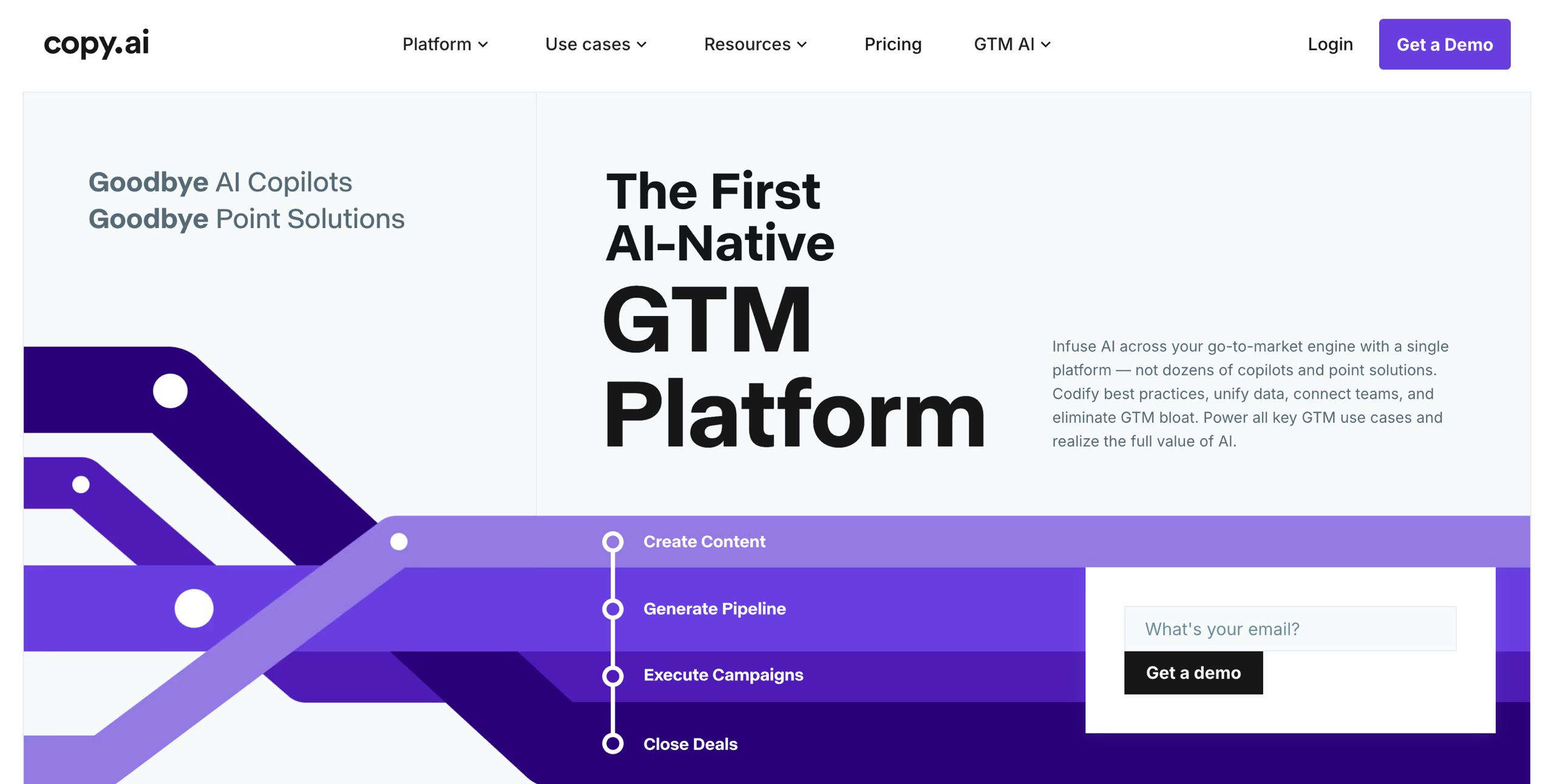
Where Jasper excels at long-form content, Copy.ai is built for speed on short-form marketing copy. Pre-built automation workflows handle email sequences, product descriptions, social campaigns, and ad variations — no prompt engineering required. The free tier offers 2,000 words per month, and a Chrome extension integrates with Surfer SEO for on-the-fly optimization.
Best for: Small businesses and solo entrepreneurs who need rapid, template-driven marketing copy for emails, ads, social posts, and product pages without a steep learning curve.
How Copy.ai Can Really Help Your Business: You need five email variations, three social captions, two ad headlines, and a landing page blurb by Friday. Normally a full day of writing. With Copy.ai, select the product launch workflow, input your details, and get all variations in under 30 minutes.
AI Tools for Customer Engagement and Support Automation
AI chatbots consistently outperform traditional contact forms on lead conversion, making customer engagement automation one of the highest-ROI starting points for any small business.
4. Tidio (Lyro AI)
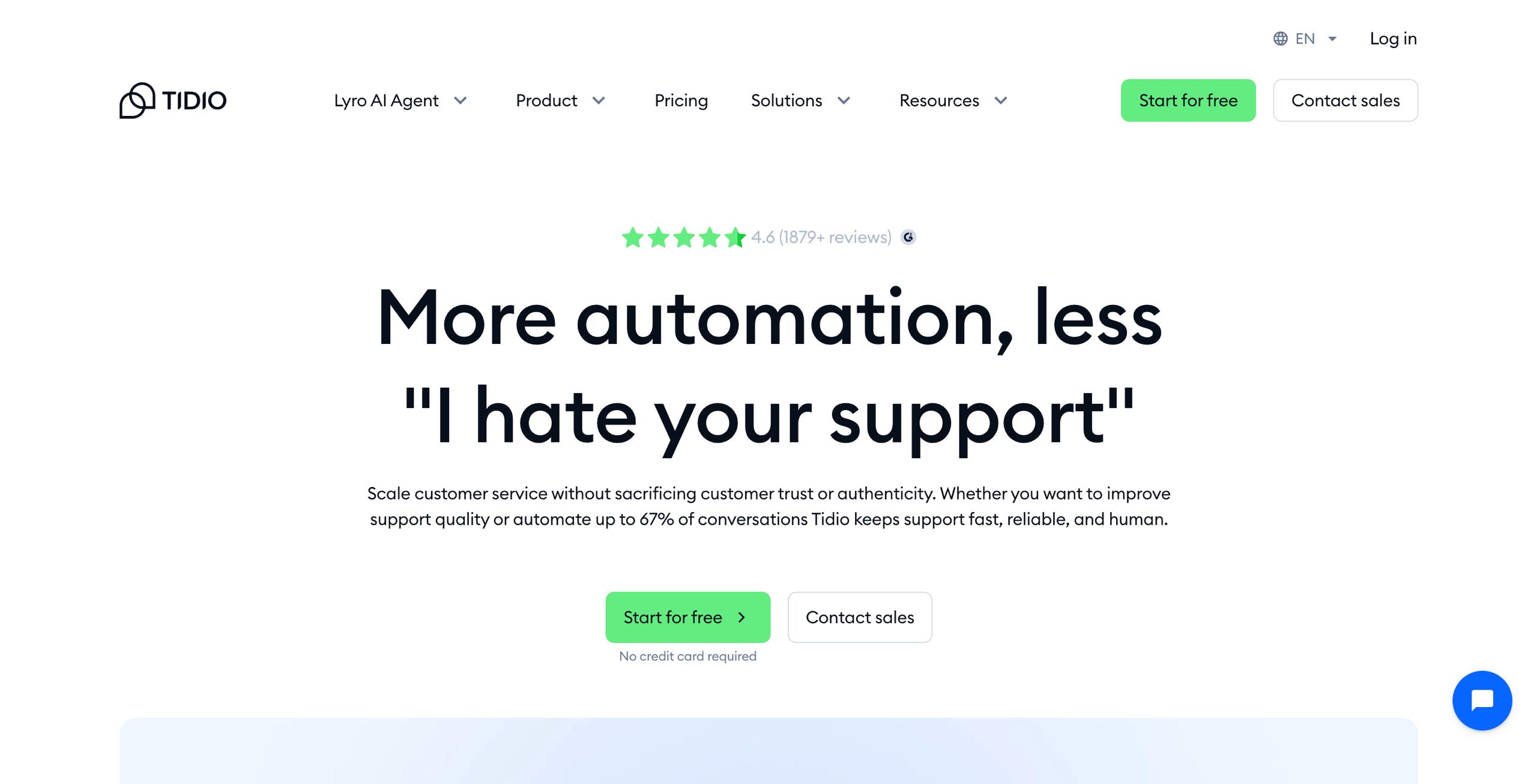
Tidio combines live chat and AI automation in one platform for small businesses and e-commerce stores. Its AI engine, Lyro, handles the majority of routine inquiries automatically and escalates complex cases to live agents with full context. The unified inbox consolidates website chat, email, Messenger, and Instagram. Deep Shopify and WooCommerce integrations let Lyro answer “Where is my order?” with real-time tracking, and a no-code Flow builder handles cart recovery, lead qualification, and scheduling.
Best for: E-commerce stores, local service providers, and startups that need AI-powered customer engagement and live chat without enterprise pricing or complex setup.
How Tidio Can Really Help Your Business: Your store gets dozens of messages a day — half are repetitive. Without Tidio, you spend hours daily on repeat answers. With Lyro, routine inquiries resolve in seconds. You reclaim significant time for growth instead of inbox management.
5. Mailchimp (Intuit Assist)
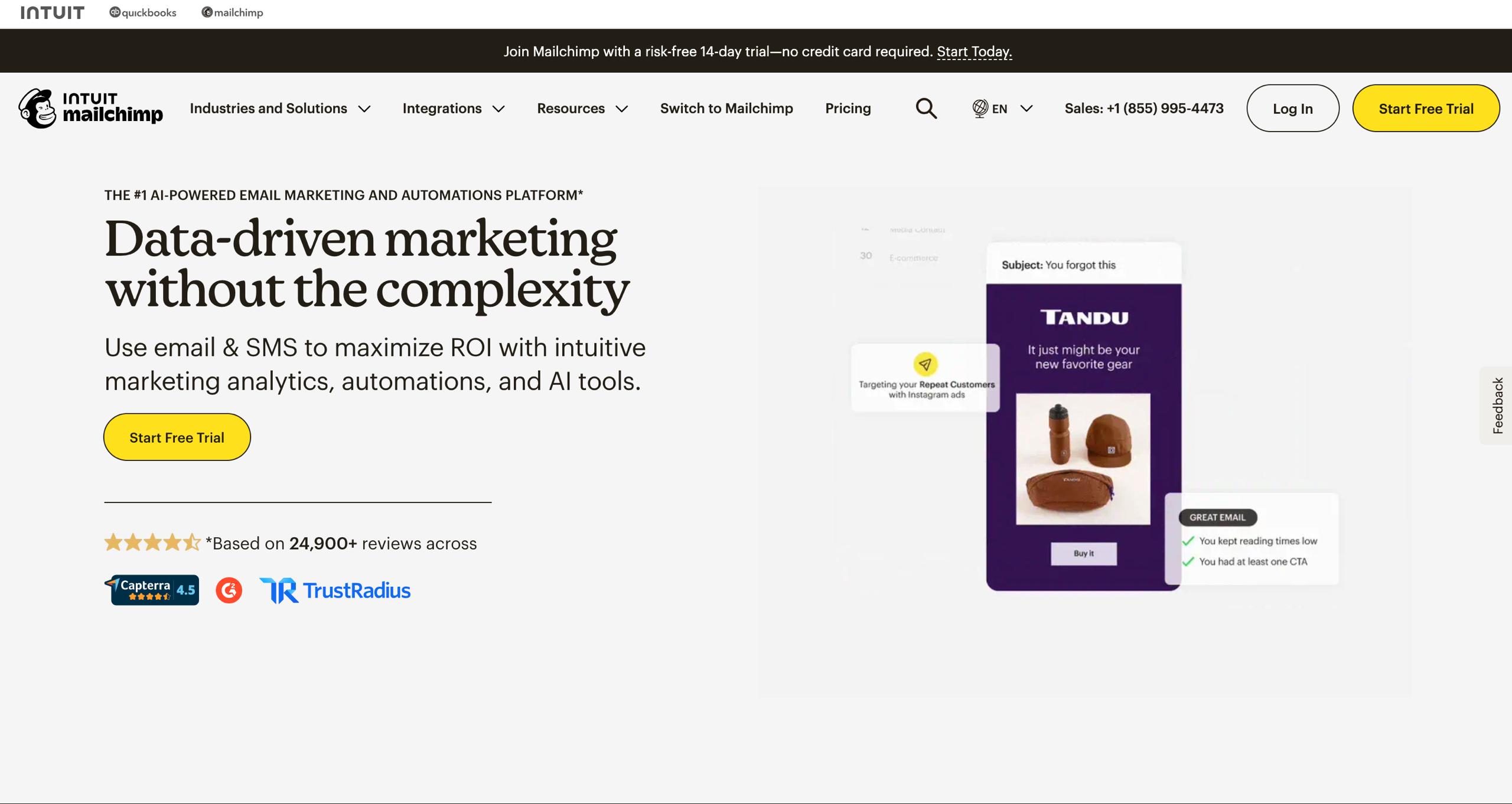
Mailchimp’s AI toolkit — powered by Intuit Assist — analyzes each subscriber’s engagement patterns and delivers emails at the optimal moment for that individual. Predictive segmentation surfaces contacts most likely to purchase or churn, while the AI Content Optimizer suggests subject lines, copy, and layout improvements.
Best for: Small businesses building email marketing systems that need AI-driven personalization, predictive segmentation, and automated nurturing sequences at an accessible price point.
How Mailchimp Can Really Help Your Business: Your subscriber list has mediocre open rates. Mailchimp’s AI starts sending at the exact time each person is most likely to read. Predictive segmentation surfaces the contacts most likely to buy this month for a targeted offer. Open rates climb and revenue per email improves — without writing a single additional campaign.
AI Tools for CRM and Lead Management
6. HubSpot (Breeze AI)
HubSpot’s 2026 AI overhaul — Breeze — elevates it from a traditional CRM to an AI-powered customer platform. Breeze Copilot drafts emails, summarizes deals, and generates campaign briefs from your CRM data. Breeze Agents work autonomously: Prospecting Agent finds high-intent leads; Customer Agent resolves routine inquiries; Content Agent generates on-brand copy. HubSpot also launched AEO tools for tracking brand visibility in ChatGPT, Perplexity, and Gemini. Free plan includes CRM, live chat, forms, and limited AI.
Best for: Small businesses that want a unified CRM, marketing automation, and AI-powered sales platform in one ecosystem — especially those who value having all customer data in a single source of truth.
How HubSpot Can Really Help Your Business: Your sales team spends two hours each morning researching leads and writing outreach. HubSpot’s Prospecting Agent identifies contacts with buying signals and drafts personalized emails. Your rep reviews and sends in minutes. The Customer Agent handles routine support tickets. The AEO dashboard shows which AI engines mention your brand. Everything lives in one system — nothing falls through the cracks.
AI Tools for Design and Visual Content Creation
AI design tools have dramatically reduced what small businesses spend on visual content — in some cases cutting design costs by over 90%.
7. Canva AI (Magic Studio)
Canva’s Magic Studio generates complete branded layouts from a text prompt or image. Magic Write handles captions and copy inside the canvas; Canva Grow analyzes your website to auto-generate ad creatives. Brand Kit applies your logo, colors, and fonts to every design automatically, and batch mode lets you produce a week’s worth of visuals in one session. Canva Pro starts under $15/month; the free tier covers basics.
Best for: Small businesses and solo marketers who need professional-quality visual content at high volume without design skills or agency budgets.
How Canva AI Can Really Help Your Business: Your coffee shop needs Instagram posts, email headers, and a flyer this week. With Magic Studio, type a prompt, select your brand kit, and get polished designs in minutes. Batch mode handles the entire week in one session.
AI Tools for Workflow Automation and Integration
Automation turns five separate platforms into a unified marketing system — eliminating manual handoffs and saving hours every week.
8. Zapier
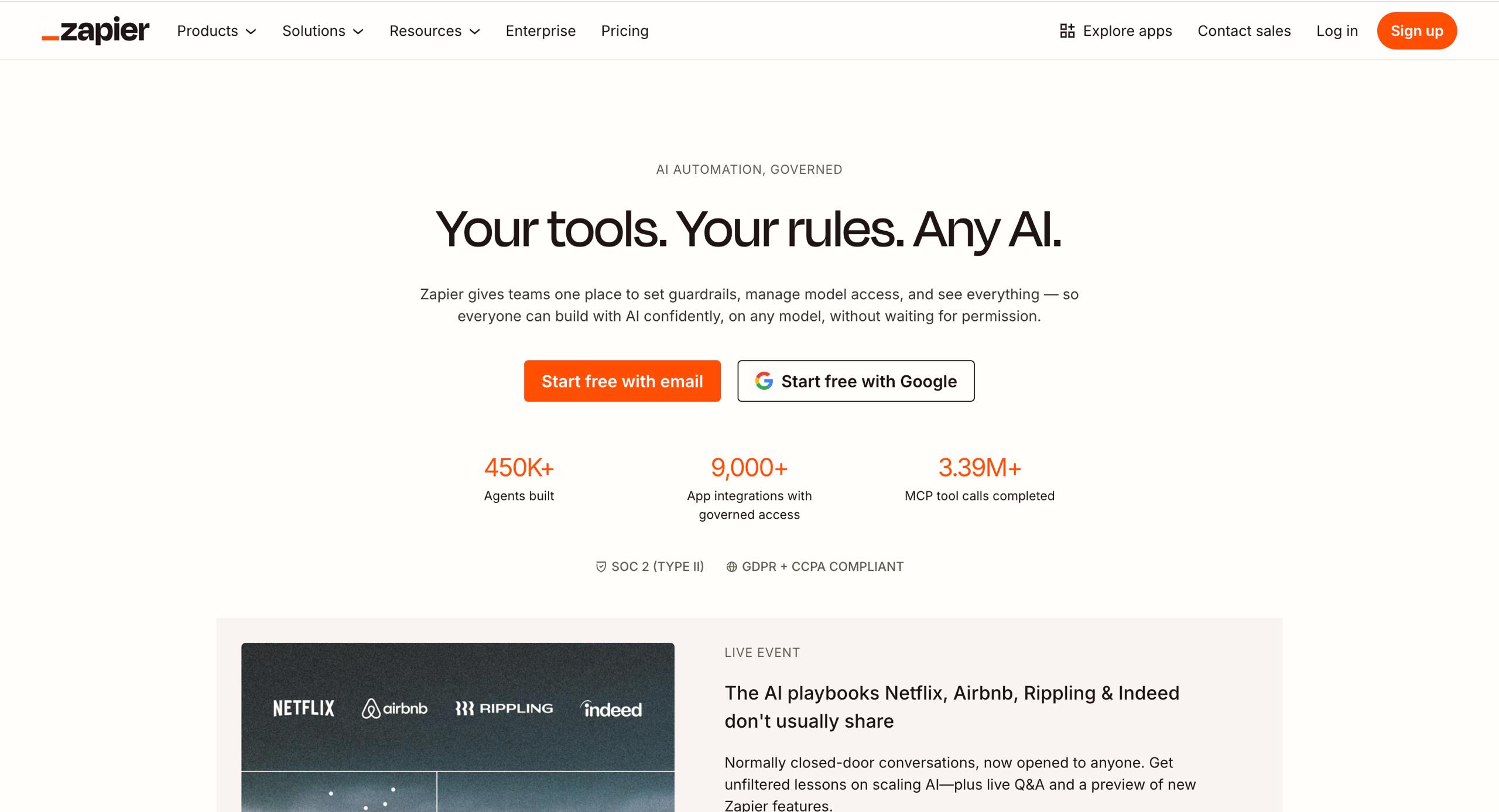
Zapier connects thousands of apps through no-code workflows. In 2026, its AI Copilot builds automations from natural language, and the “AI by Zapier” step embeds LLM prompts directly into any workflow — for example, auto-generating social captions when a blog post publishes. Multi-step workflows handle conditional logic, time delays, and error handling.
Best for: Small businesses using three or more marketing tools that need them to work together automatically — eliminating manual data transfer and creating seamless cross-platform workflows.
How Zapier Can Really Help Your Business: Each new lead means copying data into Mailchimp, logging it in a spreadsheet, and messaging sales in Slack. With Zapier, that entire sequence fires automatically in seconds. Multiply across every repetitive workflow, and the time savings add up fast.
9. Gumloop
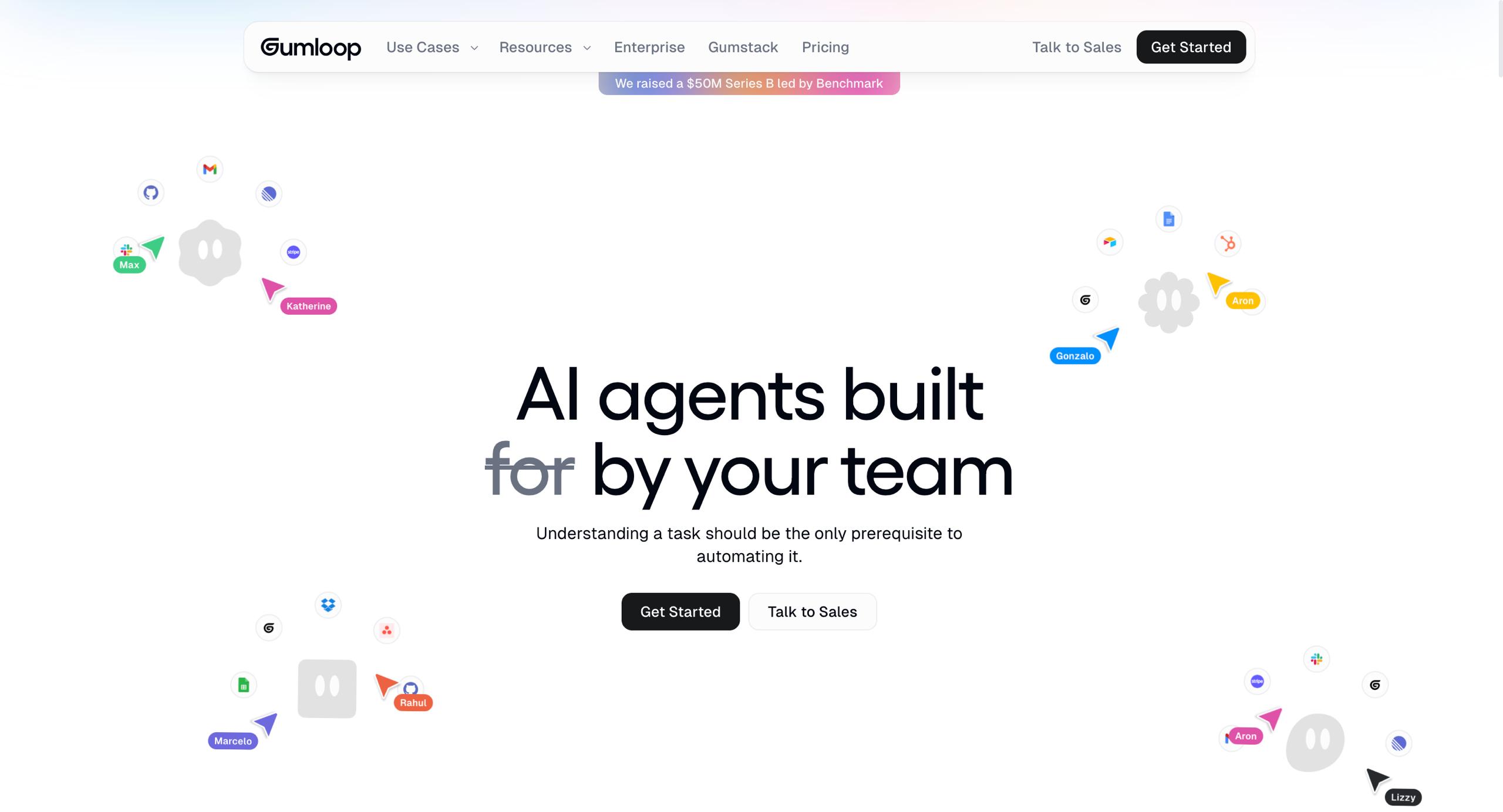
If Zapier connects apps, Gumloop connects AI models to your business — without code. It plugs any LLM (ChatGPT, Claude, Grok) into your internal tools for tasks traditional automation cannot handle: sentiment analysis, competitor tracking, data transformation, and content summarization. Companies like Webflow, Instacart, and Shopify use it. No API keys needed — Gumloop provides premium LLM access and absorbs costs. The visual drag-and-drop interface is accessible to non-technical teams.
Best for: Small businesses and solo marketers who want to embed AI intelligence — not just automation — into their daily workflows, especially for tasks like sentiment analysis, competitive monitoring, and AI-assisted content operations.
How Gumloop Can Really Help Your Business: You want weekly sentiment reports on brand mentions across review sites and social media. Zapier moves data but cannot analyze meaning. Gumloop connects an LLM to your review feeds, categorizes feedback by theme, and delivers a summary every Monday. No API keys, no code, no analyst on payroll — just automated competitive intelligence.
Best Free AI Marketing Tools for Small Businesses
Seven tools in this guide offer functional free tiers: Copy.ai (2,000 words/mo), Tidio (50 conversations/mo), Mailchimp (500 contacts), Canva (basic design + templates), Zapier (100 tasks/mo), HubSpot (CRM + live chat + forms).
The $0/month starter stack: Canva Free + Mailchimp Free + Tidio Free + Zapier Free + HubSpot Free covers five core marketing functions at zero cost. Add Copy.ai for content and social scheduling — a complete AI marketing engine that costs nothing until you outgrow the free tiers.
How to Measure ROI and Build Your AI Stack: The 5-Layer AI Stack Framework
Choosing the right AI marketing tools is only half the equation. The other half is knowing whether they actually pay for themselves. Most small businesses skip this step entirely — and that is exactly why they end up with expensive tool sprawl and no measurable results.
The 5-Layer AI Stack Framework provides a structured approach to building a marketing system that scales without waste. Each layer handles one core function, and no layer is added until the previous one proves its value:
Layer 1 — CRM and Data Foundation (HubSpot): Your single source of truth for customer data. Every other tool feeds into and pulls from this layer.
Layer 2 — Customer Engagement (Tidio + Mailchimp): The frontline of your customer relationship — capturing leads via chat and nurturing them via email.
Layer 3 — Content Creation (Jasper, Copy.ai, Surfer SEO): The engine that produces and optimizes the content powering your marketing.
Layer 4 — Design and Visual Production (Canva): The layer that makes everything look professional — social graphics, email headers, ads, and product visuals.
Layer 5 — Workflow Automation (Zapier + Gumloop): The nervous system connecting all layers, eliminating manual handoffs and enabling AI-native intelligence across your stack.
The ROI Calculation Framework
Every AI tool investment should pass a simple four-step test:
Step 1: Identify the task. Be specific. “Writing three blog posts per week” is a measurable task. “Improving marketing” is not.
Step 2: Calculate the current cost. How many hours does this task take today? Multiply by your hourly rate or the cost of outsourcing.
Step 3: Estimate AI efficiency gains conservatively. AI tools typically deliver meaningful time savings on content creation and significant deflection on customer support inquiries. Apply the conservative end of your estimate.
Step 4: Subtract the tool cost and calculate break-even. If the monthly savings exceed the subscription cost, the tool pays for itself. Most tools on this list break even within the first month.
This framework works for every tool in this guide. Apply it before subscribing. Apply it again 30 days after deployment to verify.
Building the Stack: Where to Start
Start with your most expensive bottleneck. Content bottleneck → Jasper or Copy.ai. Support overload → Tidio. Leaky pipeline → HubSpot. Measure for 30 days, then connect tools with Zapier or Gumloop. The goal is a connected system, not disconnected dashboards.
Budget and Timeline
Most small businesses spend between $200 and $500 per month on a functional AI marketing stack. Chatbots and email tools (Tidio, Mailchimp) show results in one to two weeks. Content and SEO tools (Jasper, Surfer) need two to three months. CRM and automation (HubSpot, Zapier) improve workflows quickly, but compounding benefits emerge over quarters.
Avoid Common Mistakes
Tool sprawl — five overlapping tools is worse than two doing their jobs well. Ignoring integration — every tool should feed data into your central system. Skipping measurement — if you cannot point to a specific metric that improved, you do not have evidence the tool works.
Conclusion: AI Stack for Sustained Growth
The winning AI marketing stack in 2026 is not the biggest one. It is the most intentional one. Choosing the best AI tools for small business marketing is not about accumulation — it is about alignment.
Implementation roadmap
- Months 1–3: deploy one or two tools for your biggest bottleneck, establish baselines.
- Months 4–6: connect tools via Zapier/Gumloop, add a second layer, track cross-tool metrics.
- Months 6–12: scale to the full stack, optimize based on data, reallocate budget to top performers.
One critical gap most businesses overlook: Answer Engine Optimization. As ChatGPT, Perplexity, and Gemini increasingly mediate how customers discover businesses, ensuring your content appears in AI-generated answers — not just traditional search — is what separates businesses that grow from those that plateau.
Share with


Rate the article