




Introduction
The AI search landscape is shifting faster than ever, and if you’re not paying attention to DeepSeek, you’re missing a massive opportunity. While most marketers obsess over Google SGE or ChatGPT Search, China’s DeepSeek has quietly grown into one of the most influential AI search engines, processing millions of queries daily and reshaping how Chinese users discover information.
Here’s why this matters to you: China represents the world’s largest digital market with over 1 billion internet users. DeepSeek isn’t just another search engine — it’s an AI-powered discovery platform that’s fundamentally changing how businesses reach Chinese audiences. Unlike traditional search engines that rely heavily on backlinks and domain authority, DeepSeek prioritizes content quality, relevance, and user intent in ways that feel both familiar and radically different.
If you’re a founder planning to enter the Chinese market, an SEO specialist managing global campaigns, or a marketer looking to diversify your traffic sources, understanding DeepSeek SEO is no longer optional — it’s essential. The good news? The platform is still young enough that early adopters have a significant advantage, especially those who understand answer engine optimization principles (The complete guide to answer engine optimization ↗).
In this guide, you’ll learn exactly how DeepSeek ranks content, what makes it different from Western AI search engines, and most importantly, the step-by-step process to optimize your content for maximum visibility. Let’s dive in.
Understanding DeepSeek: China’s AI Search Revolution
DeepSeek launched as an AI research company but quickly evolved into a full-fledged search platform that combines large language models with traditional search capabilities. Think of it as China’s answer to Perplexity, but with deeper integration into the Chinese digital ecosystem and unique ranking mechanisms.
What makes DeepSeek particularly interesting is its hybrid approach. It doesn’t just retrieve information — it synthesizes it, providing users with comprehensive answers drawn from multiple sources. For content creators, this means your content doesn’t need to rank #1 for a keyword to get traffic. Instead, you need to be cited as a credible source within DeepSeek’s AI-generated responses. Take a look at the key statistics that illustrate DeepSeek’s success:
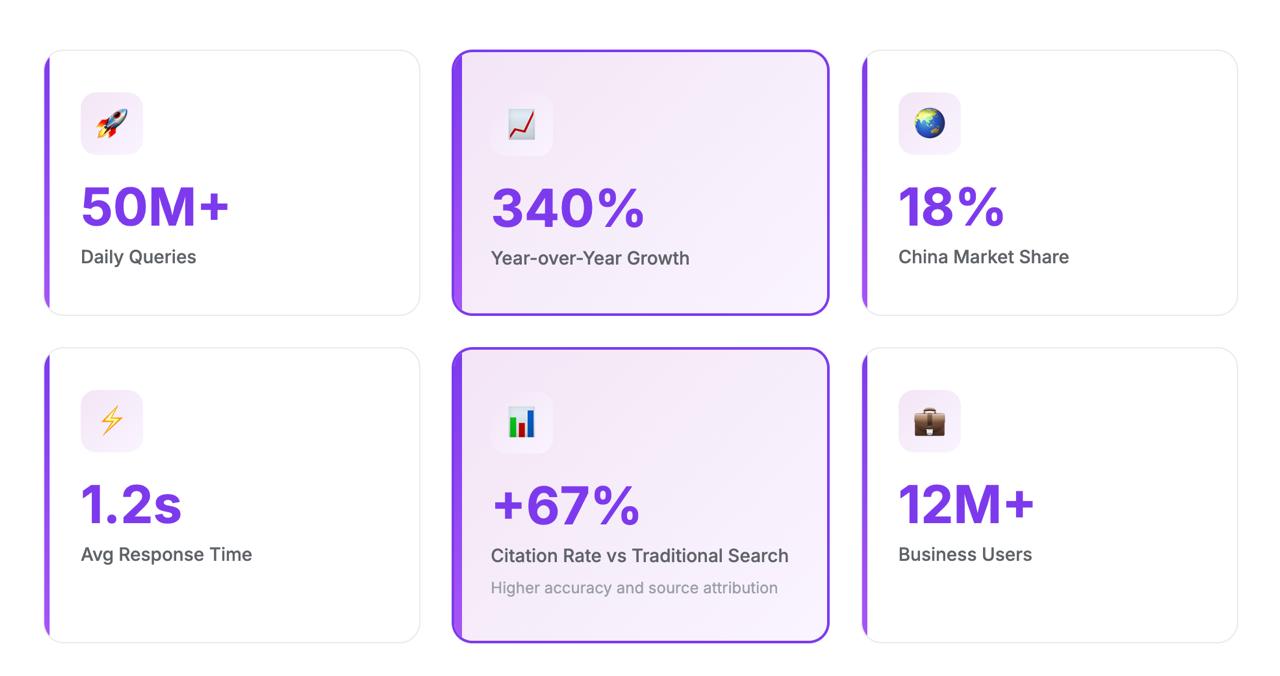
The platform has gained traction for several reasons. First, it delivers genuinely useful answers without the ad clutter that plagues traditional search engines. Second, it understands context and follow-up questions better than older systems. Third, it’s optimized for the Chinese market’s unique content ecosystem, including integration with local platforms like WeChat, Weibo, and Douyin.
How DeepSeek Differs from Western AI Search
Let’s compare DeepSeek with the AI search engines you’re probably already familiar with:
| Feature | DeepSeek | ChatGPT Search | Perplexity | Google SGE |
|---|---|---|---|---|
| Primary Market | China-focused | Global | Global | Global |
| Content Sources | Chinese web + selected international | Open web + licensed content | Open web | Google’s index |
| Citation Style | Inline references with source links | Embedded citations | Numbered footnotes | Source chips |
| Update Frequency | Real-time for trending topics | Near real-time | Real-time | Real-time with traditional index |
| Content Synthesis | Heavy summarization | Balanced | Detailed answers | Quick overviews |
| Platform Integration | Deep (WeChat, Weibo, etc.) | Standalone | Standalone | Google ecosystem |
| Ranking Factors | Authority + freshness + engagement | Relevance + authority | Source quality + recency | Traditional SEO + AI signals |
The key takeaway here? DeepSeek operates in a fundamentally different content ecosystem. While Perplexity might prioritize Reddit discussions and ChatGPT Search pulls from diverse international sources, DeepSeek gives significant weight to content from established Chinese platforms and domains with strong local presence.
For marketers, this means your Western-optimized content might not perform well without localization — not just translation, but true adaptation to Chinese digital behaviors and platform preferences.
How DeepSeek Ranks Content: The New Rules
Traditional SEO taught us to worship backlinks, optimize for keywords, and chase domain authority. DeepSeek hasn’t completely abandoned these principles, but it has fundamentally reweighted them in ways that align with broader AI SEO trends. Understanding these new ranking factors is crucial for success. (Learn more about AI SEO trends ↗)
Authority Signals in the AI Age
DeepSeek still cares about authority, but it measures it differently. Instead of just counting backlinks, it evaluates:
- Source credibility: Is your domain known for accurate information in your niche?
- Author expertise: Does the content creator have demonstrable knowledge?
- Citation network: Are other authoritative sources referencing your content?
- Engagement patterns: Do users spend time with your content or bounce quickly?
Here’s a practical example: A well-researched blog post from a mid-tier domain with strong engagement metrics can outrank a thin article from a high-authority site. DeepSeek’s AI evaluates content quality at a granular level, looking at factors like depth of explanation, use of examples, and logical structure.
Content Freshness and Relevance
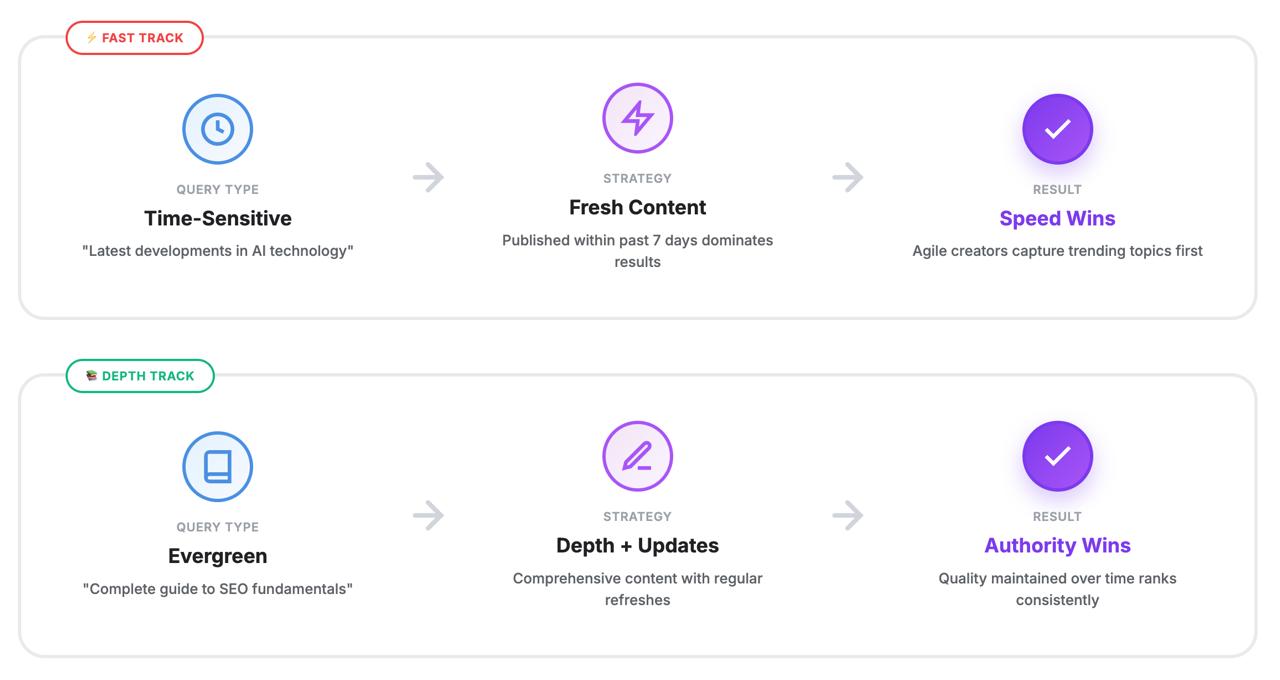
DeepSeek heavily favors fresh content for time-sensitive queries. If a user asks about “latest developments in AI technology,” content from the past week will dominate results, even if older, more comprehensive articles exist. This creates opportunities for agile content creators who can publish quickly on trending topics.
However, for evergreen queries, depth and comprehensiveness matter more than recency. A thorough guide published six months ago can still rank well if it’s regularly updated with fresh examples and maintains high engagement.
The Synthesis Factor
Here’s where things get interesting: DeepSeek doesn’t just rank individual pages — it evaluates how well your content can be synthesized into comprehensive answers. Content that provides clear, structured information with distinct takeaways is more likely to be cited in AI-generated responses.
This means your content structure matters enormously. Use clear headings, break down complex topics into digestible sections, and provide specific examples that DeepSeek’s AI can extract and reference. Vague, meandering content gets ignored, no matter how authoritative your domain.
User Intent Matching
DeepSeek excels at understanding what users really want. If someone searches for “best project management tools,” they don’t want a history of project management — they want comparisons, recommendations, and actionable advice. Content that directly addresses user intent ranks higher, even if it doesn’t perfectly match keyword density formulas.
Step-by-Step Guide: Optimizing Your Content for DeepSeek
Ready to start ranking? Follow this systematic approach to optimize your content for DeepSeek’s unique algorithm.
Step 1️⃣: Conduct AI-Search-Optimized Research
Before writing anything, you need to understand how DeepSeek currently answers queries in your niche. Search for your target topics in DeepSeek and analyze the results:
- What sources does it cite most frequently?
- How does it structure answers (lists, paragraphs, comparisons)?
- What information gaps exist in current responses?
- Which types of content get featured most prominently?
Create a research document noting patterns. For instance, if you’re targeting “content marketing strategies,” note whether DeepSeek favors tactical guides, case studies, or theoretical frameworks. This intelligence will shape your content strategy.
Step 2️⃣: Structure Content for AI Synthesis
DeepSeek’s AI needs to extract clear, discrete pieces of information from your content. Structure your articles with this in mind:
Start each section with a clear thesis statement that summarizes the key point. Use descriptive H2 and H3 headings that could stand alone as questions or topics. For example, instead of “Implementation” use “How to Implement This Strategy in 3 Steps.”
Within sections, use short paragraphs (3-5 sentences maximum) that each convey one complete idea. Follow this pattern: statement, explanation, example. This makes your content easy for both AI and humans to parse.
Include “quotable” insights — sentences that encapsulate key takeaways in 15-20 words. DeepSeek’s AI often pulls these as citations. Think: “The most effective content marketing strategies combine data-driven insights with authentic storytelling.”
Step 3️⃣: Build Topic Authority Clusters
Don’t just publish one article and hope for the best. DeepSeek rewards comprehensive topic coverage. Create clusters of related content that link together logically:
Start with a comprehensive pillar page covering your main topic broadly. Then create 5-8 supporting articles that dive deep into specific subtopics. Each piece should link to the pillar and to related cluster content.
For example, if your pillar is “AI-Powered Marketing Tools,” your cluster might include articles on AI copywriting, AI analytics, AI customer service, AI personalization, and AI campaign optimization. This signals to DeepSeek that you’re an authoritative source on the entire topic, not just one aspect.
Step 4️⃣: Optimize for Citation-Worthy Content
Your goal isn’t just traffic — it’s to be cited by DeepSeek in its AI-generated answers. Citation-worthy content has specific characteristics:
Include verifiable data and statistics with clear sourcing. Instead of “Many companies use AI,” write “According to Gartner’s 2024 survey, 67% of enterprise companies have implemented AI in their marketing operations.” DeepSeek’s AI prioritizes factual, sourced claims.
Provide original insights or unique perspectives that aren’t readily available elsewhere. This could be proprietary research, expert interviews, or novel frameworks you’ve developed. Original content is more likely to be cited than rehashed information.
Use clear attribution and citations in your own content. When you reference other sources, link to them properly. This builds your credibility in DeepSeek’s eyes and increases the likelihood that others will cite you in return.
Step 5️⃣: Maintain and Update Content Regularly
DeepSeek’s algorithm tracks content freshness signals. Static content gradually loses visibility, even if originally high-quality:
Set up a quarterly review process for your top-performing content. Add new examples, update statistics, refresh outdated references, and expand sections based on user questions or comments.
Add “Last updated: [Date]” stamps to articles, and make meaningful updates, not just date changes. DeepSeek can detect superficial updates. Substantial refreshes should add at least 10-15% new content or significantly improve existing sections.
Step 6️⃣: Monitor Performance and Adapt
Unlike traditional SEO where you might check rankings weekly, DeepSeek optimization requires more nuanced monitoring:
Track which of your pages get cited in DeepSeek’s AI answers. You can do this manually by searching for your key topics and noting when your content appears, or use monitoring tools that track AI search visibility.
Pay attention to the context in which you’re cited. Are you being used for definitions, examples, or data points? This tells you what DeepSeek values about your content and where to focus your optimization efforts.
Analyze patterns in your cited content versus non-cited content. What structural differences exist? What topics perform better? Use these insights to refine your content strategy continuously.
Step 7️⃣: Build External Signals
While content quality is paramount, external signals still matter in DeepSeek’s algorithm:
Encourage engagement on Chinese social platforms where applicable. Shares on WeChat, discussions on Zhihu (China’s Quora), and mentions on Weibo can boost your content’s visibility in DeepSeek.
Develop relationships with other content creators in your niche. Guest posts, collaborative content, and mutual citations build the network effects that DeepSeek’s AI recognizes as authority signals.
Consider partnerships with established Chinese platforms or publications if you’re entering the market. Being featured or cited by recognized local authorities can significantly boost your DeepSeek visibility.
How to Create Citation-Worthy Content That DeepSeek Loves
Now that you understand the optimization process, let’s get tactical about content creation. Here’s your practical framework for producing content that DeepSeek consistently cites:
The Citation-Worthy Content Framework
Start every piece with a clear value proposition in the first 100 words. What specific question does this answer? What will the reader learn? DeepSeek’s AI evaluates openings to determine content relevance, so front-load your value.
Structure your content using the “pyramid” method: Start with the most important information, then provide supporting details, then additional context. This ensures that even if DeepSeek only extracts your first few paragraphs, readers get complete value.
Incorporate data-driven insights at a rate of at least one verifiable statistic or research finding per 300 words. This doesn’t mean drowning readers in numbers — it means backing up your claims with evidence that DeepSeek’s AI can verify and cite.
Use comparison frameworks whenever possible. “X vs. Y” content, feature comparison tables, and pros/cons analyses perform exceptionally well because they provide clear, structured information that AI can easily extract and present to users.
✅ Your DeepSeek Content Optimization Checklist
| Element | Action Required | Why It Matters | How to Measure |
|---|---|---|---|
| Opening Value Statement | Include specific takeaway in first paragraph | Signals relevance to AI | Check if cited in DeepSeek summaries |
| Structured Headings | Use question-format H2s (How/What/Why) | Improves AI extraction | Track heading citations |
| Data Points | Add 3-5 sourced statistics per article | Builds authority signals | Monitor citation frequency |
| Original Insights | Include 2-3 unique frameworks or perspectives | Differentiation from competitors | Backlink tracking |
| Internal Linking | Connect to 5-7 related articles | Topic authority clustering | Check cluster traffic growth |
| Update Frequency | Refresh every 90 days minimum | Maintains freshness signals | Compare pre/post update visibility |
| Engagement Elements | Add 2-3 examples or case studies | Increases time-on-page | Bounce rate and session duration |
| Citation-Ready Quotes | Include 3-5 standalone insight sentences | Direct citation opportunities | Manual DeepSeek search checks |
Quick Wins for Immediate Results
Want to see faster results? Focus on these high-impact tactics:
First, identify your existing content that’s already performing well in traditional search and update it for AI optimization. Add structured data, enhance with fresh examples, and improve citation-worthiness. These pages already have authority signals, so optimization yields faster results.
Second, create “answer hub” pages that comprehensively address common questions in your niche. Format these as FAQ-style content with clear questions as headings and concise, complete answers. DeepSeek loves content that efficiently answers user queries.
Third, develop comparison content that directly pits solutions, approaches, or tools against each other. Use tables, bullet-point comparisons, and clear verdicts. This format is naturally citation-worthy because it provides definitive information that AI can extract and present.
Conclusion
DeepSeek represents a fundamental shift in how content gets discovered and consumed in China’s digital ecosystem. Unlike traditional SEO where you could optimize for algorithms and manipulate rankings through technical tricks, DeepSeek demands genuine quality, clear structure, and authoritative insights.
The opportunity is massive but time-sensitive. As more marketers discover DeepSeek’s potential, competition will intensify. Early adopters who master AI-search optimization now will build sustainable visibility advantages that compound over time.
Your action plan starts today:
Choose your three most important topics and optimize one comprehensive piece of content for each using the framework in this guide. Monitor performance for 30 days, then refine based on what gets cited and what doesn’t. Build from there, creating topic clusters and maintaining a consistent publishing schedule.
If your business needs expert guidance navigating DeepSeek SEO and the Chinese AI search landscape, ICODA is your ideal partner — the team specializes in AI-powered SEO strategies that deliver measurable results across emerging search platforms.
Remember: DeepSeek SEO isn’t about gaming an algorithm — it’s about creating genuinely useful content that deserves to be cited. Focus on providing clear value, structured information, and verifiable insights. The rankings will follow.
Ready to dominate China’s AI search landscape? Start implementing these strategies today, and watch your visibility grow as DeepSeek continues its rapid ascent. The future of search is here — make sure you’re part of it.
Frequently Asked Questions (FAQ)
DeepSeek is China’s leading AI-powered search engine that synthesizes information from multiple sources to provide comprehensive answers, unlike Google’s traditional link-based results. The platform prioritizes content quality and citation-worthiness over traditional ranking factors like backlinks and domain authority.
Most optimized content begins appearing in DeepSeek citations within 30-60 days, though high-quality, well-structured content can get cited in as little as 2-3 weeks. Ranking speed depends on content freshness, topic authority clusters, and engagement metrics rather than traditional SEO timelines.
While DeepSeek primarily serves the Chinese market, well-optimized English content targeting international audiences or global topics can still be indexed and cited. However, businesses looking to maximize visibility in China’s AI search ecosystem should consider professional localization — ICODA specializes in AI SEO strategies that bridge international content with Chinese market demands.
DeepSeek’s AI algorithm prioritizes well-structured, high-quality content that directly matches user search intent and includes verifiable data that can be easily cited in AI-generated responses. Content freshness matters for trending topics, while comprehensive coverage and clear formatting outweigh traditional SEO signals like backlink quantity or domain age.
DeepSeek SEO focuses on creating citation-worthy, AI-synthesizable content rather than chasing keyword rankings and backlinks. The goal is to be referenced in AI-generated answers through clear structure, verifiable data, and comprehensive topic coverage, not just to rank #1 for specific keywords.
While core AI SEO principles overlap — quality content, clear structure, authoritative insights — each platform has unique algorithms and content preferences. DeepSeek emphasizes Chinese platform integration and local authority signals, while ChatGPT Search and Perplexity prioritize different source types and citation styles, requiring tailored optimization approaches.
Share with


Rate the article