




Introduction
What happens when a significant portion of your potential customers stop clicking? According to SparkToro, 58.5% of all Google searches in the U.S. now end without a single click to the open web [1]. AI Overviews appear on approximately 15% of Google queries [2], and when they do, organic click-through rates drop by 61% [3].
This isn’t speculation about a distant future. It’s a transformation already underway, and businesses that prepare now will enter the upcoming year with significant competitive advantages. The search landscape that marketers have spent years mastering is undergoing its most profound transformation since Google first introduced PageRank — driven by the rise of answer engines and AI-generated results, as explained in this overview of Answer Engine Optimization (AEO).
For marketers, founders, and business leaders, 2025 is just the preparation year. The decisions you make now — about content strategy, measurement frameworks, and AI optimization capabilities — will determine whether you enter 2026 positioned for growth or scrambling to catch up, especially as features like Google AI Overviews increasingly reshape how visibility, traffic, and authority are earned. This article examines the latest AI SEO statistics and trends defining this transition period, providing actionable insights to help your business build competitive advantage before the landscape shifts permanently.
The Transformation of Search: Why This Matters Now
The search ecosystem has fundamentally fragmented. While Google remains dominant, it no longer operates in isolation. ChatGPT has become one of the most visited websites globally. Younger consumers increasingly use AI chatbots as a primary search channel. And this fragmentation will only accelerate — making multi-platform visibility essential. The SEO statistics emerging from this shift paint a clear picture: traditional optimization alone is no longer sufficient.
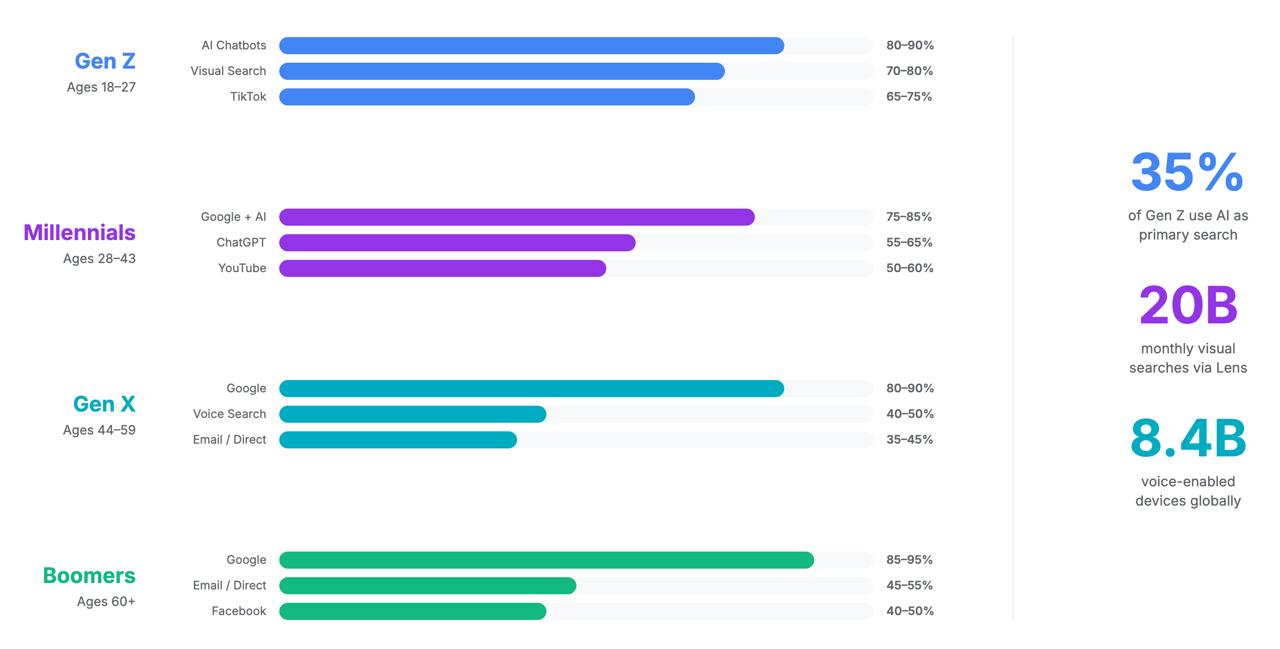
Google itself has transformed. AI Overviews now appear for a significant portion of queries, up substantially from early 2025. When these summaries appear, organic click-through rates decline sharply.
The traditional funnel — where users searched, clicked, visited, and converted — is being compressed. Users increasingly complete research and decisions within AI interfaces, without visiting websites. The businesses seeing success aren’t abandoning SEO — they’re evolving it toward earning citations and measuring brand visibility across AI platforms. Those who master this evolution in 2025 will be best positioned when the predicted search decline materializes in 2026.
How AI Decides What to Cite
Understanding how AI systems select sources is critical for any visibility strategy — and will become even more important as AI search adoption grows through the next year. Unlike traditional search engines that rank pages, AI answer engines synthesize responses from multiple sources — and they’re highly selective.
AI platforms typically cite only a handful of domains per response, far fewer than Google’s traditional 10 blue links. This creates winner-takes-most dynamics where early authority compounds over time. Brands are more likely to be cited through third-party sources than their own domains — Wikipedia accounts for a substantial portion of AI citations.
Content depth and freshness matter more than backlink counts — longer, comprehensive articles earn more citations than shorter pieces, and recently updated content outperforms outdated pages. AI Overviews favor factual statements: cited articles tend to cover significantly more verifiable facts than non-cited alternatives.
Structured content formats — clear headings, lists, FAQ sections, and schema markup — significantly improve extraction probability. Content that’s machine-readable and semantically clear gets selected; content buried in JavaScript or lacking structure gets ignored.
🌟 Key AI SEO Trends and Insights
01 The Rise of Generative Engine Optimization (GEO)
Perhaps no trend better captures the current SEO evolution than Generative Engine Optimization — the practice of optimizing content specifically for AI-powered answer engines like ChatGPT, Perplexity, Gemini, and Google’s AI Overviews. As AI search grows toward the 2026 inflection point, GEO will transition from emerging practice to essential discipline.
GEO represents a fundamental shift in how visibility works. Traditional SEO focused on ranking web pages in search results. GEO focuses on getting your brand mentioned or cited within the AI-generated answer itself. When someone asks an AI assistant for product recommendations in your category, you want your brand mentioned in that response — not just hope users will eventually click through to your website. Research demonstrates that GEO optimization can significantly boost content visibility across diverse AI search queries through methods like adding statistics, improving content clarity, and incorporating expert perspectives.
Why it matters for business: AI platforms typically cite only a handful of domains per response, far fewer than Google’s traditional 10 blue links. This creates a winner-takes-most dynamic where early GEO adoption compounds over time. Once an AI system recognizes your brand as authoritative on a topic, it tends to reinforce that choice across related queries.
Practical recommendations:
| Action | Description |
|---|---|
| Audit AI visibility | Use tools that track brand mentions across ChatGPT, Perplexity, and Gemini |
| Structure content | Create clear, answer-ready formatting that AI systems can easily extract |
| Build external authority | Earn third-party mentions on high-authority platforms |
| Focus on bottom-funnel content | Prioritize case studies and comparisons, which receive higher AI referral traffic |
The bottom line: GEO isn’t optional — it’s becoming as essential as traditional SEO was a decade ago, and early movers gain compounding advantages heading into 2026.
02 The Zero-Click Reality and What It Means for Your Strategy
The data is unambiguous: zero-click searches are no longer an edge case. A majority of searches now end without a click, and this rate rises substantially when AI Overviews appear. For news queries specifically, zero-click rates have climbed significantly over the past year. This represents a fundamental shift in how users interact with search — they’re getting answers without ever leaving the results page. The AI SEO statistics on zero-click behavior should concern any business relying heavily on organic traffic.
This has created “The Great Decoupling” — a widening gap between rising impressions and declining traffic. Many sites are seeing impressions increase year-over-year while clicks drop and CTR falls, even as rankings improve. Your content may be more visible than ever, yet driving less traffic to your website. This disconnect requires a complete rethinking of how we measure search success.
Why it matters for business: If you’re measuring success primarily through organic traffic, you’re likely underestimating your true market impact — or missing warning signs. Successful businesses are shifting toward share of voice and conversion quality rather than raw traffic.
Practical recommendations:
| Action | Description |
|---|---|
| Track impressions | Monitor brand visibility alongside clicks — AI Overviews build awareness even without direct traffic |
| Target long-tail keywords | These achieve higher CTRs because they’re less likely to trigger AI Overviews |
| Create action-driving content | Build interactive tools, proprietary data, and gated resources that give users a reason to click |
| Build direct relationships | Develop newsletters and communities that don’t depend on search traffic |
The bottom line: Visibility without clicks still builds brand awareness and influences decisions — measure what matters in the AI era, not just what’s easy to track.
03 E-E-A-T: The New Currency for AI Visibility
Experience, Expertise, Authoritativeness, and Trustworthiness — Google’s E-E-A-T framework — has become more important than ever. Both traditional algorithms and AI answer engines increasingly rely on E-E-A-T signals to determine which sources to trust. As AI-driven discovery grows toward 2026, E-E-A-T will become the primary differentiator between brands that get cited and those that remain invisible.
Google’s 2025 updates have significantly tightened requirements. While AI content isn’t penalized inherently, recent core updates have targeted mass-produced AI content without expert oversight and generic “SEO content” optimized for keywords rather than users. The “Experience” component has gained particular weight — content from someone with genuine first-hand knowledge now significantly outperforms desk research, regardless of optimization quality.
Why it matters for business: AI chat tools increasingly prioritize E-E-A-T sources when generating answers. This makes E-E-A-T mastery essential for AI-driven discovery, not just traditional SEO. The brands that invest in demonstrating genuine expertise now will be the ones AI systems learn to trust and cite consistently.
Practical recommendations:
| Action | Description |
|---|---|
| Invest in author bios | Create detailed bios that establish real credentials and link to professional profiles |
| Document first-hand experience | Publish case studies, original research, and verifiable outcomes |
| Build authoritative backlinks | Earn links from respected industry sources |
| Ensure transparent sourcing | Include clear citations throughout your content |
The bottom line: Real expertise can’t be faked — invest in demonstrating genuine experience, because both algorithms and AI systems are getting better at detecting the difference.
04 The Strategic AI Content Balance
The current data reveals nuance around AI-generated content. AI-written pages now appear in a significant portion of top search results, and AI content often ranks quickly. Yet Google’s core updates have targeted mass-produced AI content lacking human oversight.
The key distinction is strategic AI use versus AI dependence. Many marketers now use generative AI in their SEO workflows, with most reporting quality improvements. But successful users still employ additional tools and human oversight. The businesses seeing ROI increases from AI are using it as an efficiency multiplier for human expertise — not a replacement.
Why it matters for business: Pure AI content production risks penalties and reputational damage. But refusing AI tools means competing against rivals who produce higher-quality content faster. Finding the right balance now prepares you for a new shift when AI content will be even more prevalent.
Practical recommendations:
| Action | Description |
|---|---|
| Use AI strategically | Leverage AI for research, ideation, and initial drafts — then layer in human expertise |
| Implement editorial workflows | Ensure AI content is fact-checked and reviewed by subject matter experts |
| Disclose AI usage | Be transparent about automation where appropriate — follow Google’s guidelines |
The bottom line: Use AI to amplify your best human experts, not replace them — efficiency gains should support quality, not substitute for it.
05 Multimodal Search and the Visual-Voice Evolution
Search is no longer text-only. Google Lens handles billions of visual searches monthly, with a significant portion being shopping-related. Voice searches continue growing with billions of voice-enabled devices globally. Google’s Project Astra and OpenAI’s GPT-4o represent convergence of text, image, voice, and video in single AI systems.
Younger demographics drive this shift disproportionately. Google reports visual search queries are among the fastest growing query types, with younger users engaging most heavily. These search behaviors will become mainstream by 2026.
Why it matters for business: Image optimization, video content, and voice-friendly structures are no longer nice-to-haves. Text-only optimization leaves you invisible to growing search segments.
Practical recommendations:
| Action | Description |
|---|---|
| Optimize images | Use descriptive file names, detailed alt text, and relevant schema markup |
| Create video content | Build visibility across YouTube, Google’s video search, and AI platforms |
| Structure for voice | Use clear headings, bullet points, and FAQ sections that work well for voice assistants |
The bottom line: Today’s younger users are developing search habits that don’t involve typing — position your content for how they’ll search in the foreseeable future.
06 Traffic from AI Platforms: A New Acquisition Channel
Traffic from large language models has grown substantially, with some reports documenting significant increases between 2024 and 2025. AI platforms already drive meaningful organic traffic for some businesses, and this share is projected to grow. By 2026, AI referral traffic will likely become a standard metric. Recent AI SEO statistics show this channel growing faster than many traditional acquisition sources.
This traffic operates differently. Content depth, readability, and freshness matter more than backlinks. Longer, comprehensive articles earn more citations than shorter pieces. Content updated recently outperforms outdated pages.
Why it matters for business: AI traffic represents a new acquisition channel with different rules. Early movers can capture disproportionate traffic as AI adoption accelerates toward 2026.
Practical recommendations:
| Action | Description |
|---|---|
| Track AI referral traffic | Set up GA4 filters for traffic from ChatGPT, Perplexity, and other AI sources |
| Survey lead sources | Ask new leads how they discovered you, including AI platforms as an explicit option |
| Prioritize depth and freshness | AI systems favor comprehensive, recently-updated content |
The bottom line: AI referral traffic is growing rapidly — treat it as an emerging channel worthy of dedicated tracking and optimization.
07 The Measurement Evolution: From Rankings to AI Visibility
Traditional SEO metrics are becoming incomplete. Rankings don’t capture AI Overview visibility. Traffic doesn’t reflect brand awareness from AI mentions. Organizations relying solely on traditional SEO statistics will have an increasingly distorted view of their market visibility.
Forward-thinking organizations are adopting new metrics: AI citation frequency, share of AI voice, generative appearance score, and AI visibility trends.
Why it matters for business: What you measure shapes what you optimize. Organizations focused exclusively on traditional metrics are optimizing for a diminishing portion of discovery.
Practical recommendations:
| Action | Description |
|---|---|
| Implement AI visibility tracking | Monitor brand mentions across ChatGPT, Gemini, Perplexity, and AI Overviews |
| Establish baselines | Measure AI visibility now, before competitive pressure intensifies |
| Report AI metrics | Include AI visibility metrics alongside traditional SEO metrics for leadership |
The bottom line: Your dashboard should reflect where customers actually discover you — start tracking AI visibility metrics now to stay ahead.
What Businesses Should Do: Prioritized Actions
Building these capabilities in 2025 positions you for success when the new search landscape shift accelerates:
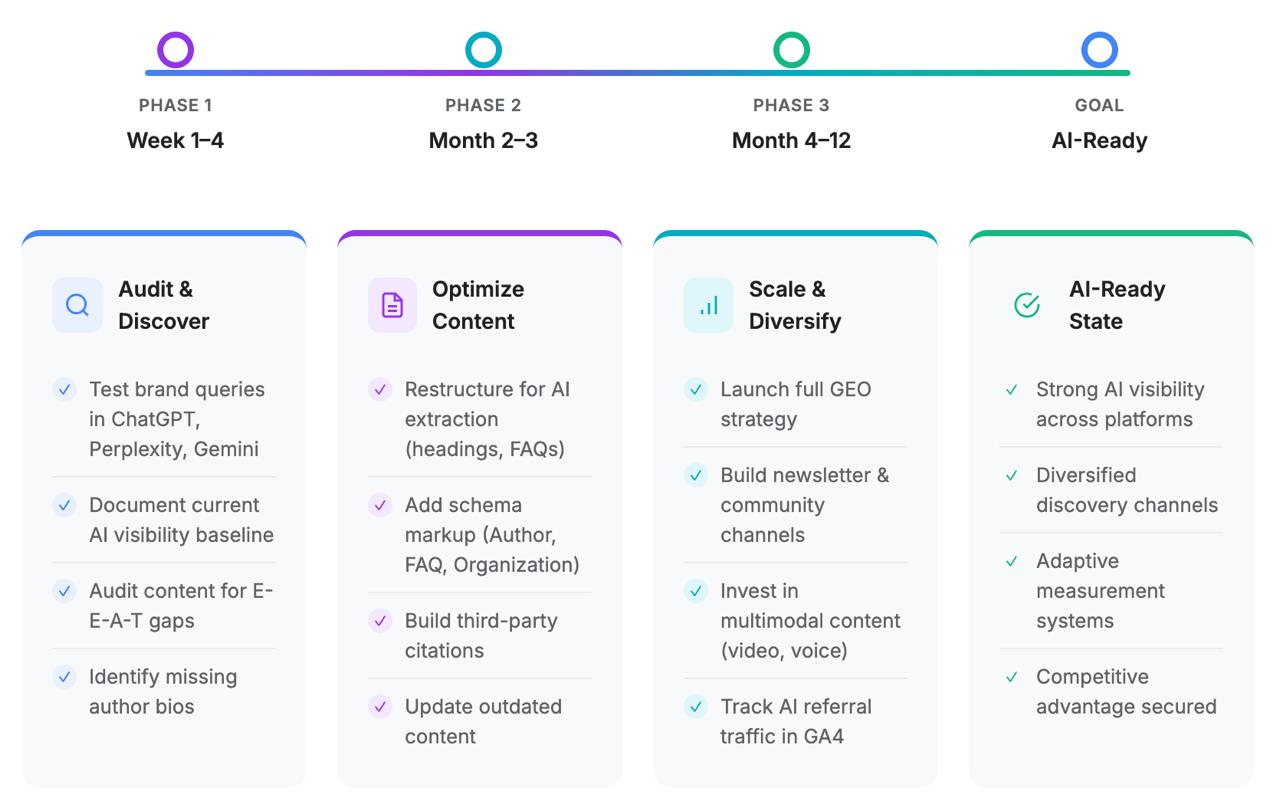
Immediate actions (next 30 days): Begin monitoring AI visibility. Test your most important commercial queries across ChatGPT, Perplexity, and Google AI Overviews. Document where your brand does and doesn’t appear. Audit content through an E-E-A-T lens — identify pages lacking author attribution or experience signals.
Short-term priorities (next quarter): Restructure content for answer extraction with clear headings, bulleted lists, and FAQ sections. Build citation authority through third-party mentions in industry publications and platforms AI systems frequently cite. Implement proper schema markup for authors, organizations, and FAQs.
Longer-term strategic shifts (next 6–12 months): Develop a genuine GEO strategy as a new acquisition channel. Diversify traffic sources through newsletters and communities. Invest in multimodal infrastructure — video production, image optimization, and voice-friendly content structures.
Conclusion
By the end of 2026, the search landscape will look fundamentally different. The predicted decline in traditional search volume, the continued expansion of AI Overviews, and the maturation of platforms like ChatGPT and Perplexity will create a discovery environment where AI citation matters as much as — or more than — traditional rankings. The SEO statistics we’re tracking today will evolve significantly, and the businesses that thrive will be those that recognized 2025 as the preparation window.
The organizations that will succeed have a common characteristic: they’re treating 2025 as preparation time, not waiting time. They’re building E-E-A-T foundations that AI systems will trust. They’re establishing measurement frameworks that capture AI visibility alongside traditional metrics. They’re developing GEO capabilities before the competition intensifies.
The fundamentals of quality content, technical excellence, and authoritative positioning aren’t disappearing — they’re becoming prerequisites for a new layer of optimization. Businesses that build strong AI visibility, diversified discovery channels, and adaptive measurement systems will capture disproportionate value as the transition accelerates.
Partnering with specialists who understand both technical and strategic dimensions of AI SEO can compress your preparation timeline significantly. The window for building competitive advantage is open now — but it narrows as more businesses recognize what’s coming and begin their own transitions.
Frequently Asked Questions (FAQ)
GEO is the practice of optimizing content for AI-powered answer engines like ChatGPT, Perplexity, and Google AI Overviews. Unlike traditional SEO, GEO focuses on earning citations within AI-generated responses, not just ranking web pages.
SEO optimizes content to rank in search results. GEO optimizes content to be cited in AI answers. SEO relies on backlinks and keywords; GEO prioritizes content depth, freshness, and factual accuracy. Both are essential for 2026.
Zero-click searches occur when users find answers on the results page without clicking any website. According to SparkToro, 58.5% of U.S. Google searches end without a click due to featured snippets, AI Overviews, and direct answers.
AI Overviews reduce organic CTR significantly. Seer Interactive’s 2025 study found a 61% drop when AI Overviews appeared. Paid CTR fell from 19.70% to 6.34% on AI Overview queries over 15 months of tracking.
E-E-A-T means Experience, Expertise, Authoritativeness, and Trustworthiness. AI systems prioritize these signals when selecting sources to cite. Strong author credentials, first-hand experience, and transparent sourcing improve AI visibility.
Begin monitoring AI citations now. Restructure content for extraction, build E-E-A-T signals, and implement schema markup. Working with experienced AI SEO specialists helps businesses prepare faster and avoid costly mistakes.
Approximately 15.69% of Google queries triggered AI Overviews as of November 2025. This continues growing, with informational, health, how-to, and product comparison queries showing the highest AI Overview frequency.
Sources:
- [1] SparkToro – For Every 1,000 US Google Searches, Only 360 Clicks Go to the Open Web, 2025
- [2] Semrush – AI Overviews Study: What 2025 SEO Data Tells Us About Google’s Search Shift, 2025
- [3] Seer Interactive – AIO Impact on Google CTR: September 2025 Update, 2025
Share with


Rate the article