

Your next client might never Google you. An AI agent will research your category, build a shortlist, and recommend a winner — all before a human ever opens a browser tab. That’s what we have to deal with today.
What Is Agentic Search Optimization?
When someone types a question into ChatGPT or Perplexity, they don’t get ten blue links. They get an answer: synthesized, confident, attributed to a handful of sources the model decided were worth citing. That decision happens inside the model, based on how content is structured, how entities are established, and how well the information matches the phrasing of the query.
Agentic search optimization is the practice of making your content, brand, and site structure legible to that process. Not to Google’s crawler. To AI agents.
A DeFi protocol that ranks on page one for “yield farming platforms” may not appear in a single AI-generated answer to “what’s a reliable yield farming platform for a mid-size portfolio?” One retrieval system returns documents. The other reasons through them and picks a winner.
A few examples of how this plays out in practice:
- A user asks Perplexity which L2 network has the lowest transaction costs. Three names get cited; the rest don’t exist in that answer
- A procurement manager asks ChatGPT to shortlist custody solutions for institutional clients. The AI generates a list based on credibility signals across training data and retrieval, not search rankings
- A retail investor asks Google AI Overviews to compare two DeFi protocols. One gets a clear description, one gets a sentence or nothing
The scale is no longer theoretical. Google AI Overviews surpassed 2 billion monthly users across 200+ countries by mid-2025. Adobe data from Q1 2026 shows AI-driven referral traffic up 393% year-over-year. In crypto, Avenue Z found that just 10 blockchain brands captured over 91% of AI citations across ChatGPT, Perplexity, and Gemini.
Agentic search optimization is how you get into that 10%.
5 Signs an Agency Has Actually Built an AEO Practice
Five things separate agencies doing real agentic search optimization from those who’ve just copied the vocabulary.
1. They draw a clear line between traditional SEO and agent-layer work. A Google ranking doesn’t get you cited by ChatGPT. That’s not a nuance. It’s the whole problem. Ahrefs data shows only 12% of URLs cited by ChatGPT, Perplexity, and Copilot rank in Google’s top 10. If an agency can’t explain why that gap exists and what they do about it, they’re running standard SEO with a new label. The crypto prop firm case shows what agent-layer work produces when that distinction is actually applied.
2. They have a real methodology for AI citation tracking. “We monitor ChatGPT mentions” is not a methodology. The actual version tracks citation frequency by query, sentiment of those mentions, share of voice against named competitors in LLM responses, and referral traffic from AI platforms. Agencies that can’t break this down in writing haven’t built the system yet. The Godex case is a documented example of what that tracking looks like in practice.
3. They work with structured data at depth, not surface-level schema tagging. That means understanding what llms.txt is and having it correctly configured on their own site. If their own site doesn’t have it, that’s your answer.
4. They’ve done conversational query optimization, not just keyword density work. AI agents answer questions differently than search engines return results. Agencies working in GEO and AEO frameworks understand how to structure content that survives that selection. Agencies that don’t, don’t.
5. They can speak to agent-readiness for your specific stack. Crawlability by AI agents, llms.txt configuration, API-accessible content layers, structured content that performs during the Evaluation stage of agentic search. Vague answers here are a red flag, not a sign of complexity.
How We Selected These Agencies
Each agency on this list was evaluated against the same five criteria:
- Documented AEO or GEO methodology: a public, specific process, not a service page that swapped “SEO” for “AI SEO”
- Crypto and Web3 domain experience: familiarity with the regulatory environment, audience, and content standards of the vertical
- Technical depth: hands-on work with schema markup, llms.txt configuration, and structured data for AI retrieval
- Measurable outputs: committed deliverables around citation rate, AI share of voice, or AI-originated traffic; not just ranking reports
- Team size fit: boutique to mid-size (10–50 people), suited to the budgets and communication expectations of most Web3 projects
What got agencies excluded: no documented methodology beyond generic claims, only traditional SEO deliverables relabeled for AI, or no visible agent-layer work on their own site.
Side-by-Side Comparison: Core Services & Specialization 👀

ICODA
Integrated Crypto AEO
Core Service
Specialization
Agentic-Specific Offering

Generis
Institutional Web3 GEO
Core Service
Specialization
Agentic-Specific Offering

LuvKaizen
AI-Native Growth Studio
Core Service
Specialization
Agentic-Specific Offering

TokenMinds
Full-Stack Token Launch Agency
Core Service
Specialization
Agentic-Specific Offering

Lunar Strategy
Full-Funnel Crypto GEO
Core Service
Specialization
Agentic-Specific Offering
5 Best Agentic Search Optimization Agencies in 2026: Full Overview
ICODA — Integrated AEO for Full-Stack Crypto and Web3 Marketing
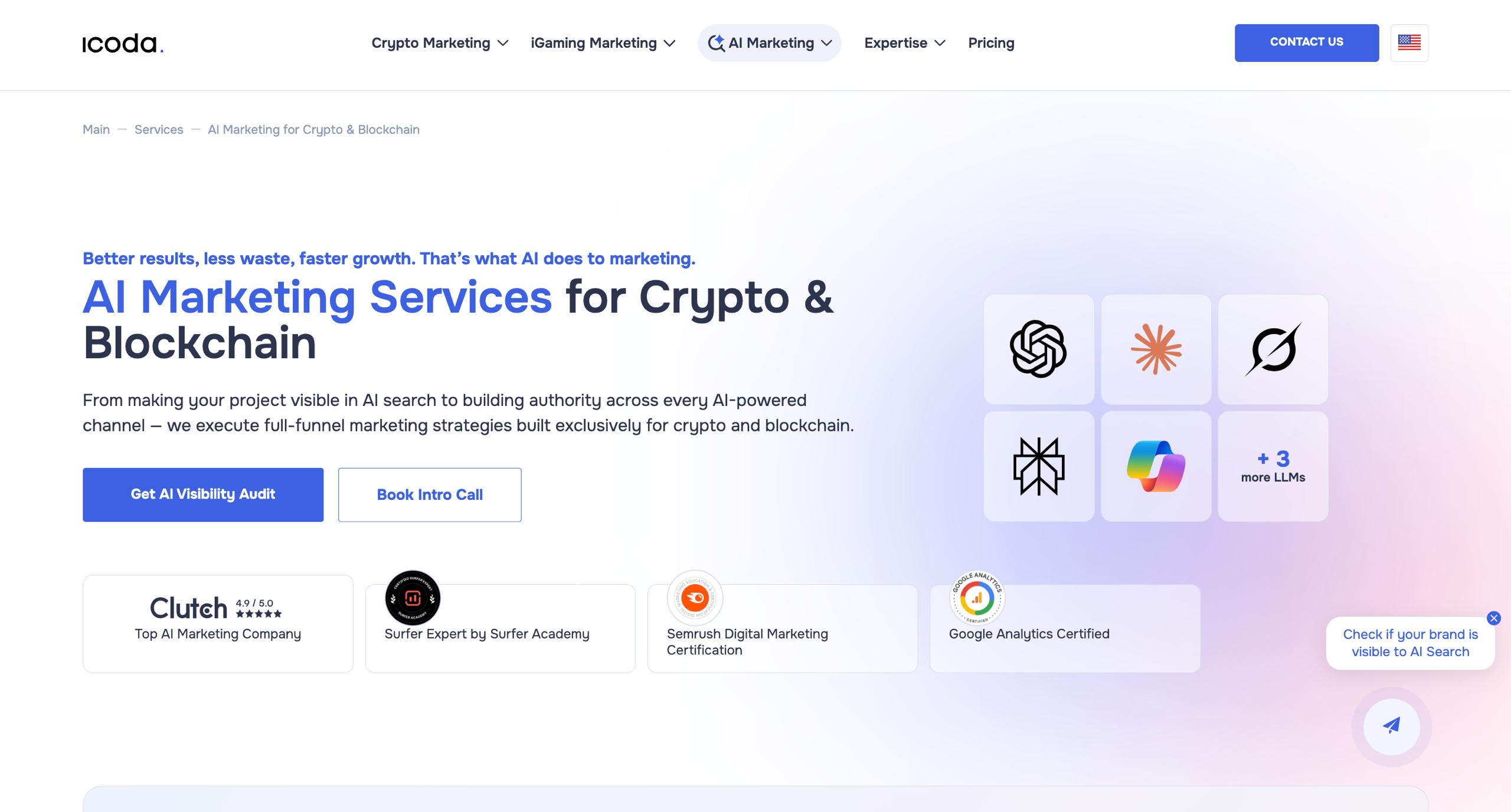
ICODA has been operating since 2017 with 650+ clients across DeFi, GameFi, iGaming, exchanges, wallets, and token sales, including BingX, Tangem, TON, Filecoin and FLOKI. The structural differentiator is how AEO is built into their overall service model rather than offered as a separate workstream: GEO, technical SEO, PR, influencer marketing, and community management run as integrated outputs. AI citations depend on trust signals from multiple channels simultaneously, and siloed deliverables don’t produce them.
Service scope includes AI visibility audits (upgraded visibility tool now tracks significantly more ranking factors than earlier versions), GEO and AEO content optimization, structured data implementation, and citation monitoring across ChatGPT, Perplexity, and Google AI Overviews.
Best for: DeFi protocols, token presales, iGaming platforms, and projects that need AEO integrated into their full marketing strategy rather than treated as a standalone service.
Pick if you need: AEO running alongside PR, community, and influencer marketing from day one.
Generis — B2B Web3 GEO for Institutional Sales Cycles
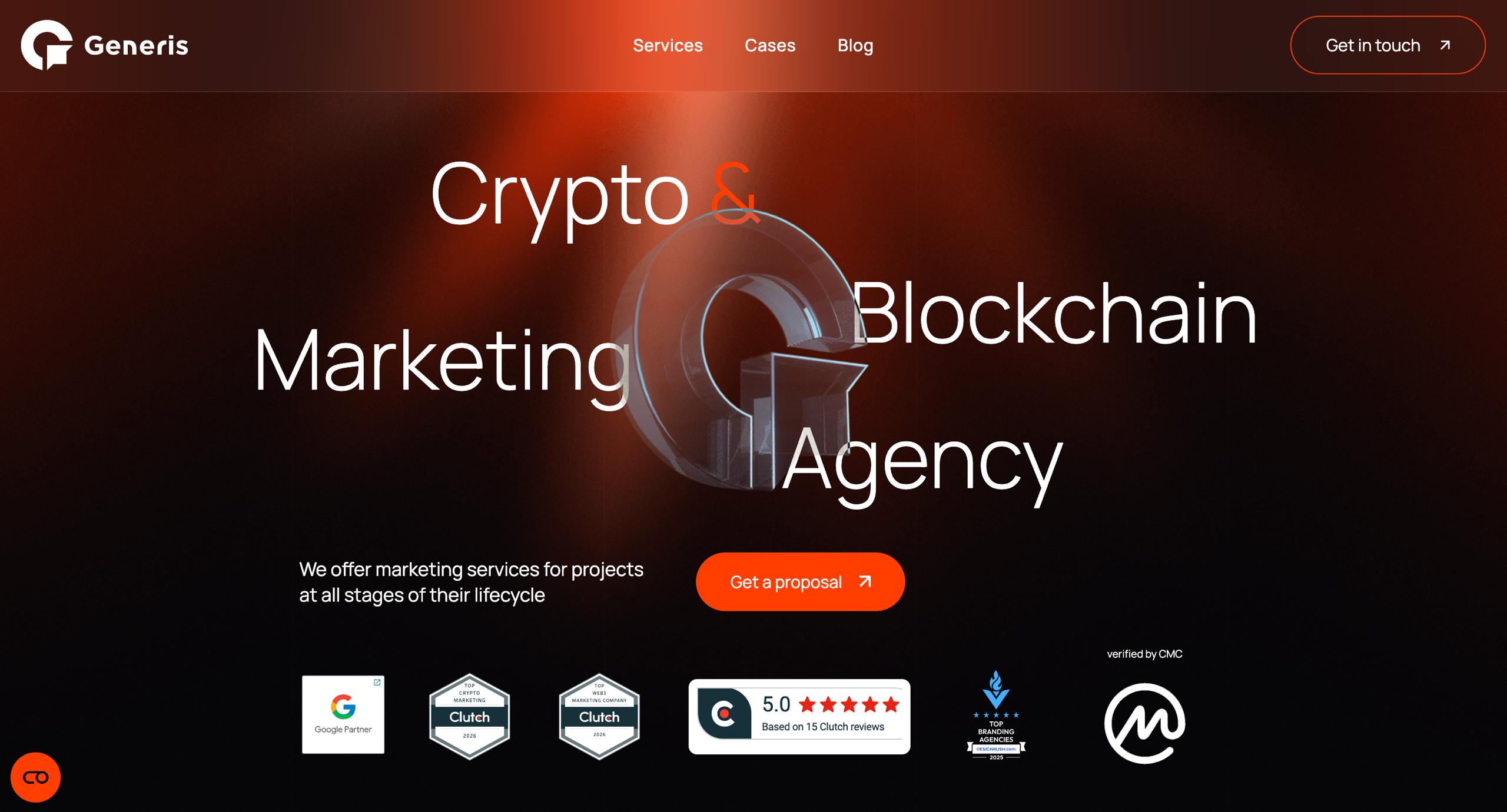
Generis is a Lisbon-based Web3 marketing agency, founded around 2022, focused on institutional B2B clients: infrastructure providers, L2 solutions, compliance platforms, and institutional custody. Their methodology centers on making a project’s differentiators and credibility signals legible to AI retrieval systems. PR and SEO are integrated from the start because the publications that carry weight in LLM training are the same ones that build credibility in enterprise sales cycles.
If your company’s deal flow starts with a procurement team or institutional investor running an AI-generated shortlist, Generis has built around that workflow. Their GEO strategy targets trust positioning in AI-mediated B2B discovery, not raw visibility volume.
Best for: B2B Web3 infrastructure providers where the enterprise sales cycle begins with an AI-generated research summary, not a branded search.
Pick if you need: To show up on an institutional investor’s or procurement team’s AI-generated shortlist before they ever visit your site.
LuvKaizen — Web3 Growth Studio with Native AI Tooling
LuvKaizen launched in 2019 out of KOLHQ.com, one of the earliest KOL management agencies in crypto. Few agencies running a full-stack studio model also build their own AI software: Contagent, an X engagement automation tool, and Prolifik, a content platform. Their understanding of LLM retrieval comes from the model side. They know how these systems select content, not just how to write for them.
Their AEO practice has two concrete differentiators. First, llms.txt is live on their own domain with AI crawlers explicitly allowed. Most competitors still block them, which creates a credibility gap when you’re selling AI visibility. Second, monthly deliverables include a prompt-panel report showing AI citation counts per platform, not keyword rankings. Their own service pages rank in positions one through four for crypto AI search terms in AI answers.
Best for: Full-funnel token launch periods and projects that want AEO, KOL, and community managed under one roof.
Pick if you need: AI citation counts per platform as a primary deliverable, not keyword ranking reports.
TokenMinds — Full-Stack Token Launch Agency
TokenMinds was founded in 2016 and operates as a 360° Web3 agency headquartered in Singapore, with 200+ projects served across DeFi, NFT marketplaces, GameFi, and token launches. Their core differentiator is combining smart contract development with growth marketing under one roof, which removes the coordination gap between technical and marketing teams during launch periods. Clients include CoinMarketCap, CryptoBlades, and GensoKishi.
SEO runs as a core pillar of their pre- and post-launch visibility work, covering whitepaper and tokenomics page optimization, authority cluster building, and content structured for AI-driven discovery. They’ve also built TMX AI, a proprietary AI-powered customer engagement platform for community retention at scale.
Best for: Token launches and NFT/GameFi projects that need development and marketing handled by a single team.
Pick if you need: A team that understands your smart contracts and your content strategy well enough to connect them from launch.
Lunar Strategy — Broad-Funnel Crypto Marketing with Emerging GEO Capabilities
Lunar Strategy was founded in 2019, also in Lisbon, with around 21 employees and a portfolio of 300+ projects including Polkadot, ICP, OKX, and Cardano. Their core strength is full-funnel crypto marketing: KOL networks, PR placements, community management, content, and paid distribution. GEO and AEO capabilities are expanding but sit alongside existing services, not as a primary offering.
That’s an honest distinction. If you need a dedicated AEO program, other agencies on this list are better fits. If you need strong marketing execution with AI search as a supporting capability, Lunar Strategy delivers on the core work. Polkadot KOL campaign: 2.66M reach, around 20K engagements over 45 days. Blast presale: $37M raised.
Best for: NFT projects, GameFi brands, and growth-stage Web3 protocols that need community, influencers, and PR alongside emerging AI search work.
Pick if you need: KOL distribution, PR, and community running at scale, with GEO as a supporting layer rather than the core engagement.
How to Choose the Right Agentic Search Optimization Agency
Step 1️⃣: Audit their own presence before the first call.
Run these checks yourself:
- Type “crypto AEO agency” and “Web3 GEO” into ChatGPT and Perplexity. Do they appear?
- Go to their domain and add
/llms.txt— if it’s missing, they haven’t configured it for themselves - Check their
robots.txtfor blocked AI crawlers (GPTBot, ClaudeBot, PerplexityBot). Blocking them while selling AI visibility is a hard disqualifier
Step 2️⃣: Ask for the methodology document, not the portfolio.
Request these directly:
- “Send me your citation tracking process document” — not a case study deck
- “Which tools do you use to monitor citations across ChatGPT, Perplexity, and AI Overviews?”
- “Show me a sample monthly citation report from a current client”
If the response is a sales call invitation or a PDF with no methodology, move on.
Step 3️⃣: Lock down metrics before the contract,
Require written agreement on:
- AI citation rate per platform (baseline + target)
- AI-originated traffic share (Google Analytics or equivalent)
- Structured data coverage score at contract start and at 90 days
- Monthly prompt-panel reporting as a standard deliverable
Expect first citation movement at 3–6 months. Material AI traffic share at 6–12. Any agency promising faster without documented proof should be pressed on it.
Conclusion
Agentic search isn’t a future channel to prepare for. It’s where a meaningful share of discovery is already happening, and the gap between brands with AI visibility and those without is widening every quarter.
The agencies that can actually help aren’t the ones that added AI to their service list. They’re the ones that built a methodology, applied it to their own presence first, and can show you exactly how they measure progress. That’s a short list in any vertical, and a shorter one in crypto and Web3.
If you’re evaluating options, the criteria in this piece give you a working framework. The due diligence process is the same regardless of which agency you’re talking to: audit their presence, ask for the process document, and agree on metrics before anything is signed.
Frequently Asked Questions (FAQ)
Traditional SEO targets Google’s ranking algorithm: you optimize for how a crawler indexes and scores a page. Agentic search optimization targets a different layer, the AI systems that retrieve information, synthesize answers, and recommend options without surfacing a ranked URL list. The focus is on how content is structured, cited, and interpreted by AI retrieval systems.
For most teams, no. A standard SEO agency isn’t equipped for this. Approximately around 12% of URLs cited by ChatGPT, Perplexity, and Copilot rank in Google’s top 10, and 80% of LLM citations don’t appear in Google’s top 100 at all. Standard SEO agencies are optimizing for a ranking signal that has almost no relationship to AI citation behavior.
Based on documented client results, first meaningful AI citation lifts appear within three to six months. Material changes in AI-originated traffic share and share of voice in LLM responses develop over a six-to-twelve month timeframe.
They weight entity recognition, publication authority, content accuracy, and frequency of mentions across credible sources. Consistency of citation across training data matters more than recency.
No. Structured data, authoritative content, and strong domain signals help both. But optimization targets and success metrics differ enough to require a separate strategy.
Share with


Rate the article