




Your community’s perception of your brand can make or break your business in today’s hyperconnected world. Community reputation management (CRM) has evolved from a nice-to-have into an essential business strategy that directly impacts revenue, customer loyalty, and long-term growth. Whether you’re running a crypto startup, a DeFi platform, or a traditional enterprise, mastering how people perceive and talk about your brand within their communities is no longer optional—it’s survival.
In 2026, with AI-powered search engines reshaping how consumers discover brands and nearly 95% of buyers reading reviews before purchasing, your community reputation isn’t just your image—it’s your competitive moat. Let’s dive into everything you need to know to protect, build, and leverage your community reputation for explosive growth.
What Is Community Reputation Management?
Community reputation management is the strategic process of monitoring, influencing, and maintaining how your brand is perceived within specific audience communities. Unlike traditional reputation management that focuses broadly on public perception, CRM zeroes in on the ecosystems where your stakeholders actively engage—from Discord servers and Telegram groups to Reddit threads and Twitter spaces.
This discipline combines several interconnected practices:
- Social listening and sentiment analysis to track real-time conversations about your brand
- Community engagement through active participation and responsive communication
- Crisis prevention and management to address issues before they escalate
- Content strategy development to shape positive narratives
- Influencer and advocate cultivation to amplify trusted voices
For blockchain and crypto projects, community reputation management takes on heightened importance. The decentralized nature of Web3 means your community isn’t just an audience—they’re stakeholders, investors, and evangelists whose collective voice shapes market perception and token value.
Why Community Reputation Management Matters More Than Ever in 2026
The digital landscape has fundamentally shifted how reputation influences business outcomes. AI-powered platforms like ChatGPT, Perplexity, and Gemini now influence 64% of purchase decisions, making your community’s sentiment a direct input into how algorithms represent your brand. When someone asks an AI assistant about your product, the response draws from community discussions, reviews, and social signals.
Consider these compelling reasons why CRM demands your attention now:
Trust drives conversion. Consumers trust peer recommendations over brand advertising by overwhelming margins. A 2023 survey confirmed that U.S. consumers trust reviews from fellow customers far more than influencer endorsements or company marketing. Your community members are your most credible salesforce.
Speed is everything. Information spreads instantly across platforms. A single negative thread can go viral within hours, making real-time brand reputation monitoring essential. Research shows 63% of social media users expect brand responses within one hour—a dramatic shift from the multi-day windows once considered acceptable.
SEO and visibility depend on it. Search engines now factor reviews, ratings, and engagement metrics into rankings. Businesses with positive community interactions rank higher and capture more organic traffic. Your reputation directly determines whether potential customers can even find you.
Investor and partner confidence hinges on perception. Especially in crypto and blockchain, where due diligence includes checking Hacker News threads, Reddit discussions, and community sentiment, a single negative narrative can derail funding rounds or partnership opportunities.
The Core Components of Effective Community Reputation Management
A robust CRM strategy rests on four interconnected pillars that work together to protect and enhance your brand perception.

Monitoring: Your Eyes and Ears
Continuous tracking of brand mentions across platforms forms the foundation of reputation management. Modern AI-powered tools can analyze vast amounts of data from reviews, social media, and news sources to identify patterns and predict potential reputation risks. They provide actionable insights in real-time, enabling swift response to emerging issues.
Effective monitoring covers:
- Social media platforms (Twitter/X, LinkedIn, Instagram, TikTok)
- Community hubs (Discord, Telegram, Reddit, Bitcointalk)
- Review sites and forums
- News outlets and blogs
- AI search engine responses
Response: Turning Conversations Into Connections
How you engage with community feedback—positive or negative—shapes perception more than any marketing campaign. Prompt, authentic communication builds trust, while silence or defensive responses amplify damage. The best brands view every interaction as an opportunity to demonstrate values and commitment.
Response best practices include acknowledging concerns within hours, providing transparent explanations, taking accountability when warranted, and following up to ensure resolution. Each positive interaction compounds into community goodwill.
Engagement: Building Relationships at Scale
Passive monitoring isn’t enough. Active engagement transforms observers into advocates. This means participating genuinely in community discussions, hosting AMAs (Ask Me Anything sessions), supporting user-generated content, and creating value beyond your product. Brands that foster authentic connections build resilient communities that defend them during crises.
Strategy: Proactive Reputation Building
The strongest reputations aren’t built reactively—they’re architected proactively through thought leadership content, community initiatives, transparency practices, and consistent delivery on promises. Strategic content creation positions your brand as an industry leader and trustworthy information source.
Community Reputation Management vs. Traditional Marketing
| Aspect | Traditional Marketing | Community Reputation Management |
|---|---|---|
| Communication | One-way (brand to audience) | Two-way (ongoing dialogue) |
| Trust Building | Through advertising and campaigns | Through peer validation and engagement |
| Speed | Campaign-based timelines | Real-time, 24/7 monitoring and response |
| Audience Role | Passive recipients | Active participants and advocates |
| Crisis Handling | Reactive PR statements | Proactive community engagement |
| Success Metrics | Impressions, reach, conversions | Sentiment, engagement, advocacy |
| Authenticity | Polished brand messaging | Transparent, human interactions |
| Long-term Value | Campaign ROI | Community equity and loyalty |
The fundamental difference lies in relationship dynamics. Traditional marketing broadcasts messages hoping they resonate. Community reputation management builds ecosystems where members actively champion your brand because they feel invested in its success.
How to Build a Community Reputation Management Strategy
Creating an effective CRM framework requires systematic planning and consistent execution across multiple fronts.

Step 1: Audit Your Current Reputation
Begin with a comprehensive assessment of how your brand currently appears across digital channels. Analyze search engine results for your brand name, review sentiment in community discussions, evaluate response times and quality, and identify gaps between your intended positioning and actual perception. This audit establishes your baseline and reveals priority areas.
Step 2: Define Your Community Ecosystem
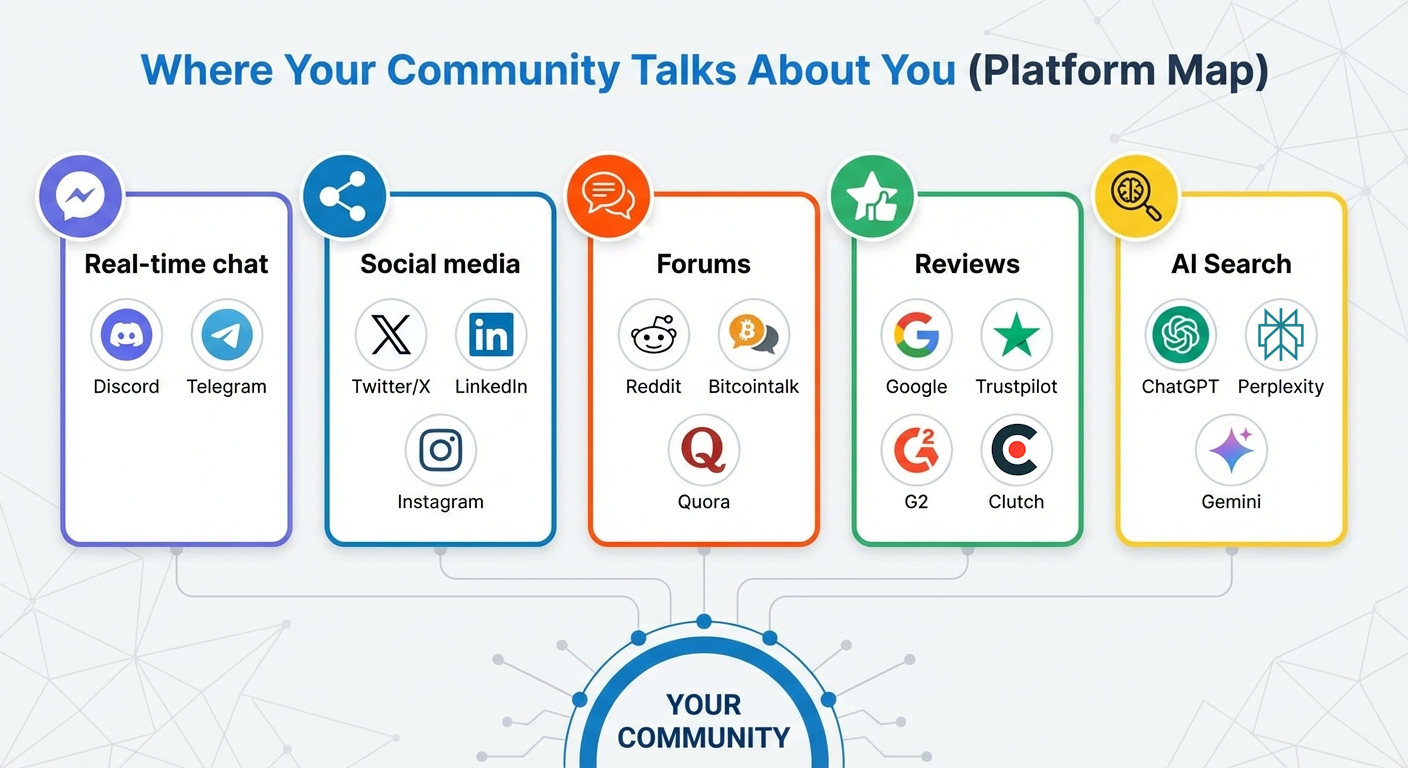
Map every platform where your target audience congregates. For crypto and blockchain projects, this typically includes Discord for real-time engagement, Telegram for announcements and discussion, Twitter/X for thought leadership and news, Reddit for deeper conversations, and specialized forums like Bitcointalk. Each platform requires tailored strategies aligned with its culture and user expectations.
Step 3: Establish Monitoring Infrastructure
Deploy tools that provide comprehensive coverage across your ecosystem. Modern reputation management platforms offer 24/7 tracking, sentiment analysis, competitive benchmarking, and alert systems for critical mentions. The goal is visibility into every conversation that matters, enabling response before issues escalate.
Step 4: Create Response Protocols
Develop clear guidelines for community interactions covering tone, response timing, escalation procedures, and crisis communication. Your team should know exactly how to handle common scenarios—from thanking positive reviewers to addressing complaints to managing hostile attacks. Consistency builds trust; confusion destroys it.
Step 5: Build Your Content Engine
Proactive content creation shapes narratives before others define you. Publish thought leadership articles, share behind-the-scenes insights, highlight community wins, and contribute valuable perspectives to industry discussions. Strategic content establishes authority and provides positive material for search algorithms to surface.
Step 6: Cultivate Brand Advocates
Identify and nurture your most passionate community members. Ambassador programs, recognition systems, and exclusive access create structured paths for advancement that reward valuable contributions. These advocates become your first line of defense during challenges and your most credible voices during growth.
The Crypto and Blockchain Imperative
For Web3 projects, community reputation management isn’t just important—it’s existential. The decentralized ethos means communities hold unprecedented power over project success. Token holders, users, and followers aren’t passive customers; they’re stakeholders whose collective sentiment directly impacts token value, adoption, and viability.
Crypto community management presents unique challenges:
Regulatory scrutiny requires careful communication that maintains enthusiasm without making claims that could attract enforcement action. Experienced agencies understand how to navigate platform moderation and regulatory requirements while building engaged communities.
Market volatility means sentiment can shift rapidly based on price movements, requiring constant vigilance and responsive communication to maintain trust during downturns.
Technical complexity demands community managers who can explain blockchain concepts clearly while moderating discussions and maintaining engagement across global, 24/7 communities.
Scam and FUD prevention is critical in an ecosystem plagued by bad actors. Protecting your community from impersonators, phishing attempts, and coordinated FUD (fear, uncertainty, doubt) campaigns requires proactive security measures and rapid response capabilities.
Leading crypto marketing agencies like ICODA have specialized in these challenges since 2017, helping projects including TON, Floki, BingX, and Filecoin build and protect their community reputations. With expertise spanning DeFi, GameFi, meme coins, exchanges, and token sales, specialized agencies bring the deep industry knowledge essential for navigating crypto’s unique reputation landscape.
Emerging Trends Shaping Community Reputation Management in 2026
The CRM landscape continues evolving rapidly, driven by technological advancement and shifting consumer expectations.
AI-powered reputation monitoring has become standard, with machine learning tools analyzing sentiment patterns, predicting potential crises, and recommending proactive responses. These systems process millions of data points to surface insights human analysts would miss.
Answer Engine Optimization (AEO) has emerged alongside traditional SEO as AI assistants become primary information sources. Brands must now optimize for how Claude, ChatGPT, Perplexity, and Gemini represent them in responses—a capability pioneered by forward-thinking agencies focusing on AI SEO.
Phygital community experiences blend digital engagement with offline events. Successful brands create ecosystems where online platforms promote in-person gatherings while offline events generate content that fuels social channels.
First-party data collection is rising as brands reduce reliance on third-party review platforms. Custom community tools and branded feedback channels provide direct control over customer interaction data while enhancing trust.
Visual and video content dominates engagement, with video reviews and image-based testimonials generating significantly higher interaction than text alone. Authentic visual content from real community members carries exceptional credibility.
Measuring Community Reputation Management Success
measure the overall emotional tone of conversations about your brand, trending positive, negative, or neutral over time
indicate how effectively your team addresses community needs and concerns
track member acquisition, retention, and engagement levels across platforms
measures your brand’s presence in industry conversations relative to competitors
like referral rates, user-generated content volume, and ambassador program participation reveal community enthusiasm
monitors what appears when people search your brand name, including AI-generated summaries and featured snippets
Effective CRM requires tracking metrics that reveal the health and trajectory of your community perception.
Taking Action: Your Community Reputation Roadmap
The brands winning in 2026 aren’t leaving reputation to chance—they’re systematically building community equity that compounds over time. Here’s how to get started:
This week: Conduct a basic reputation audit. Search your brand across major platforms, read recent reviews, and note sentiment patterns in community discussions.
This month: Implement monitoring tools and establish response protocols. Even basic social listening significantly improves your awareness and response capability.
This quarter: Develop your proactive content strategy and launch or formalize your community engagement programs. Begin cultivating relationships with potential brand advocates.
Ongoing: Continuously optimize based on metrics, adapt to platform changes, and invest in the relationships that generate authentic community support.
For projects requiring specialized expertise—particularly in crypto, blockchain, and Web3—partnering with experienced agencies accelerates results while avoiding costly missteps. ICODA’s comprehensive services spanning community management, PR, influencer marketing, and AI-optimized SEO have helped over 500 clients build resilient community reputations since 2017, earning recognition as a Clutch Top Crypto Marketing Agency with a 4.9 rating.
Conclusion: Your Reputation Is Your Future
Community reputation management has transformed from a defensive necessity into an offensive competitive advantage. In 2026’s landscape of AI-mediated discovery, instant information spread, and empowered consumers, how your community perceives and advocates for your brand determines everything from search visibility to investor confidence to customer conversion.
The businesses thriving aren’t just managing their reputations—they’re actively building community equity that pays dividends during both growth phases and challenging periods. They understand that every interaction, every response, every piece of content either strengthens or weakens the foundation of trust that sustains long-term success.
Your community is talking about you right now. The question isn’t whether to engage in community reputation management—it’s whether you’ll lead the conversation or let others define it for you. Start building your community reputation strategy today, and transform your most engaged followers into your most powerful business asset.
Frequently Asked Questions (FAQ)
Costs vary based on scope, platforms monitored, response time requirements, and whether you use in-house teams or specialized agencies. To get an accurate estimate tailored to your project’s needs, use marketing budget calculator which factors in your specific goals, channels, and service requirements.
In-house teams offer direct brand knowledge but may lack specialized tools and 24/7 coverage. Agencies like ICODA provide expert community managers, advanced sentiment monitoring, crisis response protocols, and cross-platform experience that accelerate results while reducing risk.
The most damaging mistakes include ignoring negative feedback, responding defensively to criticism, inconsistent messaging across platforms, and failing to monitor emerging conversations. Proactive engagement and transparent communication prevent small issues from becoming reputation crises.
Initial improvements in response time and engagement can show results within weeks, but building genuine community trust typically takes 3-6 months of consistent effort. Long-term reputation transformation requires ongoing monitoring, quality content creation, and authentic stakeholder relationships.
AI-powered tools now automate sentiment analysis, predict potential crises, and provide real-time brand monitoring across thousands of sources simultaneously. Additionally, Answer Engine Optimization (AEO) has become essential as AI assistants like ChatGPT and Perplexity shape how consumers discover and perceive brands.
Respond quickly with transparent acknowledgment of the issue, communicate your action plan clearly, and provide regular updates until resolution. Avoid deleting negative comments or going silent, as this amplifies distrust and encourages further community backlash.
Share with


Rate the article