

Your branded traffic used to be a guaranteed click. For example, someone searched “Uniswap” or “Chainlink staking” — they already knew where they were going.
You ranked #1 → they clicked.
That was one of the few things in SEO that felt stable.
September 2026 changed that. Google expanded AI Overviews to cover 93% of major branded crypto queries in a single month — tripling their presence across the category. For crypto projects that spent years building brand awareness, this is not a minor algorithm update. It’s a structural change in how Google handles the moment users are closest to converting.
The Data: From 20% to 93% — How It Happened
At the start of 2025, AI Overviews appeared on roughly 20% of general queries. Google was cautious about deployment — particularly on branded and commercial searches where accuracy mattered most and user trust was on the line.
By mid-2026, coverage had pushed past 70% on commercial queries and reached 89% on informational ones. SEO professionals tracked the numbers, but the common assumption held: branded queries were a safe harbor. The logic seemed sound: when someone already knows what they’re looking for, why would Google intercept that with a generated summary?
Then September happened. Branded query coverage went from roughly 30% to 93% in under four weeks — a ×3 jump in a single month.
Current AIO coverage by query type:
| Query type | AIO coverage |
|---|---|
| Branded (major crypto brands) | 93% |
| Informational | 89% |
| Commercial/transactional | 71% |
| General (early 2025 baseline) | ~20% |
Branded coverage now exceeds commercial coverage. Google is more likely to generate an AI summary on “[Project] what is it” than on a generic “best crypto wallet 2026” query. And that inversion is exactly what makes this a different problem than the AIO story crypto SEOs were already tracking.

What AI Overviews Actually Show on Branded Crypto Queries
Four queries tested across major branded crypto projects — “Chainlink explained,” “what is Uniswap,” “what is AAVE protocol,” “what is Arbitrum” — all triggered an AI Overview. Same format every time.
Look at any of those screenshots closely. The structure isn’t a paragraph. It’s a structured mini-document: an introductory definition, then an H2 (“How Chainlink Works,” “How It Works,” “How Aave Works”), then bullet points with bold subheadings covering the key mechanics. Google is generating a beginner’s guide to your project, on your branded query, before the user sees a single organic result.
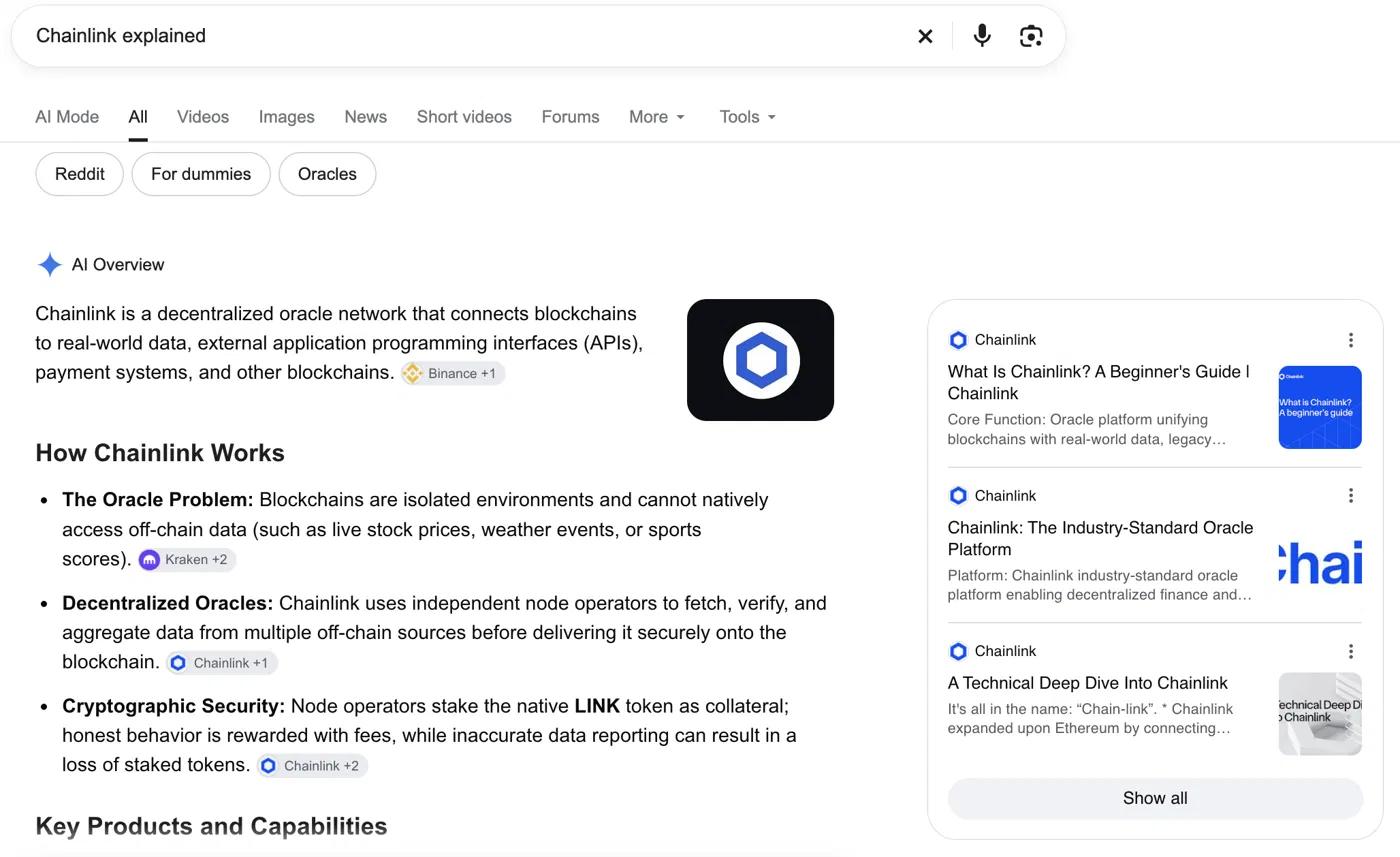
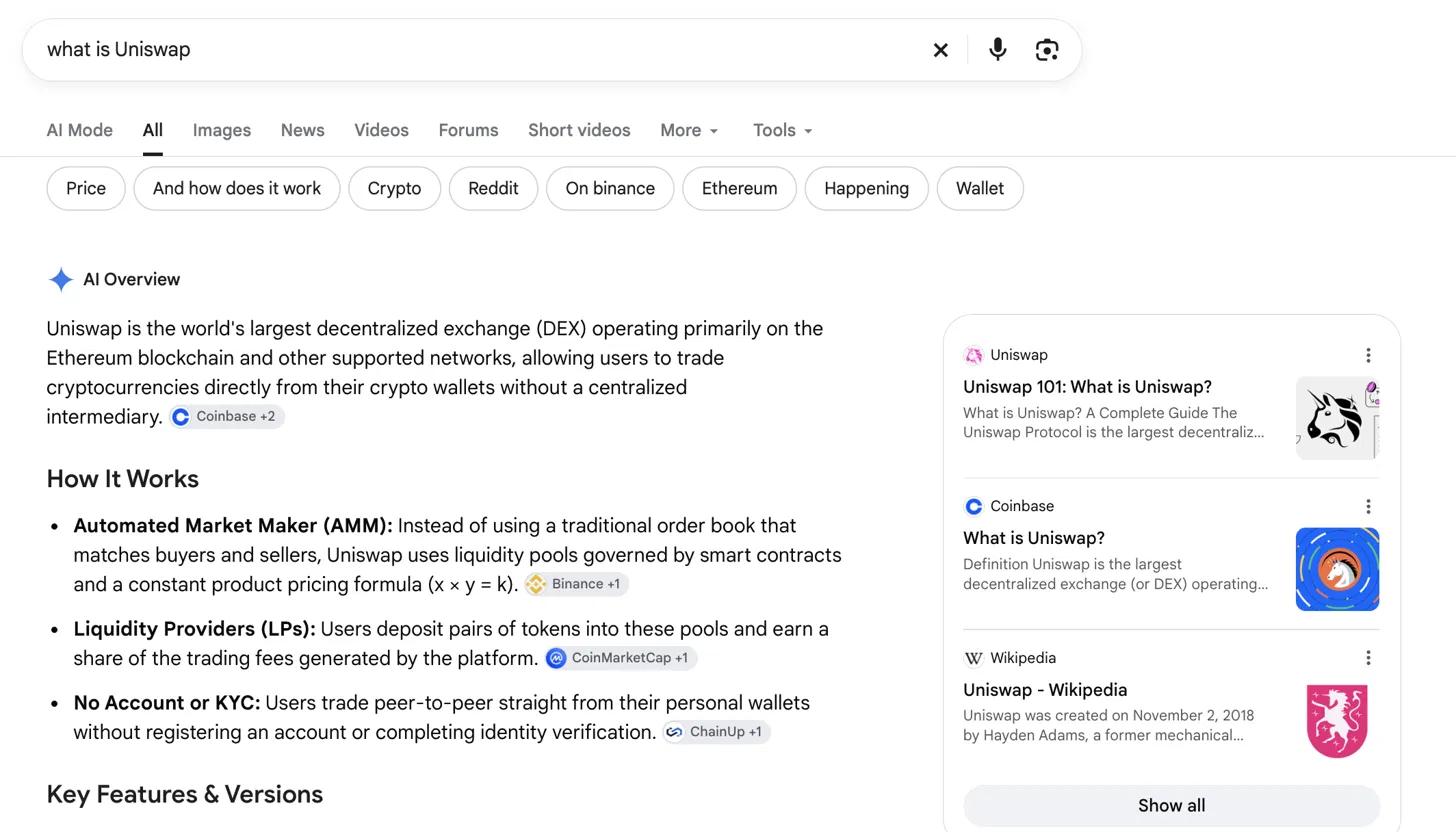
For established projects like Chainlink and Uniswap, the official site still appears in the source panel. The content is accurate. The brand is present. But here’s the point — the user already got the full answer. Chainlink explained what oracles are. Uniswap explained AMMs and liquidity pools. By the time the source panel renders, the question is answered. There’s no reason to click.
This is the zero-click problem. The threat isn’t erasure — it’s that the click never happens in the first place.
The citation pattern adds a second layer.
Every AIO pulls inline citations from multiple sources as it makes claims. Across all four queries, Binance appeared as a citation source in every single one — on Chainlink, Uniswap, AAVE, and Arbitrum branded queries alike. Kraken, CoinMarketCap, Coinbase, Ledger, Wikipedia, Bitcoin Suisse — all showed up as inline sources on queries for projects that are not those brands.
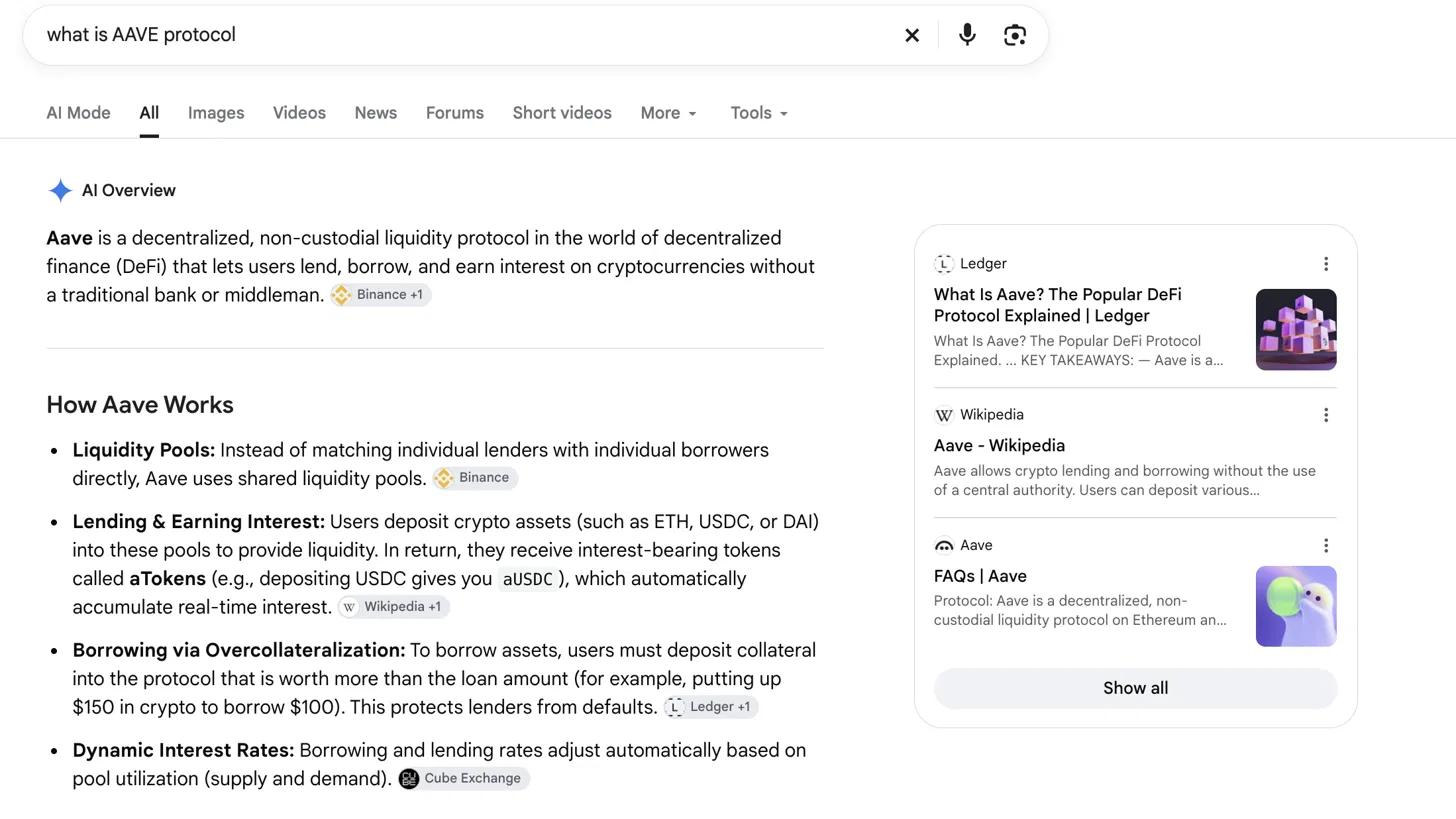
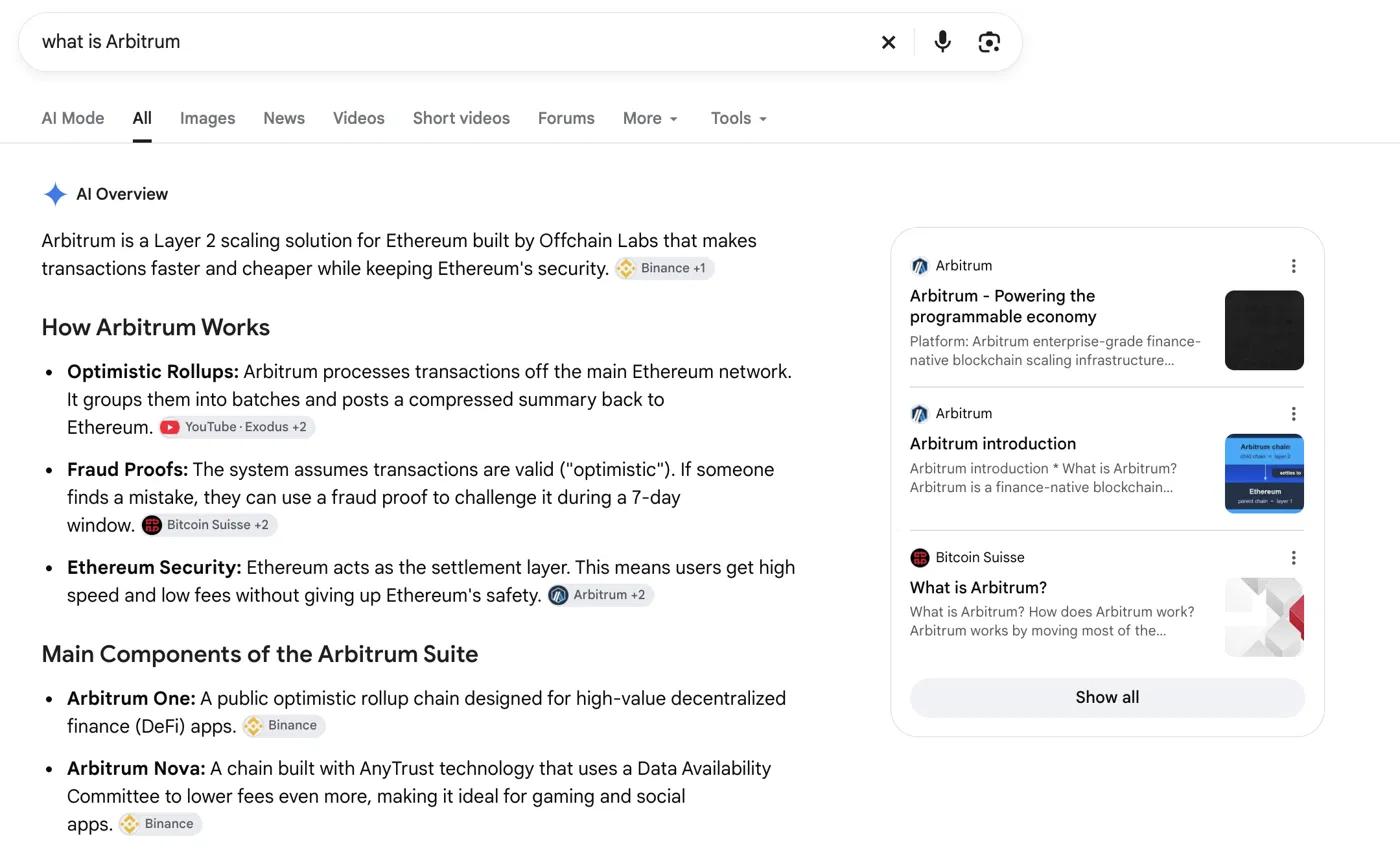
For large projects, this is a nuisance: third parties are cited alongside your own content. For mid-market projects — those without Chainlink’s domain authority or Uniswap’s Wikipedia coverage — the dynamic shifts. If your documentation isn’t structured for AIO citation, a better-optimized third party takes the inline slot on your branded query. The AIO still generates. Your name is in it. But Binance or Ledger is the one explaining you to your own potential users.
Two different problems, same root cause: Google now answers branded queries before the user reaches your site. The difference is whether you control the answer or someone else does.
Click Loss by Query Type: What’s Already Happened and What’s Coming
The traffic impact isn’t uniform — it depends on what kind of query you’re looking at. Here’s where things stand:
| Query type | AIO coverage (early 2025) | AIO coverage (Sep 2026) | Click loss YoY |
|---|---|---|---|
| Informational | ~20% | 89% | –61% |
| Branded | <10% | 93% | –3% (so far) |
Two very different numbers — but they’re at different stages of the same process.
Informational is already done. Queries like “how does proof of stake work,” “what is a DEX,” “how to bridge tokens” — click-through rates have dropped 61% year-over-year. For crypto media outlets and educational content producers who built audiences on being the answer to these questions, the model has broken. The AIO answers the question. The user never arrives.
Branded looks fine right now. A –3% loss sounds manageable. But look closer.
First, the –3% figure reflects a deployment that only hit 93% coverage in September 2026. There’s no long-term data on what sustained impact looks like. The informational vertical showed similar early numbers when AIO coverage was at 30–40% — then declined sharply as coverage pushed past 80%. Branded is currently at the same stage informational was eighteen months ago.
Second — and this is the part that gets underweighted — branded traffic converts differently. When someone searches your project name, they’re already sold — they just need the link. A 3% drop in that cohort costs more than a 3% drop in broad informational traffic. The conversion value isn’t comparable.
The question isn’t whether branded traffic loss will accelerate. The informational trajectory says it will. The question is how fast, and whether your project is a citation source when it does.
The Flip Side: Being Cited in a Competitor’s AIO = +23% Branded Search
Brands that appeared as cited sources in competitor AI Overviews saw a +23% increase in their own branded search volume within 30 days. That’s not a small signal.
The same feature that intercepts your branded traffic can send you someone else’s. Projects cited in competitor AIOs see +23% branded search lift within 30 days — because users who discover a protocol by name in an AIO go search for it directly.
Take a concrete case: a user searches “Uniswap alternatives” and the AIO lists three protocols by name — those protocols get in front of a user who was already looking in the space. Some portion search the cited project directly — that’s the branded search lift.
For crypto projects, this inverts the conventional SEO playbook. The goal was always to own your own SERP real estate. Now there’s a parallel game: getting into the AIOs on adjacent and competitor queries. A protocol cited as a comparison point in five competitor AIOs may gain more net visibility than one that owns its branded SERP perfectly.
AIO integration can become a distribution channel rather than a traffic threat. It requires different content — structured, citable, authoritative on specific technical claims — but the payoff shows up in the data.
The Bottom Line for Crypto Projects
It’s intercepted Google now generates a full structured answer on 93% of major branded crypto queries. The user learns what your protocol does, how it works, and what its key features are without leaving the SERP. The click that used to follow brand recognition now requires an extra reason to happen.
For established protocols, the threat is zero-click: your content is present, but the question is already answered. For mid-market projects, the risk runs deeper — third parties with stronger domain authority (Binance, Ledger, Wikipedia) take the inline citation slots on your own branded queries, shaping how potential users understand you before they ever reach your site.
Projects that appear as sources in competitor or category AIOs see a +23% lift in their own branded search volume within 30 days. The same mechanism that threatens your branded traffic can work in your favor on adjacent queries — if your content is structured to be cited.
How Crypto Projects Should Respond: 5 Steps
The informational query data is a preview of where branded traffic is heading. The window to get positioned before the full impact lands is now, not after you’ve watched the numbers move.
1. Run your branded query audit
Search your project name, your project name + “review,” your project name + “what is it,” and your project name + the core use case. Screenshot what appears. If an AI Overview is generating a summary about you, read it: is it accurate? What sources is it pulling from? Is your own site being cited, or are third parties doing the talking?
Cover 10–15 branded query variations. The results will tell you whether you’re dealing with an AIO accuracy problem, a citation gap, or a competitive exposure issue — and which one to fix first.
2. Audit the sources Google is citing about you
Google cites those domains because it considers them authoritative on your project. If Coindesk, Messari, and a Reddit thread are your primary citation sources, that tells you how your own content is being evaluated.
Map which domains appear. Read what they say. If there’s a gap between how you’d describe your protocol and how those sources describe it — and there usually is — that gap is the AIO’s source material.
3. Create AIO-optimized content on your own domain
AIO-friendly content answers specific questions in the first 2–3 sentences of a section. It uses terminology that matches search query language. It cites its own claims with data. Headers match the exact question format users ask.
A page titled “What is [Your Protocol]” that answers the question in the first paragraph — with section headers like “How does it work,” “What fees does it charge,” “Who is it for” — has a higher chance of being pulled into branded AIOs as a citation source, including your competitors’ AIOs. For a full breakdown of what AIO-optimized content looks like in practice, see How to Show Up in AI Overviews.
4. Build citation presence on high-authority third-party sites
If Google is pulling from Messari for your branded queries, you need accurate, current content on Messari. Same for any domain appearing in your citation audit. This isn’t about press releases or paid coverage — it’s about ensuring the content that gets cited says what you’d want it to say.
Developer docs on GitHub, technical posts on Mirror or Paragraph, educational content on protocol-specific documentation sites — all are candidates. Priority goes to any domain already showing up in your branded query results.
5. Monitor competitor AIOs for your project name
Set up monitoring for “[Competitor] alternatives,” “[Competitor] vs,” and “[Category] protocols” queries likely to generate comparison AIOs. If you appear there, you pick up the +23% branded search effect. If competitors appear in yours but you don’t, that’s a separate problem to solve.
Run this monthly. AIO citation composition changes as content authority shifts.
Check Your Branded Query Right Now
Run the search yourself. See what Google generates on “[Your Project] what is it” and “[Your Project] review.” What you find in the next ten minutes tells you more about your actual exposure than any aggregate report.
For a structured audit of your branded AIO presence — which sources are cited, where you appear in competitor queries, where the content gaps are — run it through the ICODA’s AI Visibility Tool.
Frequently Asked Questions (FAQ)
No, but they displace it. The AIO appears above organic results, so #1 no longer gets first visual contact with the user. Click behavior data shows organic results below an AIO receive fewer clicks even when users don’t engage with the AIO itself. The displacement effect exists whether or not they read the summary.
Google’s expansion to branded queries reflects both improved model accuracy and a decision to push the feature into higher-intent searches. The ×3 growth in a single month points to a deliberate rollout rather than gradual drift. Chris Long’s analysis of the September data flagged it as a structural shift, not noise.
Yes, through Google Search Console signals and robots.txt/meta directives — but think through the trade-off. Opting out cuts both ways. Removing your content from AIO citation also reduces your chances in the favorable scenarios: being cited in competitor queries, having your own branded summary be accurate. Optimizing for citation quality beats opting out for most crypto projects.
Often, but not always — especially for mid-market projects where third-party content has higher domain authority. September data showed many branded crypto queries returned AIOs that primarily cited educational resources, crypto media, and aggregator sites rather than the official project domain. If your content doesn’t match what Google considers the clearest answer to the query intent, other sources fill the gap.
There’s no recovery data yet — the 93% coverage level is too new. The informational query trajectory suggests early-stage branded traffic loss compounds as users develop habits around AIO engagement over click-through. Treat –3% as a floor.
Share with


Rate the article