




Introduction
The rules of search are changing. While traditional SEO still demands significant investment—often $3,000 to $10,000 monthly for quality services — a new frontier has emerged that’s reshaping how businesses think about online visibility. AI-powered search engines like ChatGPT, Perplexity, and Google’s Gemini are capturing an increasingly large share of search queries, and with this shift comes an opportunity: affordable AI SEO.
Let’s be clear from the start: affordable doesn’t mean cheap. Affordable AI SEO represents a strategic approach to optimizing your content for AI search engines at a price point that delivers genuine ROI without breaking your marketing budget. It’s about working smarter, not necessarily spending less on quality.
In this comprehensive guide, you’ll learn exactly what affordable AI SEO services include, how to budget effectively for this emerging channel, which tools can help you get started, and how to choose a provider that delivers real value. Whether you’re a startup founder watching every dollar or a marketing manager looking to diversify your search strategy, this article will give you the practical knowledge you need to make informed decisions about AI SEO investment.
What is Affordable AI SEO?
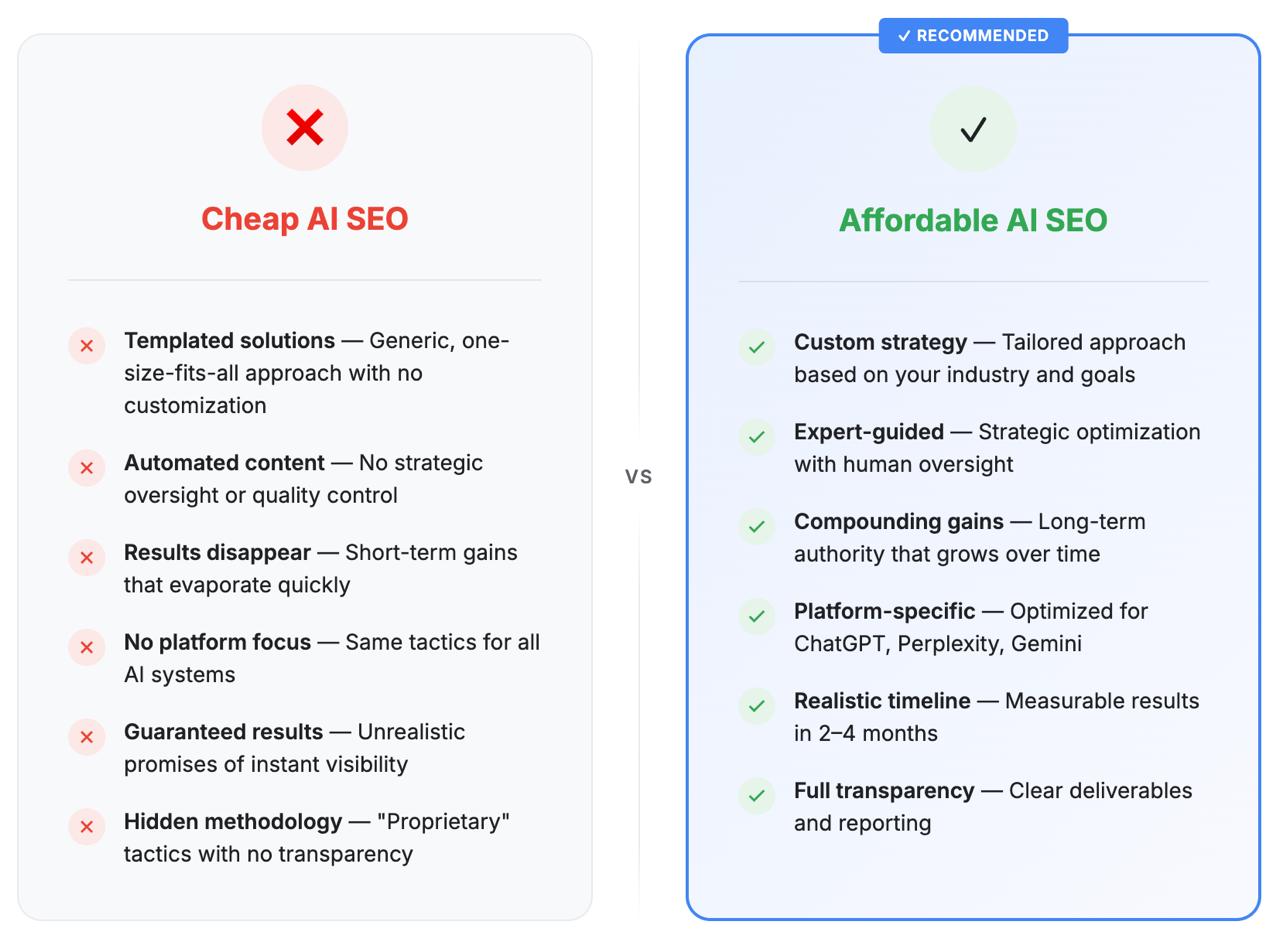
The word “affordable” carries weight that “cheap” never could. Cheap AI SEO services typically deliver templated solutions, automated content with no strategic oversight, and results that evaporate as quickly as they appear. Affordable AI SEO services, by contrast, offer professional-grade optimization at accessible price points — think mid-tier pricing with strategic value built in.
Here’s why AI SEO can actually be more budget-friendly than its traditional counterpart: the optimization landscape is newer and less competitive. While traditional SEO requires extensive backlink campaigns, years of domain authority building, and constant content production to rank on page one, AI SEO rewards quality, structure, and authoritative information — factors that don’t necessarily require massive ongoing investment.
“The core components of cost-effective AI SEO include Technical GEO Implementation, which optimizes site speed, mobile responsiveness, and crawlability specifically for AI bot indexing; Answer Engine Optimization (AEO), which structures FAQ sections and knowledge content to provide concise, accurate answers that AI platforms prefer; and AI Search Performance Tracking to monitor your visibility across ChatGPT, Perplexity, Gemini, and other AI platforms. Each of these disciplines can be implemented with focused effort and strategic investment rather than the constant spend that traditional SEO demands.”
Affordable AI SEO Agencies With Proven Results
Finding the right AI SEO partner means looking beyond promises to actual performance. The agencies below have demonstrated real expertise in optimizing for AI search engines — with documented case studies, platform-specific strategies, and measurable client outcomes.
What separates these providers from the rest? They specialize in AI SEO rather than treating it as an afterthought. They understand how ChatGPT, Perplexity, and Gemini source and cite information differently — and tailor their approach accordingly.
Here’s a comparison of five agencies delivering consistent results in AI search visibility:
5 Agencies providing affordable AI SEO 🧠

ICODA
Blockchain&B2B Marketing Leader
Specialization
- Crypto & Web3
- B2B SaaS
Best For
Notable Strength

GrowthMarshall
Proprietary AI Frameworks
Specialization
- AI Search Ops
Best For
Notable Strength

Digital Elevator
Healthcare Tech Authority
Specialization
- Healthcare & Tech
Best for
Notable Strength

GreenBananaSEO
Performance-Guaranteed Optimization
Specialization
- AI Platform Optimization
Best for
Notable Strength

mvpGrow
Revenue-Focused Growth
Specialization
- SaaS Growth
Best for
Notable Strength
The best choice depends on your goals, your industry, and the platforms your audience uses most.
Types of Affordable AI SEO Services
Understanding the specific services that comprise AI SEO helps you allocate budget where it matters most. Here are the primary affordable AI SEO services to consider:
| Service | Description | Cost Optimization Tip |
|---|---|---|
| ✨ AI-Powered Content Optimization | Restructures existing content to be more easily parsed, quoted, and cited by AI systems. Involves reformatting information into clear, attributable statements and adding context that helps AI understand authority behind claims. | Start with your highest-traffic pages and expand based on results rather than optimizing everything at once. |
| 💬 Answer Engine Optimization (AEO) | Targets how AI systems answer user questions. Includes identifying questions your target audience asks AI assistants, creating authoritative answers, and formatting content with clear headers, definitions, and structured information. | Focus on question-based keywords where you have genuine expertise rather than trying to rank for every possible query. |
| ⚙️ Technical GEO Implementation | Covers technical components of Generative Engine Optimization. Includes optimizing page structure for AI crawlers, implementing proper heading hierarchy and semantic HTML, and ensuring technical foundation supports AI discoverability. | A one-time technical audit and implementation is often more cost-effective than ongoing retainers for technical work. |
| 🔗 Multi-Source Authority Building | Builds your presence across platforms that AI systems reference (Wikipedia, industry publications, expert directories, authoritative forums) to establish credibility when AI cross-references information. | Prioritize platforms where you can demonstrate genuine expertise rather than spreading thin across too many channels. |
| 🧠 AI Search Performance Tracking | Monitors how often your brand is mentioned in AI responses, tracks context and sentiment of mentions, and compares your AI visibility against competitors. | Many providers offer tracking as part of comprehensive packages — standalone tracking services can sometimes cost more per-feature. |
| 📊 Structured Data & Schema Markup | Implements organization, product, and FAQ schema; adds author and expertise markup for content pieces; ensures structured data validates correctly across all platforms. | Schema implementation is typically a one-time project that delivers ongoing value, making it a high-ROI investment. |
Common AI SEO Mistakes to Avoid
Even with the best intentions, businesses often sabotage their affordable AI SEO efforts by falling into predictable traps. Avoiding these mistakes will save you money and accelerate your results.
1) Treating AI SEO Like Traditional SEO
The biggest mistake is assuming what works for Google works for ChatGPT. AI systems prioritize different signals — they care less about backlink profiles and more about content clarity, factual accuracy, and quotable statements. Businesses that simply repurpose their traditional SEO strategy waste budget on tactics that don’t translate. AI SEO requires its own strategic approach focused on being cited, not just ranked.
2) Ignoring Content Structure
AI systems parse content differently than human readers. Walls of text, buried answers, and unclear hierarchies make it harder for AI to extract and cite your information. Many businesses create great content but present it in ways that AI struggles to process. Invest in restructuring content with clear headers, direct answer statements, and logical flow that AI can easily navigate and quote.
3) Chasing All Platforms at Once
Trying to optimize for ChatGPT, Perplexity, Gemini, and every emerging AI platform simultaneously spreads resources too thin. Each platform has nuances, and budget-conscious businesses get better results by dominating one or two platforms before expanding. Start where your audience actually searches, establish authority there, then scale strategically.
4) Neglecting Authority Signals
AI systems don’t just evaluate your website — they cross-reference information across the web. Businesses that focus solely on on-site optimization miss the bigger picture. If your brand isn’t mentioned on authoritative third-party sources, AI has less reason to trust and cite you. Building citations on industry publications, Wikipedia, and expert platforms is essential for AI visibility.
5) Expecting Overnight Results
While AI SEO moves faster than traditional SEO, it’s not instant. Some businesses abandon their strategy after a few weeks without dramatic results, wasting their initial investment. AI systems update their knowledge bases on varying schedules, and building authority takes consistent effort over 2–4 months minimum. Patience and measurement are essential.
6) Skipping Measurement and Tracking
Flying blind is expensive. Without tracking your AI visibility, you can’t know what’s working or where to adjust. Many businesses invest in optimization but neglect monitoring tools, making it impossible to demonstrate ROI or refine strategy. Even basic tracking beats no tracking — allocate budget for visibility monitoring from day one.
How to Create an Affordable AI SEO Budget
Building an effective AI SEO budget requires strategic thinking rather than arbitrary allocation. Follow this framework to maximize your investment:
Step 1️⃣: Define Clear Goals
Start by identifying what success looks like for your business. Are you focused on brand visibility in AI responses? Direct traffic from AI platforms? Lead generation from AI-assisted search? Your goals will determine where budget should flow. A B2B SaaS company might prioritize being cited as an authority in technical discussions, while an e-commerce brand might focus on product visibility in shopping-related queries.
Step 2️⃣: Conduct an AI SEO Audit
Before spending on optimization, understand your current position. Query AI platforms with terms relevant to your business and assess how often (or whether) your brand appears. This baseline helps you prioritize efforts and measure progress. Many AI SEO agencies offer initial audits at reduced rates or as part of onboarding.
Step 3️⃣: Prioritize Platforms
Not all AI platforms matter equally for every business. ChatGPT has the largest user base but tends toward general queries. Perplexity attracts researchers and professionals who value detailed sourcing. Gemini integrates with Google’s ecosystem. Prioritize based on where your target audience actually searches rather than trying to optimize everywhere at once.
Step 4️⃣: Allocate Budget Across Services
A balanced budget for affordable AI SEO might look like: 40% for content optimization and creation, 25% for technical implementation (schema, site structure), 20% for authority building and PR, and 15% for monitoring and tracking tools. Adjust these ratios based on your audit findings — if technical issues are holding you back, shift budget there first.
Is AI SEO Worth the Investment?
The ROI question deserves a direct answer: for most businesses targeting knowledge workers, researchers, or technically-savvy consumers, budget AI SEO investment is absolutely worth it. Here’s why.
First, timeline matters. Traditional SEO typically takes 6–12 months to show meaningful results, sometimes longer in competitive industries. AI SEO can produce measurable visibility improvements in 2–4 months because you’re optimizing for systems that update their knowledge more dynamically than Google’s crawl-and-index approach.
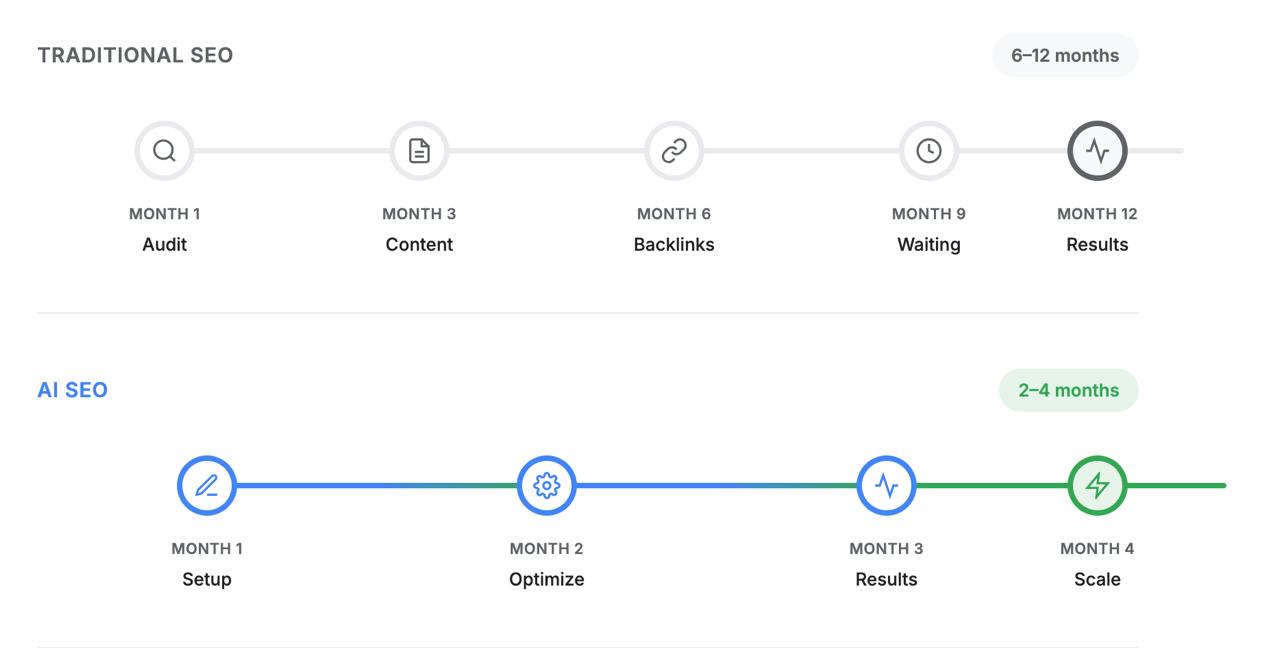
Second, you’re capturing an emerging traffic channel. Industry data suggests that AI-assisted search is growing at 30–40% annually, with platforms like Perplexity and ChatGPT becoming primary research tools for millions of users. Early movers in AI SEO are establishing authority that will compound over time.
Third, the metrics are becoming clearer. Businesses investing in AI SEO report increased brand mentions in AI responses, higher click-through rates on AI-cited links, and improved authority signals that benefit their overall search presence. While attribution remains complex, the directional impact is consistently positive for brands that invest strategically.
How to Find an Affordable AI SEO Agency
Choosing the right partner for your AI SEO agency relationship requires careful vetting. Here’s what to look for — and what to avoid:
What to Look For
- Specific AI SEO expertise: Ask potential agencies what percentage of their work is specifically AI SEO versus traditional SEO. You want a provider who genuinely specializes in this space, not one adding “AI” to their marketing.
- Measurable case studies: Request examples of AI visibility improvements they’ve achieved for clients. Look for specific metrics: increases in AI mentions, documented citations in AI responses, or traffic attributed to AI search referrals.
- Transparent pricing: Quality agencies explain exactly what’s included in their pricing tiers. Be wary of vague deliverables or pricing that seems impossibly low for the scope described.
- Platform-specific knowledge: Different AI systems have different optimization requirements. A knowledgeable agency should articulate how their approach differs for ChatGPT, Perplexity, and Gemini optimization.
Red Flags to Avoid
- Prices that seem too good to be true: An agency offering comprehensive AI SEO for $200/month is cutting corners somewhere — likely delivering templated work with no real strategic value.
- Guaranteed instant results: AI SEO takes time. Anyone promising first-page AI visibility in two weeks either doesn’t understand the space or is being deliberately misleading.
- Lack of transparency about methodology: If an agency can’t explain what they’ll actually do to improve your AI visibility, walk away. “Proprietary methods” without any detail is a red flag.
Conclusion
Affordable AI SEO isn’t about cutting corners — it’s about making strategic investments in an emerging channel that can deliver outsized returns. As AI-powered search continues to grow, businesses that establish visibility now will compound that advantage over competitors who wait.
The key takeaways are clear: understand the difference between cheap and affordable, budget strategically across services that matter most for your goals, use tools that provide genuine value, and choose partners who specialize in AI SEO specifically. With mid-tier investment and smart execution, businesses of any size can compete effectively in the AI search landscape.
The question isn’t whether AI SEO is worth investing in — it’s whether you can afford to wait while competitors capture this new territory. Start with what you can invest strategically, measure results, and scale based on what works. That’s affordable AI SEO done right.
Share with


Rate the article