Plasma raised $1B in pre-deposits in 30 minutes, then lost about 92% of its peak TVL. Morpho grew through partner distribution to a record $11.4B. We traced four DeFi launches on DefiLlama data to separate marketing that rents TVL from marketing that keeps it.
Most DeFi marketing is judged on one number: peak TVL in launch week. That number tells you how much capital a campaign attracted, not how much of it the protocol kept. Across the four launches below, capital arrived wherever the team had prepared a route for it. It stayed only where the product gave depositors a reason to stay after the rewards ran out.
This guide breaks down what Plasma, Blast, Hyperliquid and Morpho actually did, what their TVL curves did next, and how to plan a launch around retained TVL instead of a launch-week screenshot.
Key Numbers at a Glance
| Number | What it shows |
|---|---|
| ~−92% | Plasma DeFi TVL, October 2025 peak (~$6.4B) to November 2026 (~$0.5B) |
| ~−99.8% | Blast Bridge TVL, June 2024 peak (~$2.9B) to November 2026 (~$6M); the network announced its shutdown in October 2026 |
| $11.4B | Morpho TVL record in 2026, with a deepest drawdown of about −35% along the way |
| 319 wallets → 92% | Share of Hyperliquid trading volume coming from a few hundred airdrop recipients |
All TVL figures are read from DefiLlama charts on November 2, 2026, with default settings, and rounded.
Rented vs. Retained DeFi TVL: What the Charts Show
Total value locked (TVL) is the dollar value of assets deposited in a protocol’s smart contracts, and in decentralized finance it is the most quoted growth metric because it is public and updates in real time. The problem is that TVL counts every dollar the same way, whether it came for a 50% launch APR or for a product someone uses every week.
Put the four launches side by side and the split is obvious. Incentive-led launches peaked fast and gave most of it back. Distribution-led growth was slower and kept compounding.
| Protocol | Main growth lever | Peak TVL (DefiLlama) | Latest TVL (Nov 2026) | Change from peak |
|---|---|---|---|---|
| Plasma | Pre-deposits, token sale access, launch incentives | ~$6.4B (Oct 2025) | ~$0.5B | ~−92% |
| Blast (bridge) | Points, multi-level referrals, airdrop | ~$2.9B (Jun 2024) | ~$6M | ~−99.8%, network shut down |
| Morpho | Integrations into Coinbase, Crypto.com and other platforms | ~$11.4B (2026) | ~$11.2B | At record, max drawdown ~−35% |
| Hyperliquid | Seasonal points, 31% airdrop, product quality | Volume-driven, not TVL-driven | n/a | Retention concentrated in ~300 wallets |
One caveat matters when you read this table: different data providers measure TVL differently, so we use one source (DefiLlama, default view) for every row and flag the gaps where other reports disagree.
Four DeFi Launches, Case by Case
1. Plasma: A Perfect Launch Funnel With Weak Retention
Plasma, a stablecoin-focused Layer 1, ran one of the best-prepared capital funnels of the 2025 cycle, where every stage of the launch was also a news event.
| Date | Event | Channel and mechanic | Result |
|---|---|---|---|
| Jun 12, 2025 | Pre-deposit vault | Cap raised $250M → $500M → $1B on Sonar (Echo) | $1B filled in ~30 minutes, 2,900+ wallets, median deposit ~$12K |
| Jul 2025 | XPL public sale | Deposits gave the right to buy XPL at a fixed $500M FDV | $373M in bids for a $50M sale, ~7x oversubscribed |
| Aug 20, 2025 | Binance Earn USDT product | CEX as a distribution channel, depositors shared 1% of XPL supply | $250M filled in under an hour |
| Sep 25, 2025 | Mainnet beta | Simultaneous launch posts from Aave, Ethena, ether.fi and USDT0 | $2.32B TVL on day one, $5.55B by Sep 29 |
What worked in Plasma’s marketing:
- ✔️ The deposit was a ticket, not a farm. Capital was tied to the right to buy XPL at a fixed valuation, a strong motive for as long as the token traded above the sale price.
- ✔️ Every cap raise was a headline. Three cap increases created three news cycles. The team also said publicly that $1B in deposits was not a $1B raise, which kept the story clean.
- ✔️ Partners did the announcing. Four integrations were live at launch. Plasma pre-committed 10M USDT in incentives to Aave through a governance proposal, and ether.fi announced $500M in weETH (staked ETH) before day one.
- ✔️ One click to deposit. A Stargate bridge link sat inside both the Plasma and Aave interfaces on launch day.
What didn’t hold: the capital was mostly there for rewards. Blockworks found that around 65% of Plasma’s stablecoins sat in lending markets such as Aave, supported by roughly $230K in daily rewards, and that withdrawals followed as the XPL price and rewards fell. The pattern repeated at the pool level: the Uniswap v3 deployment on Plasma reached about $60M before the October 10 market crash and settled around $25M once incentives ended in late November.
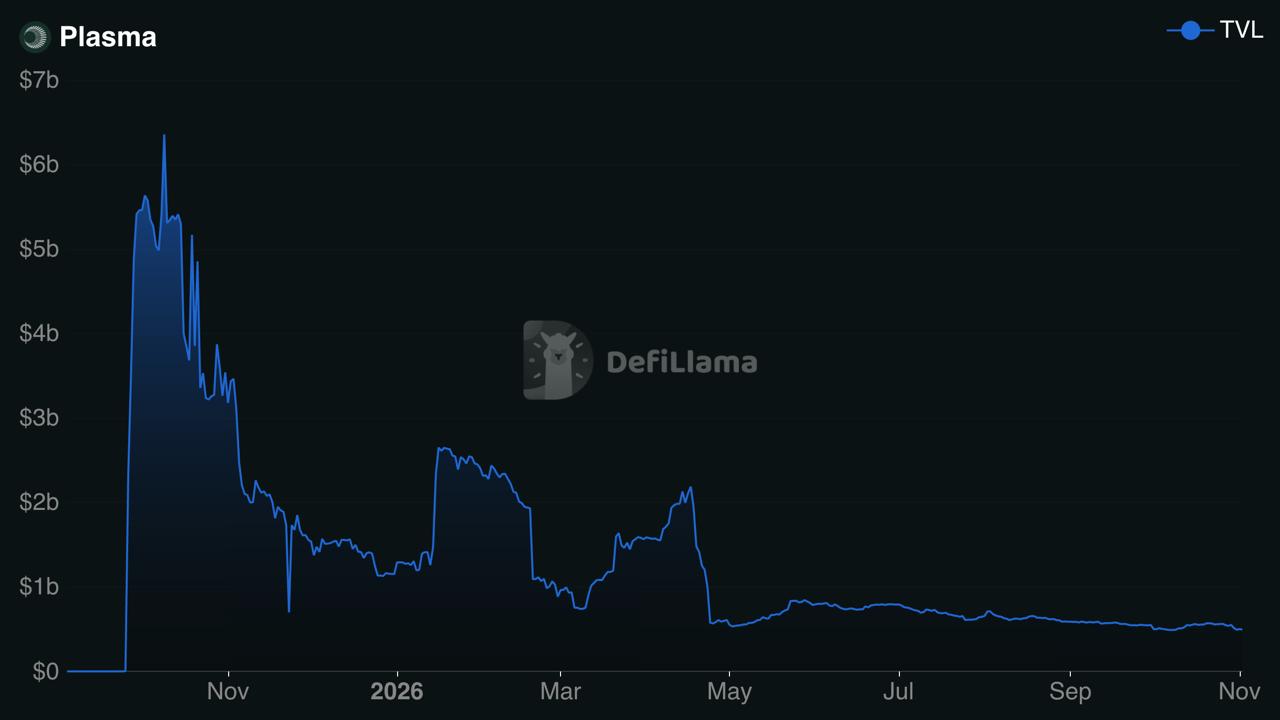
Plasma DeFi TVL, September 2025 to November 2026. Source: DefiLlama.
The chart also shows how short-lived each new push was. In April 2026, TVL climbed back to about $2B, up more than 80% in 30 days after a Tether wallet integration. By May it was back near $0.6B, and it has held between $0.5B and $0.8B since.
A note on numbers: Blockworks reported Plasma as the fourth-largest chain at $8.42B a month after launch, while DefiLlama’s default TVL view peaks near $6.4B. The gap comes from what each source includes. Pick one methodology and stick to it in client reporting.
2. Blast: Liquidity Mining With Nothing to Stay For
Blast bought TVL with points, referrals and airdrop expectations, and when the airdrop arrived, users had no other reason to keep capital on the network.
- Mechanic: points for deposits, 16% of direct referrals’ points and 8% from the second level, plus bonuses for Blur holders. The design invited multi-wallet farming.
- Growth: TVL reached $2.3B by June 5, 2024, before the token existed.
- Airdrop: on June 26, 2024, Blast distributed 17% of BLAST supply.
- After the drop: TVL fell 60% in under two months, and daily active users dropped from 77,000 to 3,500.
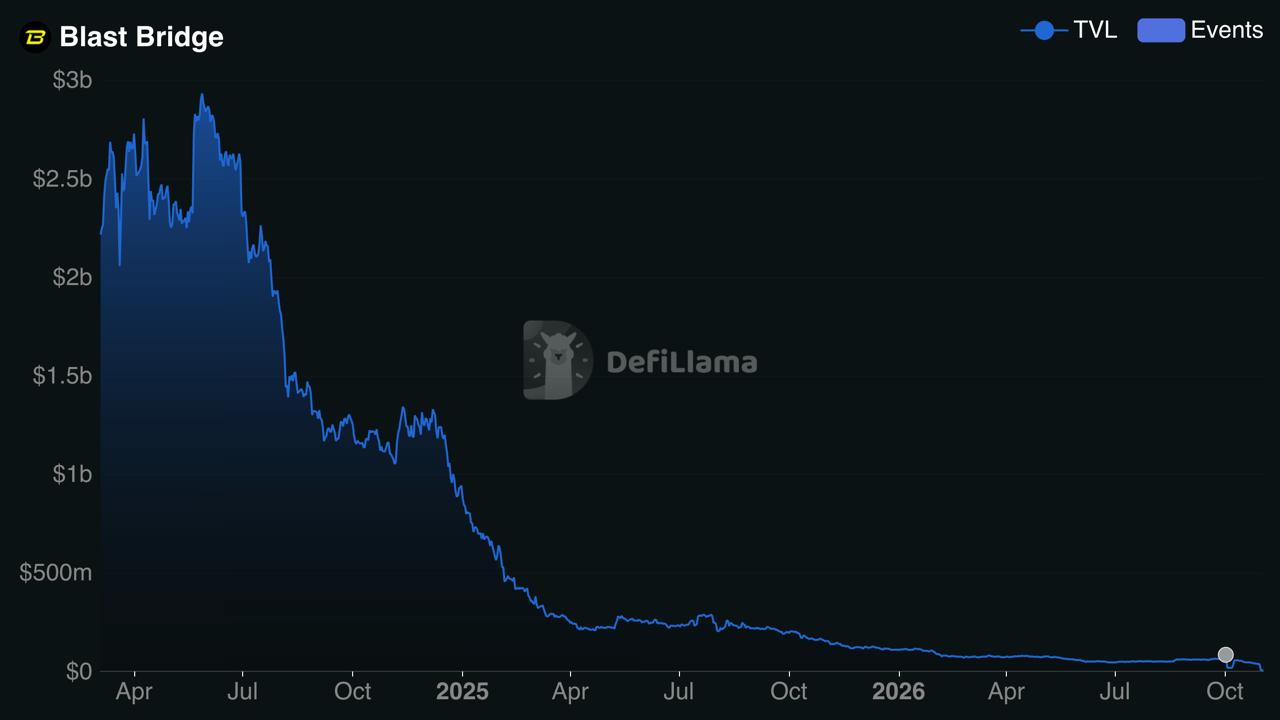
Blast Bridge TVL, March 2024 to November 2026. Source: DefiLlama.
The bridge chart shows the full arc: about $2.9B at the June 2024 peak, roughly −48% by the end of August, and a slow slide to around $6M today. On October 2, 2026, Blast announced it would wind down the L2 because operating costs exceeded revenue. Monthly chain revenue had fallen from about $3.5M in June 2024 to roughly $1,793 in September 2026. Users had until October 26 to withdraw through the interface.
The lesson is blunt. When a deposit earns nothing but points, the token distribution turns every depositor into a seller, and liquidity mining becomes a countdown.
3. Hyperliquid: Retention From Product, Not From Points
Hyperliquid spent almost nothing on loud marketing and relied on seasonal points, a community-first token distribution and a trading product good enough to keep users after the rewards stopped.
- Mechanic: points seasons (closed alpha, Season 1, Season 2) plus interim seasons 1.5 and 2.5, all tied to real trading activity.
- Airdrop: on November 29, 2024, Hyperliquid distributed 310M HYPE, 31% of supply, with no allocation to private investors, exchanges or market makers.
- Effect: daily new users went from fewer than 500 before the drop to about 10,000 two days after, with almost no paid promotion on social media.
- Retention: cohorts that joined after points ended retain at levels comparable to strong mobile apps.
- The catch: an analysis of airdrop recipients found 319 wallets generate 92% of volume. Large traders stayed. Small recipients kept the token but stopped trading.
For a perp DEX, liquidity and execution quality drive retention. The airdrop’s job is to bootstrap the network and give large traders a reason to arrive first. Retail retention on the airdrop alone is not realistic, and active users should be reported separately for whales and retail.
4. Morpho: Distribution Instead of a Campaign
Morpho grew mostly through integrations into products that already had millions of users, which is why its TVL curve looks nothing like the other four.
- Trigger: in January 2025, Coinbase launched BTC-backed loans on Morpho’s infrastructure. USDC and cbBTC now make up 53% of Morpho deposits, and 83% of cbBTC deposits and 59% of USDC deposits come from Coinbase users.
- More partners: after partnerships with Crypto.com and SG-FORGE, Société Générale’s digital asset arm, in September and October 2025, TVL climbed to $8.5B by November. In 2026 the model expanded to Coinbase USDC loans in the UK.
- Recurring channel: the Robinhood integration creates ongoing inflow rather than a one-off spike.
- Scaling to new chains: in its Unichain application, Morpho proposed integration grants and milestone-based bonuses as a way to attract sticky liquidity, not blanket farming rewards.
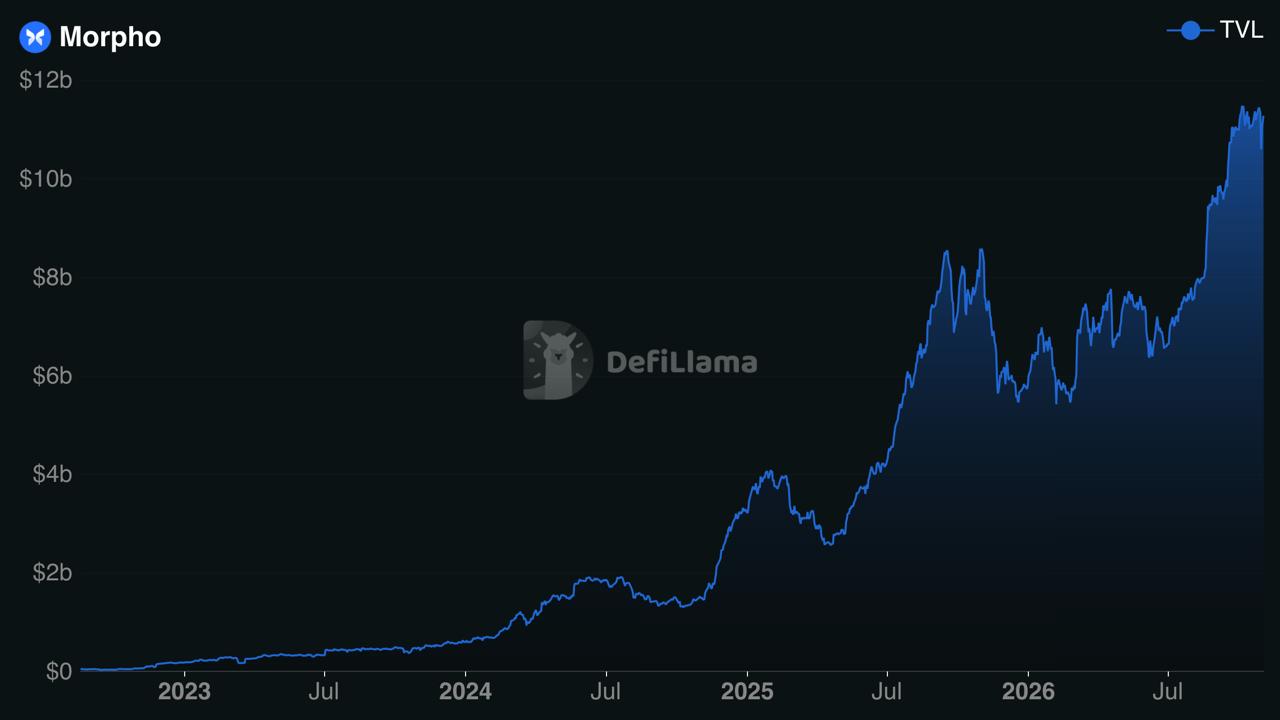
Morpho TVL, 2023 to November 2026. Source: DefiLlama.
On DefiLlama, Morpho went from under $2B in 2024 to about $4B in early 2025, $8.5B in late 2025 and a record of roughly $11.4B in 2026. Its deepest drawdown, about −35% in late 2025, recovered within months. Morpho itself reports higher deposit numbers (for example, $13B by the end of Q3 2025), because DefiLlama’s default TVL excludes borrowed funds.
For lending protocols, the main “marketing” is business development. Vault curators and risk curators act as capital allocators that route onchain capital into the protocol, while PR and social posts amplify joint announcements instead of creating the flow. The risk is concentration: a large share of deposits depends on one partner.
Seven Patterns Behind DeFi TVL Growth
Successful launches route capital in advance and give it a reason to stay; failed launches pay for entry and offer nothing after it.
- Capped pre-deposits create their own content. Plasma raised its cap twice and filled $1B in 30 minutes; each raise and each fill was a ready-made headline produced by the mechanic itself.
- Capital tied to a future right holds until the event. The right to buy a token at a fixed valuation or a share of supply through Binance Earn: each keeps deposits until it pays out, so the next reason to stay must be ready before then.
- Partners announce better than ads. Binance Earn, Coinbase and Aave governance posts moved more capital than any paid campaign in this sample. Business development and co-marketing come before paid reach.
- The airdrop is an outflow event. Blast lost 60% of TVL and over 95% of daily active users within two months of its drop. Rewards that grow with holding time and bonuses for moving to the next phase soften the exit.
- Capital is concentrated. At Hyperliquid, 319 wallets drive 92% of volume. Whales need BD and direct relationships; retail needs content and community.
- Without a product reason, TVL is rented. Blast offered points, Plasma relied on incentives; Hyperliquid and Morpho run on product and distribution.
- Plan the incentive taper before launch. Arbitrum’s TVL fell 36% in the four months after its token launch, then rose 62% from the low because the network had real demand underneath.
❗ The main idea? Peak TVL measures how much you paid for attention. Retained TVL at day 90 measures what the marketing actually built.
Retention Benchmarks You Can Cite
Only data traceable to DefiLlama or a primary source is reliable enough for client reporting; most “market average” retention figures in blogs come without a methodology.
| Benchmark | Value | Source |
|---|---|---|
| Plasma DeFi TVL from peak | ~−92% in 13 months | DefiLlama |
| Blast Bridge TVL from peak | ~−99.8% in ~29 months | DefiLlama |
| Blast TVL after airdrop | −60% in under 2 months | The Defiant |
| Blast daily active users after airdrop | 77,000 → 3,500 | The Defiant / Token Terminal |
| Arbitrum TVL after token launch | −36% in 4 months, then +62% from the low | The Defiant |
| Aave deposits when incentives were cut | about −18% | Turtle |
| Morpho deepest drawdown before new record | ~−35% | DefiLlama |
Use these as reference points, then build your own cohorts in Dune and a DeFi dashboard of your choice. DeFi analytics on your own wallets will always beat a borrowed average.
A DeFi Marketing Playbook for Retained TVL
A retained-TVL launch plan has three phases: build the capital route before the announcement, switch on distribution on launch day, and give depositors a reason to stay afterwards. The recommendations below are drawn from the cases above and follow the approach of our DeFi promotion service.
Choose the Mechanic by Feature Type
The right mix of channels depends on what you are launching. A vault and a perp DEX need different incentives and different KPIs.
| Feature type | Core mechanic | Social and PR | Points and airdrop | KPI |
|---|---|---|---|---|
| New vault or pool | Capped pre-deposit with a multiplier for early depositors | X thread with a live fill counter, KOLs with referral codes, DeFi media coverage when the cap fills | Points for time in position, not for entry | Pre-deposit volume, wallet count, retained TVL at day 30 |
| New chain or L1/L2 | Prepared liquidity, 3-4 integrations live at launch, one-click deposit | Joint partner announcements, governance posts, a CEX earn product | Tokens only with lockup, vesting or a continuation bonus | TVL at day 1/7/30, share of idle liquidity |
| Perp DEX | Points for maker liquidity and real volume | Trader KOLs, public volume dashboards | Airdrop weighted by real activity | Retained volume, whale share, active users after the airdrop |
| Integration with a major distributor | BD and a joint release | Press release and posts from both sides | No airdrop needed | Share of deposits from the partner |
The table is a starting point. Liquid staking products, stablecoin platforms and APR-driven vaults all need adjustments, but the logic stays the same: pay for time, not for entry.
Run the Launch on a T-30 to T+90 Timeline
- T-30 to T-14. Build the capital route: 2-4 partners with committed deposits, defined caps, and a cohort dashboard in Dune.
- T-14. Open a waitlist or pre-deposit with a public fill counter.
- T-0. Partner announcements go live together, with DeFi media coverage, an X thread with numbers, and a single deposit path with no extra steps.
- T+1 to T+30. Post daily numbers, run KOLs with trackable referral links, staff Discord and Telegram support.
- T+30. Launch the next points phase for holding time while the main reward is still unpaid.
- T+30/60/90. Report cohorts separately for whales and retail.
Measure Cost per Retained $1
The metric that separates a good campaign from an expensive one is the cost of each dollar still deposited 90 days later. Incentive tokens should be counted at market value at the time of the campaign; otherwise acquisition cost looks lower than it is.
Cost per retained $1 = (ad spend + incentives at market value) / TVL at T+90A campaign that delivers $500M at peak and $40M at day 90 is a $40M result. Reporting it any other way sets up the next budget conversation to fail.
Risks to Plan For
Every growth lever in this guide carries a specific risk that should be in the plan from day one.
- Sybil farming. Points campaigns need wallet filtering, or every metric is inflated.
- Partner dependence. If most deposits come through one distributor, TVL follows that partner’s terms.
- Reputation and regulation. Aggressive airdrop marketing and yield promises drew public criticism of Blast from its own backer Paradigm, and CEX earn products depend on jurisdiction.
- Token pressure. When the reward token inflates, rewards in dollar terms shrink and incentive-driven deposits leave with them, as Plasma showed.
Conclusion: DeFi Marketing That Keeps Capital
DeFi marketing works when it is built around what happens after launch week, not around the peak.
❌ What rented TVL looks like
- Deposits that exist to earn points or an airdrop allocation
- Peak TVL in week one, then −60% to −99% once rewards stop
- A token that turns every depositor into a seller
- In the worst case, a network that can no longer cover its own costs, as Blast did in October 2026
✅ What retained TVL looks like
- Capital routed through partners and products with their own users
- Drawdowns that recover, like Morpho’s −35% dip before a new $11.4B record
- Rewards that grow with holding time and a next phase ready before the first one pays out
- Reporting on day-90 cohorts and cost per retained $1, not on launch-week screenshots
Paid incentives stop the moment the budget does. Distribution deals and product reasons to stay keep working long after the campaign ends, and most protocols still plan launches the other way around.
A launch-week peak is easy to buy. Retained TVL is what investors, partners and your treasury actually care about. ICODA plans DeFi marketing around day-90 cohorts: capital routes, partner co-marketing, KOL campaigns and community programs measured by cost per retained $1. Talk to our DeFi marketing team.
In short: Analysis of four DeFi launches on DefiLlama data shows that incentive-led campaigns lost most of their capital after rewards ended: Plasma’s TVL fell about 92% from its $6.4B peak and Blast’s bridge TVL fell 99.8% before the network shut down in October 2026. Morpho, which grew through integrations with Coinbase and Crypto.com, reached a record of about $11.4B, which makes distribution and retention mechanics more effective DeFi marketing levers than points or airdrops alone.
Sources
- Plasma: LayerZero, The Block, Carey Olsen, The Defiant, Blockworks, Blockworks Research, Uniswap governance, FinanceFeeds
- Blast: The Defiant, Nansen, Decrypt, The Block
- Hyperliquid: Myshterious, Otomato, Eco, MEXC News
- Morpho: Blockworks Research, Cointelegraph, Morpho, Uniswap governance
- Methodology: Formo, Turtle, DefiLlama (charts read November 2, 2026)
Frequently Asked Questions (FAQ)
TVL (total value locked) is the total dollar value of assets deposited in a DeFi protocol’s smart contracts. Data platforms such as DefiLlama track it in real time. It measures how much capital a protocol holds, but not whether that capital will stay once incentives end.
The fastest methods are capped pre-deposits, points programs, airdrops and partner integrations. The four cases in this guide show that partner distribution and product utility produce TVL that lasts, while points and airdrops produce spikes that usually reverse within months.
Usually not on their own. Blast lost 60% of its TVL within two months of its airdrop, and its network shut down two years later. Airdrops retain better when rewards grow with holding time or when a bonus requires moving into the next phase.
Liquidity mining rewards users with tokens for depositing assets into a protocol. It bootstraps TVL quickly but attracts capital that moves to the next higher APR. Taper plans, holding-time rewards and a real product reason to stay determine how much of that liquidity remains.
Share with


Rate the article