




Parimatch operates across thousands of domains. Stake swaps its primary domain the way a startup pivots — regulators block one, a new domain fires up within days with the full link equity already transferred. 1xBet, Betway, every major operator at scale: same playbook.
While most iGaming marketing teams debate blog calendars and guest posts, top operators run distributed domain infrastructure where individual websites are disposable nodes in a permanent network. Casino SEO at this scale isn’t a content strategy — it’s an infrastructure play. This article covers what that infrastructure looks like, what it costs, and how the restricted-market version works.
Why Conventional SEO Fails in iGaming — and What Replaces It
SEO for iGaming sites breaks down for two reasons that most gambling SEO guides don’t address: the regulatory environment and the technical baseline of most casino platforms. (New to the space? Our iGaming SEO guide covers the foundations — this article picks up where it ends.)
Google bans gambling ads in most markets. That makes organic search the only scalable non-paid acquisition channel, which is why affiliates have colonized iGaming SERPs so aggressively. The operators who built real SEO infrastructure years ago now dominate, but exploitable gaps still exist, particularly in emerging geos where keyword difficulty (KD) sits in single digits.
The technical problem is more immediate. Most casino platforms (the white-label and SaaS stacks that new operators buy) are Single Page Applications (SPAs). Google cannot meaningfully crawl an SPA. The crawler encounters a JavaScript stub, not rendered game pages, reviews, or geo landing pages. The fix is Server-Side Rendering (SSR): the server delivers fully rendered HTML to Google’s crawler directly, bypassing the JavaScript execution step.
Before spending anything on links, content, or networks, every iGaming operator needs to answer three questions:
- Does your platform support SSR? If the answer is uncertain, have your dev team confirm that Google’s crawler receives rendered HTML — not empty
<div>containers. - Are your key pages indexed? Pull Google Search Console. Missing game pages and landing pages are a direct signal of SSR failure.
- Do you have the technical team to fix SSR if it’s broken? One well-documented crypto casino spent a full year failing to implement SSR. The project closed. This outcome is not rare.
No SEO strategy — not PBNs, not content, not backlinks — works on a site Google can’t index. Fix SSR first.
The Three-Layer iGaming SEO Stack
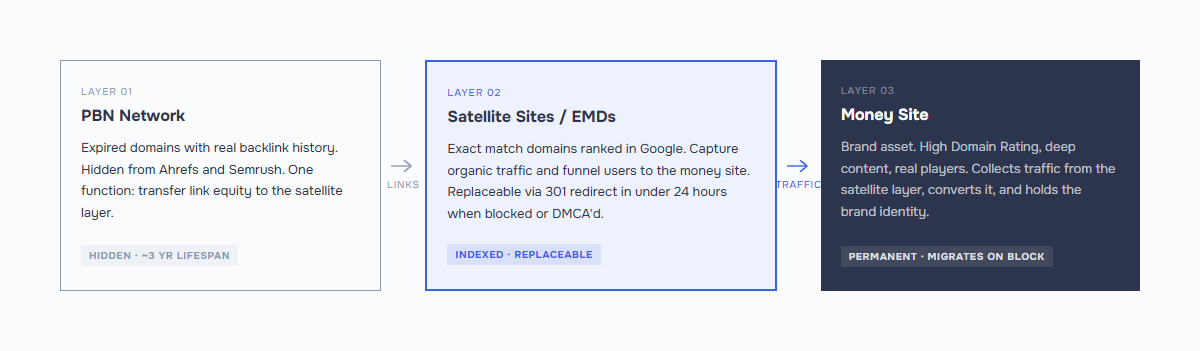
Every operator that ranks consistently in competitive iGaming SERPs runs the same structural model. It has three layers, each with a distinct function.
Layer 1 — PBN Network
A Private Blog Network (PBN) is a collection of websites built on expired domains that had real history, real backlinks, and real traffic before being abandoned. A PBN site has one job: transfer link equity to the satellite layer. PBN links are invisible to third-party tools — they don’t surface in Ahrefs or Semrush, so competitors can’t map your network. Properly managed, they live an average of three years.
Layer 2 — Satellite Sites
Satellites are the traffic machines. Built on Exact Match Domains (EMDs) or brand-variation domains, they rank in search results and funnel users to the money site. They’re designed to be replaceable: when a competitor files a DMCA claim or a regulator blocks a domain, a 301 redirect moves all traffic and link equity to a fresh satellite in under 24 hours. The PBN network re-points its links to the new domain. The event is a temporary disruption, not a loss.
Layer 3 — Money Site
The brand. High Domain Rating (DR), deep content, real users, payment infrastructure. The money site collects traffic from across the satellite network, converts it, and holds the brand identity. When its domain gets blocked in a jurisdiction, it migrates, taking the full link equity with it via redirects.
Each layer is independently replaceable. Satellites get replaced. PBNs accumulate. The money site moves. No single failure can collapse the whole structure.
Building a Casino PBN: Numbers, Costs & Timelines
Link building for iGaming follows different rules than almost any other industry. Guest posts and editorial outreach — the standard casino backlinks strategy recommended in most guides — don’t scale in a niche where the top operators run networks of hundreds or thousands of domains. The dominant approach is PBN-based: building link equity you own rather than earning or renting it.
A quality PBN domain has a specific profile: it was a real website at some point (visible in WebArchive), it has a clean backlink history with genuine referring domains, and it carries measurable Domain Rating. The original niche doesn’t matter: an expired cooking blog can become a casino PBN once rebuilt in the right vertical.
Where to find expired domains: GName auctions, domain drop marketplaces, and specialized drop-hunting services. Identifying a quality expired domain is its own specialty, distinct from SEO work.
Expired domains don’t need to be restored to their original state. Early PBN guides recommended recovering old content via WebArchive and rebuilding what was there — current practice doesn’t. The original niche is irrelevant: a domain that was once a cooking blog, an alarm clock review site, or a travel guide carries its historical backlink profile regardless of what it used to cover. Rebuild it entirely in your target vertical. What Google values is the domain’s history — not its continuity of topic.
One fully built PBN (drop domain, site build, hosting, and initial crowd reinforcement) is a four-figure investment per unit. The variable that matters more than unit cost is volume: below a geo-specific threshold, individual PBNs don’t compound into ranking effects. Above it, they do.
Volume requirements by niche:
- Casino: The threshold is higher than in most niches — operators need substantial coverage per geo before rankings move
- Crypto / SaaS: The bar is lower; a smaller network per project is enough
- Restricted markets: Higher than standard casino, because the network must be built in neutral jurisdictions to remain outside local regulatory reach
Why underinvesting is worse than not starting: A network spread too thin across multiple geos delivers nothing measurable in any of them. You spend real money, see nothing in 3 months, and the engagement ends with everyone frustrated. The economics only work at sufficient scale per geo: one market, properly resourced, produces results. Five markets under-resourced produce none.
PBN infrastructure doesn’t require a live money site before you start building. The link equity you accumulate is portable — redirect it to a new domain if your current one gets blocked, transfer it to a future project, or reassign it as the business evolves. Operators who start building PBN networks before their money site is fully ready have a measurable head start; the authority accumulates while the product is still being prepared. The network belongs to the client, hosted on the client’s infrastructure — it belongs to the client and outlasts any agency relationship.
iGaming link building at this scale is capital-intensive by design. Parimatch and 1xBet aren’t running 50 PBNs. They’re running thousands. Fifty is the point of entry — not the destination.
Your link equity should belong to you.
We build the PBN on your servers. You own every domain from day one.

EMD Satellite Networks: How to Capture Geo Traffic at Scale
An Exact Match Domain (EMD) is a domain where the target keyword is built into the domain name — bestcasinomalta.com for “best casino Malta,” for example. Google continues to award ranking advantages to EMDs for their exact-match queries, and the effect has held for the past several years.
The EMD satellite strategy, step by step:
- Find a low-KD keyword with real volume. Use Ahrefs. Target keywords under KD 10 with 500+ monthly searches and available domain names across multiple extensions. The gap between low competition and real search demand is the entry point.
- Register across every available domain extension relevant to your geos:
.com,.it,.pl,.ai,.es,.fr,.br. If the keyword is available in multiple zones, register all of them simultaneously. - Build each satellite as a proper mini-site — 10–15 pages, localized content in the target language, clean UX. Not a doorway page. A legitimate site that Google crawls and indexes willingly.
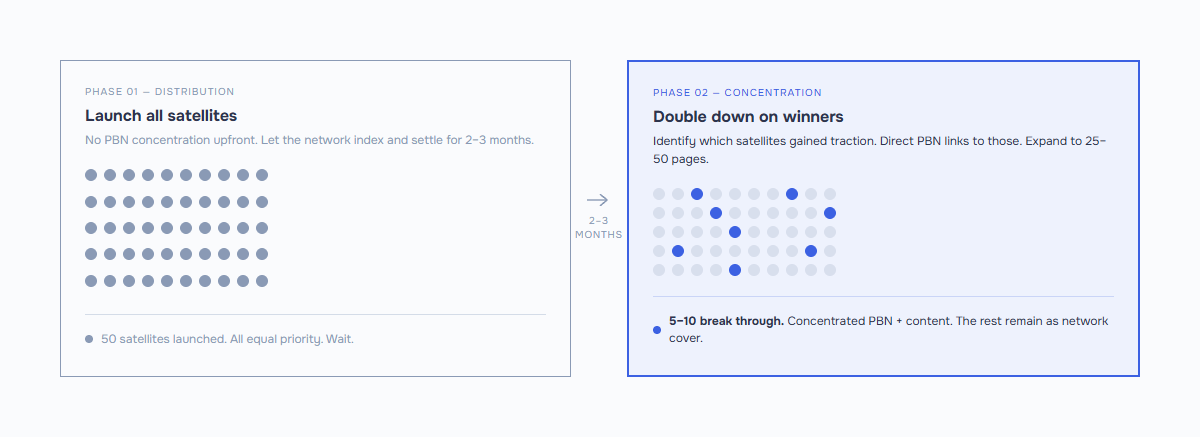
- Run two phases, not one. Launch the full satellite network in parallel without concentrating PBN investment upfront. Let the sites index and settle for 2–3 months: this is the distribution phase. Then identify which satellites have begun gaining traction and enter the concentration phase: direct PBN links specifically to those, and expand their content from the initial 10–15 pages to 25–50 pages covering the topic cluster in depth. Typically, 5–10 out of 50 satellites break through in phase one. Those become prioritized assets. The ones that don’t rank aren’t failures — they’re part of the distribution layer, which makes the network harder to reverse-engineer and attack via DMCA.
Real timeline from a live EMD project (non-casino niche, adult vertical):
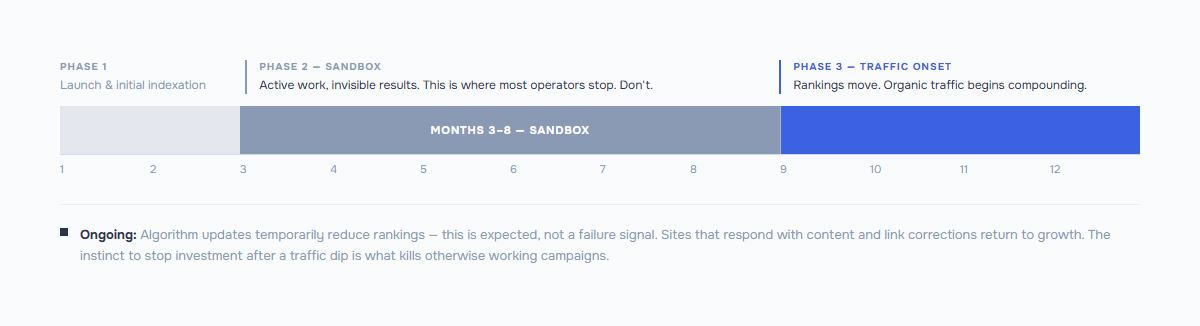
| Phase | Timeframe | What actually happens |
|---|---|---|
| Launch + initial indexation | Months 1–2 | Sites crawled, initial indexing begins |
| Google sandbox period | Months 3–8 | Minimal traffic despite ongoing work |
| Traffic onset | Month 8–12 | Rankings improve, organic traffic begins |
| Post-update adjustment | Ongoing | Algorithm updates temporarily reduce rankings — this is expected, not a failure signal. Sites that respond with content and link corrections return to growth. The instinct to stop investment after a traffic dip is what kills otherwise working campaigns. |
Eight months of apparent inactivity is normal. This is why pre-selling iGaming SEO on 3-month timelines creates client relationships that end badly. The timeline isn’t negotiable. It reflects how Google’s trust signals accumulate.
Brand capture vs. brand protection — same mechanism, different goal:
Register 50–100 domains containing your own brand name across every geo (yourbrand-pl.com, yourbrand-br.com) and funnel traffic to your own money site — that’s brand protection. Register satellite sites targeting a competitor’s brand and redirect traffic to your casino — that’s brand capture. The technical architecture is identical. The business intent differs.
The Restricted Markets Playbook (Turkey, Indonesia, LatAm)
Restricted markets require a different risk posture, not a different technical strategy. The SEO mechanics are identical; the legal and security layer changes everything.
Security comes before SEO. In jurisdictions where operating online gambling is illegal, registrant data on your domains is a legal liability. The operational structure must include:
- Servers in neutral jurisdictions with no data-sharing agreements with the target market
- Domains registered through structures that don’t expose the operator’s personal details in WHOIS lookups
- Distributed domain ownership — no single entity controls the full network, reducing seizure risk
- Payments for domains and hosting flowing through client-controlled structures, not the agency
Turkey — the structural requirements:
- PBN network in
.comor other neutral extensions. Turkish regulators have no jurisdiction over a.comdomain registered through an offshore entity and hosted outside Turkey. The network needs to be large enough to support a meaningful satellite fleet. A minimal build doesn’t work here. - Turkish-language satellite sites targeting relevant keywords in Turkish. Launch at scale: some will be blocked, some will draw DMCA complaints, but a meaningful share will rank and drive traffic.
- Rotation protocol built in from day one: When a satellite is blocked or DMCA’d, redirect to a fresh domain. PBN links re-point within 24–48 hours. Traffic recovers.
LatAm — geo-by-geo economics:
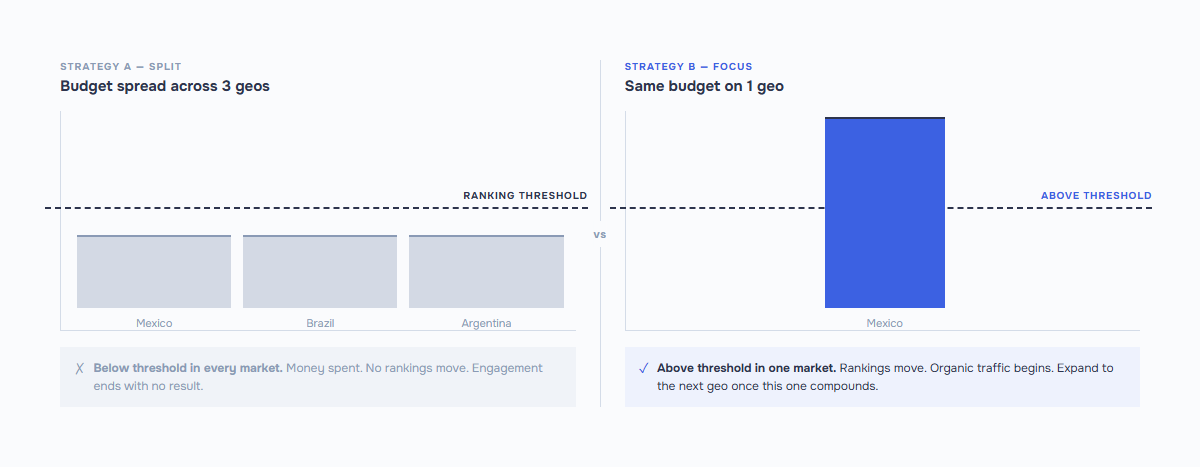
Spreading a limited budget across Mexico, Brazil, and Argentina simultaneously doesn’t work. The math is direct:
| Allocation strategy | PBNs per country | Expected outcome |
|---|---|---|
| 60 PBNs split across 3 countries | 20 per country | Below threshold in every market — no traffic |
| 60 PBNs focused on Mexico only | 60 in Mexico | Approaching threshold — measurable progress |
| 20 PBNs per country, sequential | 20 each, phased | One market at a time reaches threshold |
For multi-country LatAm expansion, budget for markets sequentially: build one geo to threshold, then expand. Splitting resources across three countries simultaneously typically means none of them reaches the point where SEO compounds.
Handling DMCA in gray-market jurisdictions:
A DMCA complaint alleging trademark infringement doesn’t automatically remove a page from Google’s index. Respond formally — address the specific trademark claim, assert your right to the domain, and document any jurisdictional mismatch (a trademark registered in one country doesn’t automatically apply in another). AI tools generate competent, legally structured responses to standard DMCA templates. Sites with established editorial profiles and clean domain histories have sustained thousands of filed complaints without losing rankings. The fear that one DMCA destroys everything isn’t supported by real operational data.
Grey Hat SEO: Where iGaming Actually Operates
The white hat / black hat binary doesn’t describe how iGaming SEO actually works. Most of what major operators do sits in grey hat territory: techniques that influence rankings beyond editorial merit but stop short of cloaking, deception, or pure spam.
The actual spectrum:
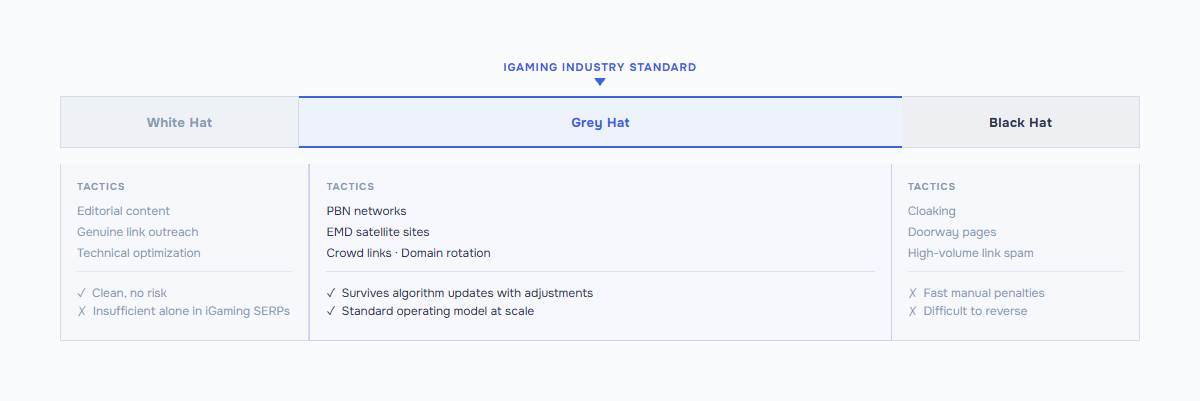
- White hat — editorial content, genuine link outreach, technical excellence. Effective in most industries; insufficient alone in competitive casino SERPs where affiliates and decade-old operators dominate the top positions.
- Grey hat — PBNs, EMD satellites, crowd links. Industry standard for operators above a certain scale.
- Black hat — cloaking, doorway pages built purely for crawlers, high-volume link spam. Fast results, fast manual penalties, not a sustainable operating model.
PBN + EMD + satellite networks are grey hat, not black hat. The distinction matters operationally: grey hat infrastructure survives algorithm updates with adjustments; black hat tactics trigger manual actions that are difficult to reverse.
The AI Overview dimension: The same satellite architecture that drives traditional search rankings is also influencing what AI tools surface. Practitioners tracking AI search behavior report that factual claims published consistently across multiple sites with credible link profiles show up in AI-generated answers — without those claims being independently verified. This is an emerging dynamic, not a stable tactic — but operators building satellite networks now are already positioned to benefit from it as AI-assisted search continues to grow. The verification infrastructure that would close this gap doesn’t yet exist at scale.
The Content Factory: Building the Base Layer
A content factory is not optional in 2026: it’s baseline infrastructure for any operator competing in iGaming SEO. Major operators publish hundreds of new pages monthly across their satellite and money-site networks. Without the same output pace, the gap in topical coverage compounds and becomes difficult to close.
What the content machine needs to produce:
The page types that drive organic traffic in iGaming each require their own production logic:
- Per-game pages — individual landing pages for every slot, table game, and live dealer title in the casino’s catalog. These pages are high-volume and relatively templated, but they must be SSR-rendered to be indexed. Many casino platforms don’t render game pages server-side by default, which means the entire catalog is invisible to Google. Without SSR on game pages, a content factory produces nothing useful.
- Geo-specific landing pages — localized pages for each target market, written in the local language, referencing local payment methods, local regulations, and local player behavior. A Spanish-language page that reads like a translation rather than native copy won’t rank competitively against locally-created content.
- Bonus and promotion pages — high-intent pages that capture players actively comparing offers. These have short shelf lives and need a production process that can update them faster than competitors.
- How-to and guide content — lower-competition informational pages that build topical authority and capture players earlier in the funnel.
The production pipeline:
- AI draft generation — produce first drafts for all target page types at scale. AI handles volume and structural consistency; it cannot handle local nuance, market-specific claims, or the kind of detail that signals genuine expertise to Google’s quality raters.
- Keyword clustering and internal linking — group pages by topic cluster before publishing. Build the internal link architecture programmatically, so every new page enters a structure that distributes authority across the site rather than creating isolated content islands.
- Native copywriter review — for every language in your geo mix, a human native speaker substantively rewrites AI drafts. This is not proofreading. A copywriter who understands the Brazilian casino market rewrites the Brazilian pages to reflect how Brazilian players actually talk about bonuses, payment methods, and game types. The difference is visible in Google’s quality signals and to users who decide whether to stay on the page.
- SSR and indexation verification — every published page confirmed indexed in Search Console before being counted as live. Pages that don’t index are wasted production capacity.
Minimum team composition:
- Native copywriters for each primary language (EN, ES, IT, FR, PT, TR, AR as relevant to your geo targets) — the absolute minimum is enough coverage that every market has a human reviewer, not just AI output
- Technical team maintaining SSR across platform updates — casino platforms frequently break SSR during feature releases
- Content manager running clustering, internal-link architecture, and production scheduling
The AI window: AI-generated content is viable for the first 3–6 months of a project, while the site is establishing initial authority and the PBN network is building link equity. After that, Google’s quality signals — particularly for YMYL (Your Money or Your Life) content, which includes financial and gambling content — shift toward material that demonstrates genuine expertise and local knowledge. The AI-to-human pipeline buys time and velocity; it doesn’t replace the human layer permanently.
Competitors running this pipeline publish hundreds of pages a month across dozens of domains. Without a content factory, you cannot keep pace with the content surface area they’re building — and in a niche where topical authority and page count directly correlate with ranking breadth, that gap compounds every month it’s left open.
What Does iGaming SEO Actually Cost?
The right question isn’t “what does it cost per month” — it’s “what does it cost to reach the threshold where the investment starts working.” Think in tiers rather than line items.
There’s a level of investment where nothing moves: the PBN and satellite count falls short of what the casino niche requires and the money disappears without a result. There’s a level where a single geo starts working: enough PBNs, enough satellites, enough content to cross the threshold where the network begins compounding. And there’s a level where you’re genuinely competitive: multiple geos, rotation infrastructure in place, a content machine running across languages. The gap between the first and second tier isn’t incremental: below threshold, the network produces nothing; at threshold, results compound.
The exact numbers depend on the geo, the competitive density of the target keywords, and whether technical infrastructure (SSR, indexation) already exists or needs to be built from scratch. A proper budget conversation starts with a geo audit — not a price list. See what’s included in our casino SEO services →
What the investment returns: a link asset owned by the operator — not rented from an affiliate network, not dependent on ad spend continuing. The PBN network redirects to new projects, new domains, or new geos as the business evolves. It appreciates as it ages. It’s capital expenditure, not operating cost.
Operators who budget SEO as a marketing line item — monthly spend with a quarterly ROI expectation — almost always stop before infrastructure produces results. Operators who treat it as infrastructure, the way they treat payment processing or platform licensing, build something that works long after the initial build phase ends.
The Window Is Open — But It’s Closing
Three years ago, keyword difficulty on top iGaming terms sat at 0–5 in most geos. Those same keywords now score 40–60 KD, with Wikipedia, YouTube, and established media occupying the top positions. The operators who built PBN infrastructure in 2022 and 2023 now hold positions that are expensive to displace.
The next three years will be harder. More operators are investing in the same infrastructure, which pushes KD up and raises the content volume threshold for everyone. Low-KD emerging geos still exist — but fewer of them every quarter, as the EMD and satellite playbook spreads.
Operators who build 50–100 PBNs in their target geos now, launch satellite networks before competitors saturate the space, and fix SSR issues that are currently blocking their indexation — those operators will hold defensible organic positions in 2028.
Operators who wait will be buying affiliate traffic at increasingly unfavorable rates.
Frequently Asked Questions
iGaming SEO is the practice of optimizing online gambling and casino websites to rank in search engines and acquire organic traffic. It combines technical optimization (SSR, site architecture, crawlability), link building (PBNs, editorial backlinks), content production (game pages, geo landing pages, reviews), and satellite network management specific to the gambling industry.
Expect 8–12 months before organic traffic is measurable. The first 6–8 months are infrastructure: PBN construction, satellite indexation, content production, and the Google sandbox period for new domains. Traffic growth follows, assuming the technical foundation — SSR and indexation — is solid from the start.
A Private Blog Network (PBN) is a set of websites built on expired domains that carry established backlink histories. PBNs transfer link equity to satellite sites or money sites without appearing in public link-analysis tools. In casino SEO, they provide the link authority that satellite sites need to rank for competitive geo-specific keywords.
The honest answer: enough to cross the threshold in your target geo. Below that threshold, the investment doesn’t produce measurable results: the PBN and satellite count simply falls short of what the casino niche requires. Above it, results compound over time. The exact number depends on the geo, the competitive density, and whether technical infrastructure already exists. A proper budget conversation starts with a geo audit, not a price list.
Yes. The strategy differs from unrestricted markets primarily in the security architecture: PBNs are built on neutral-jurisdiction domains, satellite domains are registered without personally identifiable operator information, and the rotation protocol is built in from launch. Turkey, Indonesia, and LatAm markets are all actively served with this approach.
No — and this is one of the most persistent misconceptions in iGaming SEO. A DMCA complaint alleging trademark infringement and a full deindexation are two separate events with different mechanisms. Sites with established domain histories and formal responses on file have sustained hundreds of complaints without losing ranking positions or redirect equity. The claim that “a deindexed page resets all authority through a 301” circulates confidently in iGaming SEO conversations, but live campaign data doesn’t support it. If a domain is removed from the index following a DMCA action, a properly set up 301 to a fresh domain can still transfer authority. The infrastructure doesn’t reset to zero.
The minimum is whatever it takes to build a functioning unit in one geo: enough PBNs to cross the threshold, enough satellites to capture traffic, enough content to support both. Below that level, the network simply doesn’t produce ranking effects, and the spend is wasted regardless of how it’s managed. The right starting point is a geo-specific audit that maps competitive density to infrastructure requirements.
ICODA’s iGaming SEO services cover PBN network construction, satellite site architecture, technical SEO, and content factory setup for online casinos and crypto gambling platforms across restricted and unrestricted markets. Contact the team to discuss a build plan for your specific geo and budget.
Share with


Rate the article