




In the last two years, Telegram has become ground zero for some of the largest and most damaging cryptocurrency scams in the world. From Ponzi schemes and phishing bots to professional impersonators and organized fraud rings, the platform’s popularity in the crypto world has also made it fertile ground for scammers. With over 800 million users globally and a reputation for privacy and decentralization, Telegram offers an ideal environment for fraudsters to operate under the radar, and often without consequences.
Want Crypto Project Review?
Share your project link to get featured in a high-traffic listing.

The Rise of Telegram-Fueled Crypto Fraud
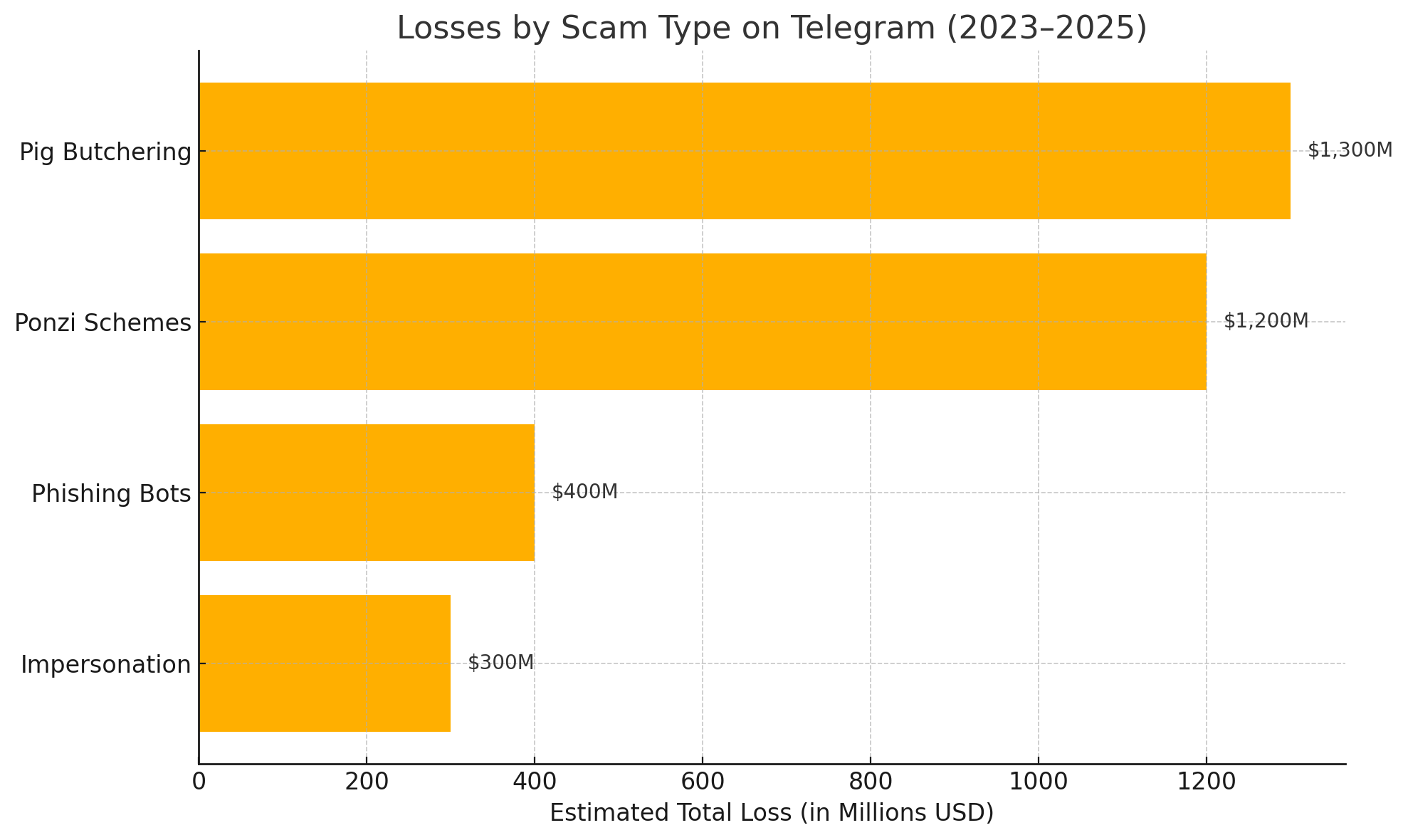
Crypto scams on Telegram have escalated into a global crisis. According to Chainalysis, total cryptocurrency fraud losses reached an estimated $17 billion in 2025, up from $12 billion in 2024, with the average scam payment rising 253% year-over-year to $2,764. In its 2025 annual report published on April 7, 2026, the FBI’s Internet Crime Complaint Center recorded $11.366 billion in crypto-related fraud losses in the United States alone, a 22% jump from the prior year and an all-time record. Crypto investment scams alone drove $7.228 billion of that total. Telegram-specific fraud jumped 43% year-over-year, and Telegram-based crypto malware attacks surged 2,000% between November 2024 and January 2025, according to blockchain security firm Scam Sniffer. A significant share of these losses trace back to schemes that originated, or were coordinated entirely, inside Telegram groups, channels, and bots.
The Biggest Telegram Crypto Scams (2023–2026)
| Scam Type | How It Works | Avg. Loss | Red Flag |
|---|---|---|---|
| Pig Butchering | Long-term grooming → fake investment platform | $62K avg. (FBI 2025); cases up to $1M+ | New “friend” pushes crypto investing |
| Ponzi / Rug Pull | Token rewards until sudden exit | $120M (VidiLook case) | Guaranteed returns, staking rewards |
| Exchange Impersonation | Fake Binance/support DMs | Varies | Urgent message about account security |
| Phishing Bots | Fake wallet verifier bots | Wallet drain | Bot asks for seed phrase or wallet connect |
| Invite Bombing | Mass-add to fake investor groups | Variable | Added to group you never joined |
| AI-Powered Scams | Deepfake video calls, voice cloning, AI romance bots | $3.2M avg. per operation (Chainalysis) | Urgent request via Telegram call or voice message |
| TON / Mini-App Fraud | Fake tap-to-earn games drain wallet via smart contract | Wallet drain | Mini-app asks to connect TON wallet |
| Pump-and-Dump | Coordinated token buys inflate price, insiders dump | Variable; $800K/month documented (Solidus Labs) | Group sends timed “buy signal” for obscure token |
1. Pig Butchering Investment Scams
Pig butchering scams on Telegram, known in Chinese as Shā Zhū Pán (杀猪盘), are a form of long-term investment fraud where scammers build fake romantic or friendly relationships before steering victims toward a fraudulent crypto trading platform. When the victim tries to withdraw, funds are frozen behind escalating fees, then the platform, the person, and the money all disappear. According to the FBI’s 2025 IC3 Report, crypto investment scams, primarily pig butchering, cost Americans $7.228 billion in 2025, a 25% increase from 2024. Of the 181,565 crypto fraud complaints filed that year, 18,589 victims each lost more than $100,000, with an average crypto fraud loss of $62,604. Many of the people running these Telegram crypto scams are themselves trafficking victims, forced to operate from compounds in Southeast Asia under threat of violence. In January 2026, Cambodian authorities arrested key figures behind networks linked to pig butchering operations and released thousands of workers from compounds across the country, according to the UN Human Rights Office.
How to identify a pig butchering scam on Telegram:
- Withdrawal attempts blocked by demands for fees or “verification deposits”
- Unsolicited contact from a stranger who quickly becomes emotionally invested
- Pressure to move the conversation to Telegram from another platform
- Refusal to video call
- Repeated, casual mentions of a specific crypto trading platform
2. VidiLook Ponzi Scheme
Touted as a revolutionary platform where users could earn tokens for watching ads, VidiLook attracted thousands through flashy Telegram campaigns. Promises of staking rewards and high returns pulled in global investors — until the project suddenly rug-pulled in 2023. Over $120 million in crypto vanished overnight. Telegram groups used to coordinate the scheme were either abandoned or deleted by the scammers.
3. Chia Tai Tianqing Impersonation Scam
This scam hijacked the name of a reputable pharmaceutical company to appear legitimate. Promoted heavily on Telegram, it promised outsized returns on crypto investments. Like VidiLook, it ran a Ponzi model before disappearing with investor funds. The scheme ranked among the top crypto scams of the year.
4. Operation Firestorm: Binance Impersonators
In 2025, Australian authorities exposed a sophisticated ring that spoofed Binance support messages via SMS and followed up with fake Telegram accounts. Victims, believing their accounts were compromised, were instructed to transfer funds to a “safe” wallet—actually controlled by the fraudsters. Over 130 victims were identified. Telegram enabled direct, anonymous contact between scammers and victims.
5. Phishing Bots and Fake Safeguard Channels
In late 2024, Telegram saw a 2,000% surge in phishing bots posing as wallet verifiers or customer support. These bots mimicked services like Phantom Wallet and tricked users into revealing seed phrases or signing malicious transactions. Telegram’s automation features and lack of app-store-style vetting made these scams especially effective.
6. AI Crypto Scams: Deepfakes, Voice Cloning, and Romance Bots
AI crypto scams on Telegram are fraud schemes that use artificial intelligence — including deepfake video, voice cloning, and automated romance bots — to impersonate trusted people and manipulate victims into sending cryptocurrency. AI has removed the human bandwidth constraint from Telegram crypto fraud: a single operator can now run hundreds of simultaneous conversations, generate a real-time deepfake video of any crypto project founder on a Telegram call, or clone a trusted person’s voice from as little as three seconds of audio. According to Chainalysis’s 2026 Crypto Crime Report, AI-powered scams generate 4.5× more revenue than non-AI equivalents — averaging $3.2 million per operation — with 60% of deposits into scam wallets now flowing to AI-assisted operations. AI-enabled fraud surged 1,210% in 2025, and the FBI’s 2025 IC3 Report dedicated a section to AI-facilitated crime for the first time, logging 22,364 AI-related complaints with losses approaching $893 million.
How to protect yourself from AI scams on Telegram:
- A convincing voice or face is not proof of identity, always verify through a second channel
- Establish a code word with contacts to verify urgent financial requests through a separate channel
- Never act on financial instructions received via a Telegram call alone
7. TON and Blockchain Telegram Mini Apps Scams
TON blockchain scams on Telegram are crypto fraud schemes that exploit the native integration between the TON network and the Telegram Mini Apps (TMA) — targeting users through fake mini-apps, phishing bots, and fraudulent token giveaways that drain wallets via malicious smart contracts. As TON’s total value locked (TVL) exploded 4,500% in 2024, crypto scams on Telegram followed the money directly into the ecosystem. Cybersecurity firm SlowMist warned of a phishing surge in mid-2024 correlating directly with TON’s TVL growth.
Fake Telegram mini-apps. Fraudulent clones of popular tap-to-earn games like Notcoin and Hamster Kombat prompted users to connect their TON wallets. Malicious smart contracts then drained funds automatically and irreversibly in seconds.
Telegram phishing bots. Fake “TON Giveaway” and “Wallet Support” bots flood crypto Telegram groups. Connecting a wallet to claim “free tokens” triggers contracts routing funds to scammer addresses. Kaspersky documented one such Toncoin referral scheme operating since November 2023 across multiple countries.
Fake Fragment clones. In 2025, fake versions of Fragment — the official TON marketplace for Telegram usernames — tricked users into sending TON for bids that went nowhere.
How to avoid TON scams on Telegram:
- Only connect your TON wallet through verified official channels — never via links shared in group chats
- Any “giveaway” requiring wallet connection is a scam by default
- Verify TON platforms through the official TON website, not Telegram search
8. Pump-and-Dump Manipulations
Crypto pump-and-dump scams on Telegram are coordinated fraud schemes in which large groups synchronise token purchases to artificially inflate prices, then sell simultaneously — leaving ordinary members with worthless holdings. Telegram has industrialised this form of crypto fraud: groups with 250,000+ members use bots and AI-generated hype content to drive coordinated buys, while sniper bots execute admin sell orders in milliseconds before regular members can react. Academic research using NLP analysis identified 2,079 pump-and-dump events on Telegram. Solidus Labs documented PumpCell — a Telegram-based fraud ring that generated $800,000 in a single month (October 2025) using this method.
How to protect yourself:
- Any Telegram crypto group offering coordinated “buy signals” for a specific token is running a pump-and-dump — by the time you receive the signal, insiders are already selling
- Before buying, check token liquidity: very low liquidity means a handful of coordinated transactions can move the price dramatically

Why Telegram Is a Scam Haven
Telegram requires no verified identity to create an account.
Scammers can broadcast messages to thousands instantly.
Fraudsters use Telegram bots to automate phishing and fake support.
Telegram doesn’t proactively moderate financial content or verify organizations.
Telegram’s design features, built for privacy and scale, make it structurally easier for scammers to operate than on most other platforms.
Has Telegram Gotten Safer? What Durov’s Arrest Means for Crypto Scams on Telegram
Telegram has significantly increased enforcement against crypto scam channels since 2024, but not enough to meaningfully reduce the risk for individual users. Following Pavel Durov’s arrest in France in August 2024 over allegations of inadequate moderation, daily scam channel takedowns climbed from 10,000–30,000 to 80,000–140,000, with peak days exceeding 500,000 removals. In total, Telegram blocked 43.5 million groups and channels for scam-related activity in 2025.
The structural problem is best illustrated by the Huione Guarantee case. In May 2025, Telegram shut down Huione Guarantee — the largest illicit marketplace in history, having processed over $27 billion in transactions primarily for pig butchering operations, according to blockchain analytics firm Elliptic. Within weeks, its pre-arranged successor, Tudou Guarantee, quickly absorbed the displaced user base — with transaction volumes approaching Huione’s peak levels within weeks, according to Elliptic. By January 2026, Tudou had itself shut down following the arrest of key figures, but Elliptic is already tracking over 30 active replacement marketplaces. Each takedown triggers migration, not elimination. For crypto users, the practical conclusion remains unchanged: Telegram’s enforcement cannot protect you from a scam that’s already targeting you directly.
How to Avoid Crypto Scams on Telegram
The clearest warning sign of a crypto scam on Telegram is unsolicited direct contact — if someone messages you first about an investment opportunity, it is almost certainly a scam. Legitimate crypto projects never initiate contact through private Telegram messages.
With billions lost to cryptocurrency scams already, protecting yourself requires vigilance and skepticism. Here’s your essential protection playbook:
🚩 Never share your private key or seed phrase.
Legitimate services will never ask for this.
🔍 Be skeptical of unsolicited messages.
If someone contacts you offering investment advice or support help, ignore or block them unless you can verify their identity.
👀 Verify all sources.
Join official project channels through their verified website links, not forwarded messages or public searches.
🔐 Don’t click suspicious links or interact with unknown bots.
Phishing bots can compromise your wallet or install malware.
🏦 Use read-only or muted settings for large groups.
This reduces your exposure to scam messages.
⚠️ Report suspicious activity.
Use Telegram’s built-in reporting features and notify the relevant crypto project if impersonation is involved.
Final Thoughts
As Telegram becomes more embedded in crypto culture, it’s also become more attractive to cybercriminals. From pig butchering and AI deepfakes to TON mini-app drains and coordinated pump-and-dump rings, the 2025–2026 scam landscape shows that even technically sophisticated users are not immune when trust, technology, and deception converge. While law enforcement is stepping up efforts and platforms like Binance are enhancing user education, the ultimate defense still lies with users themselves.
Stay cautious, stay informed, and treat every message on Telegram with healthy skepticism — especially when money is involved.
Frequently Asked Questions
Legitimate crypto projects link to their official Telegram channel from their verified website — they never find you through forwarded links or unsolicited DMs. Scam groups have consistent tells: admin messages promising guaranteed returns, pressure to act fast, and no verifiable team behind the project. If someone’s DMing you first, block them — real projects don’t do that.
Telegram does not verify financial organizations or proactively moderate investment content, which is why scam channels can operate freely until reported. Scammers also recreate channels instantly under new names the moment one gets taken down. Some pressure after the 2024 Durov situation nudged them slightly, but enforcement is still reactive, not systematic.
Being added to a crypto Telegram group you never joined is a known scam tactic called “invite bombing,” designed to expose you to coordinated manipulation by bots posing as investors. Leave immediately and don’t interact with anyone in it — don’t click links, don’t react to messages. You haven’t lost anything yet, and staying is the only way that changes.
Binance and every major exchange will never initiate contact through Telegram to report a security issue — this is a well-documented impersonation scam. The playbook is to create urgency about a fake breach, then instruct you to transfer funds to a “safe wallet” they control. Go directly to Binance’s official website and check your account there. Do not follow any instructions from that Telegram contact.
Clicking a phishing link alone typically does not compromise a crypto wallet — the real damage occurs when you connect your wallet, approve a transaction, or enter your seed phrase on the linked page. If you did any of those: move funds to a fresh wallet immediately and revoke approvals at revoke.cash. Treat that wallet as fully compromised and act fast — speed matters here.
Community-maintained scammer blacklists exist on GitHub and platforms like ScamAlert, but they go stale quickly because scammer accounts rotate usernames constantly. Some projects run bots that cross-reference wallet addresses against fraud databases in real time, which is more reliable. Learning to recognize the behavioral patterns is more durable protection than any static list.
Telegram remains the primary community hub for most major DeFi projects, including Uniswap, Chainlink, and hundreds of others, which is why leaving entirely means missing legitimate early announcements and developer communication. The same features that make it useful for real communities — large groups, bots, anonymity — also attract scammers. The practical answer is using it with a high level of skepticism, not avoiding it completely.
Recovering funds from a Telegram crypto scam is difficult because blockchain transactions are irreversible, but law enforcement has successfully seized assets in several large-scale pig butchering prosecutions. You should still report to the FBI’s IC3, FTC, and your country’s financial crimes authority — it’s a long shot for individual recovery, but your report contributes to the cases that eventually take these rings down entirely.
Share with


Rate the article