

TL;DR
- Classic data aggregators didn’t appear once across any query category, in either ChatGPT or Perplexity.
- Purpose-built “best X” roundup content was the most consistent winner, more consistent than press coverage or aggregator listings.
- Getting cited as a primary source is possible, but so far only observed for regulated entities with a recurring, audited transparency record.
- Community platforms get cited on request, not by default. Plan your community strategy around secondhand surfacing, not direct pickup.
- Cross-engine source overlap swings from total agreement to zero depending on query type. Track it that way, not as one blended number.
If you’ve read any GEO advice for crypto projects, you’ve seen the same line repeated: get listed on CoinGecko, get listed on CoinMarketCap, get into DeFiLlama, and AI engines will pick you up as a verified source. We ran a controlled, cross-engine audit, built in terms of our partnership with Semrush*, to test that assumption directly. Across every query category we tracked, not one answer cited a data aggregator.
*This blog post contains affiliate links. ICODA earns a commission if you make a purchase, at no extra cost to you.
The Assumption We Tested
The advice isn’t unreasonable on its face. Aggregators like CoinGecko and CoinMarketCap sit at the center of how humans verify a crypto project: price, market cap, contract address, socials, all in one place. It’s a short logical step from there to assuming AI engines lean on the same aggregators as their default “verification layer” when someone asks about a token or protocol. That’s the pitch behind most GEO advice aimed at crypto marketers right now.
So we tested it directly, working with Semrush and its Semrush One platform to design a controlled experiment rather than a casual spot-check. Four distinct query categories: recommendation-style (“best X in 2026”), breaking news, safety/legitimacy, and community-framed prompts that explicitly asked what people are saying. Each category replicated across both ChatGPT and Perplexity, in clean sessions, with the full answer and every citation captured — over 100 query-runs in total. The walkthroughs in this article pull nine representative runs from that larger set, chosen because they illustrate the four patterns that held across the full dataset, not because they’re the entirety of what was tested.
The top-line result: across every category, in both engines, CoinGecko, CoinMarketCap, and DeFiLlama never appeared. No citation, no passing mention, nothing. What did show up instead splits cleanly into four categories, and each one tells you something different about how to actually get cited.
→ Try Semrush One today
What Actually Wins: Four Source Types
1. Purpose-built SEO roundups
This was the single most consistent winner. Sites built specifically to answer “best X in 2026”-style queries, Coin Bureau, Strategy Arena, Datawallet, Changee, won the recommendation-style category outright. The strongest signal in the whole audit: the same recommendation-style query pulled Coin Bureau in both engines independently. Two separate models, same winner, no coordination between them.
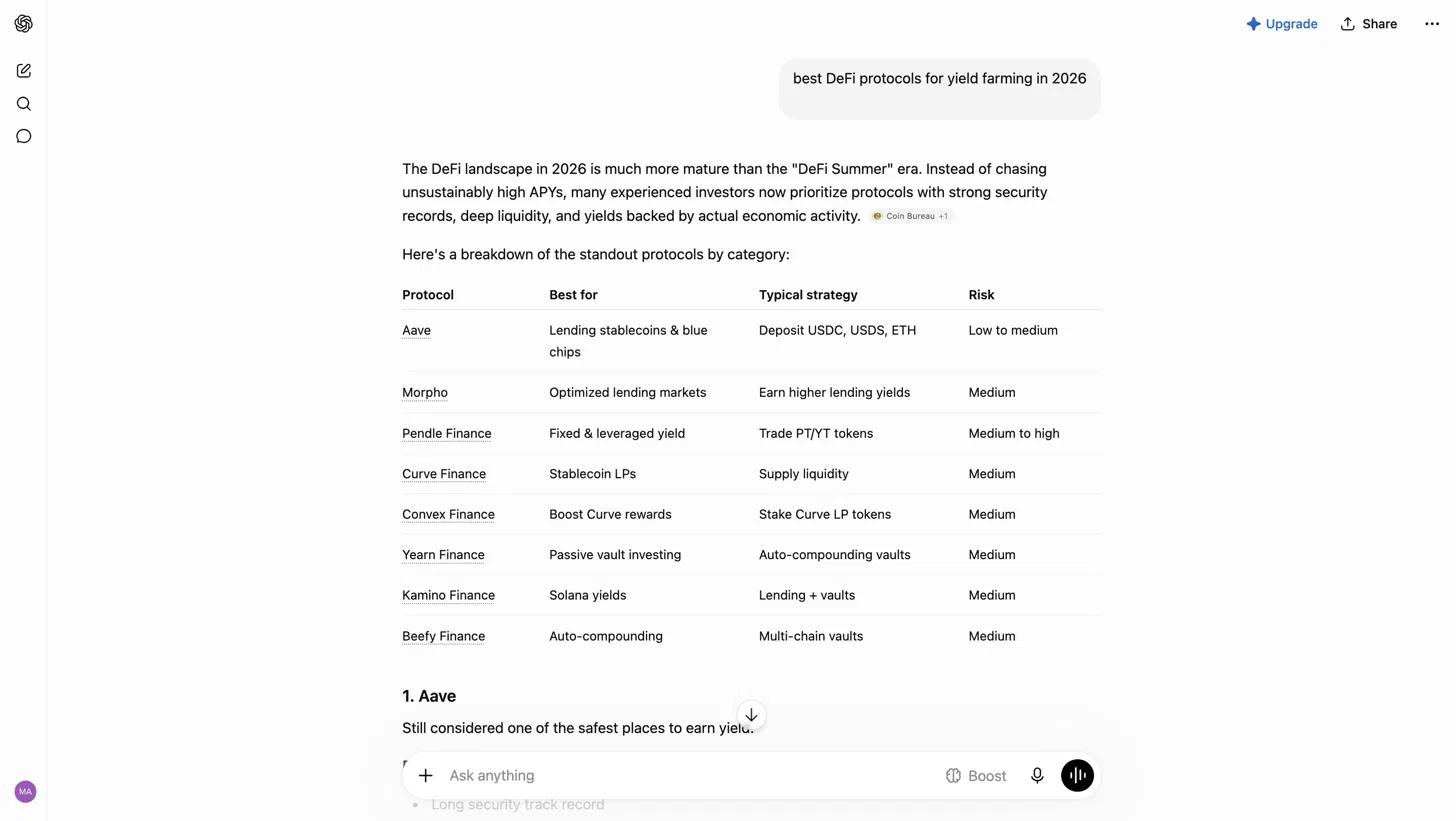
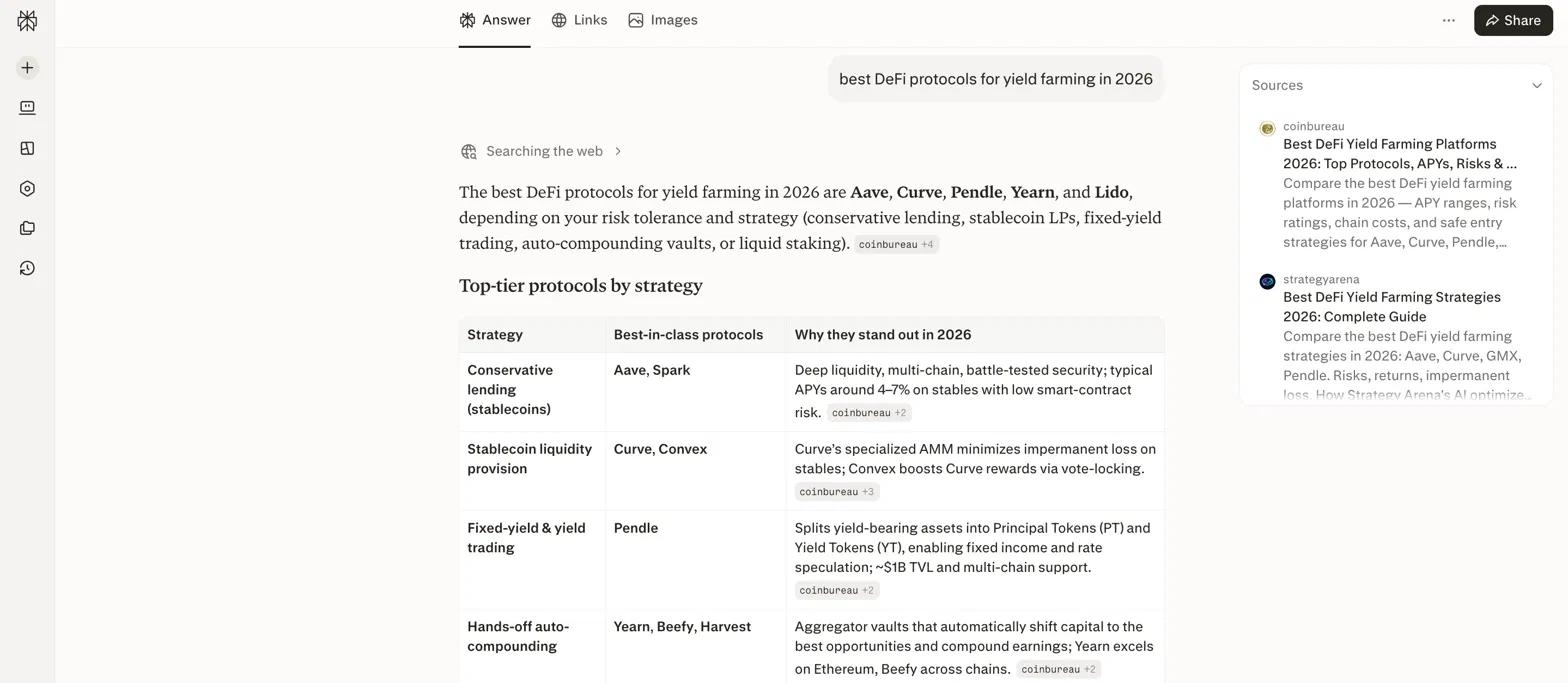
That’s not a coincidence of good SEO. These sites are structured, almost sentence-for-sentence, to match the phrasing of the query itself. When someone asks an AI engine for “the best crypto exchanges in 2026,” a page titled exactly that is going to out-compete a data table every time, because the AI engine is matching intent to structure, not looking for the most authoritative price feed.
2. Mainstream financial media and trade press
Safety and breaking-news queries pulled a different set entirely. On safety and legitimacy questions, the citations skewed toward Investopedia, Yahoo Finance, Reuters, and Business Insider. On regulatory news, the same query type instead surfaced The Block, paulhastings, and Investors.com. These aren’t interchangeable with the safety-query sources, and running the news query in both engines side by side makes the point concrete: zero source overlap between the two answers.
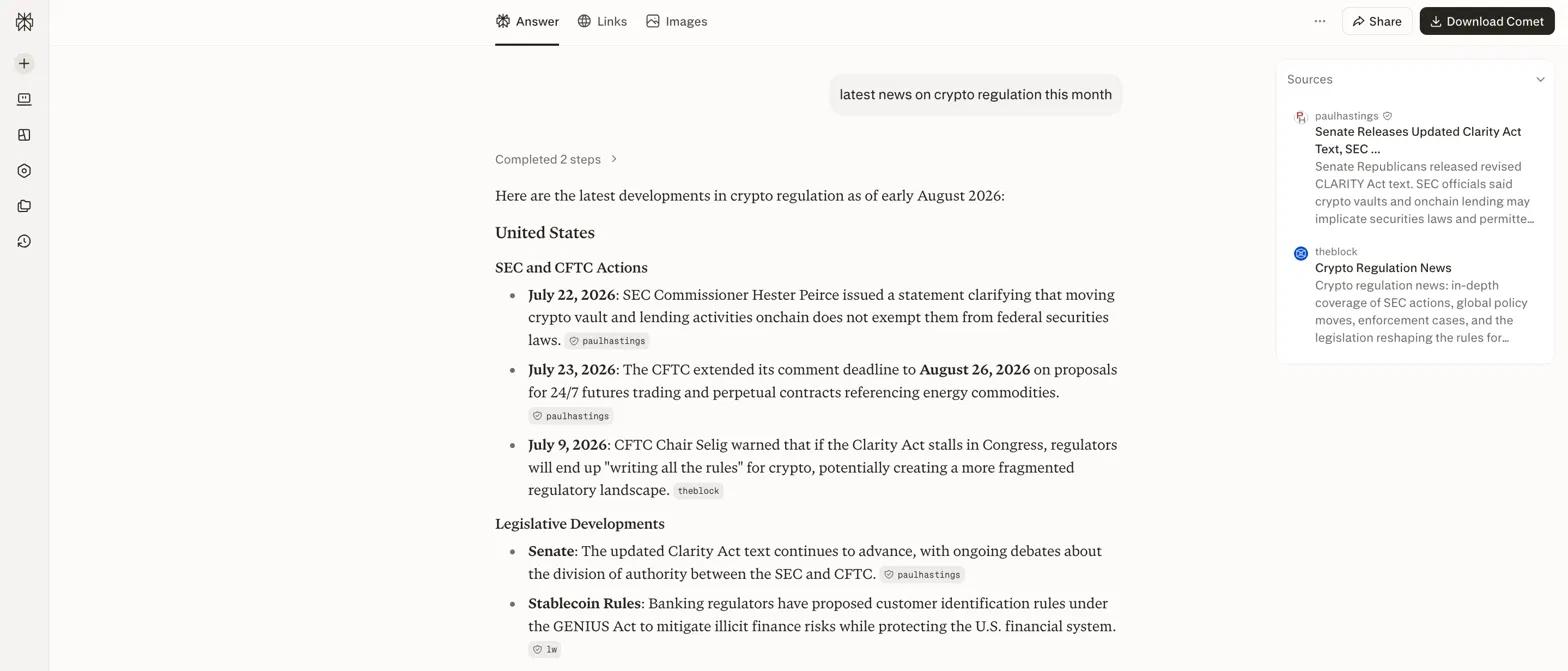
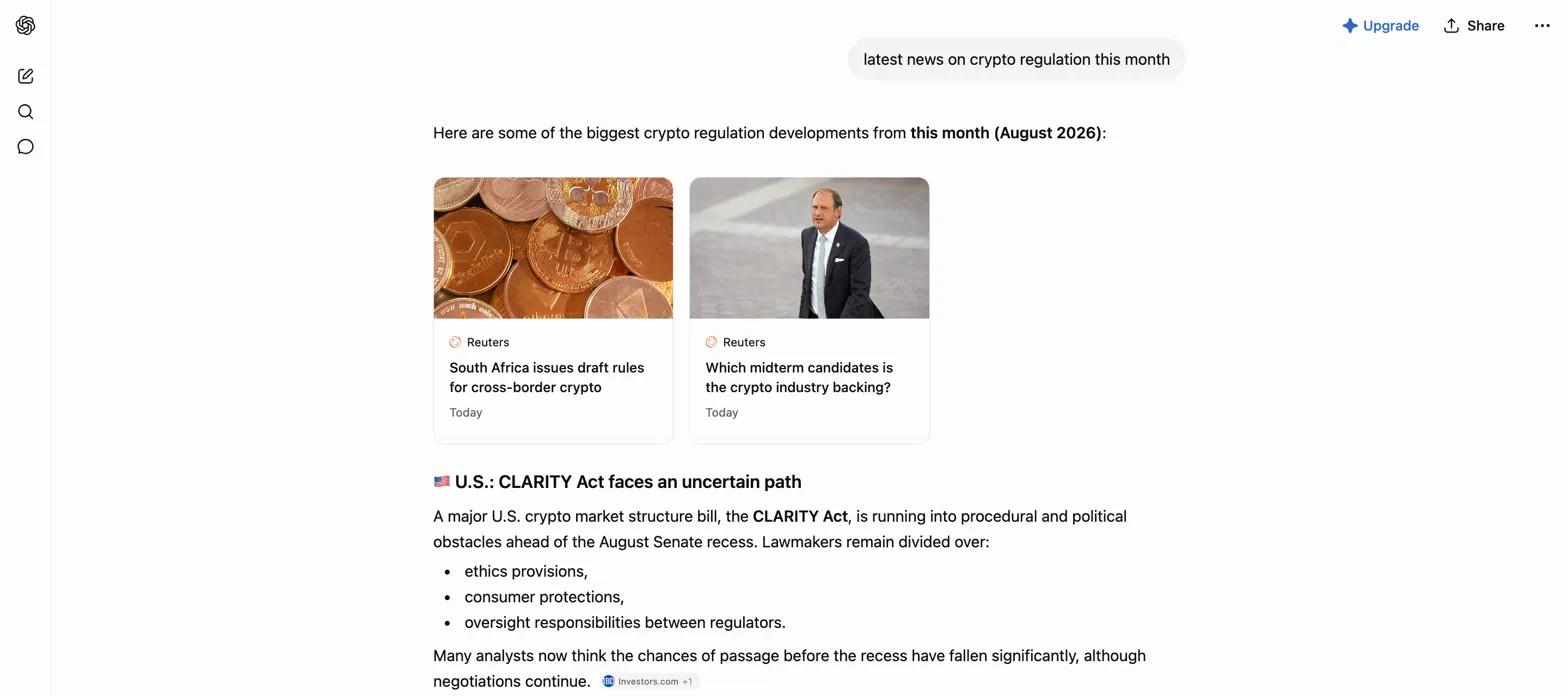
The split matters. General breaking news pulled from mainstream wire services, Reuters being the clearest example, while queries asking for regulatory depth pulled trade press and legal-industry analysis instead. paulhastings showing up isn’t an accident. It’s a law firm publishing analysis, and when the question requires legal nuance, the AI engine reached for a source built to provide it.
3. The company itself, but only under specific conditions
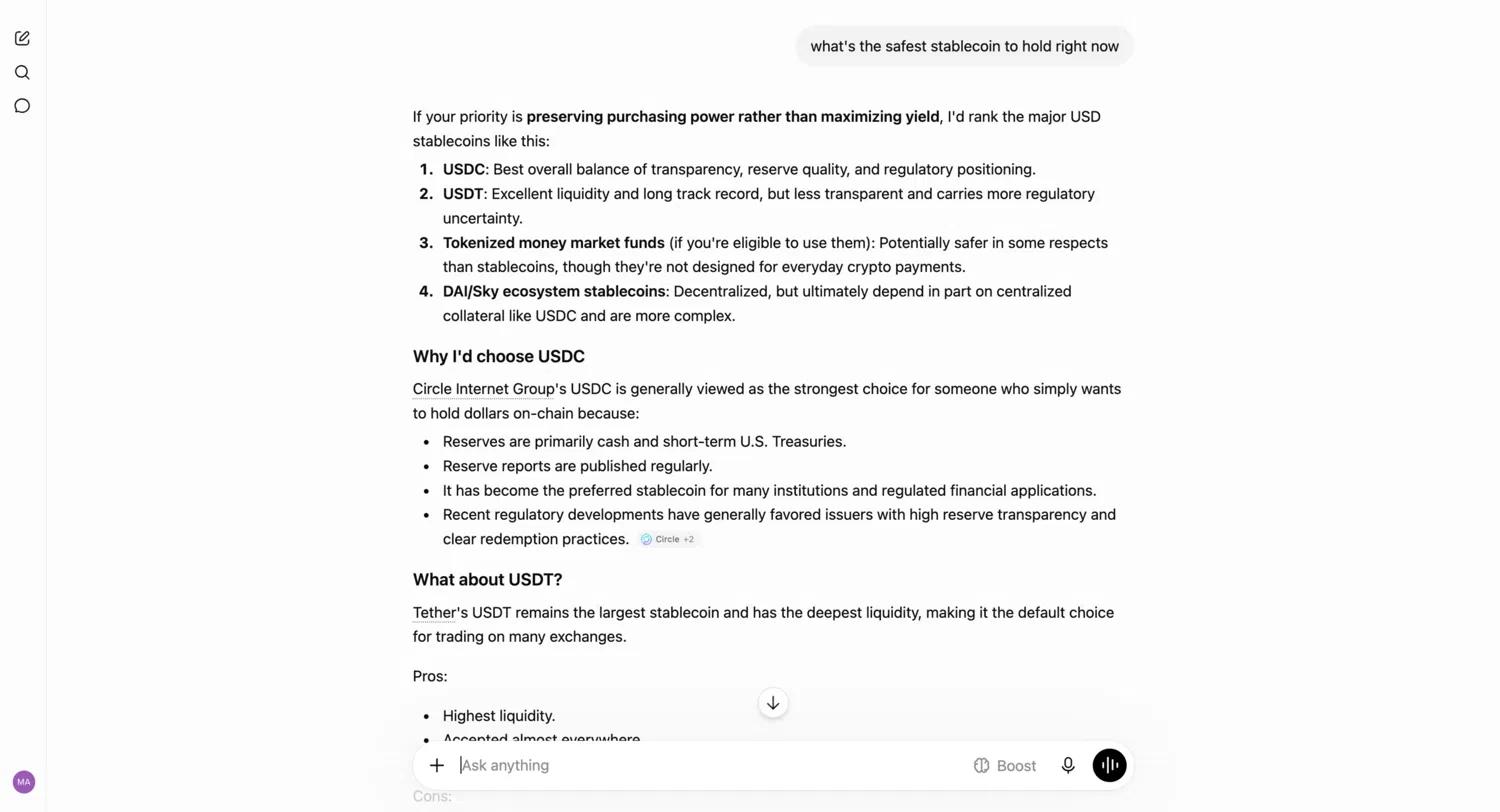
Both Circle and Tether appeared directly, not summarized by a third party, but named as the source itself.
4. Community platforms, only when named, and often secondhand
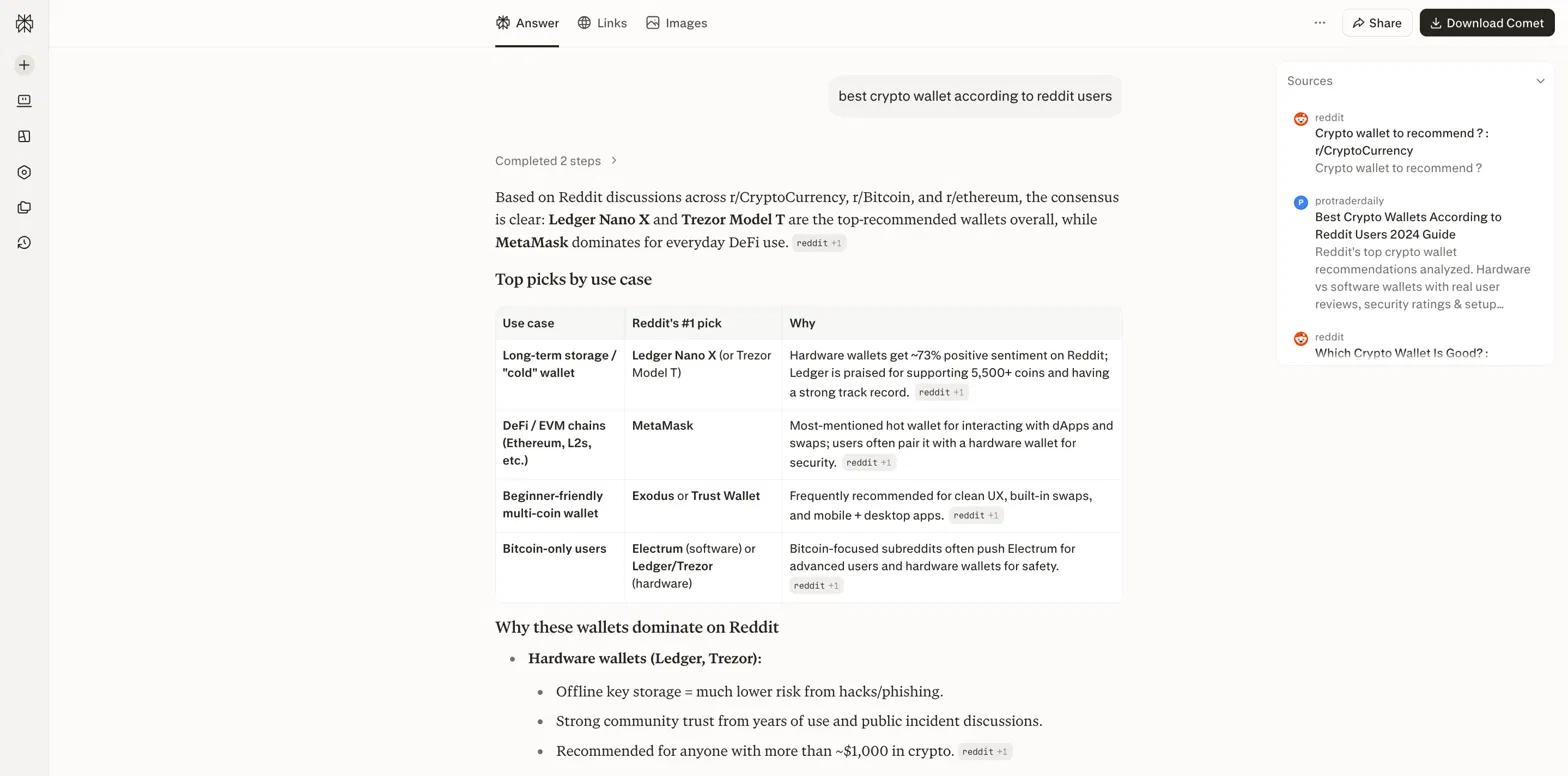
Reddit appeared directly in exactly one query, where the prompt explicitly said “according to reddit users.” Even there, it didn’t show up alone. The same answer also cited protraderdaily, a blog that had already summarized the same Reddit sentiment, sitting right next to the raw thread. That tells you community sentiment reaches AI engines through two paths: directly, when the query asks for it by name, and secondhand, through a blog or aggregator that already did the summarizing work.
Comparative summary
| Source type | Appeared on | Example sources | Why it won |
| Purpose-built SEO roundups | Recommendation-style queries | Coin Bureau, Strategy Arena, Datawallet, Changee | Matches “best X in [year]” phrasing directly |
| Mainstream media & trade press | Safety and breaking-news queries | Investopedia, Reuters, The Block, paulhastings | Established authority; trade press adds regulatory depth |
| The company itself (primary source) | Stablecoin safety query | Circle, Tether | Only when the project has recurring, audited disclosure |
| Community platforms | Query naming the platform directly | Reddit (direct), protraderdaily | Surfaces only on request, not by default |

If you’re tracking how often ChatGPT and Perplexity agree on sources, the honest answer is: it depends entirely on what kind of question you’re asking.
On the roundup-style query, overlap was high. Both engines cited Coin Bureau. On the breaking-news query, overlap dropped to zero; Perplexity and ChatGPT pulled from entirely different outlets for the same news event. On the stablecoin safety query, overlap was zero again, but for a different reason. ChatGPT went straight to primary sources like Circle and Tether, while Perplexity leaned on comparison blogs instead.
The takeaway isn’t “engines agree” or “engines disagree.” It’s that citation overlap needs to be measured per query category. A single aggregate number across all your tracked queries will average out real, structural differences in how each engine sources roundup content versus breaking news versus safety questions. Semrush’s own AI Visibility Index found the same pattern at industry scale: across 126 million prompts, the overlap between which brands get mentioned and which sources actually get cited can drop as low as 30% on a single platform like Gemini. Nine queries or 126 million, the structural point holds.
What This Means for Crypto Projects: Checklist
- Stop treating an aggregator listing as a citation tactic. It may still be worth doing, for basic data legitimacy, for users who check it directly, but across every query category we tested, it earned zero weight as an AI citation source.
- Get into the roundup content itself. Identify which sites are already winning “best X 2026” queries in your category (Coin Bureau and Strategy Arena are the clearest examples here) and pursue inclusion directly: reviews, data cooperation, guest contributions.
- Build relationships with the outlets that show up on regulatory and news queries in your space. Pitch data and expert commentary before the story breaks, not after. The Block and legal-industry analysts like paulhastings didn’t appear because they happened to cover the story fastest. They appeared because they’d already established the authority to be cited on that kind of question. This is exactly what dedicated crypto PR is built to do: place your project with the outlets that already win these queries, before you need them to.
- If your project has audited reserves or regulatory disclosures, publish them consistently and make them easy to find. That’s the specific, narrow condition that got Circle and Tether cited as primary sources, not size, not brand recognition, but a standing record of audited transparency.
- Don’t expect organic Reddit citation by default. If community sentiment is a genuine asset for your project, understand that it only surfaces to AI engines when a query names the platform directly. Otherwise it reaches the model secondhand, through whoever already summarized it.
- Monitor citations by query category, not as a single aggregate score. A roundup query and a news query about the same project can produce completely different source sets, and averaging them together hides the pattern you actually need to act on.
Final Thoughts
None of this is a one-time fix. The source types that win shift with the query, the engine, and, as this space matures, probably the quarter. Treat this checklist as a starting map, not a finished strategy, and revisit which sources are winning your category every few months rather than assuming today’s answer holds.
Frequently Asked Questions (FAQ)
We ran 100+ crypto queries through ChatGPT and Perplexity with Semrush. CoinGecko, CoinMarketCap, and DeFiLlama were cited zero times. Roundup content, mainstream media, and primary sources won instead.
Not based on this research — zero citations across every category and both engines tested. Still useful for human users checking basic data, just not an AI-citation tactic.
Four source types: SEO-style roundup content (“best X 2026”), mainstream financial media, the project’s own verified disclosures, and community platforms — but only when named directly in the query.
Sometimes. Roundup-style queries showed high overlap between the two engines. Breaking-news and safety queries showed none — each engine pulled from entirely different outlets.
Getting into the roundup content already winning “best X” queries in your category. It was the most consistent citation source across every category tested in this research.
Share with


Rate the article