

Introduction
When was the last time you searched for something by typing a full question instead of a few keywords? If you’re like most people in 2025, you’ve probably asked ChatGPT, Perplexity, or Google’s AI Overview more questions in the past month than you’ve typed traditional search queries. This shift isn’t just changing how we find information — it’s fundamentally rewriting the rules of search engine optimization.
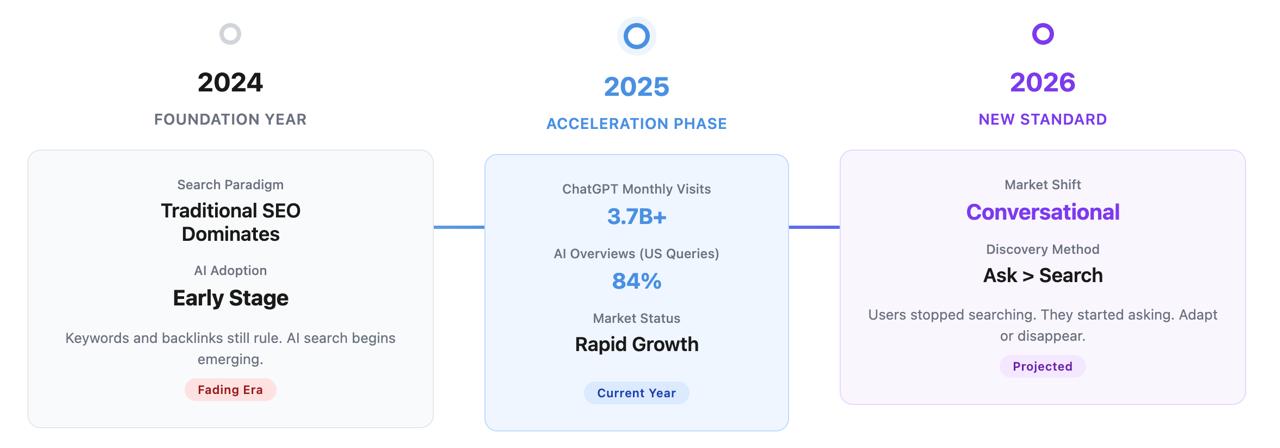
The numbers tell a striking story. According to recent data from Similarweb, ChatGPT now receives over 3.7 billion visits per month, making it one of the most-visited websites globally [1]. Meanwhile, research from Gartner predicts that traditional search engine volume will drop by 25% by 2026 due to AI chatbots and other virtual agents [2]. Perhaps most tellingly, Google’s own AI Overviews now appear in approximately 84% of search queries in the United States, fundamentally changing how users interact with search results [3].
Here’s the uncomfortable truth: if your content strategy still revolves entirely around traditional SEO tactics — keyword density, backlink profiles, and ranking for position one — you’re optimizing for a paradigm that’s rapidly becoming secondary. The future of search isn’t about ranking on page one; it’s about being cited, referenced, and trusted by AI systems that synthesize answers from multiple sources (Understand the citation economy in AI SEO ↗).
But this shift also presents an enormous opportunity. While most businesses are still figuring out that AI search exists, early adopters who understand how to optimize for these systems are already capturing attention, building authority, and converting users who never even see a traditional search results page.
This article will show you exactly how SEO for AI search works, why AI models choose to cite certain content over others, and the specific strategies you need to implement today to ensure your content gets discovered, referenced, and trusted in this new era of search.
The New Search Reality
Traditional search and AI search might seem similar on the surface — both involve users seeking information — but the underlying mechanics and user behaviors are fundamentally different.
How Traditional vs. AI Search Works
| Aspect | Traditional Search | 🚨 AI Search |
|---|---|---|
| User input | Keywords and short phrases | Full questions in natural language |
| Results format | List of ranked links | Direct, synthesized answer |
| Number of sources presented | 10+ results per page | 3-5 cited sources |
| User behavior | Click, scan, compare multiple sources | Read answer, ask follow-up questions |
| Your goal | Rank higher than competitors | Be cited as a trusted source |
With traditional search engines, users type keywords or short phrases. Google returns a list of blue links ranked by relevance and authority. Users click through multiple results, scan content, and piece together their own answers.
AI search operates on an entirely different model. Users ask complete questions in natural language. The AI synthesizes information from multiple sources and provides a direct, conversational answer (Learn the fundamentals of answer engine optimization ↗). Instead of presenting ten blue links, systems like ChatGPT with web search, Perplexity, and Google AI Overviews curate information, extract key facts, and present a coherent response.
The Behavioral Shift
Think about how you search today versus two years ago:
- Recipe searching: Do you type “best chocolate cake recipe” into Google, or ask ChatGPT “how do I make a moist chocolate cake with ingredients I already have at home?”
- Business research: Do you open ten tabs and synthesize findings yourself, or ask Perplexity to “compare the pros and cons of content marketing versus paid ads for B2B SaaS companies?”
- Quick facts: Do you scroll through articles, or ask an AI for an immediate answer?
This behavioral shift reveals a crucial difference: users are moving from searching to asking, from browsing to conversing, from assembling answers to receiving them (Stay ahead of AI SEO trends and insights ↗).
Understanding the Major AI Search Platforms
Each platform has distinct characteristics that affect how content gets discovered and cited:
| Platform | Description | Key Strengths | Content Preferences |
|---|---|---|---|
| ChatGPT with web search | Conversational AI assistant with web browsing capabilities | Multi-turn interactions; Users can refine questions based on previous answers | Authoritative, well-structured content; Direct, clear answers |
| Perplexity | Positions itself as an “answer engine” | Cited responses with clear source attribution | Strong expertise signals; Factual accuracy and verification |
| Google AI Overviews | Appears directly in Google search results | Synthesizes information without requiring clicks | Google’s quality guidelines; Trusted domains; Established authority |
| Gemini | Google’s multimodal AI assistant | Deep integration with Google’s ecosystem; Real-time information | Fresh, current content; Multimodal understanding capabilities |
What This Means for Your Strategy
The strategic implication is clear: ranking alone is no longer sufficient. Your content must be citation-worthy — clear, authoritative, structured, and directly answering the questions your audience asks.
The shift requires rethinking content creation from the ground up:
- Write for synthesis, not just visibility
- Optimize for being quoted, not just ranked
- Focus on clarity over cleverness
- Prioritize directness over comprehensiveness
How AI Decides What to Cite
Understanding what makes content citation-worthy requires looking inside the “black box” of how large language models select sources. While the exact algorithms differ across platforms, several consistent patterns emerge from analyzing which content gets cited versus ignored.
AI models don’t simply prioritize the highest-ranking Google results. They evaluate content based on factors that signal trustworthiness, clarity, and relevance to the specific query.
Authority and trust signals remain paramount, but AI interprets them differently than traditional search algorithms. E-E-A-T (Experience, Expertise, Authoritativeness, Trustworthiness) matters enormously. AI systems prefer content from recognized experts, established publications, educational institutions, and domains with strong topical authority. A detailed article from a specialized industry blog may get cited over a superficial piece from a high-authority general news site if the former demonstrates deeper expertise.
Content clarity and directness heavily influence citation likelihood. AI models favor content that answers questions explicitly and efficiently. If your article buries the answer in paragraph seven after six paragraphs of background, an AI will likely cite a competitor who puts the answer in paragraph one. The model values content that respects the user’s time and cognitive load.
Structural formatting acts as a signal of quality and makes content easier for AI to parse and extract. Clear heading hierarchies, bulleted lists, numbered steps, tables, and definition-style formatting all increase citation probability. When an AI encounters well-structured content, it can more confidently extract accurate information and attribute it correctly.
Freshness and accuracy determine whether content gets cited for current events or time-sensitive topics. AI models often check publication dates and prefer recent content for queries where recency matters. However, evergreen content on timeless topics can remain citation-worthy for years if it’s comprehensive and accurate.
Cross-source verification plays a subtle but important role. When multiple reputable sources make the same claim, AI systems gain confidence in citing that information. This creates a network effect where content that aligns with established consensus gets amplified, while outlier claims require exceptional evidence.
Real-World Examples
Query: “What is the ideal length for a blog post for SEO?”
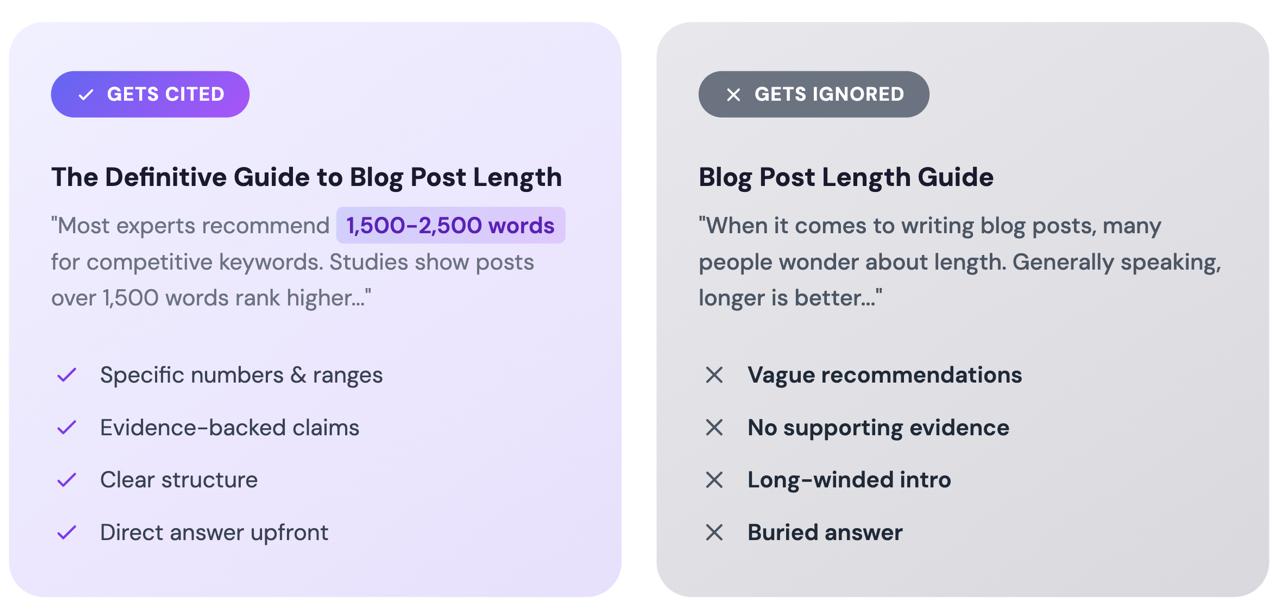
Content that gets cited: An article from a respected SEO agency that begins: “Most SEO experts recommend blog posts between 1,500-2,500 words for competitive keywords, though length should ultimately serve the user’s needs. Studies show posts over 1,500 words tend to rank higher and earn more backlinks.” The article then breaks down factors that influence ideal length with clear subheadings.
Content that gets ignored: A generic article titled “Blog Post Length Guide” that spends 300 words on introduction before eventually mentioning “longer is better” without specific recommendations or supporting evidence.
Query: “How do I reduce cart abandonment on my ecommerce site?”

Content that gets cited: A detailed guide that lists “7 Proven Strategies to Reduce Cart Abandonment” with each strategy explained in 100-150 words, including specific implementation steps and expected impact.
Content that gets ignored: A 5,000-word comprehensive guide that discusses cart abandonment theory, psychology, and case studies but never provides a clear, scannable list of actionable tactics.
The pattern is clear: AI systems favor content that demonstrates expertise through clarity, structure, and directness rather than through length or comprehensiveness alone.
SEO for AI Search: Practical Guide
Optimizing for AI search requires specific, implementable strategies that make your content more citation-worthy. Here are the essential tactics that will increase your visibility across AI-powered platforms.
01 Structure Content Around Questions
Every piece of content should explicitly answer a question your audience is asking. Use actual questions as H2 or H3 headings. Instead of “Email Marketing Strategies,” use “What Are the Most Effective Email Marketing Strategies for B2B Companies?” This approach aligns with how users query AI systems and makes it immediately clear that your content addresses their specific need.
Why AI favors this: AI models are trained on question-answer pairs. When your content structure mirrors the question-answer format, the AI can more easily identify relevant sections and extract citation-worthy information with proper context.
02 Answer Directly in the First 150 Words
State your main answer, key insight, or primary recommendation in the opening paragraph. Provide context and details later, but give the immediate answer upfront. If someone asks “What is SEO for AI search?” your first sentence should define it clearly, not provide historical background.
Why AI favors this: AI systems scan for direct answers to avoid presenting users with vague or meandering responses. Content that immediately delivers value signals higher quality and gets prioritized for citation.
03 Implement Clear Heading Hierarchy
Use H2 for main sections, H3 for subsections, and maintain logical nesting. Never skip heading levels. Include descriptive, specific headings that preview the content below. “Heading Hierarchy Best Practices” is better than “Best Practices” alone.
Why AI favors this: Heading structure acts as a content map that AI uses to understand information architecture. Clear hierarchies enable precise extraction of specific facts without misattribution or loss of context.
04 Add Schema Markup for Key Content Types
Implement structured data markup for articles, FAQs, how-tos, reviews, and other relevant content types. Use JSON-LD format and validate with Google’s Rich Results Test. Schema markup creates machine-readable signals about what your content contains and how it’s organized.
Why AI favors this: Structured data provides explicit metadata that helps AI systems understand content type, purpose, and key elements. This reduces ambiguity and increases confidence in citation accuracy.
05 Build Topical Authority Through Content Clusters
Create comprehensive content clusters around core topics relevant to your expertise. Instead of publishing isolated articles, develop interconnected pieces that thoroughly cover a subject area. Link related content together to establish clear topical relationships.
Why AI favors this: When multiple high-quality articles on related topics come from the same domain, AI systems recognize concentrated expertise. This topical authority increases the likelihood of citation across multiple queries within that subject area.
06. Maintain Content Freshness with Regular Updates
Review and update existing content quarterly or when significant industry changes occur. Update statistics, refresh examples, and add new insights. Include a “Last Updated” date prominently. Create new content addressing emerging questions in your field.
Why AI favors this: AI models check publication and update dates, especially for time-sensitive queries. Fresh content signals ongoing expertise and reduces the risk of citing outdated or inaccurate information.
07. Write in Natural, Conversational Language
Avoid overly formal, academic, or keyword-stuffed writing. Use the same language your audience uses when speaking. Include contractions, rhetorical questions, and direct address (“you/your”). Write as if explaining the topic to a knowledgeable colleague.
Why AI favors this: AI models are trained on conversational data and natural language. Content that mirrors how people actually communicate is easier to parse, more likely to match query phrasing, and provides better user experience when cited.
08. Cite Authoritative Sources Within Your Content
Reference and link to reputable studies, industry reports, and expert opinions. Use inline citations with source names. Don’t just link — explain why the source is credible. This demonstrates rigor and positions your content as synthesizing existing knowledge thoughtfully.
Why AI favors this: When your content cites authoritative sources, it signals research depth and accuracy. AI systems recognize this pattern of expertise and are more confident citing content that demonstrates verification and cross-referencing.
Before/After Optimization Examples
Seeing the difference between traditional content and AI-optimized content makes the transformation concrete. Here’s how key elements should change when you adapt your strategy for AI search.
| Element | Before AI Optimization | After AI Optimization |
|---|---|---|
| Article title | “Blog Post Length Tips” | “What Is the Ideal Blog Post Length for SEO in 2026?” |
| Opening paragraph | “Content length is important. Many factors determine how long your posts should be. In this article, we’ll explore various considerations…” | “Most SEO experts recommend 1,500-2,500 words for competitive keywords, though ideal length depends on search intent and topic complexity. Research from Backlinko analyzing 11.8 million search results shows that longer content tends to rank higher.” |
| Heading structure | “Benefits” → “Examples” → “Tips” | “Why Does Content Length Affect Rankings?” → “How Long Should Different Content Types Be?” → “What Factors Determine Ideal Length?” |
| Content organization | Introduction → Background → Body paragraphs → Examples → Conclusion | Direct answer → Supporting evidence → Detailed explanation → Implementation steps → Related questions |
| Source attribution | “Studies show that longer content performs better…” | “According to a 2023 Backlinko analysis of 11.8 million search results, the average first-page result contains 1,447 words…” |
| Call-to-action placement | Only at the end of article | Brief inline mention + comprehensive CTA at end |
| Sentence structure | “It is recommended that marketers should consider implementing…” | “Marketers should implement…” |
The transformation isn’t about making content longer or adding more keywords — it’s about making every element clearer, more direct, and more useful. AI systems reward content that respects both their parsing capabilities and user needs.
Notice how the optimized versions answer questions explicitly, use natural language, attribute sources specifically, and organize information logically. These changes make content more valuable for human readers while simultaneously making it more citation-worthy for AI systems.
Measuring Success
Traditional SEO metrics — keyword rankings, organic traffic, time on page — don’t fully capture your performance in AI search. While these remain valuable, you need additional measurement approaches to understand your AI visibility.
Core AI Search Metrics to Track
1. Manual AI Citation Monitoring
The most direct way to assess AI visibility is through systematic manual testing:
- Query major AI platforms (ChatGPT, Perplexity, Google AI Overviews) with questions your content answers
- Search for your brand name and key topic areas
- Document when your content gets cited and how it’s referenced
- Track which competitors appear alongside you
- Note the context and quality of citations
Tracking frequency:
- Weekly for priority topics
- Monthly for broader content library
- After each major content update
This qualitative approach provides direct visibility into AI behavior and helps identify citation patterns.
2. Branded Search Volume Changes
| Metric | What to Monitor | Why It Matters |
|---|---|---|
| Brand name searches | Week-over-week trends in Google Search Console | Indicates growing awareness from AI discovery |
| “Brand + topic” searches | Searches combining your brand with key topics | Shows users seeking you after AI citation |
| Direct traffic spikes | Unusual increases in direct visits | May indicate AI-driven awareness without trackable referral |
When users encounter your brand through an AI-generated answer, many will search directly for your company or content. Monitor these trends in Google Search Console as a proxy for AI discovery impact.
3. Referral Traffic from AI Platforms
While attribution remains imperfect, emerging referral signals include:
- chatgpt.com — Direct referrals when ChatGPT provides clickable citations
- perplexity.ai — Citation-driven traffic from Perplexity’s source links
- google.com/search — Some AI Overview traffic appears as Google referrals
- Unknown/direct traffic spikes — May indicate unattributed AI discovery
How to track effectively:
- Set up custom channel groupings in Google Analytics for AI platforms
- Use UTM parameters when possible for better tracking
- Monitor traffic timing patterns (AI traffic often shows different hour/day patterns)
- Analyze landing page distribution (AI tends to deep-link to specific answers)
4. Engagement Quality Metrics
AI-driven traffic often behaves differently than traditional search traffic. Compare these metrics across traffic sources:
| Metric | What It Reveals | Target Benchmark |
|---|---|---|
| Bounce rate | Whether AI citations match user intent | 15-25% lower than organic average |
| Pages per session | Content relevance and site engagement | 20-30% higher for quality AI traffic |
| Time on page | Content depth alignment | Higher for specific answer-seeking queries |
| Conversion rate | Traffic quality and intent match | Often 2-3x higher when well-targeted |
High engagement suggests strong topical alignment between AI-discovered users and your content. Poor engagement may indicate citation context mismatches.
Building Your Measurement Framework
Create a simple tracking system:
- Weekly: Run 5-10 test queries on major AI platforms for your priority topics
- Bi-weekly: Check branded search trends in Search Console
- Monthly: Analyze referral traffic sources and engagement patterns
- Quarterly: Comprehensive AI visibility audit across all content
The measurement landscape for AI search remains nascent, but establishing baseline tracking now positions you to identify trends and optimize based on emerging patterns. As AI platforms develop more robust analytics, early adopters will have historical data to inform strategy.
Looking Ahead: The Future of Search Is Already Here
The transformation from traditional search to AI-powered discovery isn’t coming — it’s already underway. Every day that passes without adapting your content strategy is a day your competitors gain ground in establishing authority with AI systems that millions of users now trust for answers.
The businesses that will thrive in this new landscape aren’t necessarily those with the largest SEO budgets or the most backlinks. They’re the ones that understand a fundamental truth: AI search rewards clarity, expertise, and user-centricity above all else. If your content genuinely helps people, answers their questions directly, and demonstrates real expertise, AI systems will find it, cite it, and drive engaged audiences to your door.
The strategies outlined in this article aren’t theoretical — they’re based on observable patterns in how AI systems select and reference content today. Implementing them requires effort and often a shift in how you think about content creation. But the competitive advantage goes to those who act now, while the majority are still optimizing exclusively for a previous era of search.
If you’re looking to accelerate your AI search optimization strategy with expert guidance, exploring advanced techniques can provide additional frameworks. The right approach, implemented consistently, can establish your content as a trusted source across multiple AI platforms within months rather than years.
The question isn’t whether to optimize for AI search. It’s whether you’ll lead this transition or spend years catching up to those who moved first.
Frequently Asked Questions (FAQ)
Traditional SEO focuses on ranking web pages in search engine results through keywords and backlinks, while AI search optimization aims to get your content cited and referenced by AI platforms like ChatGPT, Perplexity, and Google AI Overviews, etc. AI SEO prioritizes content clarity, direct answers, and authoritative signals over traditional ranking factors like domain authority and link building.
Most businesses see initial visibility improvements in AI search results within 2-4 months, significantly faster than the 6-12 months typical for traditional SEO campaigns. Results depend on content quality, topical authority, and how well you structure information for AI parsing and citation.
You can implement basic AI SEO tactics yourself, according to the guide recommendations. However, comprehensive strategies involving competitive analysis, technical GEO implementation, and cross-platform optimization often benefit from specialized expertise — agencies like ICODA offer dedicated AI SEO services that accelerate results and ensure you’re optimizing across all major AI platforms effectively.
Start with ChatGPT and Google AI Overviews since they capture the largest share of AI-assisted search queries, with ChatGPT receiving over 3.7 billion monthly visits. Perplexity is valuable for B2B and professional audiences who prioritize cited sources, while Gemini matters if your audience uses Google’s ecosystem heavily.
Track AI visibility through manual citation monitoring by querying platforms like ChatGPT and Perplexity with relevant questions, monitoring branded search volume increases in Google Search Console, and analyzing referral traffic from chatgpt.com and perplexity.ai in your analytics. Set up weekly test queries for priority topics and document when your content appears in AI-generated responses.
AI search optimization complements rather than replaces traditional SEO, as Google’s traditional search results still drive significant traffic for most businesses. The most effective strategy combines both approaches: maintain strong traditional SEO fundamentals while adapting content structure, freshness signals, and authority markers specifically for AI citation.
Question-and-answer formats, comprehensive how-to guides, and content with clear heading hierarchies perform best in AI search platforms. AI systems favor content that answers questions directly in the first 150 words, uses natural conversational language, cites authoritative sources, and demonstrates genuine expertise through detailed explanations and practical examples.
Sources:
- [1] SE Ranking – AI Traffic in 2025: Comparing ChatGPT, Perplexity & Other Top Platforms, 2025
- [2] Xponent21 – Google AI Overviews Now Appear in 60% of Searches, 2025
- [3] Seer Interactive / Dataslayer – Google AI Overviews Impact: CTR Down 61%, 2025
Share with


Rate the article