




Introduction
58.5% of Google searches now end without a single click. That number jumps to 93% when Google’s AI Mode answers the query. If you’re still measuring success by website traffic, you’re tracking a disappearing metric.
Welcome to the Citation Economy.
This isn’t a subtle shift. AI search engines have fundamentally rewritten how brands earn visibility. The old playbook — rank high, earn clicks, convert traffic — is collapsing. In its place, a new economy has emerged where being cited by AI matters more than being clicked by humans.
This transformation is called the “Citation Economy,” a landscape where brand authority is measured not by page views but by how often AI systems reference, quote, and recommend your content when answering user questions.
The implications are massive. And most brands are completely unprepared.
Why Clicks Are Becoming Obsolete
AI-generated answers are replacing the need to visit websites entirely. When ChatGPT, Perplexity, or Google AI Overviews provide complete answers directly in their interfaces, users have no reason to click through.
The data tells a clear story:
- Zero-click searches increased from 56% to 69% after Google AI Overviews launched in May 2024
- Organic CTR drops from 1.41% to 0.64% when AI answers appear for informational queries
- AI traffic grew 7x year-over-year, from 0.02% in 2024 to 0.15% in 2025
- ChatGPT now drives 20% of Walmart’s referral traffic and nearly 15% to Target
This creates a paradox. AI search is simultaneously destroying traditional traffic and creating new visibility opportunities for brands that adapt. The brands being cited in AI responses gain recognition, authority, and trust — even when users never visit their websites.
How AI Search Engines Decide What to Cite
Different AI platforms have distinct citation preferences, and understanding these patterns is essential for visibility.
ChatGPT prioritizes encyclopedic and authoritative content. Wikipedia captures 7.8% of total citations, making it the most-cited source. The platform favors established domains — 45.8% of citations come from websites over 15 years old.
Perplexity leans heavily into community-driven content. Reddit dominates at 46.7% of top citations. The platform functions like a research assistant, always showing its sources and linking to nearly every claim.
Google AI Overviews blends professional and community content. YouTube captures 1.9% of citations, Reddit 2.2%, and LinkedIn performs strongly for B2B queries. The platform now triggers on 13.14% of US desktop searches — more than double January 2025’s 6.49%.
Microsoft Copilot shows the most distinctive pattern, favoring platforms like SourceForge (21.33%) and Software Advice (16.97%) for technical queries.
Here’s what this means practically: optimizing for one AI platform isn’t enough. Each system evaluates trustworthiness differently, pulls from different source types, and weighs authority signals uniquely.
The Citation Authority Framework
Visibility in AI responses requires what can be described as “Citation Authority” — the combined weight of signals that make AI systems trust your content enough to cite it.
Citation Authority rests on three pillars:
1. Source Credibility Signals
AI models assess who is speaking, not just what they’re saying. Author credentials, consistent brand positioning, and third-party validation (mentions on authoritative sites, reviews, expert endorsements) all contribute. According to recent research, brands with the most web mentions appear up to 10 times more often in AI results.
⭐ Key Insight: It’s not enough to publish great content — AI needs proof that you’re the credible source. Build author profiles, earn mentions, and get validated by third parties.
2. Content Structure for Extraction
AI systems need to identify and extract specific claims efficiently. This means:
- Clear, direct answers in opening sentences
- Logical heading hierarchies that signal topic relationships
- Structured data (schema markup) that clarifies page purpose
- FAQ sections addressing common queries directly
⭐ Key Insight: Write like AI will quote you. Lead with the answer, structure for scanning, and make your best insights impossible to miss.
3. Multi-Platform Presence
AI models don’t just index your website. They evaluate your brand’s presence across forums, reviews, social platforms, and industry publications. Reddit, YouTube, Wikipedia, and niche review platforms all feed into AI citation decisions. A study analyzing 6.8 million AI citations found that 86% originate from brand-controlled assets — but that remaining 14% from forums and reviews can make or break your visibility.
⭐ Key Insight: Your website is one input, not the whole picture. AI builds trust from how you show up everywhere — forums, reviews, and community platforms included.
The Old Rules vs. The New Rules
The Citation Economy operates on fundamentally different principles than traditional SEO. Here’s how the paradigm has shifted:
| Traditional SEO | 📊 Citation Economy |
|---|---|
| Rank on page one | Be cited in AI responses |
| Optimize for keywords | Optimize for semantic understanding |
| Build backlinks | Earn brand mentions across platforms |
| Drive website traffic | Achieve visibility within AI answers |
| Measure clicks and sessions | Measure citation frequency and context |
| Target search volume | Target conversational query patterns |
| Content length for rankings | Content depth for AI extraction |
| Domain authority focus | Entity authority across the web |
| Single-platform optimization | Multi-platform presence strategy |
| Compete for 10 blue links | Compete for 3-5 AI recommendations |
The shift from “10 blue links” to “3-5 AI recommendations” deserves attention. When AI synthesizes information, it doesn’t present pages of results. It names specific brands, recommends particular solutions, and cites authoritative sources. If you’re not among those citations, you’re invisible.
What AI Systems Actually Want
AI platforms prioritize content that demonstrates genuine expertise and delivers clear, citable answers. This goes beyond traditional E-E-A-T signals.
Freshness matters more than ever. The average age of URLs cited by AI assistants is 1,064 days — 25.7% fresher than traditional organic SERP results. AI systems favor recent content with updated information, current statistics, and contemporary insights.
Originality triggers citations. AI models have been trained on enormous amounts of existing content. They already “know” generic information. What triggers citations is novel research, unique frameworks, proprietary data, and expert perspectives that don’t exist in their training data.
Clarity wins over comprehensiveness. LLMs favor the first or clearest explanation of a concept. If your content is convoluted or buried in jargon, AI systems will cite simpler, more accessible alternatives—even if those alternatives have less depth.
Conversational alignment improves visibility. AI search queries are longer and more conversational than traditional searches. Queries of 8+ words have a 57% chance of triggering AI Overviews. Content structured around how people actually ask questions performs better.
The New Metrics That Matter
Traditional analytics fail to capture Citation Economy performance. New measurement frameworks are emerging.
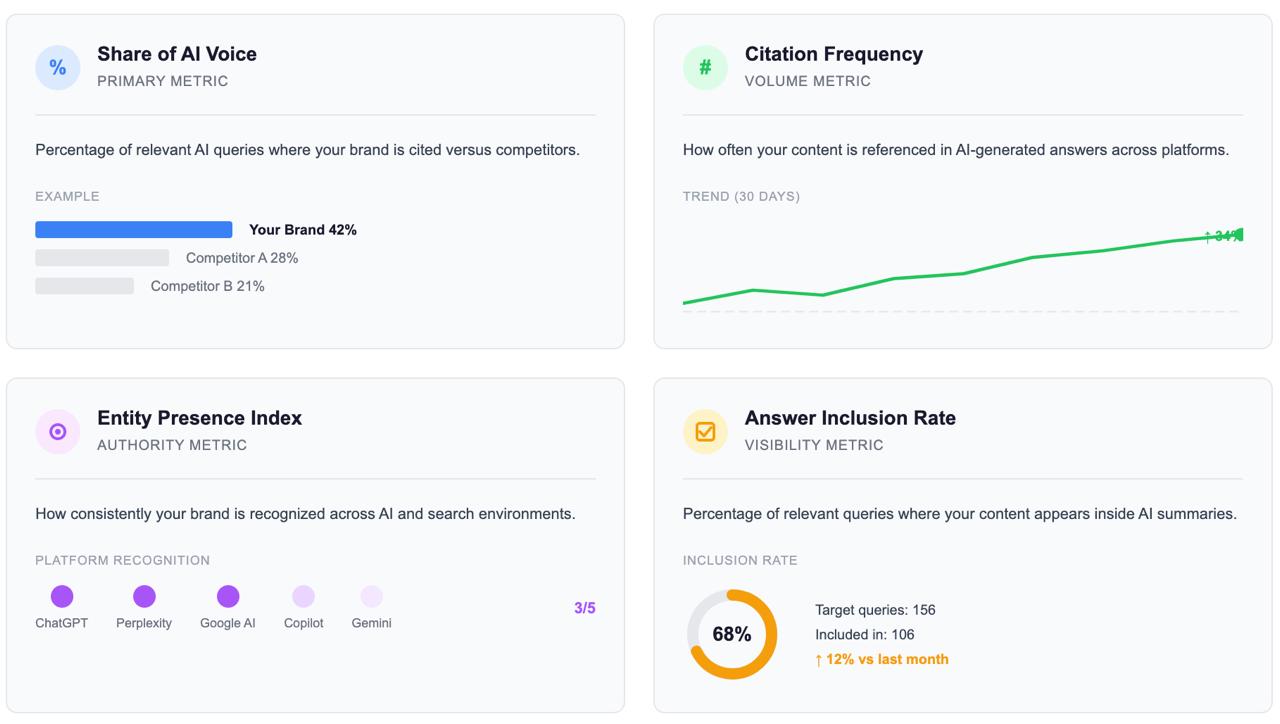
- Share of AI Voice: The percentage of relevant AI queries where your brand is cited versus competitors. This metric directly measures visibility in AI-generated responses across ChatGPT, Perplexity, Google AI Overviews, and other platforms.
- Citation Frequency: How often your content is referenced in AI answers. Unlike backlinks (which are static), AI citations fluctuate based on real-time relevance and query context.
- Entity Presence Index: How consistently your brand is recognized across AI and search environments. This measures whether algorithms associate your brand with specific topics and expertise areas.
- Answer Inclusion Rate: The percentage of relevant queries where your content appears inside AI summaries. High inclusion rates indicate that AI systems view your content as authoritative and extractable.
ICODA’s AI SEO optimization framework combines automated monitoring across AI platforms with manual testing of high-value queries. The goal isn’t just measuring visibility — it’s understanding why certain content gets cited and reverse-engineering those signals.
The Platform Diversification Imperative
Relying on a single channel is now strategically dangerous. AI models pull from diverse sources, and brands need presence across multiple platforms.
Reddit has emerged as a citation powerhouse. It leads Perplexity’s citations at 46.7% and ranks among the top sources for Google AI Overviews (2.2%). AI systems value the community validation and real-world perspectives found in forum discussions.
YouTube contributes 1.9% of Google AI Overview citations. Video content, properly optimized with searchable transcripts and structured descriptions, feeds AI understanding of brand expertise.
Review platforms heavily influence commercial queries. In B2B software queries, GetApp captures 39.74% of Perplexity citations. For agencies, Clutch commands an overwhelming 84.5% of ChatGPT citations in its category.
Wikipedia remains foundational. It captures 7.8% of ChatGPT citations — more than any other single source. Brands with Wikipedia presence benefit from this trust signal.
The strategic implication: your website is just one input. AI visibility requires orchestrating brand presence across forums, reviews, video platforms, and industry publications.
E-E-A-T in the AI Age
Experience, Expertise, Authoritativeness, and Trustworthiness signals remain critical — but their application has evolved for AI search.
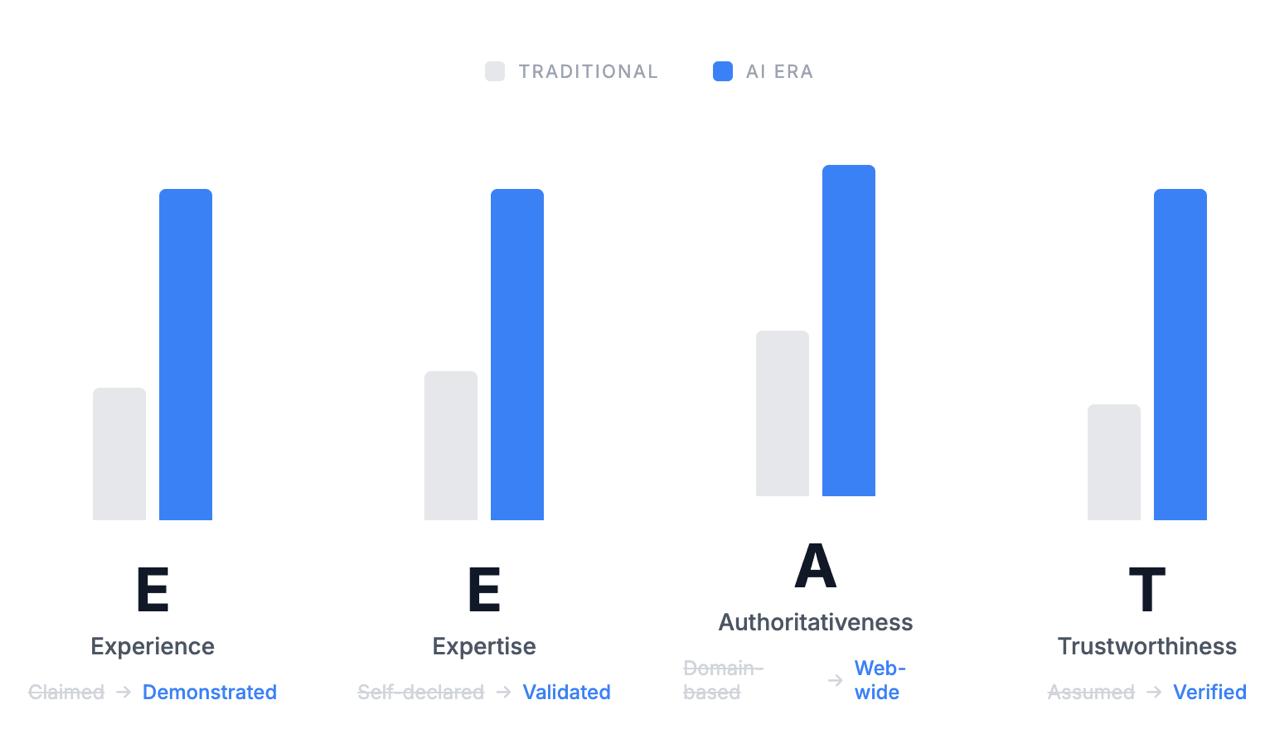
Experience now means demonstrable real-world engagement. AI systems detect when content is theoretical versus practical. Case studies, specific examples, and first-person insights signal genuine experience.
Expertise requires validation beyond your own site. Being cited in industry publications, mentioned by recognized experts, and referenced in academic or technical contexts builds the expertise signal AI models evaluate.
Authoritativeness is measured across the entire web. Your brand’s authority isn’t just your domain rating — it’s how consistently you’re mentioned in authoritative contexts across multiple platforms.
Trustworthiness increasingly includes accuracy verification. AI systems are designed to identify reliable information. Citing credible sources, maintaining consistency across platforms, and correcting errors quickly all contribute to trust signals.
Brands ranking well in traditional search don’t automatically perform well in AI citations. The correlation between Google rankings and AI visibility is weaker than most marketers assume. This creates opportunity for brands willing to invest specifically in Citation Economy strategies.
Strategic Actions for Citation Economy Success
Winning in the Citation Economy requires specific tactical adjustments. The brands capturing AI citations aren’t lucky — they’re executing a deliberate playbook that aligns with how AI systems evaluate, select, and reference sources.
| 🎯 Tactic | 🔍 What It Means | 💡 Why It Works |
|---|---|---|
| Restructure content for extraction | Lead every section with a direct, citable answer in ≤160 characters | AI systems pull concise statements; buried insights don’t get cited |
| Build multi-platform presence | Audit and develop brand presence across Reddit, reviews, forums, and publications | AI pulls from diverse sources; single-channel brands get overlooked |
| Create proprietary frameworks | Coin original terminology, develop unique frameworks, publish first-party research | AI cites novel concepts that don’t exist elsewhere in training data |
| Monitor AI visibility actively | Track brand appearance across ChatGPT, Perplexity, and Google AI Overviews | You can’t optimize what you don’t measure; citation patterns shift constantly |
| Prioritize freshness | Update high-value content regularly with current data and insights | AI systems favor recent sources; dated content loses citation potential |
| Invest in entity SEO | Define your brand in Google’s Knowledge Graph via structured data and Wikipedia | Clear entity signals help AI systems confidently attribute information to you |
These six tactics work together as a system. Content structure makes your insights extractable. Multi-platform presence ensures AI finds you across sources. Original frameworks give AI something unique to cite. Active monitoring reveals what’s working. Freshness keeps you relevant. And entity SEO ties it all back to your brand. Start with one or two — but plan to implement all six.
The Conversion Paradox
Here’s what makes the Citation Economy counterintuitive: less traffic can mean more business.
Traffic from AI sources converts differently. Visitors arriving from AI citations are often further along in their decision journey. They’ve already received context and recommendations from the AI system. They arrive with higher intent and greater trust.
Research shows AI-driven traffic converts at higher rates, with some studies indicating up to 4.4x higher conversions compared to traditional organic traffic. The click-through rate on cited answers in AI interfaces is 6x higher than classic organic links.
This means Citation Economy success isn’t measured in volume — it’s measured in quality. Being recommended by AI carries implicit endorsement that raw search rankings never provided.
The Future Belongs to the Cited
AI search will continue capturing market share. The AI search market, valued at $43.6 billion in 2024, is projected to control 62.2% of total search volume by 2030. By 2026, this shift will no longer be emerging but firmly established, as AI search becomes the default interface for information discovery across most user journeys. Brands that fail to adapt by then will not just lose visibility — they will be excluded from the sources AI systems trust and cite.
Brands that treat this as a temporary disruption will fall behind. Those that recognize the structural shift — and invest accordingly — will own the conversations that matter.
The Citation Economy rewards clarity over cleverness, authority over optimization tricks, and genuine expertise over manufactured content. It favors brands that build real presence across the web, not just on their own domains.
Your competitors are already adjusting. Some have achieved 1400%+ traffic growth by becoming the sources AI systems prefer to cite. Others are watching their visibility evaporate as AI answers eliminate the need for clicks to their sites.
The question isn’t whether the Citation Economy will reshape your market. It already has.
The question is whether you’ll be cited — or forgotten.
Frequently Asked Questions (FAQ)
The Citation Economy is a paradigm where brand visibility is measured by how often AI systems cite your content, rather than by clicks and rankings. It reflects the shift from 10 blue links to earning 3-5 AI recommendations.
AI SEO is optimizing content to appear in AI-generated responses from ChatGPT, Perplexity, and Google AI Overviews. Unlike traditional SEO focused on rankings, AI SEO prioritizes semantic understanding, citation authority, and multi-platform presence.
AI search engines evaluate credibility signals, content structure, freshness, and multi-platform presence. Brands with strong E-E-A-T signals and consistent mentions across forums, reviews, and publications get cited most.
Zero-click searches are rising because AI Overviews satisfy user intent directly on the results page. With 58.5% of Google searches ending without a click—and 93% in AI Mode—users no longer need to visit websites.
Track AI visibility through manual testing of key queries across ChatGPT, Perplexity, and Google AI Overviews, or use dedicated AI monitoring platforms. ICODA combines automated tracking with strategic query testing to measure citation frequency and Share of AI Voice.
GEO is optimizing content specifically for AI-powered search and answer engines. It focuses on making content extractable, citable, and authoritative so AI systems select it when generating responses.
Share with


Rate the article