

Perplexity is the second-largest AI search engine — and it works nothing like ChatGPT. Most crypto teams haven’t figured that out. They’re ignoring it or applying the same ChatGPT playbook: brand mentions, Wikipedia citations, training-data coverage. None of that works here.
Check your current Perplexity visibility score as your baseline before applying this playbook →
Why Perplexity Requires a Different Strategy
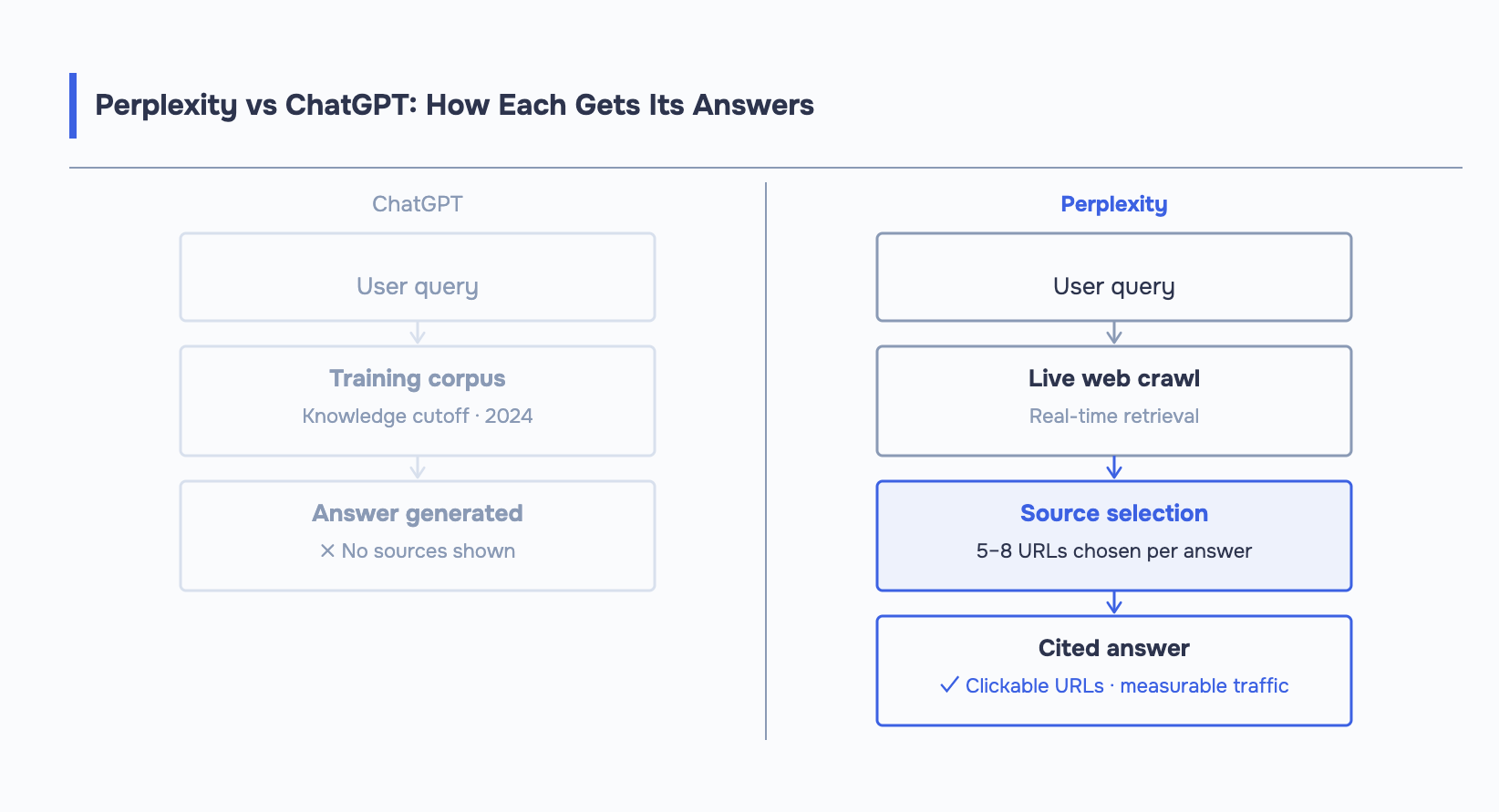
ChatGPT synthesizes from a fixed training corpus with a knowledge cutoff. Perplexity runs live web retrieval on every query — pulling pages, parsing them, assembling a sourced answer in real time. Citations aren’t decorative. Users see the URLs, click them, traffic flows.
With ChatGPT, you need to be absorbed into training data — appearing in enough credible sources that the model associates your project with the right concepts. With Perplexity, you need to be the source that gets pulled for a given query today. Yesterday’s answer might cite you. Tomorrow’s might not.
This is citation decay. Perplexity’s answers skew toward recent content because users asking research questions expect current information. A 2023 post explaining your protocol’s architecture might still rank in Google. In Perplexity, something newer has already displaced it.
Perplexity users also ask differently. Not “best DeFi protocol” but “what are the risks of using Aave for yield farming in 2026” or “how does [X protocol] compare to Compound for institutional lending.” These are users in evaluation mode, past the awareness stage. Getting cited in those answers puts your project in front of people who are actively deciding — not browsing.
Perplexity SEO for crypto is not a brand awareness game. It’s a relevance and recency game, and the tactics look very different from traditional SEO or ChatGPT visibility work.
How Perplexity Selects Sources for Crypto Queries
Perplexity has no publicly documented ranking algorithm. But citation patterns across crypto queries reveal consistent source preferences.
Domain authority still matters, but the threshold is lower than Google’s. Perplexity will cite a well-structured Substack post over a thin page on a high-DA domain if the content is more directly relevant. Smaller crypto projects that can’t compete on backlinks have a real opening here.
Freshness is weighted heavily for time-sensitive topics. Crypto is almost always time-sensitive — prices move, protocols upgrade, regulations shift. For any query that implies recency (“current,” “now,” “2026,” “latest”), a page published last week outcompetes one published last year, assuming comparable quality.
Source diversity is built into the answer. Perplexity typically pulls 5–8 citations and diversifies by source type. You don’t need to be the only source on a topic — you need to be the best source of a type not already represented. If it’s citing CoinDesk for news and a Reddit thread for community perspective, your protocol explainer might fill a third slot.
Structured, fact-dense content extracts better. Perplexity reads your page and pulls sentences to synthesize into an answer. Pages with clear structure — defined claims, specific numbers, logical section breaks — parse better than walls of prose. This directly affects whether your content gets cited at all.
For crypto queries, Perplexity consistently favors: project documentation, protocol research blogs, technical community forums, and Reddit.
The Reddit → Perplexity Pipeline for Crypto
Reddit is not a bonus source for Perplexity. It’s a primary one.
Perplexity indexes Reddit at high frequency. Crypto subreddits appear consistently in answers to community-driven queries: r/CryptoCurrency, r/ethfinance, r/defi, r/Bitcoin, r/CryptoTechnology. Ask Perplexity “what do people think of [protocol X]” or “is [project] safe to use” — Reddit threads are often the first thing it pulls.
The pipeline:
- A high-quality Reddit thread — a detailed comparison, a technical explainer, an honest AMA answer — gets indexed by Perplexity
- That thread appears in answers when relevant queries come in
- Users click through to a Reddit discussion that includes your project, your team’s perspective, your community’s advocacy
The catch is authenticity. Crypto subreddits have well-calibrated spam detectors. A thread that reads like a marketing post gets downvoted, deleted — and Perplexity won’t cite a thread at negative karma. The content needs to be genuinely useful: honest technical breakdowns, comparisons that include trade-offs, substantive answers to real questions.
Build a consistent community presence, not manufactured posts. Teams that engage regularly in r/defi or r/ethfinance — answering questions, correcting misunderstandings, sharing research — accumulate an indexed Reddit footprint that Perplexity draws from continuously.
The screenshot below is a Perplexity answer to a community-intent query — the Sources panel shows exactly what gets pulled first.
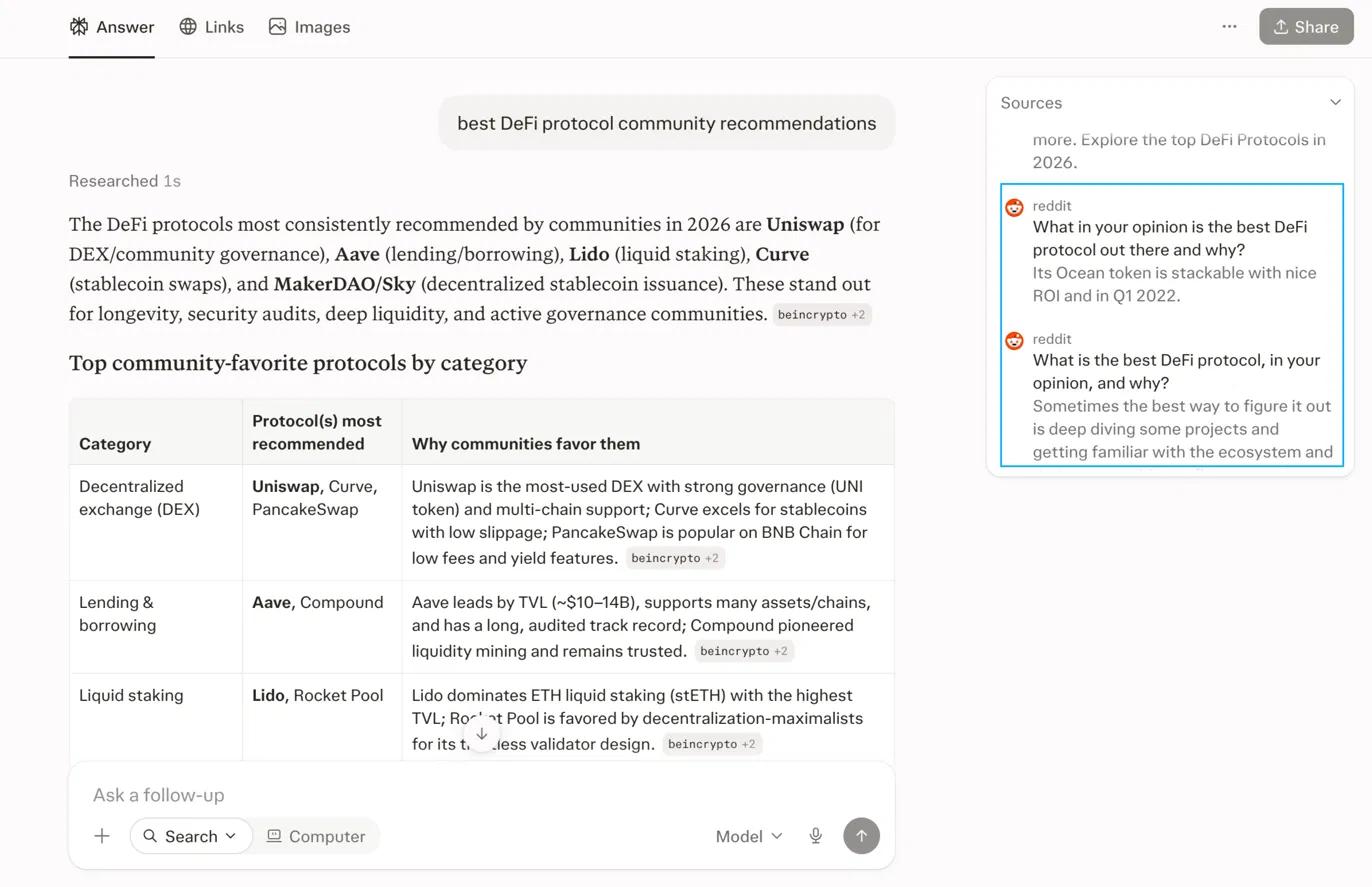
Run your project name as a Perplexity query. If Reddit threads appear but your team isn’t in them, that’s a gap. If Reddit doesn’t appear at all, your community presence is too thin to generate content Perplexity pulls.
Content Format That Gets Cited: Real-Time, Sourced, Structured
Format matters as much as substance when publishing for perplexity citations crypto.
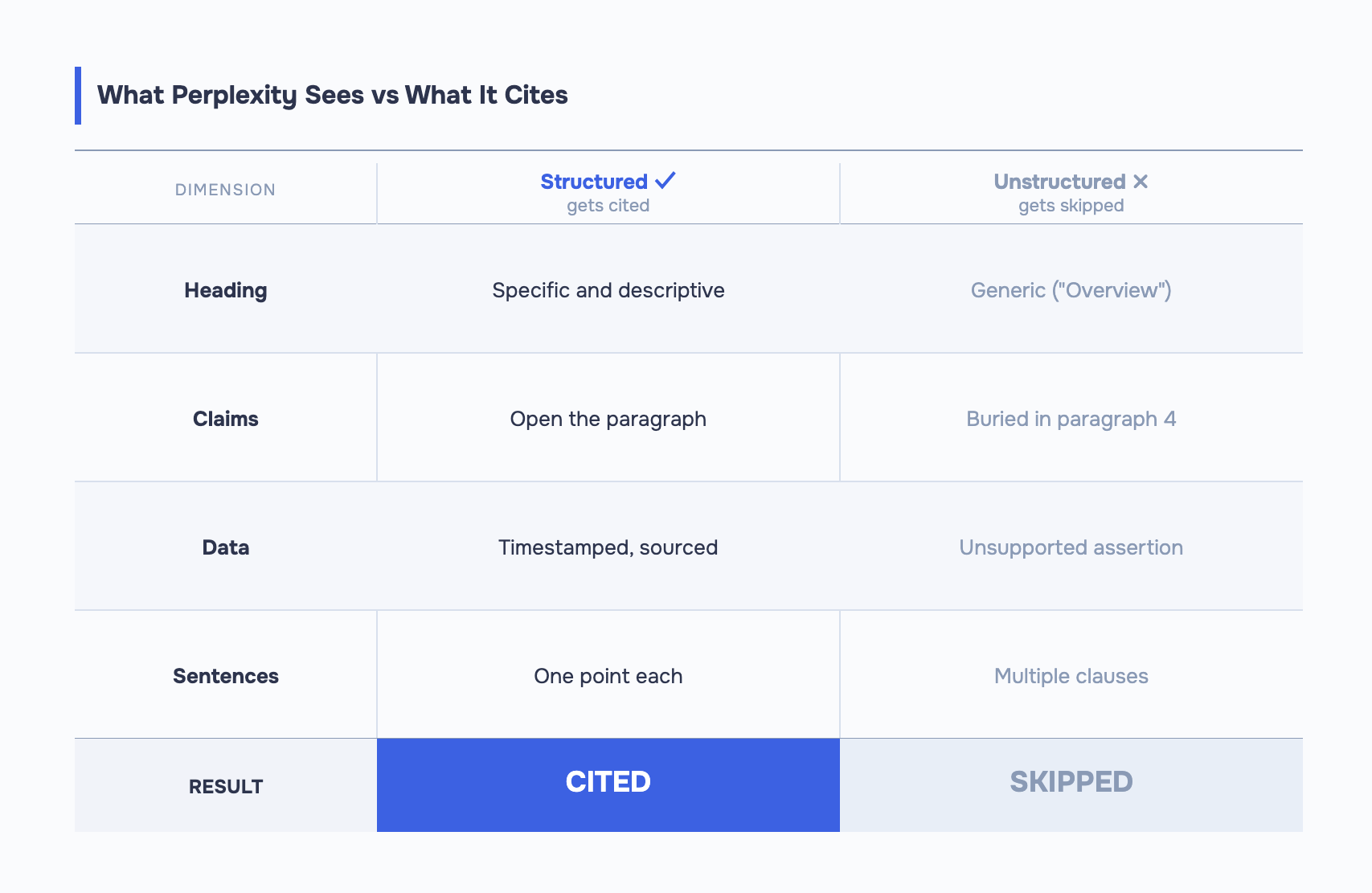
Source your claims. Content that cites on-chain metrics, links to protocol audits, or includes timestamped TVL figures signals research, not marketing. Perplexity’s answer engine weights pages that look like research. Unsupported assertions get skipped in favor of sourced ones.
Update frequently. Pages flagged as fresh get pulled more often. A static “About our protocol” page from 2022 won’t compete with a research post published last month. Teams that publish or update content weekly maintain higher citation share than those publishing quarterly.
Structure for extraction:
- Lead with the claim. Perplexity extracts sentences to synthesize answers. If your most citable sentence is in paragraph four, it might not get used. Put the specific, factual claim first.
- Use descriptive headings. Not “Overview” — “How [Protocol X] Handles Liquidation Risk.” Perplexity’s parser uses heading context to understand what a section covers.
- One point per sentence. A sentence making three points with three clauses is hard to extract without misrepresenting something.
- Date your content explicitly. “As of Q3 2026” tells Perplexity the content is fresh and gives users a reason to trust it.
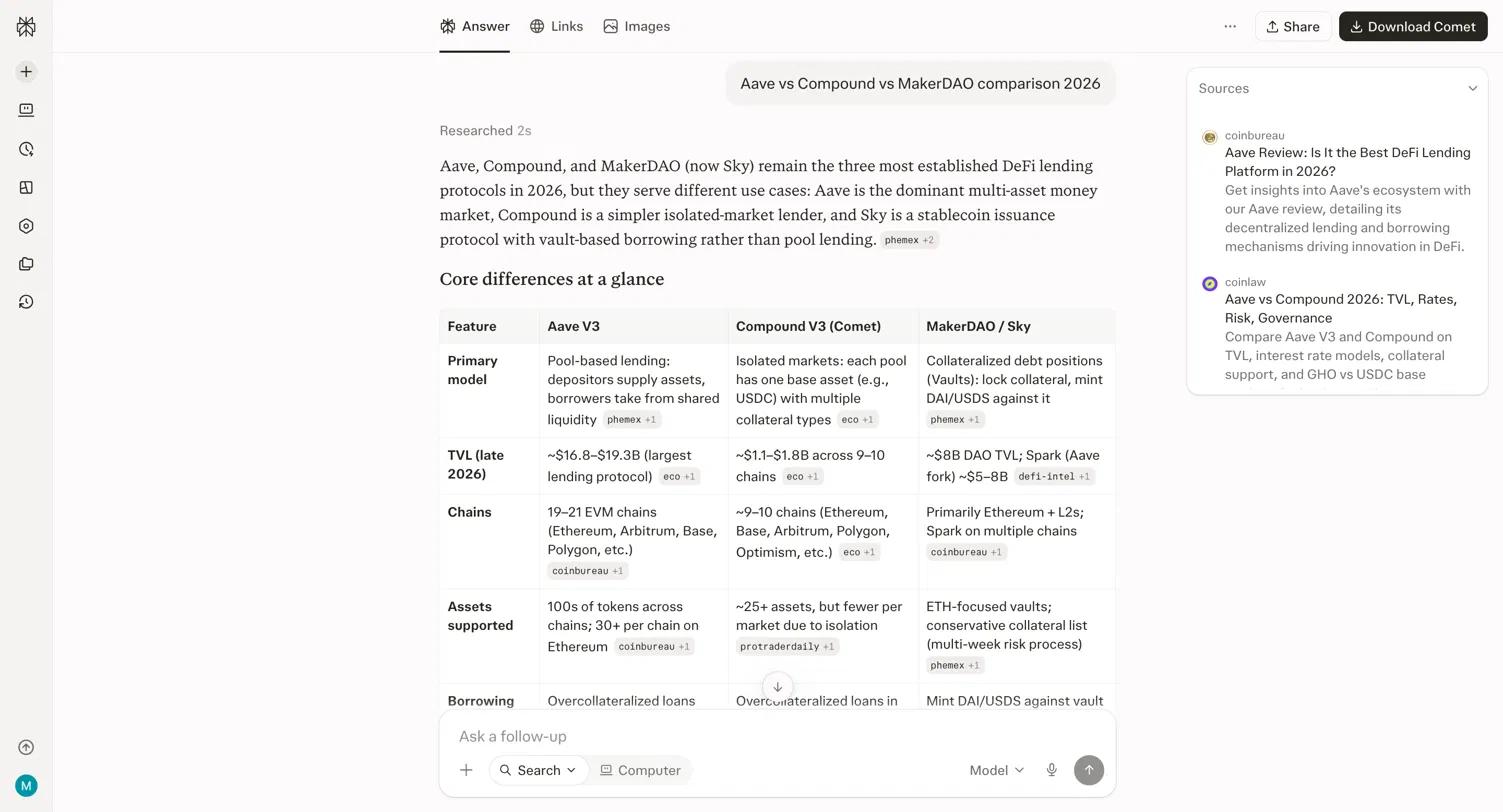
The format that performs best for Perplexity AEO is the comparative answer post: a page that directly compares your protocol to competitors across specific dimensions — fees, security model, liquidity depth, governance. Perplexity fields comparison queries constantly from users in evaluation mode, and these pages get cited because they hand Perplexity a pre-built answer structure.
When the input is structured — protocol A vs B vs C — the output becomes a table with citations in every row. Pages that already present data this way get extracted first; Perplexity doesn’t have to restructure them.
Technical Setup: llms.txt, Freshness Signals, URL Structure
The technical side of how to rank in perplexity 2026 is still evolving, but these are actionable now.
llms.txt tells AI crawlers what to index and how to prioritize. It works like robots.txt: a file at your root domain that directs Perplexity’s crawler toward your most valuable pages — research blog, documentation, protocol explainers — and away from boilerplate legal pages and thin landing pages. For crypto projects, list your protocol documentation, tokenomics explainer, security audit summary, and any research papers.
Freshness signals go beyond publication dates. Regular inbound links, updated timestamps, social engagement — all correlate with higher crawl frequency. In practice:
- Update core pages (protocol overview, FAQ, comparison pages) whenever anything changes — don’t only add new posts
- Publish a regular “state of the protocol” update monthly or quarterly to force fresh crawl activity across your domain
- Verify your CMS outputs accurate
Last-Modifiedheaders — some headless setups strip them
URL structure sends topic signals. yourproject.xyz/research/liquidation-mechanics-explained gives Perplexity cleaner context than yourproject.xyz/blog/post-143. Organize content into named directories: /research/, /docs/, /comparisons/. Avoid date-based slugs — they age the URL before the content does.
Schema markup improves extraction quality. Use Article on research posts, FAQPage on FAQ pages, HowTo on tutorials. Perplexity uses structured data when formatting extracted content. Most CMS platforms support this through plugins or native fields.
Canonical tags on syndicated content are non-negotiable. If you republish to Mirror, Substack, or a media partner, the original on your domain needs canonical priority. You want Perplexity citing your domain, not the syndication partner’s.
Measuring Your Perplexity Citation Share
Perplexity has no Search Console equivalent. Measuring perplexity visibility crypto project means building your own monitoring system.
Start with a query bank: 20–50 questions your target user might ask about your protocol, your category, and your competitors. Run those queries in Perplexity weekly. Track which sources appear, whether your domain shows up, and at what position.
At scale, a scraping script can automate this — running queries through Perplexity’s interface and extracting citation URLs. The output is a clean dataset: query → citations → your share. Over 30–60 days you’ll see which content types get cited most, which queries you’re winning, and where competitors appear instead.
Key metrics:
- Citation frequency — how often does your domain appear across your query bank?
- Citation position — first or fifth? The top 1–2 citations in a Perplexity answer get dramatically more clicks.
- Query coverage — what share of your target queries return at least one citation of your content?
- Competitor share — who appears in the queries where you don’t?
The fastest proxy: search your domain name in Perplexity and read how the AI describes your project. Accurate and current means your content is getting through. Outdated or vague means your freshness signals are failing.
Third-party AI search monitoring tools — several launched in 2025–2026 — now track Perplexity citation share alongside ChatGPT and Google AI Overview. Worth considering if you’re managing visibility across multiple AI channels.
Perplexity Playbook: 10-Step Checklist
Work through this in order. Each step builds the foundation the next one needs.
- Build your query bank. List 30–50 questions your target user asks at every funnel stage — from “what is [category]” to “is [your protocol] safe for $500K positions.” This becomes your measurement baseline and content brief source.
- Run a baseline audit. Search each query in Perplexity. Document every citation. Where competitors appear and you don’t — that’s your content gap list.
- Set up llms.txt. Add it to your root domain. Prioritize research pages, protocol docs, and high-quality explainers. Exclude boilerplate.
- Fix your freshness signals. Verify your server returns accurate
Last-Modifiedheaders. Add a current-state section to your five most important pages, even if the core content hasn’t changed. - Restructure content for extraction. Audit your top 10 pages. Move key claims to the top of each section. Rewrite generic headings to be specific. Break long compound sentences into single-point ones.
- Add schema markup. FAQ schema on FAQ pages, HowTo on tutorials, Article on research posts. If you have no FAQ page, build one — use questions from your query bank.
- Launch a Reddit presence. Pick 2–3 subreddits where your target users are active. Assign a team member — ideally a technical founder or researcher — to participate genuinely for 60 days. Answer questions. Share findings. Don’t promote.
- Publish a comparative analysis page. One page, your protocol vs 2–3 main competitors, on specific factual dimensions. High citation rate on comparison queries, consistently.
- Set a publishing cadence. Publish or update content at least every two weeks. One post a month is too slow for most competitive crypto verticals.
- Track citation share weekly. Run your full query bank every week. Log citations. After 30–60 days the trend lines tell you what’s working.
Check Your Perplexity Visibility Baseline
Most crypto teams that run a first AI Visibility audit find they’re cited for far fewer queries than expected — or that competitors appear in answers where their own project should be the obvious source.
Run your target queries. Log which sources appear, which positions you hold, and where you return zero citations. That map is your real starting point. Every step in this playbook gets more targeted when you know where you’re starting from.
The teams winning Perplexity visibility in crypto aren’t the ones with the biggest budgets. They publish substantively, update consistently, and treat AI search as its own channel with its own rules. That gap between knowing this and acting on it is where the advantage lives right now — and it’s closing.
Frequently Asked Questions (FAQ)
No — and treating it as a replacement is a strategic mistake. Perplexity currently handles a fraction of Google’s query volume, though its share in research-heavy categories like crypto is growing. Perplexity SEO is a separate channel with different mechanics. Some content investments (structured pages, quality documentation, Reddit presence) benefit both channels; others are more Perplexity-specific (llms.txt, aggressive freshness management).
Much faster than Google. Perplexity crawls and indexes fresh content within hours to days for active domains. If you publish a high-quality page today, it can appear in Perplexity answers within 24–72 hours. This is dramatically faster than waiting for Google to re-rank a page, and it’s one of the reasons consistent publishing cadence matters so much here.
Yes, and more easily than in Google. Perplexity’s source selection favors relevance and recency over raw domain authority. A protocol’s own research blog — if it’s genuinely substantive and current — can outcompete CoinDesk or Decrypt on specific technical queries about that protocol. The ceiling on domain authority effects is lower.
Treating it like ChatGPT optimization. The tactics for ChatGPT (Wikipedia presence, being mentioned in training data sources, brand authority signals) don’t translate directly. Perplexity needs fresh, crawlable, well-structured content that it can retrieve and extract right now. Teams that spend months on ChatGPT training data strategies and neglect their live web presence often have near-zero Perplexity visibility.
Perplexity Pages — the platform’s own published pages — are indexed and can be cited in answers. However, they’re primarily useful for establishing topical presence when you don’t have external web content covering a query. Building out your own domain and Reddit presence typically generates stronger and more durable citation share than relying on Perplexity Pages alone.
Share with


Rate the article