




You’ve already seen the lists. Same ten agency logos, slightly different order depending on who’s paying for placement. None of them tell you what separates an agency worth hiring from one that will invoice you $30K a month to post on X and call it a community strategy.
This guide gives you a concrete evaluation framework: specific questions to ask, red flags to watch for, and the criteria that matter in 2026. If you’re on a call with an agency next week, you should be able to use this directly.
Why Choosing a Crypto Agency in 2026 Is Fundamentally Different
Advice from two years ago is now actively misleading. The landscape shifted fast enough that agencies built for 2022 conditions are selling you a service that no longer matches how crypto audiences find and evaluate projects.
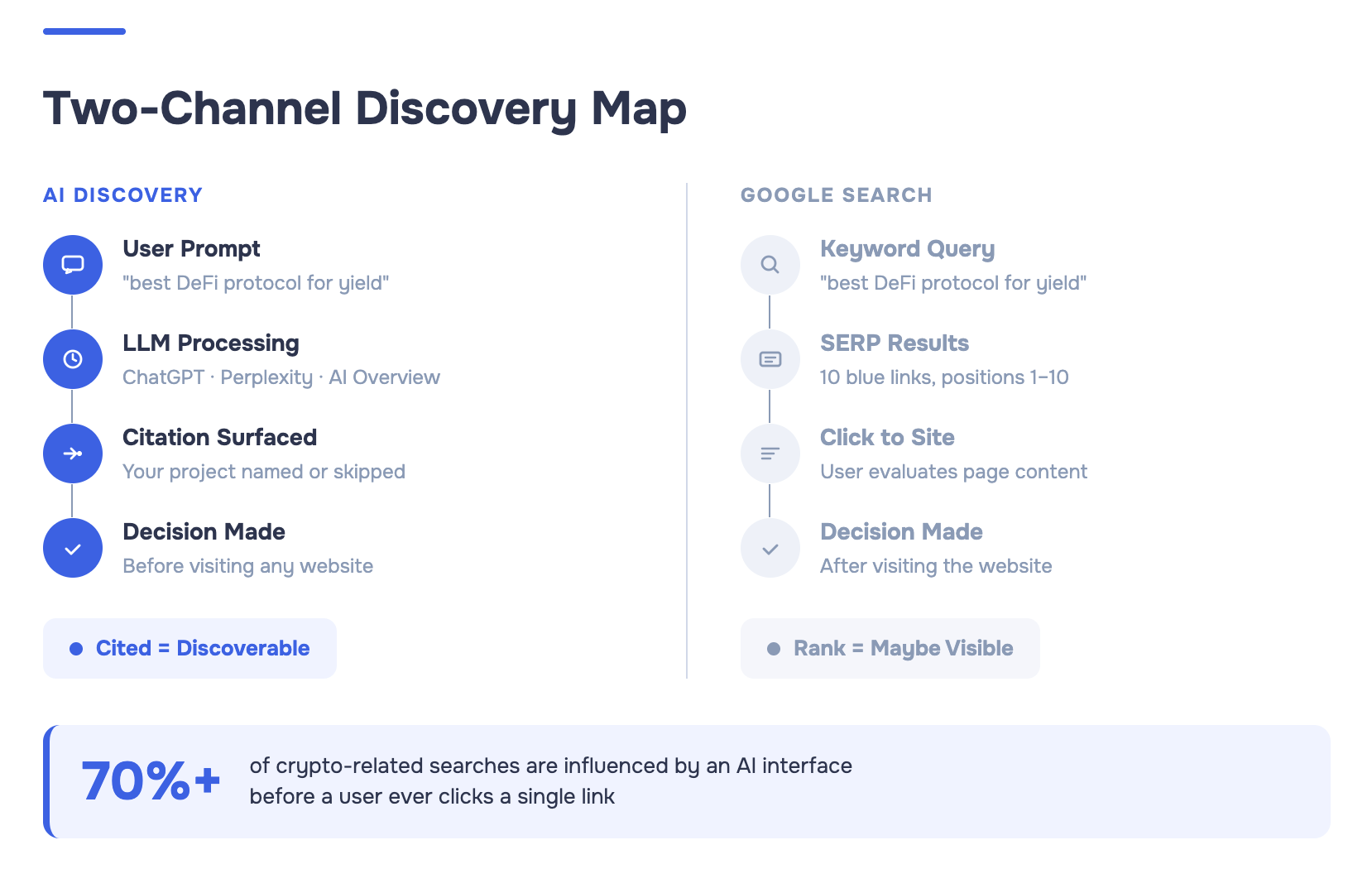
The clearest change: AI-powered discovery has split marketing into two parallel channels. Traditional search rankings are one. LLM citations are the other — when someone asks ChatGPT, Perplexity, or Google AI Overviews for a DeFi protocol recommendation, your project either comes up or it doesn’t. More than 70% of crypto-related searches are now influenced by an AI interface before a user ever clicks a link. An agency optimizing only for Google is delivering half a product.
Compliance has hardened too, in ways most agencies aren’t equipped for. MiCA is live across the EU. The GENIUS Act is reshaping stablecoin marketing in the US. Google and Meta keep tightening crypto ad policies. An agency without regulatory fluency isn’t a neutral partner — one misclassified token promotion can get your ad accounts pulled.
AI writing and design tools have also commoditized mid-tier execution. Anyone can produce mediocre content at scale for cheap now. What separates a valuable agency from a well-packaged commodity shop is strategic depth: building authority in AI citation networks, understanding tokenomics, developing community culture rather than inflating member counts.
The $4T+ crypto market means competition for attention is at a level where those distinctions show up fast.
In 2026, choosing a crypto marketing agency means evaluating two parallel discovery channels: traditional search rankings and LLM citations. Agencies that only address one are already behind.
Red Flag #1 — The Agency Only Talks About Google Rankings
Listen to what channel an agency lives in when they pitch you. If every case study, every KPI, and every recommendation revolves around organic Google traffic and domain authority, pay attention to that.
When someone types “best DeFi protocol for yield” or “most trusted crypto exchange” into ChatGPT or Perplexity, your project either appears or it doesn’t. No page two. No position 7 that still pulls a trickle of clicks. Cited or invisible.
Roughly 37% of product discovery queries now start in AI interfaces, and that figure skews higher for crypto-native audiences who adopt new tools early. An agency building your entire marketing budget around Google rankings is betting on a channel that’s losing share month over month.
Ask them directly: “Can you show me examples of client projects being cited in ChatGPT, Perplexity, or Google AI Overviews?”
A capable agency should be able to show this, not explain it theoretically. Also worth asking: what’s the difference between SEO, AEO, and GEO? How they answer tells you a lot about where their expertise actually sits.
What is AEO (Answer Engine Optimization)?
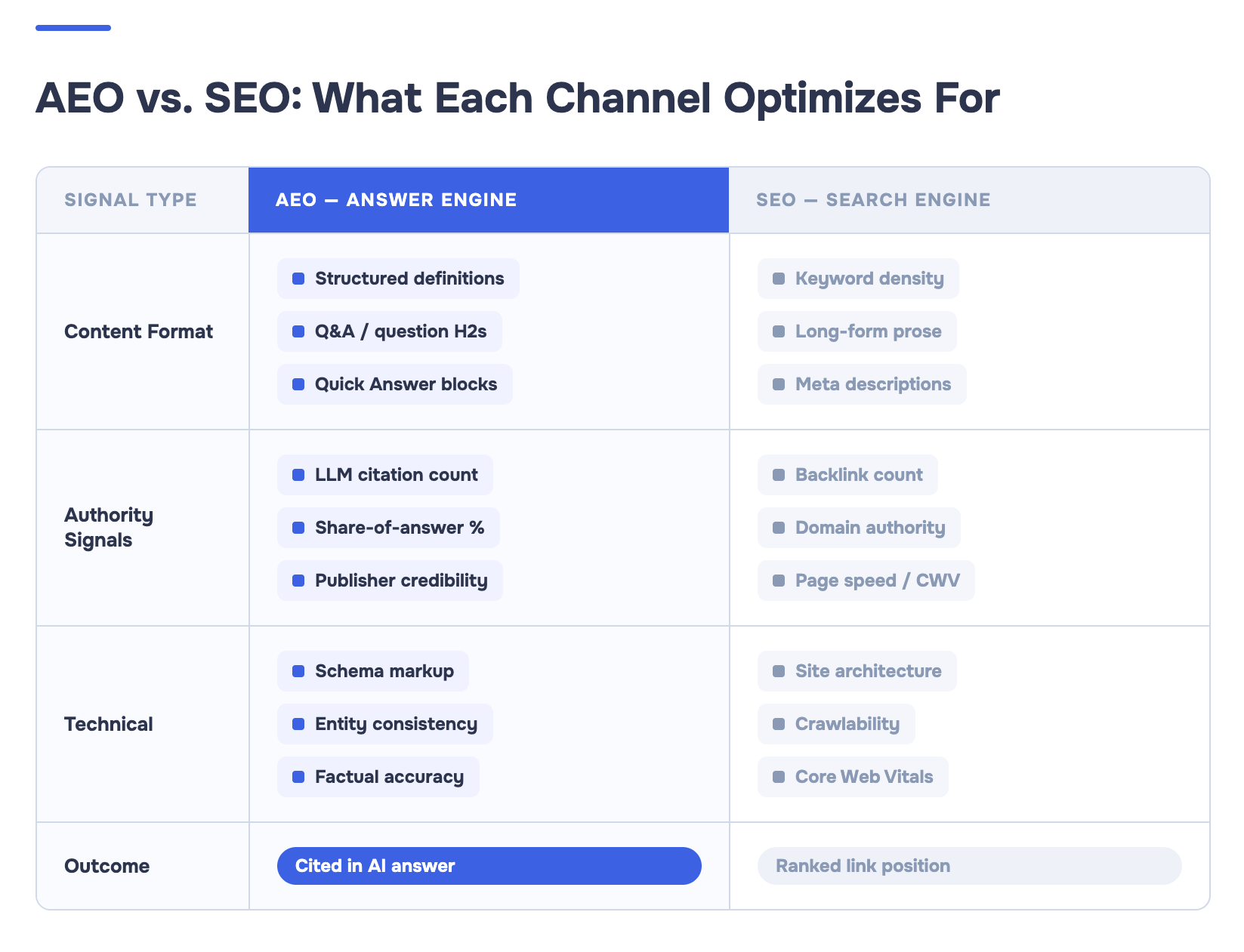
AEO is the practice of structuring content so it gets cited as a direct answer by AI engines like ChatGPT, Perplexity, and Google AI Overviews, as opposed to traditional SEO, which targets ranked link positions. SEO optimizes for relevance signals that surface links; AEO optimizes for authority signals that surface citations. For crypto projects, the practical difference is that AEO reaches users at the point of intent, before they’ve landed anywhere.
If an agency conflates GEO (Generative Engine Optimization, which focuses on content structure for LLM retrieval) with SEO, or can’t explain the distinction at all, you know where their expertise sits.
Red Flag #2 — No Proof of AI Citation Results
“We do AI search optimization” is something any agency can put on a slide deck. The question is what proof they have.
Agencies that can back up the claim are tracking which prompts trigger citations for their clients, which AI platforms cite them, and how share-of-answer shifts over a campaign. Tools like Profound make this systematic, tracking citations across ChatGPT, Claude, Gemini, and Perplexity for specific query clusters and showing before/after comparisons. If an agency can’t produce a share-of-answer report for a past or current client, the capability is copy, not a service.
For context on what the competitive landscape looks like: Coinbase and Kraken together capture about 22% of all AI citations in the US crypto category (5W AI Visibility Index 2026). For a mid-market protocol, getting into citation rotation for even a handful of targeted prompts can shift how discoverable you are.
5 ways to check whether an agency’s AI visibility work is real:
- Ask for a share-of-answer report, before and after, for a current or former client. Anonymized data with real numbers is fine.
- Look at their own blog. Do they use Quick Answer blocks, question-based H2 headings, structured definitions? If their own site isn’t built for LLM citation, they’re not doing what they’re selling.
- Ask which specific tools they use to track LLM citations. “We monitor AI performance” is not a workflow.
- Ask what percentage of current clients have measurable AI citation coverage. Any honest answer will be imperfect; what matters is whether there are numbers at all.
- Ask them to walk through the content architecture changes they’d make to a specific page to improve citation probability. A team with a real process can explain this without a pitch deck.
When you ask about AI visibility and the agency pivots to a Google Analytics screenshot, you have your answer.
How to Choose a Crypto AI Marketing Agency: A Practical Checklist
Most agency selection processes collapse into two steps: Google “best crypto marketing agency,” skim a few lists, and book a call with whoever has the most recognizable logos. That’s how you end up overpaying for templated execution. This checklist gives you a structured way to evaluate agencies before any proposal lands in your inbox.
1) Vertical depth, not vertical breadth
DeFi, GameFi, NFT, L1/L2 infrastructure, centralized exchange, token launch — surface-level experience in one doesn’t transfer to another. An agency that ran community campaigns for NFT drops knows little about DeFi protocol positioning. Ask for specifics by vertical. Depth in one or two areas is more credible than claimed fluency across everything.
2) Strategy that starts with your situation, not a template
A capable agency asks about your token structure, target user base, and growth stage before committing to any approach. If the pitch sounds the same regardless of what you’ve told them, it probably is.
3) Editorial relationships, not directory submissions
Guest posts and directory submissions are table stakes. What moves authority signals for both traditional SEO and LLM citation is editorial coverage from publishers that AI engines treat as credible. Ask for ten specific editorial domains where they’ve placed client coverage in the past 12 months. A vague reference to “our publisher network” is not an answer.
4) Tokenomics literacy
This is where Web3-native agencies separate from traditional shops with a crypto landing page. Tokenomics shapes which marketing messages hold up, what user acquisition incentives are sustainable, and what community dynamics you’re managing. An agency that doesn’t ask about your token structure early doesn’t understand the product they’re marketing.
5) Actual ecosystem presence
CT dynamics, Discord culture, the difference between a genuine community and an airdrop farm — none of that comes from a webinar. Ask where team members spend time, who they follow, what communities they’ve been part of for more than six months. Specific handles and events beat vague answers here.
6) Compliance fluency
An agency operating in 2026 without working knowledge of MiCA, the GENIUS Act, and current Google/Meta crypto ad policies is a liability. Ask how they handle compliance review on ad copy and whether they have legal counsel involved. If they treat compliance as someone else’s problem, it will become yours.
7) Measurable AI visibility, not claimed capability
Any agency can add “AI search optimization” to a service page. The question is whether they can show citation data across ChatGPT, Perplexity, Gemini, and Google AI Overviews for a current or past client. If they can’t produce before/after share-of-answer metrics, the capability exists on the deck, not in the work.

How to Evaluate Case Studies — What Numbers Actually Matter
Every agency has case studies. Almost none contain the numbers you need.
The pattern: a logo wall, testimonials, metrics that look impressive without context (“500% growth in community engagement”). None of that tells you whether the agency can do what you need.
Vanity metrics vs. real metrics:
| Vanity Metrics (Ignore) | Real Metrics (Demand) |
|---|---|
| Follower counts | Wallet sign-ups |
| Total impressions | TVL growth |
| Discord member count | Token holder acquisition cost |
| “Reach” statistics | Trading volume lift |
| Bot-inflated engagement | Governance participation rate |
| Google Analytics traffic only | LLM citation share-of-answer growth |
For a DeFi protocol, wallet sign-ups and TVL growth map to business outcomes. Token holder acquisition cost tells you whether growth is sustainable or manufactured through incentives that won’t hold. Governance participation rate is a proxy for whether your community is engaged or just present.
For AI-focused campaign claims, ask to see share-of-answer growth across tracked prompts and citation count changes over the campaign period. Those numbers exist if the agency tracked them. If they didn’t track them, that’s the answer.
Look for baseline → campaign → outcome structure. Specific numbers, even anonymized, matter. “Grew TVL by 40% over 90 days for a lending protocol” is useful. “Dramatically increased user engagement” is not.
Two examples of what properly documented AI visibility results look like in practice: ICODA’s work with a no-KYC crypto exchange that had been losing organic visibility with no path to paid advertising, resulted in 688% traffic growth from ChatGPT and 500+ AI citations across search platforms — with a clear before/after attribution through AI SEO and PR. A separate engagement with a crypto prop trading firm produced top-1 positions across five LLMs within 90 days, covering 15+ commercial discovery queries. Both cases show the baseline, the intervention, and the outcome with specific numbers — which is exactly the structure you should be demanding.
Watch for: logos without outcomes; testimonials that describe experience rather than results; cases where the only positive metric is token price increase without attribution methodology. Token prices move for plenty of reasons unrelated to marketing. An agency taking credit for price appreciation without explaining the causal chain is telling you something about how they operate.
Benchmark: effective campaigns for mid-market protocols typically run $20K–$80K/month. If case study ROI is proportionate to that investment level, it’s a reasonable signal. Wildly above or below without explanation — dig deeper.
Before You Sign: The 10-Question Checklist for Choosing a Crypto AI Marketing Agency
Use this in an agency evaluation call. Thirty to forty-five minutes should be enough to work through it and come away knowing whether the agency can do what they’re claiming.
AI Visibility Capability
1) Can they show you a share-of-answer report (before and after) for a current or past client, with citation data across ChatGPT, Perplexity, or Google AI Overviews?
2) Can they explain the operational difference between SEO, AEO, and GEO without reverting to generic answers?
3) Does their own content use the structural signals — Quick Answer blocks, question-based headings, structured definitions — that drive LLM citation?
Crypto-Native Expertise
4) Do they have verifiable depth in your specific vertical, not just “crypto” broadly?
5) Can they walk through a project-specific strategy that shows they’ve processed your details?
6) Do they ask about your tokenomics before giving strategic recommendations?
7) Can they name ten editorial publications where they’ve placed client coverage in the last 12 months?
Transparency & Pricing
8) Do their case studies show baseline → campaign → outcome with specific numbers, not just logos and testimonials?
9) Is pricing tied to deliverables and measurable KPIs rather than ad spend percentage?
10) Is there a defined exit clause if performance doesn’t meet agreed benchmarks?
An agency that moves through all ten without deflection, vague answers, or shifting into pitch mode is worth serious consideration. Most won’t manage it. That tells you something useful too — and it’s exactly the kind of clarity this checklist is designed to surface before any contracts get signed.
The Real Filter
Most founders spend more time evaluating software tools than they do evaluating the agency that shapes how their project is perceived. A bad tool costs a few hundred dollars and an afternoon. A bad agency costs six months of runway and a community that’s stopped believing in the project.
The filter that counts isn’t which agency has the most polished deck or the longest client logo list. It’s whether they can prove, with data, that they know how to make your project findable in 2026 — on Google and in the AI interfaces where your users are increasingly making decisions before they visit any website.
Ask the hard questions before you sign. Agencies that are capable at this work won’t dodge them. If you’re looking for a team covering the full stack — crypto-native expertise, AI citation tracking, compliance-aware strategy — ICODA’s AI marketing services for crypto and blockchain are built around exactly these criteria. That’s where to start, rather than working through another ranked list.
A traditional crypto marketing agency focuses on channels like PR, SEO, community, and KOLs. An AI marketing agency adds a layer on top: optimizing content specifically to get cited by ChatGPT, Perplexity, Gemini, and Google AI Overviews. In 2026, the distinction matters because LLM citations are increasingly where crypto audiences discover and evaluate projects before visiting any website.
Ask for case studies with specific, verifiable numbers — wallet sign-ups, TVL growth, LLM citation share-of-answer data. Legitimate agencies show baseline → campaign → outcome structure. Red flags: logo walls without outcomes, guaranteed results promises, pricing based purely on ad spend percentage, and inability to name specific editorial publications where they’ve placed coverage.
AEO (Answer Engine Optimization) is the practice of structuring content so it gets cited as a direct answer by AI engines like ChatGPT, Perplexity, and Google AI Overviews. For crypto projects it matters because when someone asks an LLM for a DeFi protocol recommendation or the best crypto exchange, your project either appears in the answer or it doesn’t — there is no page two.
The most important ones: the agency only tracks Google rankings with no LLM citation data; case studies show follower counts and impressions rather than wallet sign-ups or TVL growth; pricing is tied to ad spend percentage rather than KPIs; contracts have no defined deliverables or exit clause; the team can’t explain the difference between SEO, AEO, and GEO; and there’s no evidence of compliance awareness around MiCA, the GENIUS Act, or platform ad restrictions.
Ask for a share-of-answer report — before and after — for a current or past client, with citation data across at least two LLM platforms. Check whether their own content uses Quick Answer blocks, question-based headings, and structured definitions. Ask which specific tools they use to track LLM citations. If they respond to AI visibility questions with Google Analytics data, that tells you what you need to know.
Share with


Rate the article