Ask ChatGPT, Claude, or Gemini to name the leading lending protocols on Ethereum and you’ll get a shortlist. Your project is either on it or it isn’t. And if it isn’t, the reason usually has nothing to do with how good your docs are.
Here’s the part most crypto teams miss: large language models don’t open your website when someone asks about you. They answer from what they already “know” — a compressed memory of entities formed during training and topped up through retrieval. Your protocol lives in that memory as a recognized entity, or it may as well not exist.
So while you’re optimizing pages for keywords, the model is doing something else entirely. It’s recognizing, disambiguating, and ranking entities. The projects that get cited again and again aren’t the ones with the slickest copy. They’re the ones whose identity is structured, verified across independent sources, and consistent everywhere a model might look.
This guide shows you how to build that structure — the entity cluster — for a Web3 project, one step at a time.
What Is an Entity in Crypto Context (and Why It’s Not a Keyword)
A keyword is a string of characters. An entity is a thing the model believes exists — with a category, a set of attributes, and relationships to other things it already knows.
That distinction is the whole game for entity SEO in crypto. When you target the keyword “best DeFi lending,” you’re betting a page ranks for a phrase. When you build an entity, you’re teaching the model that your protocol is a specific organization in the lending category, built by specific people, governed by a specific DAO, with a specific token. Keywords get matched. Entities get recalled.
Technically, your project isn’t stored as a row in a database. Models compress entities into vector proximity clusters — regions of embedding space where related concepts sit close together. A project with enough consistent signals lands in the right cluster, next to its real peers. A project with thin or contradictory signals lands in the wrong cluster, or in no cluster at all.
In Web3 you’re rarely dealing with one entity. You’re dealing with several that need to be linked:
- The project or protocol — the organization and the product it ships
- The token — its own entity, with a ticker, a contract address, and a chain
- The founders and core contributors — person entities, each a node
- The DAO or governance body — often distinct from the company behind it
- Partners, integrations, and backers — entities you connect to
An entity cluster for crypto is the connected graph that ties these together: project, topic, sources, identifiers. Get the links right and the model sees one coherent thing. Get them wrong — a founder’s name spelled three ways, a token the model can’t match to its protocol — and you fragment into noise it can’t safely cite.
How LLMs Build Their Knowledge About a Crypto Project
There are two ways a model learns about you, and they run on different clocks.
The first is training. The model reads the open web at scale and forms a durable, compressed picture of entities — who they are, what category they sit in, how often independent sources talk about them. This is slow-moving memory, and it’s where most of the “recall” in an AI answer comes from.
The second is retrieval. When ChatGPT search or Perplexity answers a live query, it can pull fresh pages and quote them. Retrieval is faster to influence, but it still leans on the same signals: the model reaches for sources it already trusts.
Either way, a predictable sequence decides whether you show up. Think of it as four gates:
- NER filter. Named Entity Recognition has to classify your project as an Organization or Product in the right category. Fail here and you’re dropped from retrieval before content quality is ever assessed. Nothing downstream can save you.
- Disambiguation. If your name collides with another word or company, the model picks the more established candidate. Polysemic names lose by default — and crypto is full of them.
- Source selection. Among the survivors, the model favors sources with the highest density of verifying signals from independent domains.
- Content extraction. Only now does it pull a passage to cite. Models lean heavily toward the opening of a document, so what sits in your first few paragraphs matters far more than what’s buried deeper down.
Here’s what trips up most teams: your own site is the weakest source of all. The large majority of AI citations point to earned media — content you neither own nor pay for. Community platforms like Reddit and reference sites like Wikipedia regularly rank among the most-cited sources, while your own domain rarely does. The model trusts the room’s consensus about you far more than your own description of yourself.
The Entity Cluster Map: What It Looks Like for a DeFi Protocol
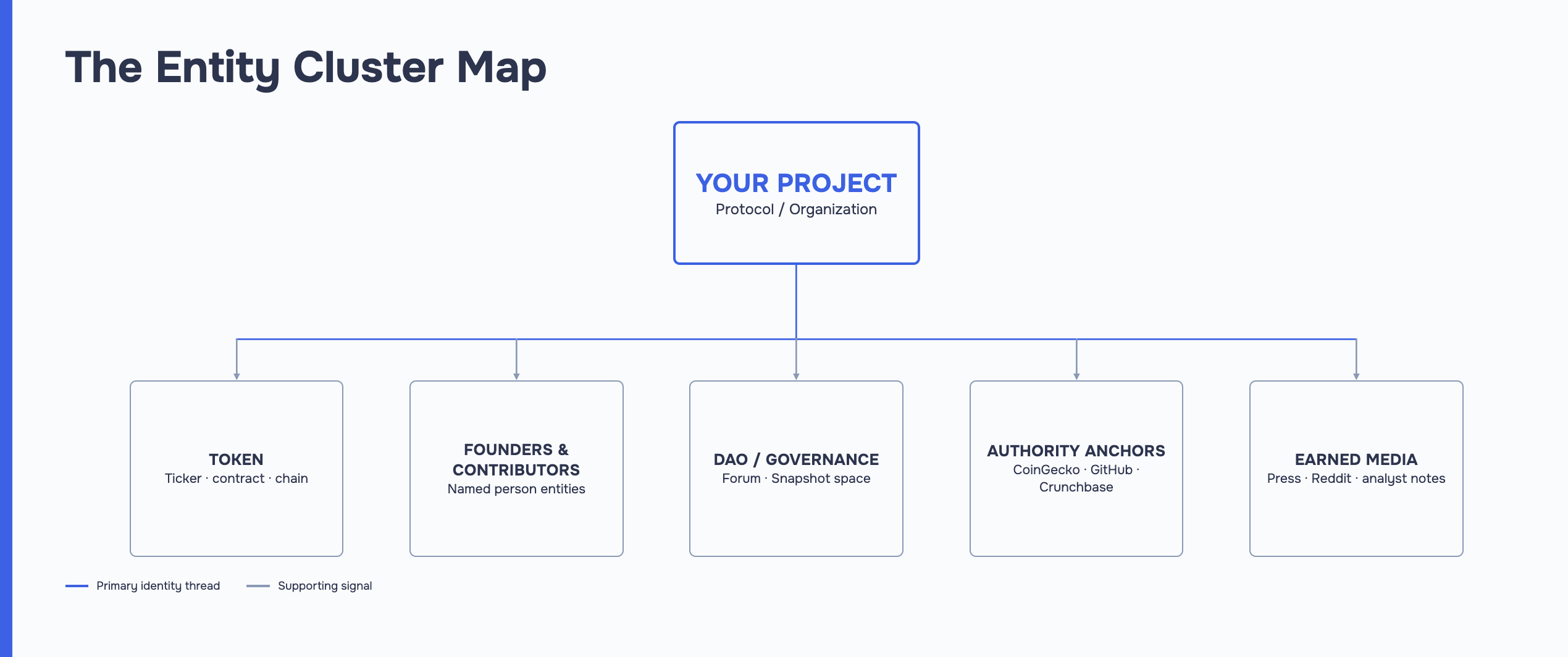
Before you build anything, you need a picture of what you’re building. An entity cluster is a graph with your protocol at the center and verified connections radiating out. Take a hypothetical lending protocol — call it Lendora — and the map looks like this:
Lendora — Protocol / Organization (category: DeFi lending on Ethereum)
|- Token: $LEND (contract address, chain: Ethereum)
|- People: founders + core contributors (each a Person entity)
|- Governance: Lendora DAO (governance forum, Snapshot space)
|- Structured identity: Wikidata Q-ID / Organization Schema @id / sameAs
|- Authority anchors: CoinGecko / CoinMarketCap / GitHub / Crunchbase
|- Earned media: analyst notes / industry press / Reddit + forum threads
Every node here is itself an entity the model might know, and every line is a claim you want several independent sources to confirm. The cluster isn’t a single page. It’s the agreement between pages.
It helps to picture the cluster in three layers, roughly ordered by how much each moves the needle:
- Structured Identity — your Wikidata Q-ID, Organization Schema with a stable
@id, andsameAslinks. This layer confirms you exist and names your category. - External Verification — earned media, analyst coverage, exchange and aggregator listings, independent mentions. This builds multi-domain consensus and is the heaviest operational factor of the three.
- Content Signals — deep, structured content with high entity density, statistics, and quotes. This is what actually gets extracted once you’ve cleared the first two layers.
Getting all three consistent pays off in a way you can measure. Brands with coherent entity data across all three layers get cited far more often than brands whose identity is fragmented. The lever is consistency, not volume.
Step 1: Wikipedia and Wikidata — The Non-Negotiable Foundation
If you do only one thing from this guide, make it this. Wikidata is the primary identity hub LLMs lean on to confirm a crypto project is a real, categorized entity. Without an entry, your project reads to the model as an unverified mention — a name it saw, not an entity it knows.
The two platforms do different jobs:
Wikidata is a structured, machine-readable set of statements: instance of → DeFi protocol, inception → 2022, founded by → [a named person], official website → [the URL]. Those are exactly the clean, declarative facts a model absorbs reliably.
Wikipedia is the prose layer that convinces the model the entity is notable enough to exist at all.
Now the honest caveat: a Wikipedia page is necessary but not sufficient. Pew Research — the only major independent, non-vendor study on AI sources — found Wikipedia, YouTube, and Reddit together supply just 15% of AI summary sources. A lone Wikipedia page won’t buy systematic citations if nothing else backs you up. It’s the foundation, not the house.
A few rules keep the effort from going to waste:
- Earn notability first. Wikipedia demands coverage in independent, reliable sources. If you have no earned media yet, Step 2 comes before this one in practice — a page created without it tends to get deleted.
- Write Wikidata statements with real identifiers. Attach the official site, GitHub org, Crunchbase, and relevant profiles as properties. This is where your
sameAscluster actually lives. - Keep the Q-ID stable and the facts current. Entity maturity — Wikidata quality plus Schema coherence plus a consistent
sameAscluster — is one of the strongest predictors of whether an LLM cites you. Stale or contradictory statements drag that signal down.
Done right, this becomes the anchor that every other signal in your cluster points back to.
Step 2: Authority Source Network — CoinGecko, CMC, GitHub, Crunchbase
This layer does the most work, and it’s the one teams reach for last. External verification — what independent sources say about you — is the heaviest operational factor in whether an LLM cites you. The model trusts consensus across domains, then repeats it.
Start with the entity anchors every serious crypto project needs:
- CoinGecko and CoinMarketCap — not just price pages. They’re category databases that tie your token to its project, chain, and contract. For a crypto entity they act like a trade registry the model reads as authoritative.
- GitHub — a public org with active repos marks you as a real building organization, not a landing page. Link the org from Wikidata and from your site.
- Crunchbase — the canonical record for company facts: founders, funding, founding date, category. It answers the same “who is this organization” question the NER filter asks.
The rule across all of them is blunt: say the same thing everywhere. Same legal name, same founding year, same founder names, same one-line category. Fragmented facts across these anchors are exactly how a project lands in the wrong vector cluster.
Then widen the net to earned media and community sources, because this is where the weight really sits — not on your own domain. Ahrefs’ study of 75,000 brands found brand mentions correlate with AI visibility three times more strongly than backlinks — 0.664 versus 0.218. Independent coverage in industry outlets and analyst reports is the strongest signal of all; presence on Reddit, G2, and professional forums is the fastest-growing one.
There’s a structural bonus here. When your entity data is structured and consistent across several independent sources, the model has to do less work to figure out who you are — so it reaches for you more readily. Multi-domain agreement doesn’t just prove you exist — it makes you the path of least resistance.
Step 3: Controlled Vocabulary — Defining How LLMs Talk About You
Models don’t invent language about you. They echo the language they see most consistently. So decide, on purpose, how you want to be described — then use those exact words everywhere, forever.
A controlled vocabulary for a crypto project has a few fixed elements:
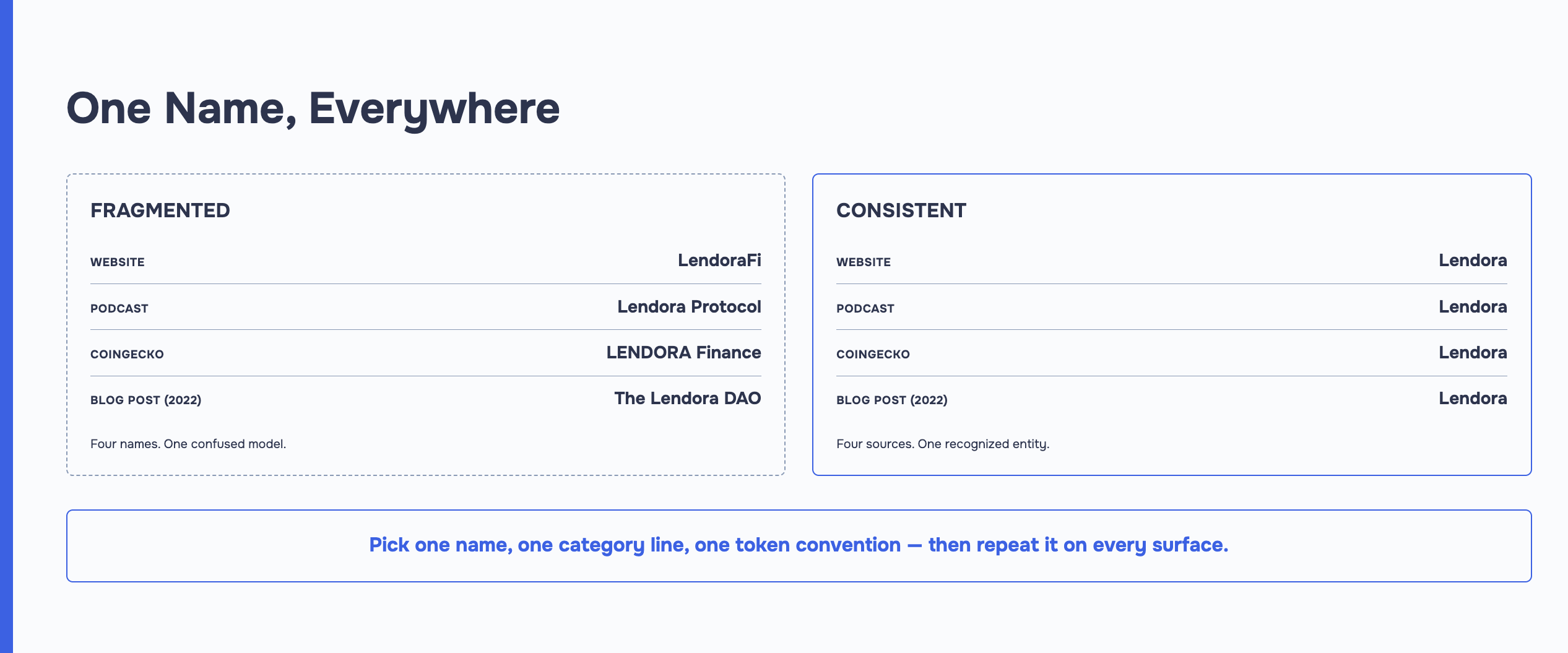
- The canonical name. Pick one spelling and capitalization. Is it “Lendora,” “LendoraFi,” or “Lendora Protocol”? Choose, and never drift. Every variant you tolerate is a disambiguation problem you’re handing the model.
- The category line. One sentence the model can lift verbatim: “Lendora is a decentralized lending protocol on Ethereum.” This is the sentence you want quoted back in an AI answer, so write it as if it already is.
- The token convention. Always “LEND, the governance token of Lendora,” never the ticker floating free. You’re stitching the token entity to the project entity every time.
- The disambiguators. If your name collides with a common word or another company, bolt on identifiers — the chain, the category, the founder, the contract. This is how you win the model’s disambiguation step instead of losing it to a more popular namesake.
Entity optimization for LLMs is mostly this discipline practiced at scale. Your website, docs, GitHub README, CoinGecko description, Crunchbase blurb, and press boilerplate should all open with the same category line and the same canonical name. When an outlet covers you, hand them that boilerplate so the earned media reinforces it too.
The failure mode is quiet and common. A founder describes the project one way on a podcast, the site says something slightly different, and a 2022 blog post says a third thing. None of it is wrong. But the model now holds three fuzzy descriptions instead of one sharp one — and fuzzy entities don’t get cited.
Step 4: Internal Content Cluster as Entity Signal
Your own site won’t be the model’s favorite source — that’s earned media’s job. But it plays a specific, important role: it’s the reference map that tells the model how your entities relate. A tightly linked content cluster is you drawing your own entity graph and handing it over.
The pattern that works is hub-and-spoke, often parked under a dedicated path like /ai/. A pillar page defines the core entity — the protocol — and spoke pages cover each connected entity and concept: the token, the governance model, the founders, the audits, each integration. Every spoke links back to the pillar and sideways to its siblings. The link structure mirrors the cluster map from earlier, and that’s the point. You’re teaching relationships, not just publishing pages.
Inside those pages, content architecture decides what gets extracted once you’ve cleared disambiguation. The data here is unusually consistent:
- Lead with the answer. Most citations are pulled from the opening stretch of a document, not the end. Put the definition and the key fact up top, never in a conclusion.
- Use real numbers. Adding statistics is the single most effective optimization in the Princeton GEO Study — a visibility lift of around 41% — and adding quotes from authoritative sources performs nearly as well.
- Go deep. Longer, substantive pages get cited far more often than thin ones.
- Keep it fresh. Recently updated content gets cited more than stale pages.
- Pack in entities. Every named entity near your brand — a chain, a standard, a partner, a founder — is another verification anchor.
One warning worth internalizing: don’t mistake schema markup for this work. Google’s own AI-search guidance (May 2026) states there’s no special structured data you need to add for generative AI features. Schema still helps Google’s Knowledge Graph and rich results. It doesn’t make an LLM cite you — language and structure do.
Step 5: Cross-Platform Consistency — When Your Entity “Learns”
Everything so far builds a snapshot. This step is about the feedback loop that turns a snapshot into momentum — or quietly erases it.
Here’s the mechanism. When AI systems retrain or update, they use citation data from earlier versions as a signal. Entities that were cited often carry that authority forward into the next model. Get cited, and you become more likely to be cited again. That’s why AI visibility compounds, and it’s the engine behind the “anchor entity” effect: a handful of top brands in each category now pull the majority of AI citation share, and that concentration has been climbing fast. The rich get richer, fast.
The flip side is that your entity is always learning from whatever it sees most consistently — including your contradictions. If your CoinGecko category says one thing and your Wikidata says another, you’re not just losing points. You’re teaching the model that your identity is uncertain. Cross-platform consistency is what lets the loop run for you instead of against you.
And none of it is set-and-forget. AI visibility is genuinely unstable:
- A single model release can reshuffle which domains get cited.
- Brand visibility in AI citations can swing sharply from one month to the next.
- Many brands don’t hold steady visibility even from one session to the next.
So treat entity strength as a monitored metric, not a project you finish. Track how ChatGPT, Claude, Gemini, and Perplexity describe your protocol. Watch for drift after model updates. When a new source contradicts your canonical facts, fix it fast — before the next training run bakes the error in.
Entity Cluster Checklist: 20 Items
Work top to bottom. Identity first, because the NER filter runs first. Authority next, because it carries the most weight. Content and monitoring last, because they only pay off once the first two hold.
1. Structured identity
- [ ] Create or upgrade your Wikidata entry with a stable Q-ID
- [ ] Fill key Wikidata statements: instance of, inception, founders, official website, chain
- [ ] Publish or improve a Wikipedia page once you have independent coverage
- [ ] Add Organization Schema with a stable @id on your main site
- [ ] Add Person Schema for each founder and core contributor
- [ ] Build a complete sameAs cluster across Wikipedia, Wikidata, LinkedIn, Crunchbase, and GitHub
- [ ] Lock one canonical name and spelling across every surface
- [ ] Write one category line and reuse it verbatim everywhere
- [ ] Always tie the token to the project, never let the ticker float free
- [ ] Add disambiguators if your name is polysemic (chain, category, contract)
2. Authority network
- [ ] Claim and complete your CoinGecko listing with consistent facts
- [ ] Claim and complete your CoinMarketCap listing so it matches
- [ ] Keep an active public GitHub org, linked from the site and Wikidata
- [ ] Create or update a Crunchbase profile with matching founder and funding data
- [ ] Earn independent coverage in industry outlets and analyst reports
- [ ] Build real presence on Reddit, G2, and relevant professional forums
3. Content and monitoring
- [ ] Build a pillar-and-spoke content cluster under a path like /ai/
- [ ] Lead every key page with the answer and a hard number in the first 30%
- [ ] Refresh core pages at least every 30 days
- [ ] Track how ChatGPT, Claude, Gemini, and Perplexity describe you, and correct drift
Check Your Entity Strength Before the Next Model Update
You now have the framework: identity first, authority next, content and consistency on top, all pointing back to one coherent entity. The projects that win AI citations aren’t guessing at this. They’re building it on purpose and watching it closely.
Start with a diagnosis. Open ChatGPT, Claude, Gemini, and Perplexity and ask each one to describe your protocol, name its token and founders, and list its competitors. The gaps you find — the wrong category, the missing founder, the rival who shows up instead of you — are your entity cluster’s weak links, already ranked by urgency.
↗️ Check how strong your project’s entity presence is in AI search right now — then fix the weakest link first, before the next model update decides for you.
Frequently Asked Questions (FAQ)
Longer than you’d like, and it depends on the loop. Retrieval-based tools like Perplexity and ChatGPT search can reflect new earned media within weeks. The deeper “recall” baked into model weights only updates when models retrain, so those gains surface over months. Entity optimization compounds. The earlier you build verified signals, the more authority carries forward each cycle.
Wikidata is the higher priority because it’s structured, LLM-friendly, and easier to create. Wikipedia adds a notability signal and a text source models read during training, but it demands independent coverage first and a lone page won’t carry you. Build the Wikidata entry now, and earn the media that justifies a Wikipedia page in parallel.
Not on its own. In controlled tests, adding JSON-LD produced no meaningful change in ChatGPT citations, and Google’s own guidance says there’s no special structured data you need to add. Schema still helps Google’s Knowledge Graph and RAG systems, so keep Organization and Person schema in place — just don’t expect it to move LLM citations by itself.
Lean hard on disambiguators. Never let the name stand alone — always pair it with the chain, the category, the contract address, or a founder. The model’s disambiguation step favors the more established candidate, so your job is to make your version unmistakable. A clean Wikidata entry with a unique Q-ID is the strongest single fix.
Prompt the major models directly and read what they say. Ask ChatGPT, Claude, Gemini, and Perplexity to describe your protocol, list alternatives in your category, and state your token and founders. Watch three things: whether you appear at all, whether the facts are right, and whether they stay consistent across sessions. Consistency between sessions is rare, so inconsistency is the norm you’re fighting.
Share with


Rate the article