




Search is splitting in two. On one side, Google still drives the majority of crypto organic traffic. On the other, AI systems — ChatGPT, Perplexity, Google AI Overviews, Gemini — are rapidly becoming the first stop for users with high-intent questions about exchanges, wallets, and DeFi protocols.
The problem: these two ecosystems don’t overlap the way most teams assume.
This report synthesizes data from 30+ industry studies alongside ICODA’s hands-on experience working with crypto projects across both channels. Five findings stand out:
- Only 38% of AI Overview citations come from Google’s top 10 — down from 76% in mid-2025. Ranking first doesn’t mean AI systems will cite you.
- Brand mentions correlate 3x more strongly with AI visibility than backlinks (0.664 vs 0.218). The signals that built your Google authority matter less in AI search.
- 77% of top crypto media outlets lost organic traffic between 2024 and 2026. The YMYL/E-E-A-T reclassification hit crypto harder than almost any other vertical.
- AI-referred traffic converts at rates 5–11x higher than standard organic search — making AI visibility a revenue problem, not just a branding one.
- Technical barriers unique to Web3 — SPA rendering, wallet connection scripts, API-heavy price widgets — are invisibly blocking AI crawler access for a large share of crypto projects.
The window to establish AI visibility before citations consolidate around a small set of trusted brands is narrow. What follows is a breakdown of what’s actually happening and what to do about it.
Methodology
To produce this report, the ICODA research team spent several months mapping the AI visibility landscape for crypto and blockchain projects. We reviewed over 30 studies, datasets, and citation analyses — covering more than 129,000 domains, 75,000 brands, and hundreds of millions of AI-generated citations across ChatGPT, Perplexity, Google AI Overviews, and Gemini.
That external data was cross-referenced against crypto-specific research: traffic dynamics of major crypto domains across the 2024–2026 Google core update cycle, YMYL and E-E-A-T compliance patterns across exchanges and DeFi protocols, Web3 technical architecture audits, and campaign data from ICODA’s own client work in the vertical.
Where findings apply to the broader web, we say so. Where patterns are specific to crypto — driven by YMYL classification, advertising restrictions, or the technical constraints of blockchain products — we treat them as a separate case. Every statistic in this report comes from verified research or direct client data.
Finding 1: Most Top-50 Crypto Projects Are Invisible in ChatGPT Despite Ranking in Google
There’s a disconnect at the heart of most crypto SEO strategies that almost no one is talking about.
The standard assumption has been simple: rank well in Google, and AI systems will follow. The data from 2025–2026 has demolished this assumption.
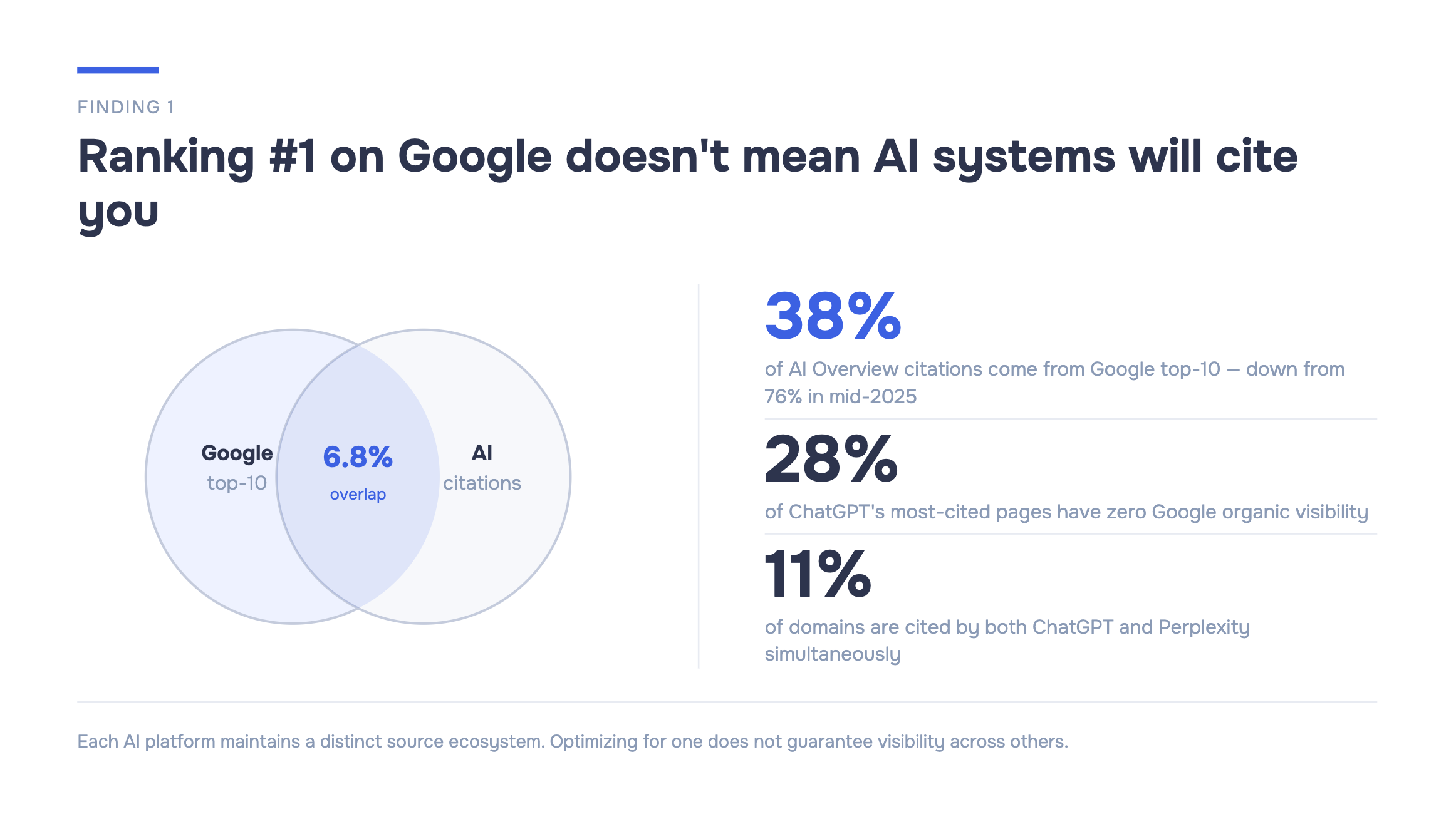
In mid-2025, approximately 76% of pages cited in Google AI Overviews also ranked in the top 10 organic results. By early 2026, that figure had dropped to 38% — and BrightEdge data puts it even lower, at 17%. Meanwhile, an Ahrefs analysis found that 28.3% of ChatGPT’s most-cited pages have zero organic visibility in Google at all. A page that doesn’t rank anywhere on Google can still be the primary source ChatGPT references for a given topic.
For crypto projects, this divergence is especially sharp. When you ask ChatGPT “best anonymous crypto exchange” or “top DeFi lending protocols,” the brands that appear aren’t always the ones dominating Google SERPs. They’re the ones that AI systems have learned to trust — through a different set of signals.
Why the gap exists
Each AI platform draws from its own source ecosystem. Only 6.82% of ChatGPT results overlap with Google’s top 10 organic results. Google AI Overviews and AI Mode, despite being Google products, share just 13.7% of cited URLs. Perplexity has its own entirely separate citation logic.
This means a crypto project can have a DR 70 domain, thousands of backlinks, and consistent first-page Google rankings — and still be effectively invisible to the 900 million weekly users asking AI assistants about crypto products.
The practical consequence: most crypto marketing teams are optimizing for the wrong measurement entirely. Position tracking in Google tells you almost nothing about your AI visibility score.
Finding 2: Brand Mentions Are Now the Primary AI Visibility Signal — and Most Crypto Projects Are Missing This
Backlinks built the internet’s trust infrastructure for 25 years. AI systems have partially overridden that infrastructure with something different.
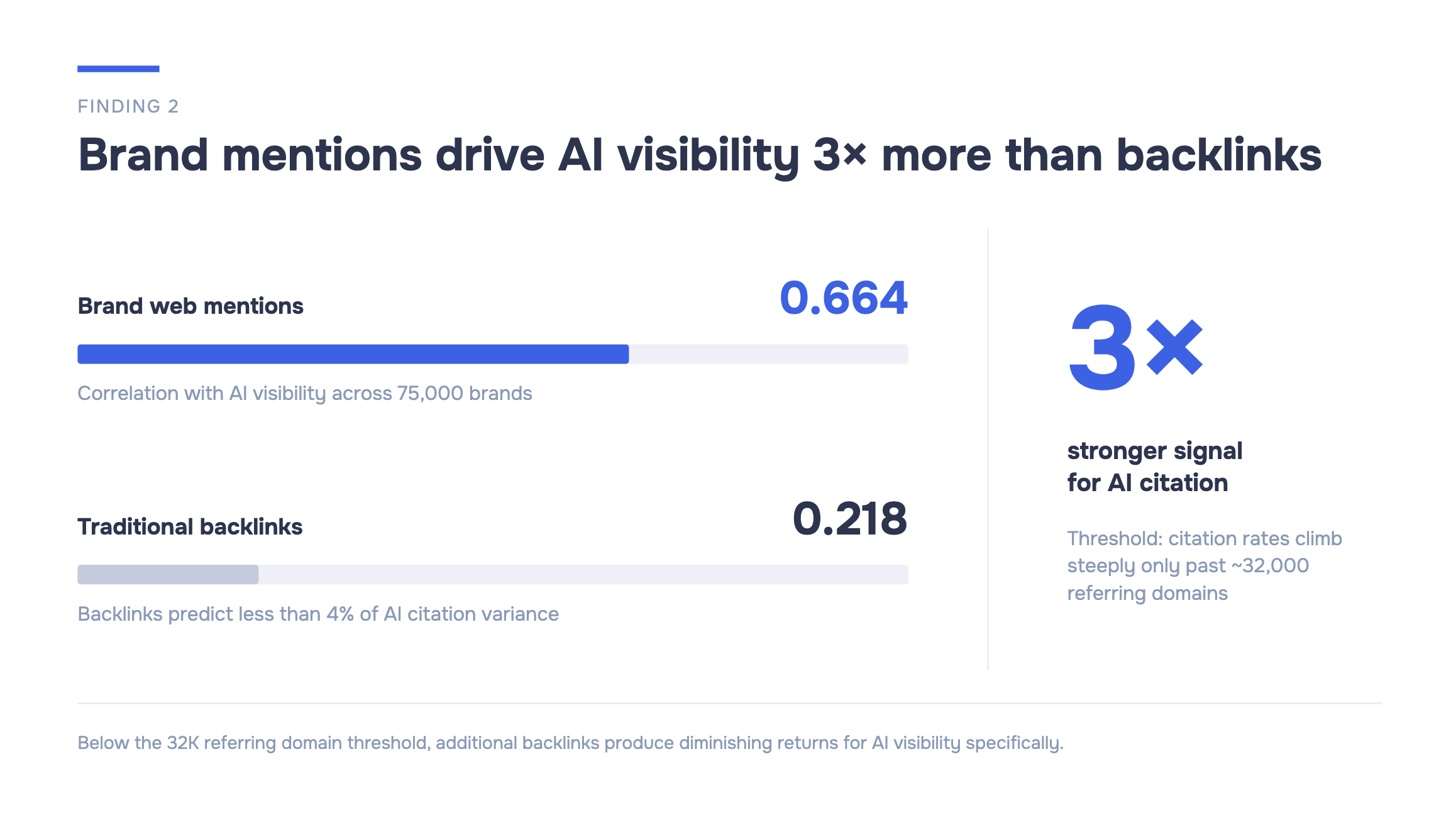
A large-scale analysis of 75,000 brands found that brand web mentions correlate with AI visibility at 0.664, while traditional backlinks correlate at just 0.218 — nearly a 3:1 difference. Brands in the top 25% by mention volume receive an average of 169 AI citations. The next tier down gets 14. That’s not a small gap; it’s a different game entirely.
For crypto projects, this creates a specific problem. The Web3 ecosystem has historically been strong at generating backlinks through directories (CoinGecko, CoinMarketCap, DeFi Llama), press releases, and exchange listing announcements. These create link equity. They don’t necessarily create the kind of editorial brand mentions that AI systems interpret as genuine authority signals.
What AI systems are actually reading
When ChatGPT or Perplexity decides whether to recommend a crypto exchange, they’re not primarily running a PageRank calculation. They’re looking for corroborating signals: does this brand appear in comparative content across multiple independent sources? Do crypto forums discuss it? Does it have editorial coverage in recognized financial media? Does Reddit have substantive threads where users recommend it?
A project that ranks #1 for “best crypto swap platform” through technical SEO but has minimal independent editorial coverage is a shaky citation candidate for an AI system trained to be cautious about financial content.
The threshold effect
Backlinks aren’t irrelevant — but the correlation curve is non-linear. SE Ranking’s analysis of 129,000 domains found that meaningful ChatGPT citation rates only start to climb steeply once a domain crosses approximately 32,000 referring domains. Below that threshold, adding more backlinks produces diminishing returns for AI visibility specifically. Above it, the effect compounds.
Most mid-tier crypto projects sit well below this threshold. Which means the highest-leverage investment for AI visibility isn’t more link building — it’s building the kind of multi-platform brand presence that AI systems recognize as genuine authority.
Finding 3: AI Visibility Correlates with Content Depth, Not Domain Authority
The “content quality” maxim gets repeated so often it loses meaning. The data from AI citation studies finally puts concrete numbers behind it.
Depth over length, but length helps
Pages cited by AI systems average significantly more substantive content than uncited pages. SE Ranking found that pages over 2,900 words are 59% more likely to be cited than pages under 800 words. But word count alone isn’t the driver — cited content contains 32% more explicit concepts than uncited content. AI systems aren’t rewarding padding; they’re rewarding coverage.
For crypto specifically, this matters enormously. A page explaining how a DeFi lending protocol works — covering collateralization ratios, liquidation mechanics, gas optimization, risk scenarios — gives an AI system far more extractable material than a generic “what is DeFi” overview. The more complete the picture, the more useful the page is as a citation source.
The 30% rule
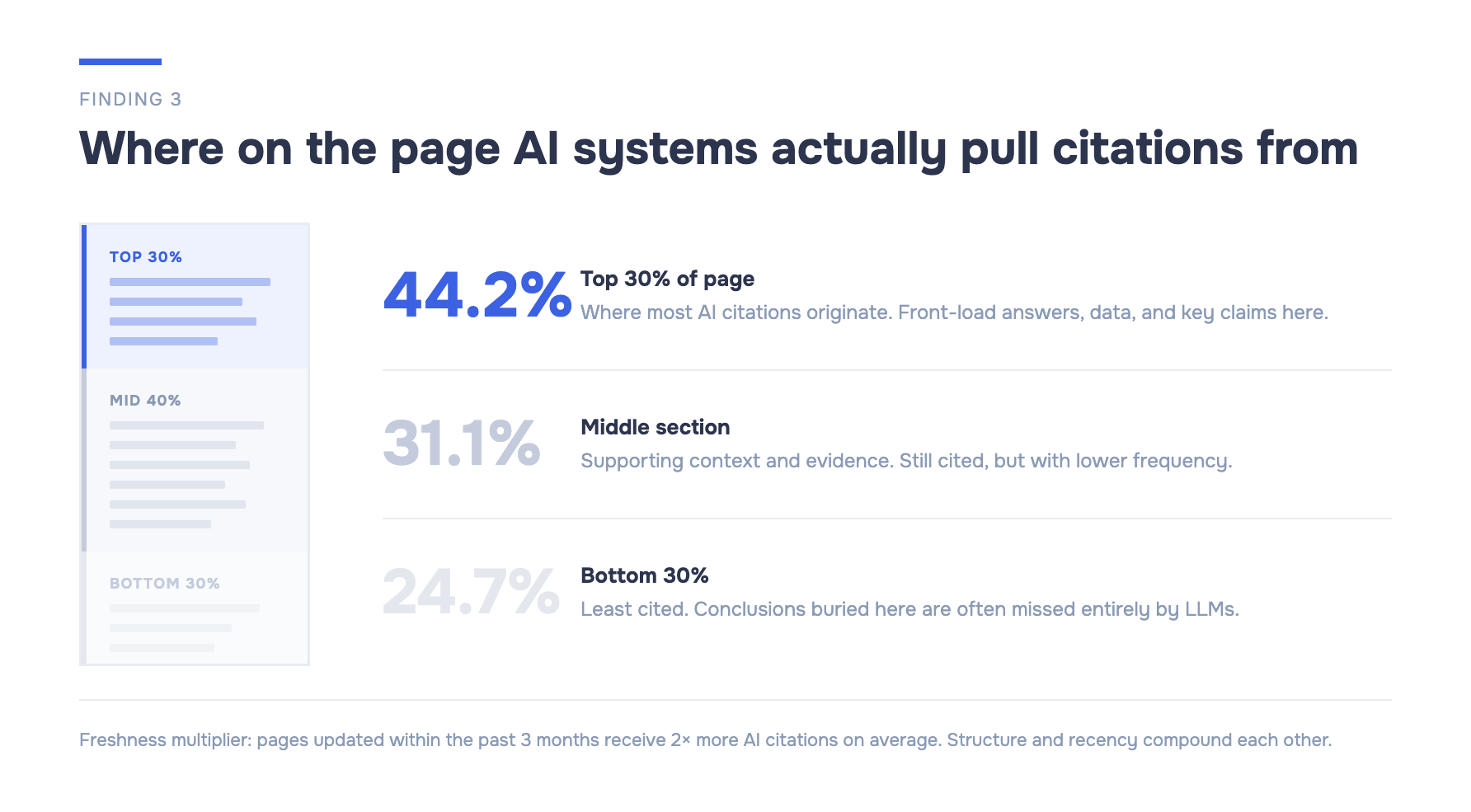
Research on citation patterns across LLMs found that 44.2% of all AI citations are drawn from the first 30% of page content. The final third contributes only 24.7%. This has direct implications for how crypto content should be structured. If the actual answer to a user’s question is buried after a long introduction, historical background, and regulatory disclaimer section, AI systems will often miss it entirely — or cite a competitor whose content front-loads the same information.
Freshness compounds everything
AI-cited content is on average 25.7% fresher than typical Google top-10 results (median age 1,064 days vs. 1,432 days). Pages updated within the past three months average 6 AI citations versus 3.6 for older content — nearly double. For crypto, where protocol parameters, regulatory status, and fee structures change frequently, keeping content genuinely current isn’t just a best practice. It’s a citation prerequisite.
One nuance worth flagging: “freshness” means substantive updates, not cosmetic date changes. Google’s December 2025 Core Update introduced what analysts called a “Fake Freshness” penalty — sites that appended “2026” to headers without meaningful content additions saw trust signal reductions. The crypto vertical was hit particularly hard by this.
The YMYL ceiling
There’s a structural ceiling on AI visibility for crypto content that doesn’t affect most industries: the YMYL classification.
Google’s Quality Rater Guidelines explicitly categorize cryptocurrency content as Your Money or Your Life — the same tier as medical advice and legal guidance. This means every page on a crypto site faces the highest content quality standards Google applies. The real-world consequence has been severe. Between 2024 and early 2026, 77% of top crypto media outlets lost organic traffic. Cointelegraph — DR 89, nearly 79,000 referring domains — dropped from 18,560 keywords in the top 3 to just 27. CoinGecko’s monthly visits fell from 43.5 million to 18.5 million.
The common thread across sites that collapsed: anonymous authorship, lack of verifiable expertise signals, and content that looked authoritative by traditional SEO standards but couldn’t demonstrate first-hand experience. Sites where named experts write from demonstrable experience, where credentials are disclosed, and where regulatory compliance is clearly documented held their positions.
For any crypto project hoping to compete for AI citations on high-intent queries, this is the baseline. AI systems trained on Google’s quality signals have absorbed these preferences. Getting cited as a credible financial source requires looking like one.
What This Means for Your Crypto Marketing Strategy
The compounding effect of AI visibility is what makes the timing matter.
Traffic from AI platforms converts at rates between 5x and 11x higher than standard organic search. Visitors arrive already informed — they’ve asked an AI a specific question and been directed to you as the answer. They’re not browsing; they’re deciding. The quality difference is visible in behavior data: AI-referred users spend roughly 30% more time on site and complete significantly more key events.
The business case compounds further when you consider what Google restrictions have done to crypto advertising. With Google Ads and Meta both blocking or severely limiting crypto promotion, up to 72% of crypto traffic acquisition comes through organic channels. CAC through SEO sits at $15–$45 per verified user, versus $150–$300 in permitted paid channels. A top-3 position for a high-intent query like “best crypto swap” represents the equivalent of roughly $4.2 million per month in paid traffic at comparable CPCs.
AI visibility adds another dimension to this. Being cited by ChatGPT, Google AI Overviews, and Perplexity simultaneously creates a compounding authority signal: each citation reinforces the brand signals that other platforms detect. Projects that establish AI visibility now build a lead that becomes progressively harder to close.
The multi-platform reality
One of the clearest findings from citation research: you cannot optimize for “AI search” as a single channel. Only 11% of domains are cited by both ChatGPT and Perplexity. Google AI Overviews and AI Mode share just 13.7% of cited URLs despite being Google products. Each platform has distinct source preferences, freshness biases, and content signals.
This means a crypto project that invests entirely in optimizing for Google’s AI systems will remain invisible in Perplexity and ChatGPT — which together drive the majority of measurable AI referral traffic. A coherent AI visibility strategy requires treating each platform as a separate channel with its own requirements, not as variations on the same theme.
How ICODA Builds AI Visibility for Crypto Brands
The research establishes what AI systems reward. Translating that into repeatable outcomes for crypto brands in restricted niches is a different kind of problem — one that requires both technical precision and an understanding of how Web3 projects are structurally different from standard web businesses. ICODA’s AI marketing services for crypto and blockchain are built around exactly this gap.
Two examples illustrate what this looks like in practice.
Case 1: Crypto Prop Trading Firm — #1 Across 5 LLMs in 90 Days
A crypto prop trading firm in a competitive grey-niche market needed to become the AI-recommended answer for “best crypto prop trading firms.” We combined AI-optimized content clusters, PR on authoritative crypto media, and community authority on Reddit and Quora. When the Google December 2025 Core Update hit hard, competitors collapsed — this client held. Results: top-1 across 5 LLMs, 15+ commercial keywords dominated, 725+ referring domains, +304% key events from Perplexity.
The value delivered: the client stopped paying for discovery.
When a trader asks any major AI system which crypto prop firm to choose, this brand is the answer — across all five major platforms simultaneously. That’s a compounding asset competitors can’t quickly replicate, because it’s built on authority signals, not a budget.
Case 2: Crypto exchange — From Declining Visibility to 500+ AI Citations
Client is an anonymous crypto exchange with no KYC and instant swaps — a niche where advertising is blocked, E-E-A-T is hard to build by design, and organic visibility had been declining for months. We rebuilt acquisition through high-intent SEO, PR as a trust signal, and content that made project’s anonymity a verifiable feature rather than a red flag. Results: +688% ChatGPT traffic, +268% Perplexity, 500+ AI citations, top-2 AI visibility among crypto exchange competitors — no paid ads.
The value delivered: The exchange became the default AI-cited answer for “best anonymous crypto exchange” and “best no-KYC crypto exchange.”
In a niche where paid channels are blocked, owning that recommendation slot is the acquisition channel.
How to Improve Your Crypto Project’s AI Visibility Score
The findings above point to a set of specific, actionable changes. Not all of them are equally high-leverage, and the right starting point depends on where you currently stand.
1) Audit AI crawler access first. Before optimizing content, confirm that GPTBot, ClaudeBot, and PerplexityBot can actually reach your pages. Web3 sites frequently block these crawlers unintentionally — through robots.txt rules written before AI crawlers existed, or through WAF configurations that treat unfamiliar bots as threats. Crawler access is a binary factor: blocked means zero AI visibility, regardless of content quality.
SPA architecture is a related issue. If your site is a React or Vue app that renders content client-side, AI crawlers may see empty shells rather than actual content. Server-side rendering or static generation for key landing pages is a prerequisite, not an optimization.
2) Restructure content for extraction, not just ranking. The AED pattern — Answer first, Evidence second, Depth third — works because it puts the most citable material where AI systems are most likely to find it. For each important page, ask: if an AI system reads only the first 300 words of this, does it have a complete, citable answer? If not, restructure.
This isn’t about dumbing down content. It’s about front-loading conclusions and evidence, then supporting them with depth. Long-form content (2,500+ words) still correlates with higher citation rates — but only when the structure delivers the answer immediately rather than building toward it gradually.
3) Build editorial mentions, not just backlinks. The 0.664 vs. 0.218 correlation difference isn’t a reason to abandon link building. It’s a reason to add a parallel track focused on brand mentions in editorial contexts — comparison articles, industry roundups, forum discussions where your brand appears as a genuine recommendation rather than a paid placement.
For crypto, the most valuable mention surfaces are independent review sites, established crypto media comparison posts, and Reddit threads in relevant communities. These are the signals AI systems have learned to trust for financial product recommendations.
4) Treat freshness as maintenance, not a launch task. Pages covering protocol parameters, exchange fees, regulatory status, or supported assets have a natural expiry date. Build a review cadence — quarterly at minimum for core landing pages — and make updates substantive rather than cosmetic. Change the actual information, add new data, update examples. The freshness signal comes from genuine content evolution.
5) Establish E-E-A-T signals explicitly. For crypto YMYL content, named authorship with verifiable credentials isn’t optional — it’s the floor. If your founding team prefers anonymity (common in Web3), separate the content authorship from company ownership: engage named experts or advisors to author or review key pages, and make their credentials visible.
Compliance signals matter too: KYC/AML policy pages, regulatory disclosures, financial disclaimers in appropriate places. These function as trust markers that AI systems use to assess whether a financial source is credible. Their absence is a negative signal.
6) Measure AI visibility separately from SEO. Standard analytics tools misattribute most AI traffic — up to 70.6% of AI referrals arrive without proper referrer headers, appearing as direct traffic in GA4. Set up custom channel groupings with regex patterns covering chatgpt.com, chat.openai.com, perplexity.ai, and Google’s AI referral parameters. Only then can you measure what AI visibility is actually producing.
The brands that move on this now will find it progressively easier to defend their positions as AI systems consolidate around trusted sources. The ones that wait will find themselves optimizing for an AI landscape already shaped by competitors who started earlier.
The Window Is Narrowing
AI search is still early enough that first-mover advantage is real. Citation patterns are not yet locked — the brands AI systems recommend today are not necessarily the strongest in their categories, they’re simply the ones that showed up first with the right signals.
That won’t be true indefinitely. As more crypto projects build editorial coverage, structured content, and multi-platform brand presence, the threshold to break into AI recommendations will rise. The competitive moat gets deeper the longer established citations compound.
The data is clear on what AI systems reward in crypto: verified authority over anonymous presence, editorial mentions over link volume, content depth over keyword optimization, and technical accessibility over everything else. Our deep-dive into crypto SEO data maps exactly how these signals played out across the 2024–2026 algorithm cycle — and which projects came out ahead. None of these are shortcuts. All of them are durable.
If you’re not sure where your project stands today — which AI systems cite you, for which queries, against which competitors — that’s the right place to start.
Share with


Rate the article