




In 2026, your Web3 project competes for attention in three places: Google search, AI assistants like ChatGPT and Perplexity, and community feeds on Discord, Telegram, and X. Most agencies only handle one.
The agencies that dominated the last bull run were built for a world where Google was the only discovery layer. That world no longer exists. Crypto users now ask Perplexity which Layer-2 has the strongest developer ecosystem. Retail investors query ChatGPT before they read a whitepaper. And a project that ranks on page one of Google can still be invisible to the fastest-growing segment of high-intent buyers.
This guide explains what separates a genuinely AI-first Web3 marketing agency from one that’s bolted “AI” onto a 2021 playbook — and what to look for when your project’s growth depends on getting that distinction right.
What Makes a Great Web3 Marketing Agency in 2026
A Web3 marketing agency is a specialist firm that builds awareness, community, and conversion for blockchain-based projects — tokens, DeFi protocols, NFT platforms, GameFi ecosystems, and Layer-1/Layer-2 networks. The difference between a Web3-native agency and a traditional digital shop isn’t just vocabulary; it’s operational wiring.
A generalist agency can run Google Ads and write blog posts. It cannot manage a Discord server of 40,000 token holders through a market correction. It doesn’t know why a KOL with 200K followers and 0.3% engagement is worse than one with 20K followers and 8% engagement on technical posts. It can’t read a tokenomics model and tell you whether your unlock schedule is going to create a sell-side event that marketing can’t outrun.
The core disciplines of a serious blockchain marketing agency — community management, KOL partnerships, PR, SEO, and on-chain analytics — must all coexist. Each one is only as useful as the others. PR without community follow-through evaporates. SEO without AI visibility optimization now misses a growing slice of discovery entirely.
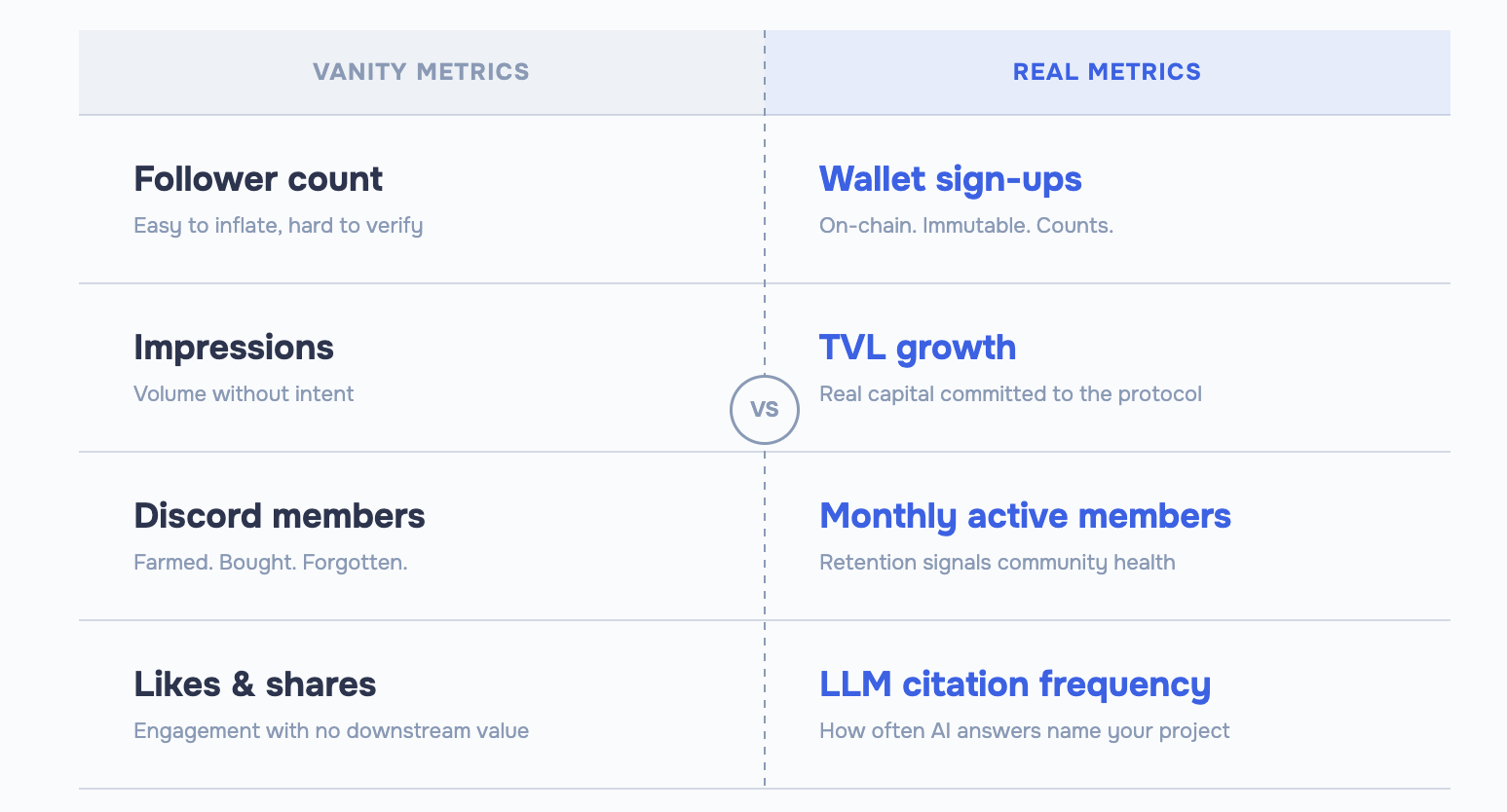
The broader shift shaping 2026 is the move from hype-driven to trust-driven marketing. After multiple cycles, communities distinguish between projects that generate noise and projects that deliver. A great crypto marketing agency tracks community health — monthly active users, message retention, wallet signups — not just follower count.
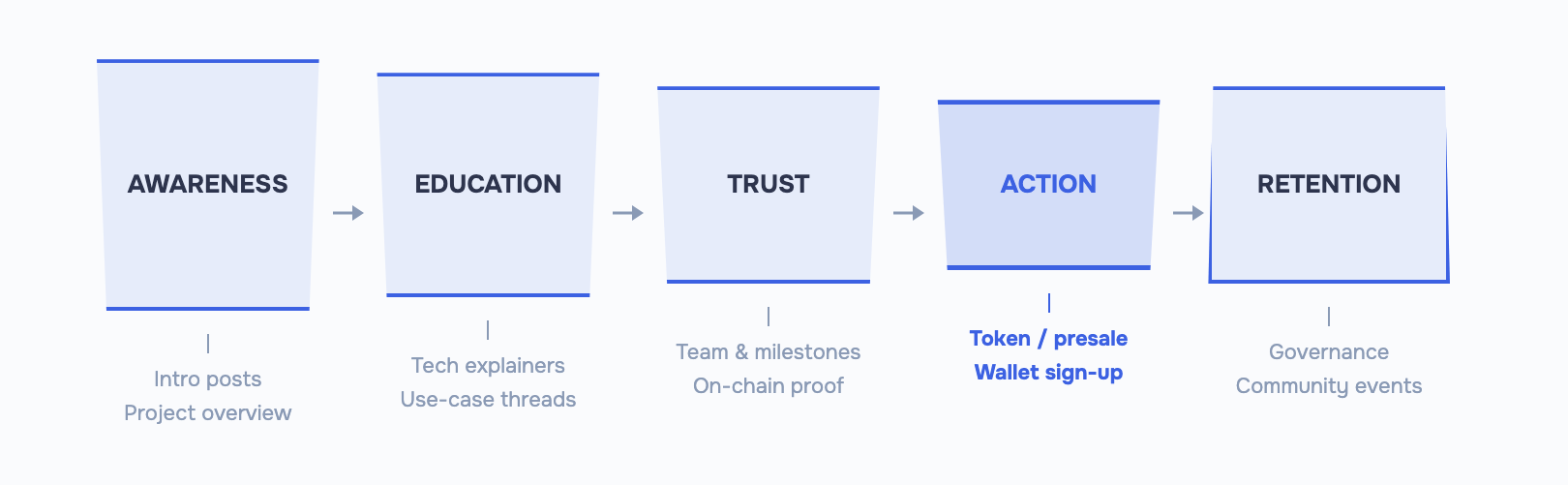
AI-First vs. Traditional Web3 Agencies: The Key Difference
“AI-first” is now attached to everything, which has made it nearly meaningless as a label. In the Web3 agency context, it has a specific, operational definition — and most agencies claiming it don’t actually meet it.
An AI-first Web3 agency optimizes for visibility across all three discovery surfaces simultaneously: Google SERPs, AI assistants (ChatGPT, Perplexity, Google AI Overviews), and crypto community feeds.
A traditional Web3 agency, regardless of how it markets itself, primarily optimizes for one: Google.
The distinction matters because the two channels behave independently. Research on LLM ranking factors shows that traditional SEO signals — domain rating, backlink profiles — do not reliably predict whether a brand gets cited in AI-generated answers. A project can rank on page one of Google and be entirely absent from Perplexity. Conversely, a project with average organic rankings can dominate the AI discovery layer where high-intent buyers are forming shortlists — because AI citation is driven by content structure and entity authority, not just link equity.
AI search traffic also converts at a meaningfully higher rate than standard organic traffic. Users querying an AI assistant about crypto infrastructure are further along in their decision-making than someone clicking a broad informational result. Capturing that traffic isn’t optional anymore; it’s where the highest-value buyers are.
Here’s how the two agency types differ in practice:
| Traditional Web3 Agency | AI-First Web3 Agency | |
|---|---|---|
| Primary discovery target | Google SERPs | Google + ChatGPT + Perplexity + AI Overviews |
| Content format | Blog posts, PR, social | Structured content, FAQs, entity-optimized pages |
| Tracking | Rankings, traffic, impressions | Rankings + LLM citation frequency + brand mentions in AI answers |
| Competitive edge | Channel execution | First-mover in AI discovery layer |
The disciplines behind AI-first web3 growth marketing go by several names: Answer Engine Optimization (AEO), Generative Engine Optimization (GEO), and LLM visibility optimization. AEO structures content so AI models can extract and cite it cleanly — direct answers, FAQ formats, entity definitions. GEO builds the citation graph: the external references, structured data, and topical authority signals that cause AI systems to treat a project as credible on specific subjects.
These are distinct from traditional SEO, and the gap matters more in crypto than in most other verticals. Crypto buyers are among the highest-research demographics online. Before committing capital, they’re running multi-step queries across Google, AI assistants, and community channels — cross-referencing what they find. A project that appears consistently across all three surfaces builds credibility through repetition. A project that only shows up on Google is invisible to anyone who starts their research on Perplexity or asks ChatGPT for a protocol comparison.
The mechanics of AI citation are also fundamentally different from link-building. LLMs weight entity clarity, topical consistency, and the quality of structured content over raw domain authority. A project with a clearly defined entity graph — consistent naming, clear descriptions of what the protocol does, FAQ pages that answer the exact questions users ask AI assistants — will outrank a project with more backlinks in AI-generated answers. That’s a leveling force for newer projects, but only if they know to exploit it.
A project can be doing excellent keyword-driven content work and still have zero LLM visibility, because the content isn’t structured for extraction. AI-first agencies track citation frequency in ChatGPT and Perplexity as a first-class metric alongside rankings and traffic — because that’s where the next generation of Web3 users is looking.
The question to ask any agency before engaging:
“Do you track LLM visibility? Can you show me where our brand currently appears in ChatGPT or Perplexity responses?”
If they look uncertain, you have your answer.
What to Look for When Choosing a Web3 Marketing Agency
The criteria for picking the best Web3 marketing agency are different from general B2B vendor selection, and the cost of getting it wrong during a token launch window is high.
1. Crypto-native track record with verifiable results. Named clients willing to be referenced, with outcomes tied to on-chain metrics — TVL growth, wallet signups, trading volume. Any agency hiding all its clients behind NDAs should be viewed skeptically.
2. Relevant vertical experience. DeFi, NFT, GameFi, RWA, and L1/L2 networks each have different community architectures and KOL ecosystems. An agency that primarily works NFT drops may lack the institutional relationships needed for a DeFi protocol launch.
3. Transparent reporting on the right metrics. Monthly active community members, sentiment, wallet activations — not follower count. If the pitch deck leads with follower numbers, the conversation is already going the wrong direction.
4. A concrete AI search strategy. The best Web3 marketing agencies in 2026 proactively discuss LLM visibility, not just Google rankings. They should explain what AEO and GEO mean in practice, and show you examples of clients appearing in AI-generated answers — not promise to “optimize for AI” without specifics.
5. Regulatory awareness. MiCA, SEC guidance, platform-specific crypto ad policies — an agency that doesn’t raise compliance implications during discovery is one that could inadvertently suspend your campaigns mid-launch. Ask directly.
6. Quality of the first conversation. Do they ask about your tokenomics? Do they push back on your assumptions? An agency that jumps straight to deliverables and pricing is optimizing for close speed, not your outcomes.
How ICODA Approaches Web3 Marketing
ICODA has been running Web3 marketing campaigns since 2017 — through two market cycles, the DeFi summer, the NFT correction, and the current phase of institutional adoption and RWA tokenization. Over 500 blockchain clients have come through the agency. The team has seen enough failure modes to know which ones are avoidable.
The core service stack covers the full cycle: crypto SEO, AI SEO/AEO/GEO, PR and media placement, Search Engine Reputation Management (SERM), KOL and influencer campaigns, community management, and multi-regional localization for CIS, Asian, and Spanish-speaking markets.
The differentiator is the AI SEO platform. In practice, this means actively managing where and how often a project appears in ChatGPT, Perplexity, and Gemini responses — not as a passive byproduct of good content, but as a tracked, optimized channel. AEO formats structured content for AI extraction. GEO builds the entity graph and citation signals that cause AI models to treat a project as authoritative on specific topics. Together, they ensure that when a crypto user asks an AI assistant about relevant infrastructure, your project is in the answer — not a competitor’s.
The results are measurable:
| Metric | Result |
|---|---|
| Traffic growth | 1,400% |
| ROI | 5× in 3 months |
| AI search citations | 500+ |
| Google rankings | Top 3 for transactional crypto keywords |
| Clients served | 500+ blockchain projects since 2017 |
Clients include Filecoin, TON, BingX, FLOKI, BC.Game, and Swisstronik. The KOL network and media relationships — built over nine years — provide access that a newer or generalist agency cannot replicate.
The vertical range extends beyond infrastructure and DeFi. When New Era Medicine, a Web3 healthtech project building oncology centers across four countries, needed to launch its social presence from absolute zero, the challenge was compounded: healthcare demands trust, and Web3 carries its own skepticism. ICODA built the brand identity, tone of voice, and community infrastructure from scratch — and grew the project to 23,000 Telegram followers and 10,000 X followers within a single month, entirely through organic content and active community management. The case illustrates something that applies across verticals: community growth driven by genuine engagement compounds in ways that purchased reach never does.
What sets the AI SEO approach apart from competitors claiming the same label is the attribution layer. ICODA tracks LLM citation frequency across ChatGPT, Perplexity, and Gemini as a reportable metric — not a secondary consideration. Clients see not just where they rank on Google, but how often and in what context their project surfaces in AI-generated answers. That feedback loop allows the team to refine entity definitions, FAQ content, and structured data in response to actual AI behavior, not assumptions about it.
Web3 Marketing Agency Red Flags to Avoid
1. Vanity metrics reporting. Progress reports that lead with follower growth and impressions, with no mention of on-chain activity or wallet signups, are measuring what’s easy to inflate. Follower counts can be purchased. Neither moves your token fundamentals.
2. KOL networks selected by follower count, not credibility. The “fake alpha” problem: influencers with large audiences and zero technical credibility pushing projects to followers who exit immediately. A serious agency selects KOL partners by engagement quality and vertical reputation, not reach.
3. Inability to discuss tokenomics or compliance. An agency that can’t engage with your unlock schedule or the regulatory environment (MiCA, SEC) is not equipped for Web3. These aren’t edge cases — they determine which campaigns are viable and whether your ad accounts survive launch.
4. No named clients or anonymized-only case studies. Legitimate agencies have clients willing to be referenced. Ask for at least two referenceable clients in your vertical before signing.
5. Guaranteed ROI promises. No agency can promise token price increases or overnight community growth. Price guarantees signal manufactured results, not real ones.
6. No LLM visibility strategy. In 2026, an agency that cannot explain AEO or LLM visibility optimization is already operating on an outdated playbook. It’s no longer a differentiator — it’s a baseline. If your agency goes blank when you ask about AI search citations or Perplexity mentions, you’re paying for yesterday’s strategy.
Is ICODA the Right Web3 Marketing Agency for Your Project?
Three things separate projects that build lasting visibility in 2026 from those that don’t: crypto-native expertise deep enough to engage with tokenomics and compliance; an AI-first approach that builds presence across Google, AI assistants, and community feeds simultaneously; and a service model that fits the project’s actual stage.
Most agencies cover one of the three surfaces where your project competes. An AI-first agency covers all three.
ICODA is the first-mover in AI-first Web3 marketing — the only AI marketing agency with a dedicated AEO/GEO platform built for blockchain projects, alongside the PR, KOL, and community infrastructure a full launch requires.
Frequently Asked Questions (FAQ)
The terms are often used interchangeably. A crypto marketing agency typically focuses on token-related promotion — exchanges, pricing visibility, trading volume. A Web3 marketing agency works at a broader level, building community, protocol credibility, developer relations, and long-term brand equity. The best agencies handle both; knowing which emphasis your project needs helps you evaluate fit.
Organic and SEO results typically compound over 3–4 months. KOL campaigns and paid distribution generate visible activity within days. Community growth is the slowest lever — and the most durable. LLM citation presence in AI search results is typically buildable within a 2–3 month window with a structured AEO strategy.
Web3 growth marketing is a full-funnel, community-native approach to growing a blockchain project’s user base, liquidity, and ecosystem. It measures success through on-chain conversions — not just clicks — and in 2026 includes LLM visibility as a core channel alongside organic search and social distribution. The goal is compounding ecosystem growth, not campaign-level acquisition.
Yes — AI-first agencies offer AEO and GEO optimization to ensure your project is cited by ChatGPT, Perplexity, and Gemini when users search for relevant crypto topics. This includes structuring content for LLM extraction, building entity signals, and tracking citation frequency across major AI assistants. It’s a distinct service from traditional SEO, and not all agencies offer it.
Measurable signup growth, improved community retention, and search visibility for the keywords your buyers actually use. Traffic growth of 10x+ over 6–12 months is achievable with the right SEO foundation. What isn’t realistic: overnight community growth, guaranteed token price performance, or viral momentum on demand.
Share with


Rate the article