



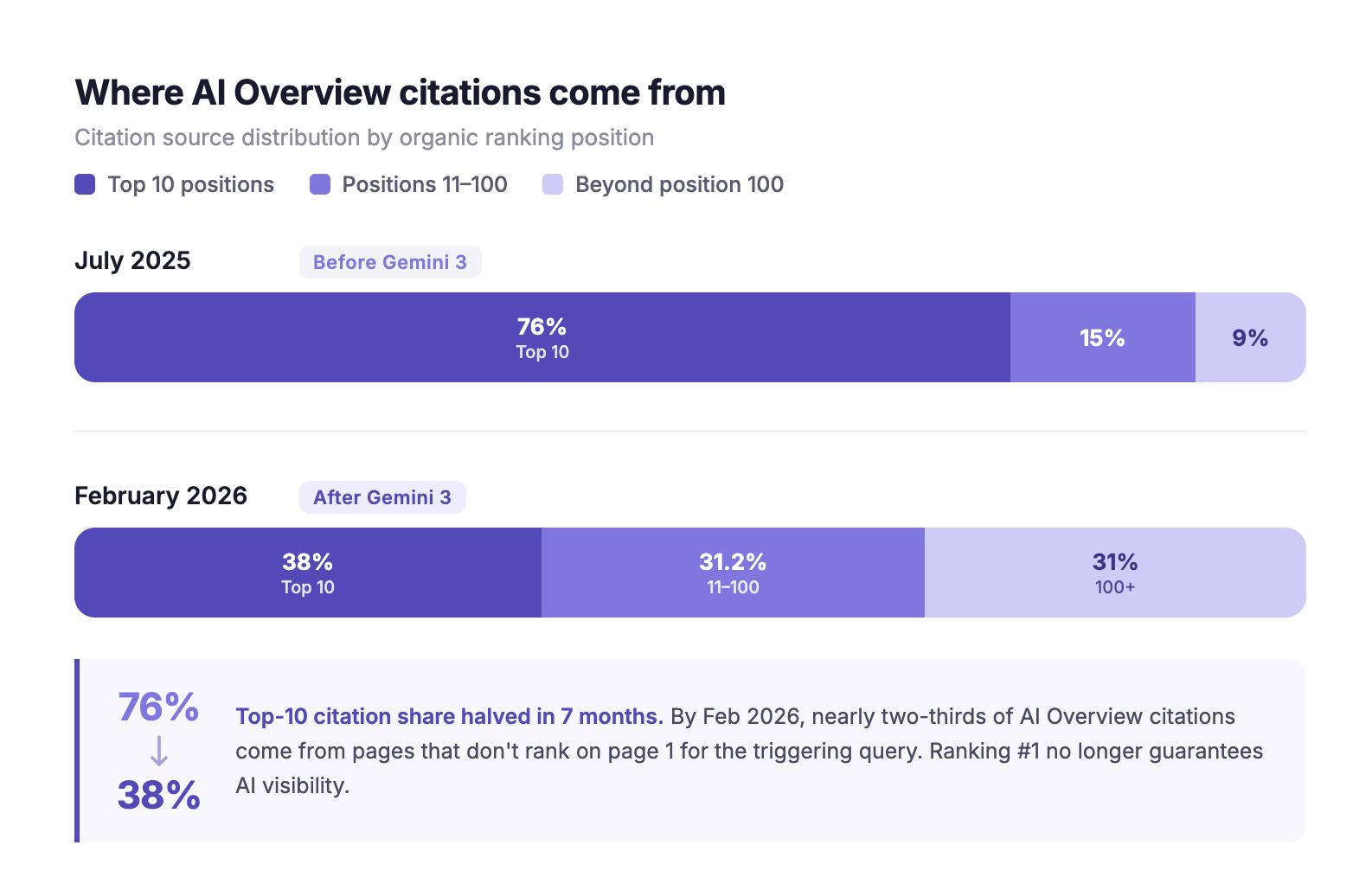
Seven months ago, 76% of Google AI Overview citations came from pages ranking in the organic top 10. By February 2026, that number had collapsed to 38%.
That single data point — drawn from an Ahrefs analysis of 863,000 keywords and 4 million AI Overview URLs — invalidates the core assumption behind most AI overview optimization guides published today. The dominant advice is still “rank higher to get cited.” The data says that’s increasingly wrong.
Welcome to what we’re calling the Citation Paradox: the structural decoupling between where your content ranks in traditional search results and whether it gets cited in AI-generated answers. If your strategies for optimizing content for Google AI Overviews still start with “improve your organic rankings,” you’re solving last year’s problem with last year’s playbook — a gap that dedicated AI Overviews SEO experts are built to close.
This article breaks down what actually drives AI Overview citations in 2026, based on a cross-source synthesis of research from leading SEO platforms and dozens of practitioner reports. You’ll learn which seven signals correlate most strongly with citation selection, which three former pillars of SEO authority have lost their predictive power, and how to restructure your content strategy around the mechanics that matter now.
The stakes are real. And the window to adapt is narrowing.
The State of AI Overviews in 2026: Scale, Impact, and the Conversion Surprise
AI Overviews are no longer an experiment. According to BrightEdge’s 12-month tracking through February 2026, they now trigger on 48% of all tracked queries — up 58% year-over-year from roughly 31%. Google’s AI-generated answers reach over 2 billion users monthly, and when you add ChatGPT interactions, that number exceeds 3 billion.
The traffic impact is severe. Organic CTR has dropped 61% on queries where AI Overviews appear — from 1.76% down to 0.61%. Paid CTR fared even worse, falling 68%. Research shows searches triggering AI Overviews carry an 83% zero-click rate, compared to 60% for traditional queries. Gartner projects overall organic CTR will decline 25% by end of 2026.
But here’s the counterintuitive part — and the reason this isn’t just a doom story. Brands that are cited in AI Overviews earn 35% more organic clicks and 91% more paid clicks than non-cited brands. AI Overview traffic converts at 14.2% versus traditional organic’s 2.8% — a 5x quality premium. One agency case study reported AI referrals converting at 25x the rate of traditional search leads. Meanwhile, Semrush’s AI search traffic study found that LLM visitors convert 4.4x better than organic search visitors, confirming that AI-referred traffic is a fundamentally different — and more valuable — channel.
AI Overviews are functioning as a pre-qualification layer. Users who click through have already processed the summary and are seeking deeper engagement. The total volume of clicks drops, but each click is dramatically more valuable.
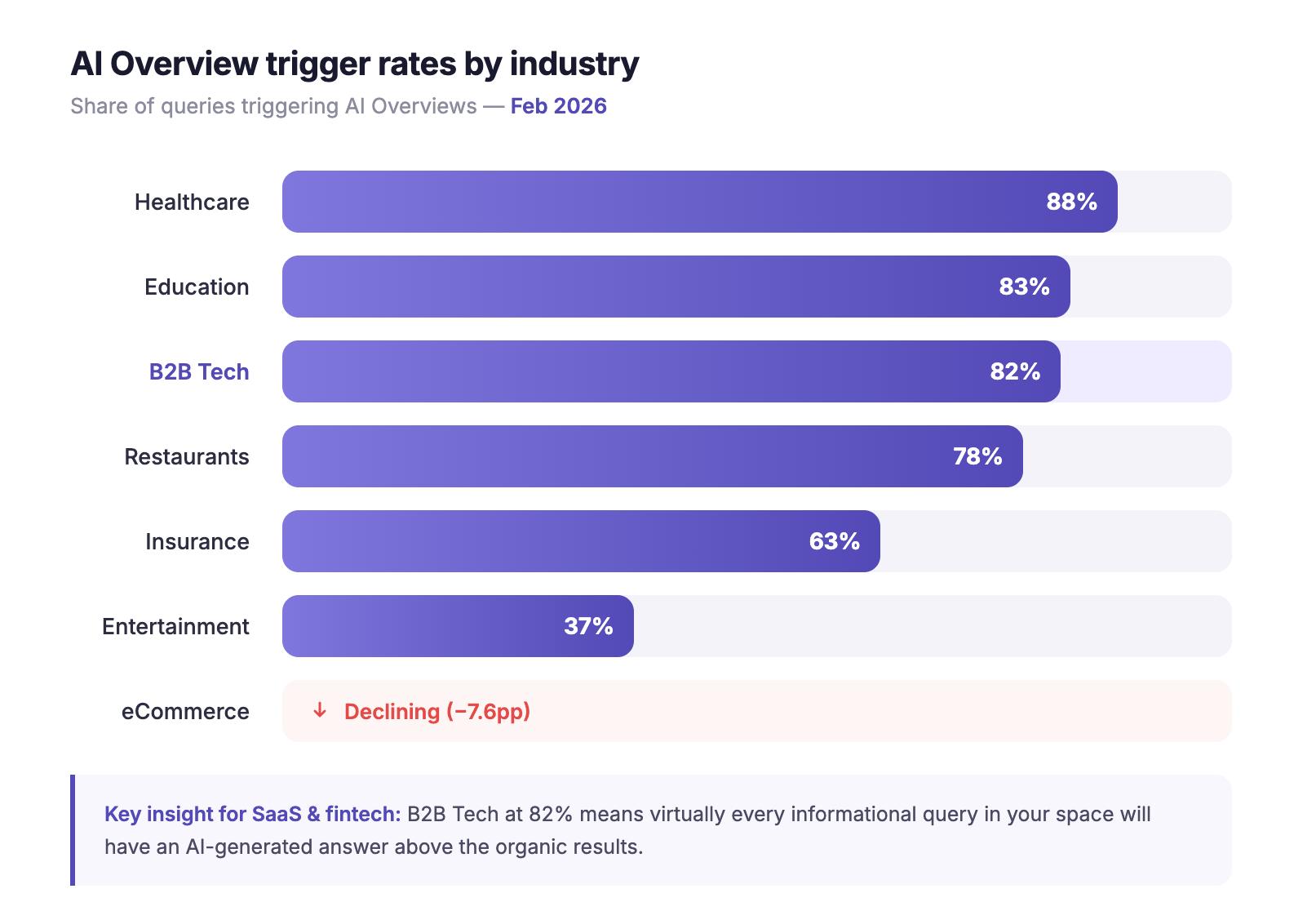
The impact isn’t distributed evenly. Industry data shows Healthcare queries trigger AI Overviews 88% of the time, followed by Education (83%), B2B Tech (82%), Restaurants (78%), and Insurance (63%). Entertainment lags at 37%, and eCommerce has actually declined in AI Overview presence. For SaaS and fintech companies, the B2B Tech figure is the one that matters: 82% means virtually every informational query in your space will have an AI-generated answer sitting above the organic results.
| Industry | Feb 2025 | Feb 2026 | YoY Change |
|---|---|---|---|
| Healthcare | 72% | 88% | +16pp |
| Education | 18% | 83% | +65pp |
| B2B Tech | 36% | 82% | +46pp |
| Restaurants | 10% | 78% | +68pp |
| Insurance | ~17% | ~63% | +46pp |
| Entertainment | Low | ~37% | Growing |
| eCommerce | Higher | Declining | −7.6pp |
The question is no longer whether AI Overviews affect your traffic. It’s whether you’re among the cited — or among the invisible.
Why Ranking #1 No Longer Means Getting Cited
The collapse from 76% to 38% citation-to-top-10 overlap is the defining data point of AI search in 2026. The remaining citations split almost evenly: 31.2% come from pages ranking in positions 11–100, and 31% come from pages ranking beyond position 100 entirely. Parallel research found even starker numbers — only about 17% overlap between AI Overview–cited sources and the organic top 10.
This isn’t a measurement artifact. It’s a structural shift driven by how Google’s AI actually retrieves information.
At Google I/O 2025, the company confirmed that AI Mode uses a “fan-query technique, breaking down a question into subtopics and issuing a multitude of queries simultaneously.” Every AI-triggering search fires 8–12 parallel sub-queries behind the scenes. When Gemini 3 became the default model for AI Overviews in January 2026, the effect intensified. SE Ranking’s post-Gemini-3 analysis found that 42% of previously cited domains were replaced — Gemini 3 delivers roughly 32% more comprehensive responses, pulling from a wider range of sources.
This is why we use the term “Topical Surface Area” to describe what actually determines citation probability. It’s not about ranking #1 for the original keyword. It’s about how many of those 8–12 fan-out sub-queries your content can answer. A page that covers 3 of 12 sub-queries will lose to a page covering 8 of 12, regardless of which ranks higher for the seed keyword.
A separate large-scale analysis of 173,902 URLs across 10,000 keywords confirms this from another angle: 68% of pages cited in AI Overviews were not in the top 10 organic results. Another study found that while 99.5% of AI Overview sources rank somewhere in the top 10 for some query, it’s rarely the triggering query — it’s one of the fan-out sub-queries.
The Search Initiative demonstrated what happens when you optimize with this understanding. Working with an industrial manufacturer, they focused on E-E-A-T optimization and AI-specific content restructuring. The result: a 2,300% increase in monthly AI referral traffic, going from zero to 90 keywords appearing in AI Overviews — despite the client not holding dominant organic rankings.
The implication for generative engine optimization is clear: you’re no longer competing in one ranking race per keyword. You’re competing in 8–12 simultaneous races. And winning the original one is no longer enough.
How to Get Your Content Cited: The 7 Signals That Actually Work
If traditional ranking factors have lost their grip on AI citation, what has replaced them? Our cross-source analysis identifies seven signals with the strongest evidence base. Here’s what each one means — and how to act on it.
1. Make Every Page a Complete Answer (Semantic Completeness)
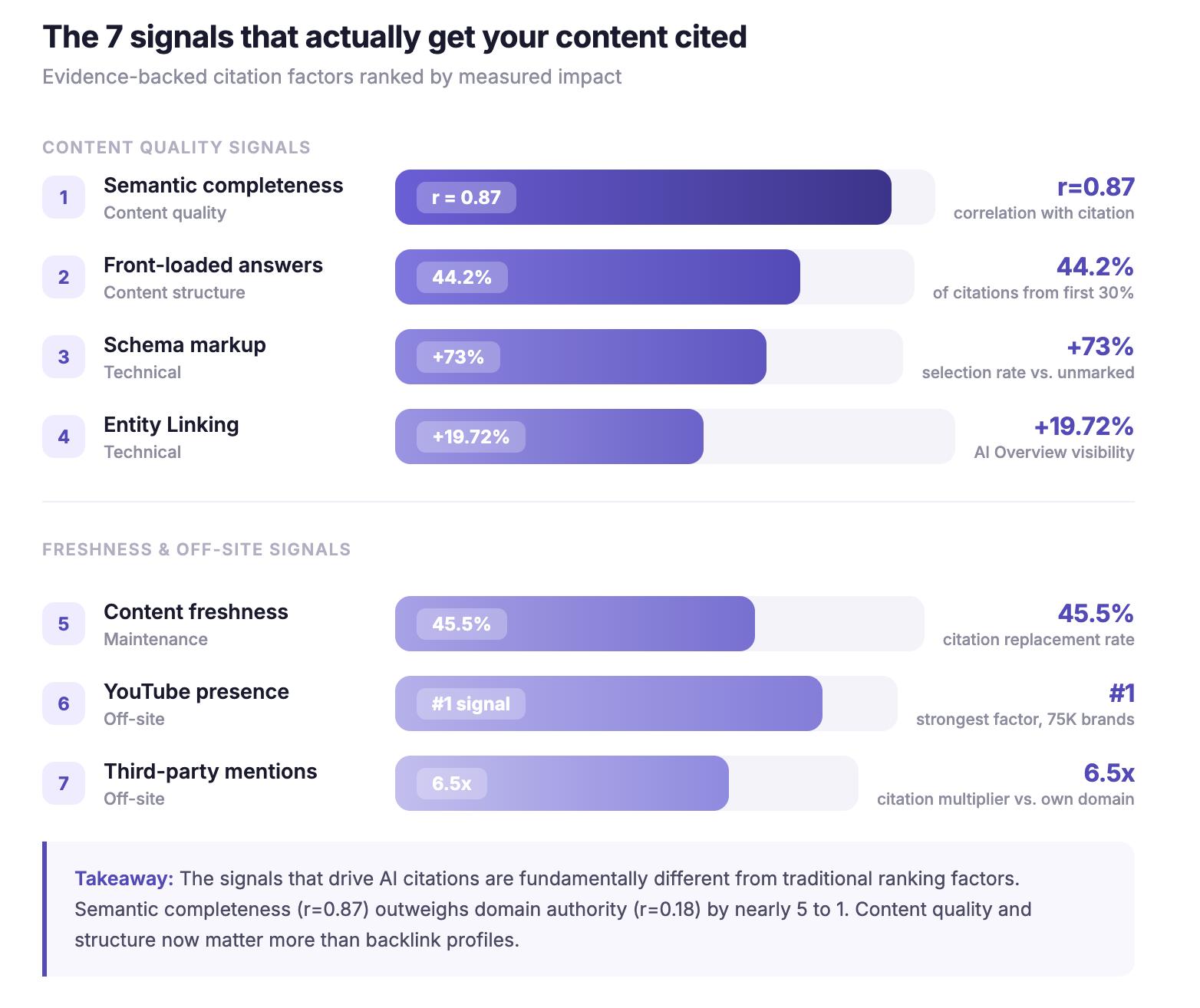
The strongest single predictor. Research shows a correlation of r=0.87 between semantic completeness — the ability to answer a query fully without requiring external references — and citation selection. Meanwhile, 96% of AI Overview citations go to pages demonstrating E-E-A-T signals.
➡️ What to do: For each target query, ask whether your page answers it completely without the reader needing to click elsewhere. If it depends on context from other pages, consolidate. Add definitions, relevant data, and concrete examples until the page can stand entirely on its own.
2. Put Your Best Answer First (Front-Loaded Structure)
Analysis of LLM citation patterns found that 44.2% of all citations are pulled from the first 30% of an article’s text. AI retrieval systems evaluate content in chunks, and the opening sections get the most extraction attention.
➡️ What to do: Restructure every key page so the clearest, most direct answer appears in the first 150–200 words. Lead with the conclusion, then explain. Treat your intro as the snippet AI will extract — because it probably will.
3. Structure Content for Extraction (Question Headings + Self-Contained Sections)
Structured content — question-based headings, self-contained paragraphs, clear H2/H3 hierarchies — is consistently the most effective format for earning AI citations.
➡️ What to do: Rewrite H2s as the actual questions your audience asks (e.g., “How much does X cost?” not “Pricing”). Place a short, direct answer of 50–70 words immediately below each heading before elaborating. Apply the “paragraph extraction test”: if a section were pulled out and shown alone, would a reader understand it completely? If not, rewrite it.
4. Implement Schema Markup and Entity Linking
Pages with schema markup (FAQ, HowTo, Article) show a 73% higher selection rate for AI Overview citation versus unmarked content. One case study on Entity Linking — connecting content entities to Knowledge Graph entries via structured data — produced a 19.72% increase in AI Overview visibility.
➡️ What to do: Add FAQ, HowTo, and Article schema in JSON-LD to every key content page — Google officially recommends JSON-LD as of May 2025. For advanced gains, implement Entity Linking that maps your key concepts to Knowledge Graph entries. This is no longer optional for any brand serious about how to appear in AI overviews.
5. Update Key Content on a Weekly-to-Monthly Cycle (Freshness)
AI Overview citations are volatile. Data shows that AI Overview content changes 70% of the time for the same query, and when it regenerates, 45.5% of citations get replaced with new sources. Yet semantic similarity between consecutive AI Overviews is 0.95 — the answer stays the same, but the sources rotate constantly. The effective “citation half-life” is roughly 4 days.
➡️ What to do: Set a refresh cadence for your top 20 pages: update statistics, add recent examples, refresh timestamps. Even small updates signal freshness. Build this into your editorial calendar as a recurring task, not a one-time optimization.
6. Create Short YouTube Explainers for Core Topics
The sleeper signal. An analysis of 75,000 brands found that YouTube mentions — in video titles, transcripts, and descriptions — are the single strongest correlating factor with AI Overview visibility, stronger than backlinks or domain rating. YouTube is also the most frequently cited individual source in AI Overviews.
➡️ What to do: Produce 60–90 second explainer videos for your top 10–15 topics. Optimize titles and descriptions with the same target queries as your written content. Upload full transcripts. Most AI overview SEO guides ignore video entirely — this is a genuine competitive gap whether you’re in healthcare tech, fintech, or eCommerce.
7. Build Third-Party Brand Presence Across Platforms
Brands are 6.5x more likely to be cited in AI responses through third-party sources than through their own domains. Wikipedia appears in 28.9% of AI Mode citations and 18.1% of AI Overviews. For local queries, 86% of AI citations come from brand-influenced sources.
➡️ What to do: Invest systematically in your presence on Reddit, LinkedIn, YouTube, review platforms like G2, and community forums. Contribute expert answers, earn reviews, and build brand mentions where AI systems already look for sources. For crypto and Web3 brands, community platforms carry outsized influence — this channel may drive more AI citation value than your on-site content alone.
The 3 Signals That No Longer Matter (As Much)
Three pillars of traditional SEO authority have measurably weakened as AI citation predictors. They’re not useless — but treating them as primary levers is now a strategic error.
Domain Authority once seemed like the ultimate predictor of search visibility. Data now shows it correlates with AI Overview citation at just r=0.18, down from r=0.23 in 2024 and declining. For context, semantic completeness correlates at r=0.87. Domain authority is being outweighed nearly 5-to-1 by content quality signals. SERP analysis tells the same story: for competitive AI-related queries, sites with DR 36 outrank sites with DR 75+, confirming that topical authority and content quality are overcoming pure domain authority.
Content Length has an almost nonexistent correlation with citation probability — r=0.04, essentially random noise. Even more telling: 53% of all AI Overview citations go to pages under 1,000 words. The traditional SEO playbook of writing 3,000+ word comprehensive guides actively works against AI citation. AI systems prefer concise, front-loaded content with high fact-density over sprawling long-form pieces.
Pure Ranking Position is the most dramatic casualty. The 76% to 38% collapse in citation-to-top-10 overlap means ranking on page one now predicts AI visibility less than a coin flip. Research shows that ChatGPT Search specifically cites lower-ranking pages — position 21 and beyond — about 90% of the time.
None of these signals are irrelevant. Domain authority still helps with crawlability and trust. Strong rankings still generate traditional organic traffic. Length still matters for depth on complex topics. But if you’re allocating budget and effort, these are no longer where the citation ROI lives.
Not showing up in AI answers?
ICODA runs AI visibility audits across 8 major LLms

Stop Optimizing for One Keyword — AI Runs 12 Searches at Once
Understanding why citations have decoupled from rankings is useful. Having a framework to act on it is essential. The Fan-Out Coverage Model provides a four-level system for evaluating and improving your content’s AI citation potential, and it’s among the most practical strategies for optimizing content for Google AI Overviews available today.
Level 1 — Single Answer (Low citation probability): Your content answers only the primary query. It covers 1 of 8–12 fan-out sub-queries. Example: a page that explains “What is an AI Overview?” but addresses no follow-ups about CTR impact, optimization tactics, or industry differences. Most content sits here.
Level 2 — Clustered Answers (Moderate citation probability): Your content answers the primary query plus 2–3 related sub-questions, covering 3–4 of the fan-out sub-queries. Example: a page that explains what AI Overviews are, how they affect CTR, and which queries trigger them.
Level 3 — Comprehensive Coverage (High citation probability): Your content or topic cluster answers the primary query plus 6–8 related dimensions, covering the majority of fan-out sub-queries. It includes data, comparisons, how-to guidance, and concrete examples. This is the level where documented results begin to accelerate — one agency case earned 96 AI Overview keyword citations, an 809% increase in AI referral traffic, and a 169% lift in conversions through content optimization and schema restructuring alone.
Level 4 — Fan-Out Dominance (Maximum citation probability): Your content ecosystem — the core page plus interlinked topic cluster, YouTube explainers, and third-party brand mentions — addresses virtually all fan-out sub-queries. It includes original data, expert perspectives, actionable frameworks, and multimedia. The content becomes, as the data suggests, “too comprehensive and authoritative for AI to ignore.”
To assess where your content sits today: identify a target keyword, map the 8–12 sub-questions Google would logically decompose it into (use People Also Ask, community forums, and fan-out query tools), and count how many your existing content answers. The gap between your current level and Level 3 is your optimization roadmap.
AI Citations Don’t Stop at Google — Neither Should You
Focusing exclusively on Google AI Overviews means ignoring where the majority of AI referral traffic actually originates. According to Conductor’s November 2025 data, 87.4% of all AI referral traffic comes from ChatGPT — not Google.
The citation preferences across platforms barely overlap. Research found only 13.7% citation overlap between Google’s AI Overviews and its own AI Mode. Across external AI assistants (ChatGPT, Gemini, Copilot, Perplexity), only 12% of citations overlap with Google’s organic top 10. Perplexity shows the highest Google alignment at 28.6%; others hover around 8%.
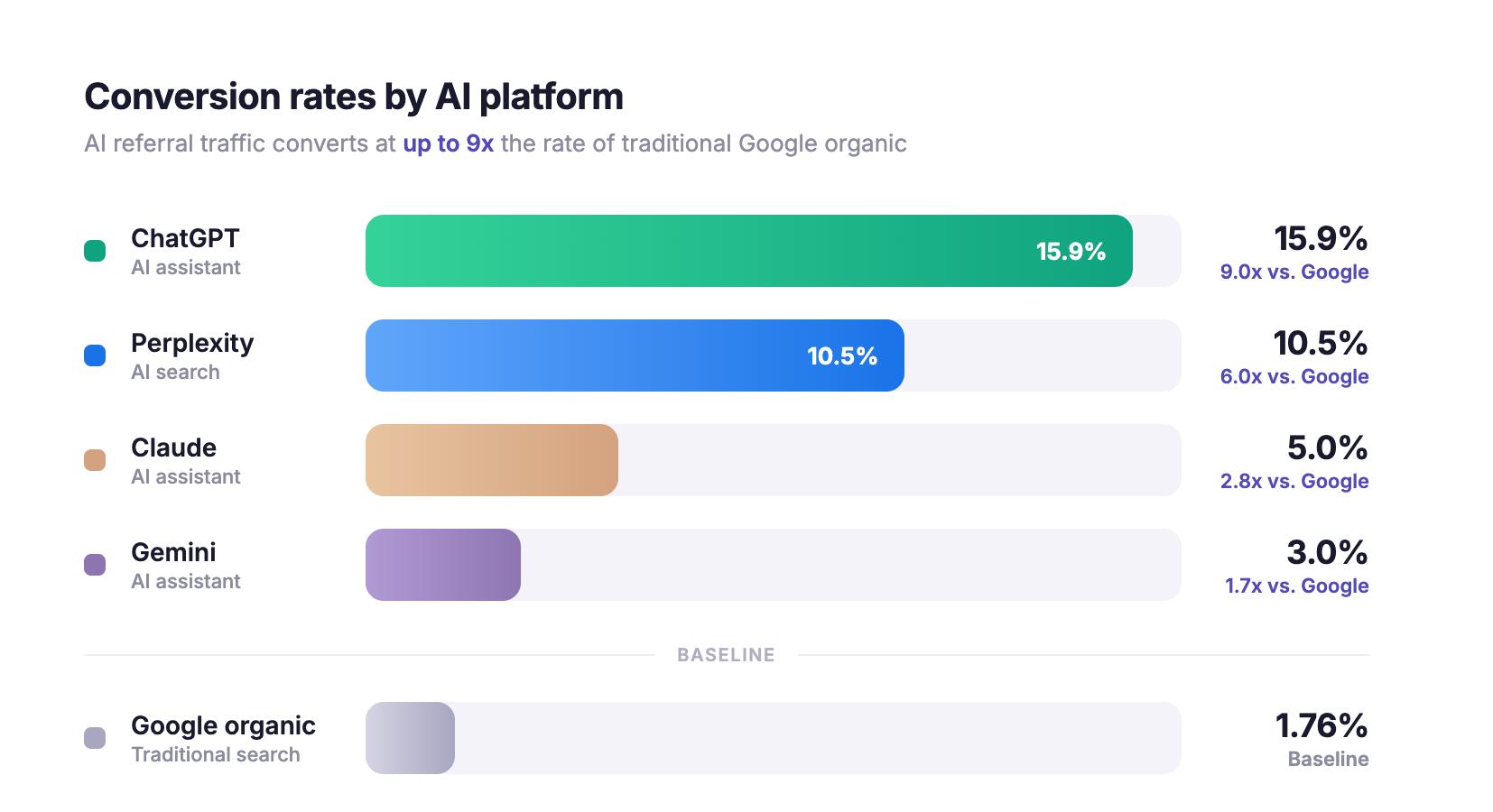
Conversion rates tell a compelling story about where answer engine optimization efforts should focus: ChatGPT referrals convert at 15.9%, Perplexity at 10.5%, Claude at 5%, Gemini at 3%, all versus Google organic’s 1.76%. One agency reported an 83.33% monthly conversion increase by treating AI referral traffic as a distinct, high-value channel.
| Platform | Conversion Rate | vs. Google Organic (1.76%) |
|---|---|---|
| ChatGPT | 15.9% | 9.0x higher |
| Perplexity | 10.5% | 6.0x higher |
| Claude | 5.0% | 2.8x higher |
| Gemini | 3.0% | 1.7x higher |
| Google organic | 1.76% | Baseline |
Each platform favors different sources. Wikipedia leads ChatGPT citations at 7.8%, followed by Reddit (1.8%), Forbes (1.1%), and G2 (1.1%). BrightEdge’s March 2026 data shows Google AI Overviews are 44% more likely to surface negative brand sentiment than ChatGPT. A multi-platform AI visibility strategy isn’t a nice-to-have — it’s where the conversion value lives.
What to Do Now: Three Immediate Actions
The paradigm shift is clear: from “rank first, get cited automatically” to “engineer content specifically for AI extraction and fan-out coverage.” The brands that internalize this — across SaaS, eCommerce, fintech, healthcare tech, crypto, and beyond — will capture a disproportionate share of AI-referred traffic and its 5x conversion premium.
Three actions to start this week.
First, audit your top 20 content assets against the Fan-Out Coverage Model — identify which fan-out sub-queries each page answers, and close the gaps.
Second, restructure key pages for extractability: front-load answers, add question-based headings, implement FAQ and Article schema in JSON-LD, and ensure every section stands alone as a complete answer unit.
Third, invest in off-site citation surfaces — YouTube explainers, Reddit and LinkedIn presence, and third-party review platforms — because brands are 6.5x more likely to be cited through third-party sources than their own domains.
The strategies for optimizing content for Google AI Overviews have fundamentally changed. Rankings are no longer the proxy for visibility they once were. Citation is the new currency — and the content that earns it looks nothing like what dominated page one five years ago.
For brands that lack the in-house expertise to navigate this shift, working with a specialized AI SEO agency that understands citation mechanics across ChatGPT, Claude and Perplexity can be the difference between adapting early and playing catch-up.
Frequently Asked Questions (FAQ)
Focus on citation signals, not just rankings. The top factors in 2026: semantic completeness (r=0.87 correlation), front-loaded answers (44.2% of citations from first 30% of text), schema markup (+73% selection rate), content freshness, YouTube explainers, and third-party brand mentions.
Only 38% of citations come from top-10 pages — down from 76% in mid-2025. Google fires 8–12 sub-queries per search, so your content must answer multiple related questions across the topic, not just the primary keyword. Cover at least 6–8 fan-out sub-queries.
AI Overviews trigger on 48% of queries, but it varies wildly by industry: Healthcare 88%, B2B Tech 82%, Entertainment just 37%, eCommerce declining. Long-tail queries (4+ words) trigger them 60.85% of the time; transactional queries rarely do.
AI Overviews change 70% of the time for the same query, and 45.5% of citations get replaced each cycle — yet the answer stays nearly identical (0.95 similarity). Sources rotate roughly every 4 days, making ongoing content freshness essential.
Gemini is Google’s AI model; AI Overviews are the search feature it powers. The Gemini 3 upgrade in January 2026 replaced 42% of previously cited domains and expanded source diversity by 32%. Only 13.7% of citations overlap between AI Overviews and AI Mode.
No — it’s forking into two disciplines. Traditional SEO still governs 52% of queries without AI Overviews. For the 48% that trigger them, citation optimization is a separate track with its own signals. Brands cited in AI Overviews earn 35% more clicks at 5x conversion rates.
Share with


Rate the article