




Can you find your crypto project in a ChatGPT answer right now?
If you don’t know the answer, that’s already a problem. Because a growing share of your target audience isn’t opening Google anymore. They’re asking AI. And the projects that show up in those answers are pulling traffic that converts at roughly 4× the rate of traditional organic search.
Consider what that means in practice: a DeFi protocol tracked 1,000 visitors from Google and 200 from ChatGPT in the same month. The ChatGPT cohort drove more wallet connects. Most teams would optimize for the bigger number. That’s exactly backward.
ChatGPT and Perplexity aren’t a new coat of paint on SEO. They’re a different system with different rules, different trust signals, and different ways of deciding which projects get mentioned and which don’t exist. This guide walks you through four concrete steps to get your crypto project cited in AI answers — plus a checklist to audit where you stand today.
Why ChatGPT & Perplexity Are Now Essential for Crypto Projects
What is AI visibility for a crypto project? It’s the likelihood that ChatGPT, Perplexity, or Google AI Overviews mention your project by name when a user asks about your category — “best DeFi staking protocol,” “safest cross-chain bridge,” “top Layer 2 networks.” If you’re not in those answers, you don’t exist to a growing share of your target audience.
The scale has shifted faster than most teams realize:
- ChatGPT surpassed Bing in daily traffic in mid-2025; roughly one in five internet users now opens it monthly
- By 2026, Forrester projects more than half of consumers under 50 will use AI tools for financial research and advice
- Two-thirds of brands that AI recommends don’t rank in Google’s top results for the same query — the two systems run on different logic
That last point matters for crypto specifically. The same demographic that moved from traditional banks into DeFi is now moving from Google into AI search. These are technically sophisticated, high-intent users who distrust institutional sources and trust peer signals, data, and direct answers. Perplexity — research-native, citation-forward — is their natural habitat. Projects that embedded GEO strategies early are already reporting 30–40% improvements in AI visibility, and those gains compound.
How AI Models Decide Which Crypto Projects to Mention
Before tactics, you need to understand the mechanics. Otherwise you’re just guessing.
ChatGPT and Perplexity don’t work the same way. Here’s the core difference:
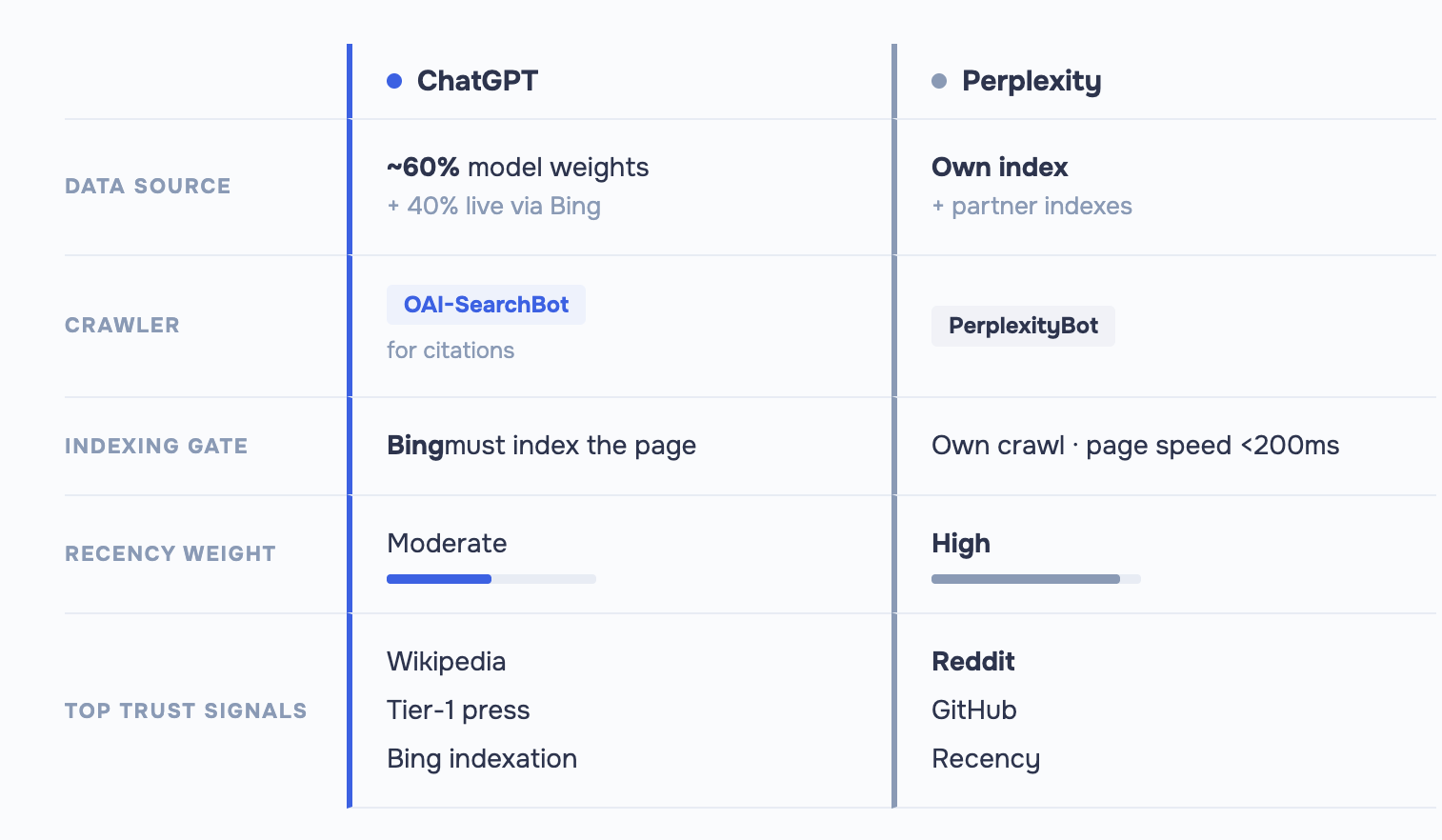
A few things here that catch crypto teams off guard.
1️⃣ First: blocking GPTBot does nothing to protect your citation rights. GPTBot crawls for training data. The bot that controls whether ChatGPT cites your pages in search mode is OAI-SearchBot. They’re separate. Most robots.txt guides conflate them.
2️⃣ Second: if Bing doesn’t index your site, ChatGPT can’t cite it in search mode. “We rank in Google, so we’re fine” is a dangerously common assumption. ChatGPT’s retrieval layer pulls primarily from Bing for many query types. Run a Bing Webmaster Tools check before anything else.
Third: Perplexity has built its own search infrastructure — it doesn’t use Google’s index. It has its own crawl cadence and weighs recency heavily. A page updated last week will outrank a stronger 2024 page on the same query. For a market that moves as fast as crypto, this is actually an advantage if you’re actively maintaining your content. See how one DeFi protocol put this to work in this Perplexity ranking case study.
Step 1 — Build Authoritative Content AI Can Cite
This is the one lever entirely in your control, and most crypto projects handle it badly.
The core finding from the KDD 2024 GEO paper (Princeton + IIT Delhi) is that including structured data — statistics, citations, verifiable claims — increases AI visibility by over 40%. That’s not a soft correlation; it’s the most replicated finding in GEO research so far.
The BLUF Rule
Perplexity extracts introductory paragraphs most often. Pages that bury the answer behind long preambles almost never get cited. Apply this to every page that matters: your homepage, whitepaper summary, and tokenomics page.
Each section should open with the direct answer. Not “In this section we’ll explore the yield mechanisms of [Protocol]…” but “[Protocol] generates yield through a combination of liquidity provision fees and staking rewards distributed every epoch.” Then explain it.
Use question-based H2 headers. “What problem does [Protocol] solve?” “How does [Token] generate yield?” “What’s the max supply of [Token]?” These aren’t just SEO-friendly — Perplexity’s extraction system explicitly favors content structured around questions with direct answers in the first sentence of each section.
Your Whitepaper Is an AI Asset
Most crypto whitepapers are PDFs written for investor relations. That’s the wrong frame if you want AI visibility. The whitepaper summary page on your website should be:
- HTML, not just a PDF download
- Structured with question-based headers
- Including a tokenomics table in machine-readable format (not an image)
- Citing third-party audits and data sources
Include verifiable statistics every 150–200 words. Cite your sources. ChatGPT and Perplexity both actively prefer content that’s verifiable — they’re trying to reduce hallucinations, and cited data gives them confidence to pass information forward.
The llms.txt File
Add an llms.txt file to your site root. It’s an AI-readable manifest that points crawlers to your most important pages — equivalent to a sitemap but specifically for language model crawlers. Small effort, measurable signal.
Step 2 — Get Mentioned on Sources AI Systems Trust
On-site optimization gets you indexed. Off-site mentions get you cited. These are different outcomes.
The data is clear: brand mentions correlate with AI visibility at 0.664 — significantly higher than backlinks at 0.218. For AI-answer optimization specifically, being talked about matters more than being linked to.
Tier-1 Crypto Media
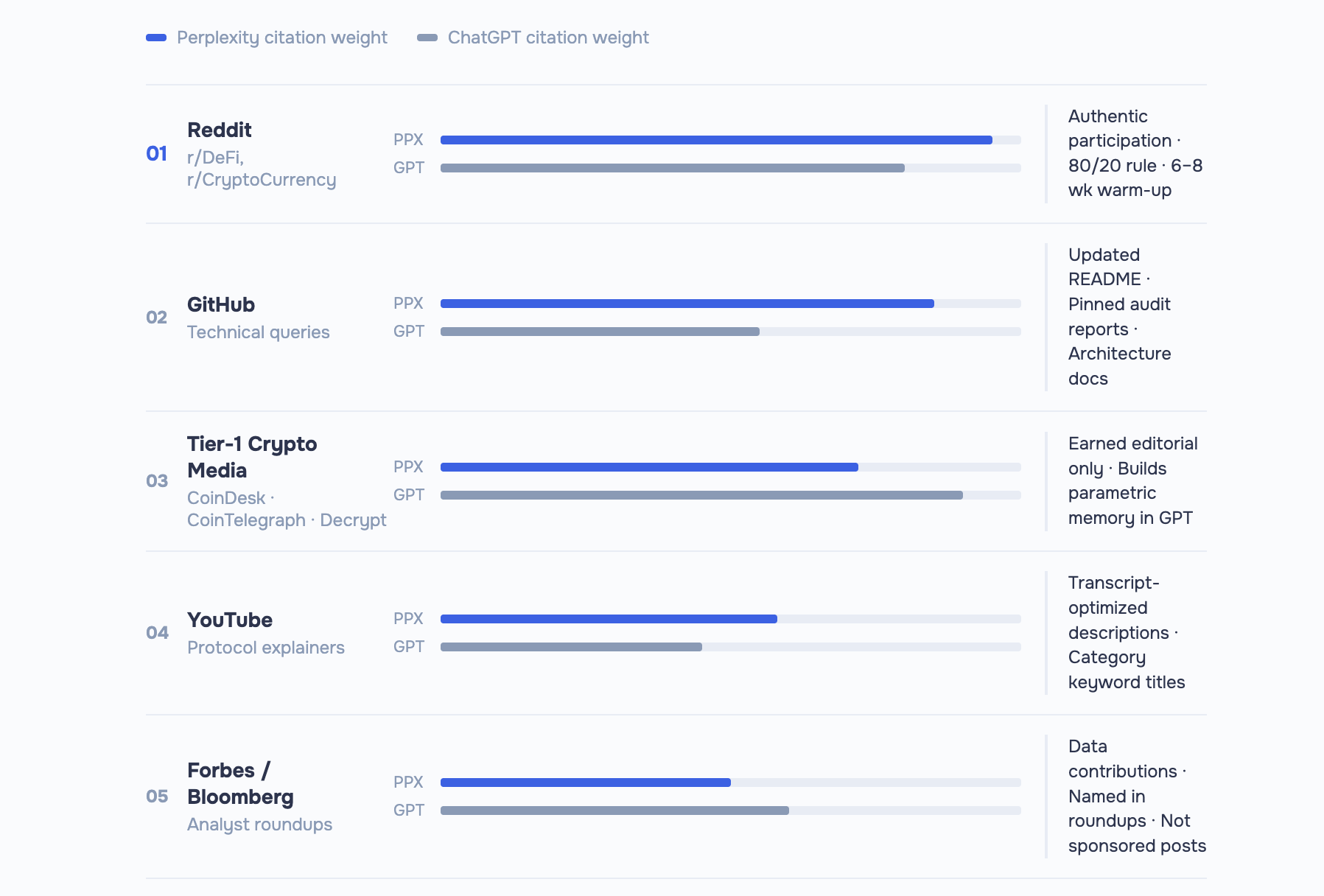
A CoinDesk, CoinTelegraph, Decrypt, or The Block feature does something a mid-tier publication can’t: it embeds your project in ChatGPT’s parametric memory. These domains have been in the model’s training data at volume for years. Getting covered there isn’t just a PR win — it literally “codes” your project into ChatGPT’s weights in a way that influences answers even when live retrieval isn’t active.
This doesn’t mean you need a Decrypt homepage feature to exist in AI answers. But it does mean earned coverage in authoritative crypto media is now dual-purpose: you’re building both traditional credibility and AI parametric presence simultaneously. If you want this done systematically, ChatGPT SEO for crypto projects covers the full earned-media and on-site stack.
Reddit Is the Most Important Platform You’re Ignoring
Reddit is consistently the most cited domain in Perplexity responses. ChatGPT treats Reddit threads as first-person experience signals — exactly the type of content AI search prefers. For crypto projects, r/CryptoCurrency, r/DeFi, r/ethereum, and protocol-specific subreddits are not optional.
The playbook here is slow and non-negotiable: 80% genuinely helpful, non-promotional comments before any mention of your project. A 6–8 week warm-up minimum. Reddit’s spam detection is sharp, and AI systems can detect inauthentic community participation patterns too. The only approach that works long-term is genuine participation.
GitHub for Technical Credibility
Perplexity actively cites GitHub as one of the most authoritative domains for technical queries. Your README, architecture documentation, and audit reports aren’t just for developers — they’re AI-facing content. Keep them updated. Add clear descriptions to your repository. Link your audit reports prominently.
A well-maintained GitHub repo sends a trust signal that no amount of press releases can replicate for a technical audience. The full off-site playbook for Perplexity — Reddit, GitHub, and beyond — is covered in detail in Perplexity SEO for crypto projects.
Step 3 — Structured Data & Technical Optimization for AI
Why Does ChatGPT Sometimes Get My Project Wrong?
This is the question crypto founders ask most often after their first AI visibility check. They search their project name in ChatGPT and find hallucinated details — wrong tokenomics, confused history, mixed up with a competitor that has a similar name.
The fix is entity disambiguation. AI systems cross-reference structured data across sources to verify what they think they know. If your project has clean, consistent entity signals, the model can cite you confidently. If it’s ambiguous, it either guesses or skips you.
For crypto projects specifically, entity disambiguation means:
- Organization schema on your site with
SameAsproperties linking to your Wikidata entry, LinkedIn, CoinGecko, CoinMarketCap, DeFiLlama, and Crunchbase profiles - Consistent naming across every platform — same project name, same description, same contract address cited everywhere
- knowsAbout attributes in your schema:
["DeFi", "staking", "cross-chain liquidity", "AMM"]— whatever accurately describes your protocol’s domain
Sites with clean entity schema get cited more often because AI can confidently identify the source without risk of misattribution.
Structured Data by Page Type
65% of pages cited in AI Mode and 71% of pages cited by ChatGPT contain structured data. Schema markup prevents AI hallucinations by explicitly defining facts about your project.
- FAQPage schema on your whitepaper summary and documentation pages
- HowTo schema on your onboarding and integration guides
- Organization schema on your homepage and About page with full entity properties
Technical Crawl Requirements
- Explicitly allow both
PerplexityBotandOAI-SearchBotin yourrobots.txt— many crypto sites block all bots by default as a security measure and don’t realize they’ve locked out AI citation crawlers - Verify Bing indexation for your homepage, whitepaper, tokenomics page, and any high-value docs
- Page load speed matters for Perplexity specifically — it deprioritizes sites slower than 200ms response time
Step 4 — Track Your AI Visibility (Tools & Methods)
Only 16% of brands systematically measure their AI answer performance in 2026. That gap is your opportunity — the teams that start tracking now will have a significant data advantage within six months.
Defining AI Share of Voice
AI share of voice is the percentage of AI-generated answers in your tracked query set that mention your brand, relative to all brand mentions across those answers.
Formula: (Your brand mentions ÷ Total brand mentions across all tracked queries) × 100
For example: you track 20 queries like “best DeFi staking protocol” and “safest cross-chain bridge.” Across those 20 queries, 45 total brand mentions appear in AI answers. Your project appears in 9 of them. Your AI share of voice = 20%.
This metric barely exists in crypto marketing stacks today. That means defining it clearly — and owning it — positions your content to be cited whenever someone asks what AI share of voice means in a Web3 context.
Setting Up Your Tracking System
Manual baseline (start here): Build a panel of 10–15 queries that matter for your category. Run them in ChatGPT (with web search enabled) and Perplexity weekly. Log which projects get mentioned, where you appear, and which sources get cited. This takes 30 minutes a week and gives you directional data immediately.
Tools for scale:
- ICODA AI Visibility Tool — built specifically for crypto projects; shows how your project appears across ChatGPT, Perplexity, and other AI engines, tracks share of voice against category competitors, and surfaces which content gaps are costing you citations. A good starting point if you want a Web3-native view rather than a generic brand monitoring tool;
- HubSpot AEO and Profound — broader AI visibility tracking with trend views;
- Google Analytics 4 — ChatGPT traffic appears as referral traffic from
chatgpt.com; filter by this source to isolate AI-referred sessions from organic.
Crypto-Specific KPIs
Standard AI visibility metrics track traffic and mentions. For crypto, connect AI visibility to on-chain outcomes:
- AI share of voice by category query (weekly)
- AI-referred wallet connects — segment by referral source in your dApp analytics
- AI-referred signups — for CEX or platform-based products
- AI citation sources — which platforms (Reddit threads, GitHub, CoinDesk articles) are actually getting cited when your project appears
The goal is to close the loop between GEO activity and on-chain conversion, not just site traffic. A project that appears in 40% of DeFi staking queries but sees none of that traffic connecting wallets has a different problem than one with 10% AI share of voice and strong conversion.
Crypto AI Visibility Checklist
Run through this before you do anything else. Fourteen items across four areas — most teams find at least five gaps on the first pass.
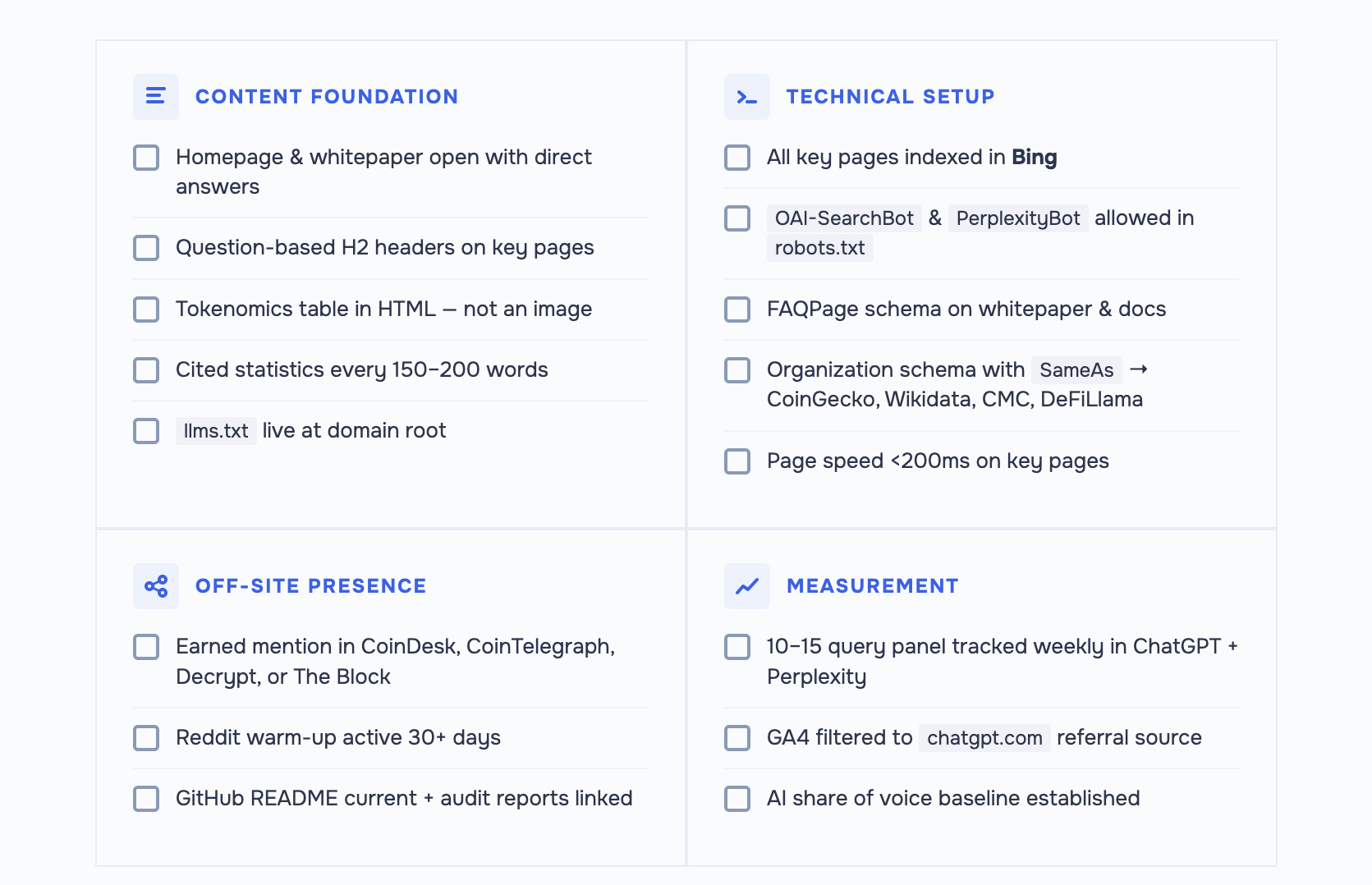
If your project clears fewer than half of these, the issue isn’t strategy — it’s infrastructure. Most crypto teams have deep protocol expertise but no GEO-specific setup. If you want an expert audit of exactly where you’re losing citations — which pages Bing isn’t indexing, which off-site signals are missing, which schema gaps are causing hallucinations — run a free audit right now.

Frequently Asked Questions (FAQ)
No — but you need to be indexed by Bing. ChatGPT’s search mode pulls primarily from Bing for live retrieval. A project that ranks well in Google but hasn’t been set up for Bing indexation can be completely invisible to ChatGPT’s retrieval layer.
It depends on parametric vs. retrieval mode. For queries where ChatGPT uses live search, a new token with good Bing indexation and structured data can appear quickly. For queries answered from model weights, new tokens have no parametric presence yet — that only builds through consistent coverage in sources ChatGPT was trained on.
Yes, materially. Wikipedia is one of the most heavily weighted sources in ChatGPT’s parametric knowledge. A Wikipedia entry creates a stable entity anchor that helps the model confidently identify your project. It also serves as a SameAs target in your Organization schema. If your project is notable enough to qualify, pursuing a Wikipedia page is high-leverage.
GPTBot crawls your site to use content in future training runs. OAI-SearchBot crawls your site to enable citation in ChatGPT’s search mode right now. Blocking GPTBot (which some projects do to control training data usage) has no effect on citation eligibility — that’s controlled by OAI-SearchBot. Many teams don’t realize they’ve blocked the wrong bot.
Paid sponsored posts on crypto media sites provide minimal AI citation value. What matters is editorial mention — a journalist or analyst naming your project in genuine coverage. ChatGPT’s model weights (and Perplexity’s trust signals) favor organic editorial over sponsored placements. Use PR budgets to earn coverage, not to buy labeled posts.
Run the Bing indexation check and add FAQPage schema to your whitepaper and tokenomics pages. These two actions take under a day, cost nothing, and address the two most common gaps that make otherwise credible projects invisible to AI systems. Everything else builds from there.
Share with


Rate the article