

Your Google rankings improved last month. Your impressions climbed. Your traffic dropped 34%. Welcome to the decoupling era.
If that combination of metrics makes sense to you, you’ve already felt what this article is about. If it doesn’t, you will soon. In Google’s AI Mode, the zero-click rate has hit 93% — nine out of every ten users get their answer and never leave the results page. The question is no longer how to get more traffic from search. The question is how to earn citation authority in a world where the click has been removed from the equation entirely.
This piece walks through what Google’s AI Mode update actually does, how much traffic brands are losing, why your rankings are lying to you, what Generative Engine Optimization is, how AI reshapes buying decisions before anyone visits your site, the new metrics worth tracking, and where agentic search takes all of this next.
What the Google AI Mode Update Actually Does
Google AI Mode is a persistent, conversational search experience that uses Gemini 3 to break your query into subtopics, search the web in parallel across those subtopics, and return a synthesised answer you can keep talking to.
Three things distinguish it from what came before:
- Query fan-out instead of single lookup. When you ask a complex question, AI Mode splits it into multiple sub-queries and runs them at once. So “what compliance tools work for Series A fintech” becomes a dozen parallel searches on specific requirements, vendors, pricing, and reviews — stitched into one answer.
- Gemini 3 as the default model for AI Overviews globally, with seamless escalation from an inline AI Overview directly into a conversational AI Mode session with memory and follow-up.
- Agentic features — hotel price tracking, calling local stores on your behalf, and Canvas-style trip planning. Search is no longer just a lookup tool. It’s something that acts for you.
It helps to keep the three surfaces separate in your head:
- Traditional search returns ten blue links. You click. You read. You decide.
- AI Overviews sit above those links as an AI-generated summary. You often don’t need to click.
- AI Mode is a full conversation with memory, follow-ups, and tasks it can execute on your behalf. The results page is barely a page anymore — it’s a workspace.
The rollout is tiered. The free experience gets AI Overviews and basic AI Mode in supported regions. The AI Pro and AI Ultra subscriber tiers get deeper agentic features, earlier access to new task types, and longer conversational memory. The distribution matters for brand strategy — your best-fit buyers are disproportionately in the subscriber tiers that remove the click earliest.
The Zero-Click Tsunami — The Numbers Brands Can No Longer Ignore
The scale of the shift is easy to under-appreciate until you see the numbers side by side.
Searches that trigger AI Overviews now show an average zero-click rate of 83%, while traditional queries without AI Overviews average around 60%. In Google’s AI Mode specifically, the zero-click rate reaches 93%. Seer Interactive’s analysis of 3,119 informational queries found organic CTR collapsed from 1.76% to 0.61% — a 61% decline — on queries where AI Overviews appear. There’s a twist worth holding onto though: brands cited in AI Overviews earn 35% more organic clicks and 91% more paid clicks than non-cited competitors on the same queries.
Bain’s consumer research reports that roughly 80% of consumers now rely on zero-click results in at least 40% of their searches, cutting organic web traffic by an estimated 15–25%.
The impact is not uniform. Informational queries are the hardest hit. Commercial-intent queries (transactional, “best”, comparison) still drive meaningful click volume. Navigational queries, when someone is looking for a specific brand, are largely unaffected.
Here’s the contrast most marketing decks haven’t yet absorbed:
| 2022 traffic model | 2026 traffic model | |
|---|---|---|
| Rank #1 informational query | ~30% CTR | ~3–6% CTR |
| Answer visible on SERP | Rarely | Default |
| Zero-click rate (AI Mode) | N/A | 93% |
| Brand benefit from rank #1 | Direct traffic | AI citation (if earned) |
| Measurement primitive | Sessions | Mentions + sessions |
What percentage of searches end without a click in 2026? On AI Overview-triggering queries, 83%. In AI Mode, 93%. Across all searches, north of 65%. The old traffic funnel didn’t shrink. It inverted.
The Great Decoupling — Why Your Google Rankings Are Now Lying to You
Why is your traffic falling when your rankings are stable? Because AI systems don’t pick citations the way PageRank picks rankings. They weight entity authority, content recency, structural extractability, and third-party co-citation — and those signals correlate only loosely with your blue-link position.
The overlap between top-10 Google rankings and AI Overview citations collapsed from roughly 75% in mid-2025 to between 17% and 38% by early 2026. Over the same period, BrightEdge recorded a 400% increase in citations pulled from results ranked in positions 21–30. Pages that would never have driven traffic in the old model are now being quoted by the AI system sitting on top of search.
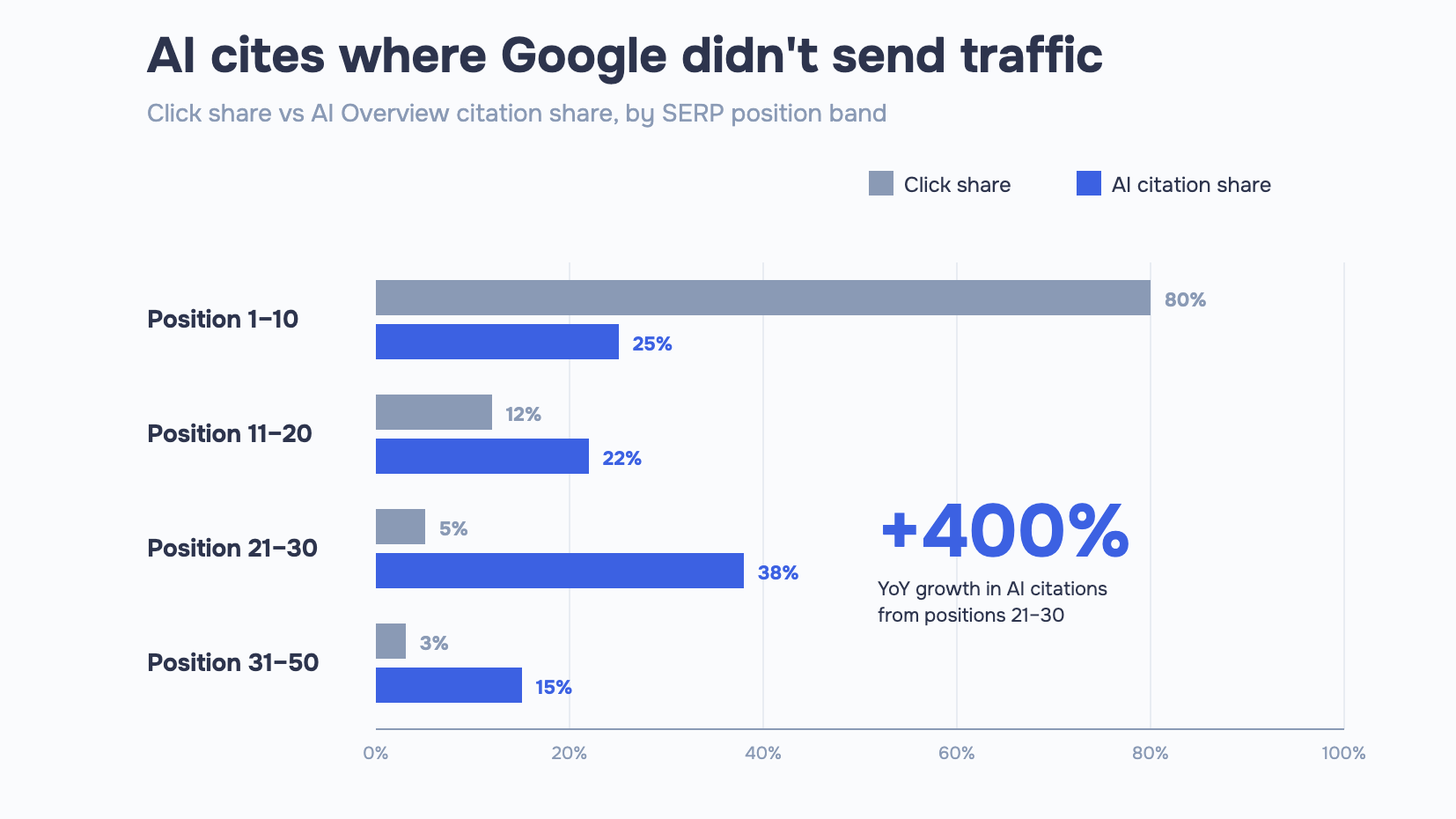
The inverse pattern is just as instructive. In a 90-day engagement, ICODA took a crypto brand to TOP-1 across ChatGPT, Perplexity, Gemini, Claude, and Google AI Overviews for 15+ commercial queries — and held position through Google’s December 2025 Core Update.
Part of what makes this confusing is a double-counting problem inside Google Search Console. AI Overviews inflate impression counts without correspondingly increasing clicks, so your visibility metrics can climb even as users stop landing on your pages. Rising impressions are no longer a leading indicator of rising traffic. Often they’re the exact opposite.
The practical reframing: commercial-intent queries still drive the highest clicks, and you should keep competing for them in the traditional sense. Informational content now drives AI citations and topical authority, and those citations compound into brand presence — but the expectation that great informational content will generate traffic the way it did three years ago is gone. It can still generate pipeline. It just won’t generate sessions. These are different currencies now, and treating them as the same is what makes the decoupling feel inexplicable.
What Is Generative Engine Optimization (GEO) — And Why SEO Alone Won’t Save You
Generative Engine Optimization (GEO) is the practice of structuring a brand’s content, authority signals, and technical infrastructure to earn citation and recommendation within AI-generated answers across Google AI Mode, ChatGPT, Perplexity, Gemini, and Claude.
The cleanest way to understand GEO is by contrast with SEO:
| SEO | GEO | |
|---|---|---|
| Goal | Rank high on results page | Get cited in AI-generated answers |
| Optimises for | Position (1–10) | Presence (cited / not cited) |
| Key metrics | Rankings, CTR, sessions | Citation rate, Share of Model, mentions |
| Primary output | Organic sessions | Brand recall + AI-referred conversions |
| Core tactic | Links + on-page relevance | Structured extractable content + entity authority |
The term GEO was formalised in a 2023 Georgia Tech paper (Aggarwal et al.), which framed it as a systematic discipline for optimising visibility within generative answers rather than within ranked lists. The discipline picked up commercial urgency at Google I/O 2025, when AI Mode was announced as a general-availability surface in Search, and shifted from theoretical framework to operational requirement once Gemini 3 became the default AI Overviews model in 2026.
GEO is sometimes confused with Answer Engine Optimization (AEO), which focuses narrowly on featured snippets and voice-assistant answers. GEO is broader: it encompasses every AI-generated answer surface, including conversational models like ChatGPT, Perplexity, and Claude that have no traditional “snippet” equivalent and no SERP underneath them at all. AEO is best understood as a subset of GEO — still relevant, but no longer sufficient on its own.
GEO rests on four pillars.
Content structure for extraction. Clear H2/H3 hierarchy, short declarative sentences, comparison tables, FAQ schema, and direct one-sentence answers placed early. 44.2% of all LLM citations come from the first 30% of a page’s text — the intro and opening sections carry disproportionate weight. Pages with three comparison tables earn 25.7% more citations. Shortlist-style pages averaging fewer than 10 words per sentence earn 18.8% more citations.
Entity and E-E-A-T authority. Google Knowledge Graph presence, consistent brand entity definition across the web, third-party co-citation in industry listicles, author bylines with verifiable credentials, and content that demonstrably reflects first-hand experience. AI systems disambiguate entities constantly — if your brand isn’t clearly established as a distinct, authoritative entity, you get flattened into a category.
Technical accessibility for AI crawlers. A robots.txt that permits the crawlers you want (GPTBot, Google-Extended, PerplexityBot, ClaudeBot), JSON-LD structured data on every content page, clean HTML that doesn’t hide key information in JavaScript, and fast server response times so crawlers can index depth rather than bouncing.
Off-site authority signals. Appearing in the authoritative round-ups and “best of” listicles that LLMs draw from disproportionately. Digital PR isn’t dead — it just has a new job. Getting mentioned alongside your established competitors in a credible third-party comparison is one of the highest-leverage moves in GEO, because that co-citation teaches the model to associate your brand with the category.
SEO asks where you rank. GEO asks whether you appear at all. Both matter. But only one of them still maps directly to revenue in 2026.
How to Optimize for Google AI Mode: 7-Step GEO Framework
The four pillars explain what GEO is. The seven steps below explain how to operationalise it inside an existing marketing function — in roughly the order you should tackle them.
- Audit your current AI visibility. Run your top 50 non-branded queries through ChatGPT, Perplexity, Gemini, and Google AI Mode — either manually, or through a tool like AI Visibility checker that runs the sweep across all four models in one pass. For each query, record three things: whether your brand appears, how it’s described, and which competitors are cited in your place. This is your baseline — without it, every later step is unmeasurable.
- Restructure content for extraction. Move the definitive one-sentence answer to the first 30% of every page. Break paragraphs at the idea level, not the prose level. Add comparison tables to category pages and cap sentence length on shortlist pages at around 10 words. These are not stylistic preferences — they correlate directly with citation rates.
- Build entity authority. Claim and complete your Google Knowledge Panel, standardise your brand entity definition across Wikipedia, Crunchbase, LinkedIn, and your own About page, and make sure author bylines carry verifiable credentials and outbound links. Models triangulate entities across sources before deciding to cite them — inconsistency reads as ambiguity, and ambiguity reads as risk.
- Open the door to AI crawlers. Audit your robots.txt to permit GPTBot, Google-Extended, PerplexityBot, ClaudeBot, and OAI-SearchBot. Deploy JSON-LD structured data (Article, FAQPage, Product, Organisation, LocalBusiness as relevant) on every commercial and informational page. Move key information out of client-side JavaScript and into server-rendered HTML.
- Earn third-party co-citation. Identify the 20 most-cited authoritative listicles and comparison articles in your category and run a focused digital PR programme to be included in them. AI systems lean disproportionately on these aggregator pages when assembling answers — appearing alongside your established competitors there is one of the highest-leverage moves in GEO.
- Set up Share of Model measurement. Build a prompt library of 50–200 high-intent queries and run them weekly across your target models using a Run-and-Regenerate approach. Track citation frequency, brand visibility score, AI share of voice, sentiment, and LLM-attributed conversions. A spreadsheet works for the first 90 days; tools like Semrush AI Tracker, Ahrefs Brand Radar, Evertune, or Siftly automate it from there.
- Prepare the agentic layer. Make sure your product catalogue, pricing, and inventory are exposed in machine-readable, real-time form. Synchronise your local listings across Google Business Profile, Apple Maps, and Bing so an agent reconciling sources never finds a conflict. Treat your site as a service endpoint that an AI agent must be able to query, not a brochure that a human must read.
A reasonable cadence: steps 1–4 in the first quarter, 5–6 in the second, step 7 layered in throughout. Brands that try to start at step 7 without the foundation underneath end up with beautifully structured data that no AI system has any reason to cite.
The Invisible Funnel — How AI Now Shapes Buying Decisions Before the Click
Here’s the scenario that keeps CMOs up at night and almost never shows up in an analytics review.
A Series A fintech head of operations opens ChatGPT and asks: “what compliance tools work for early-stage fintechs handling card payments in the UK?” She gets four named recommendations. She opens a new chat and asks about integration complexity and pricing. She gets more detail. Over two days of conversational research, she narrows to two vendors. Only then does she go to Google — and only to type the names of the two vendors she’s already chosen.
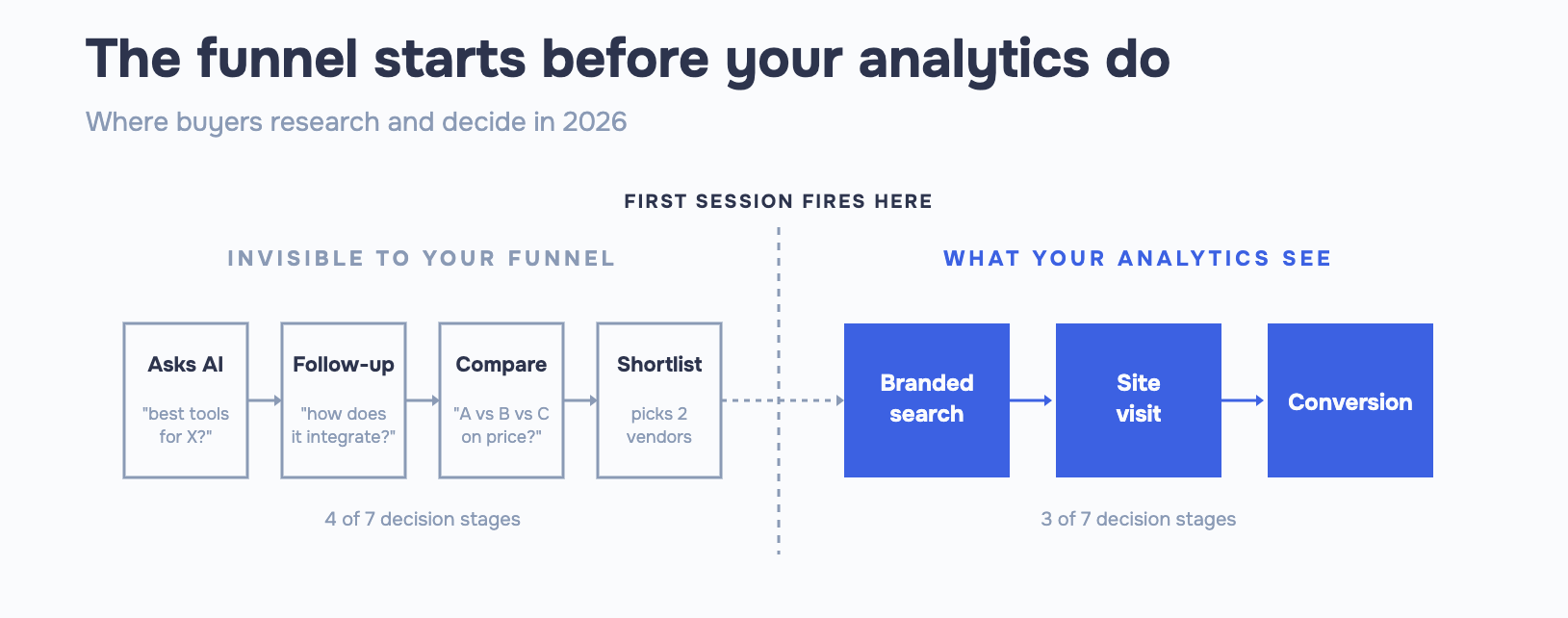
If your brand wasn’t surfaced in those first conversations, the loss is invisible. It will never show up as a bounced session, because there was no session. It shows up six months later as a pipeline gap with no obvious cause.
More than half of consumers already use AI-powered search tools, and up to 40% of traditional search traffic is at risk because AI engines provide ready-to-use answers early in the customer journey — capturing decisions before users click a single link. For B2B specifically, 89% of buyers now use generative AI during their purchasing journey, yet most marketers have zero visibility into whether AI systems mention their brand.
Two patterns inside that data deserve their own attention.
The ghost citation problem. 61.7% of LLM citations are “ghost citations” — the domain gets a source link but the brand name isn’t mentioned in the answer text. The model reads your content, uses it, and drops a footnote. The user reads the answer, takes the information, and never consciously registers where it came from. You get the citation credit in the URL; you get none of the brand recall. This is why pages that would historically have built brand awareness through traffic no longer do — the awareness is being intercepted upstream.
The conversion asymmetry. AI-referred traffic converts at roughly 4.4x the rate of traditional organic search. When users do click through from an AI answer, they arrive already informed, further down the buying decision, and with specific intent. A tenth of the sessions can generate the same revenue. This is the silver lining of the invisible funnel — the clicks you do earn are worth dramatically more per visit.
The New Measurement Playbook — Share of Model, Citation Rate, and AI Visibility Score
The measurement gap is the single biggest reason GEO investment keeps stalling inside marketing teams. 89% of brands now appear in AI-generated search results — and only 14% of marketers track AI search citations. Most have no way to connect AI presence to meaningful traffic or revenue, so the whole discipline gets filed under “emerging” and deprioritised. Wrong file.
Share of Model (SoM) is the metric that measures how frequently an LLM cites your brand as a solution across a defined set of high-intent prompts. It’s the direct AI-era analogue of Share of Voice, built for a world where impressions aren’t purchased and rankings don’t determine visibility.
SoM calculation combines three inputs: citation frequency (how often you appear), sentiment (how the AI describes you when it does), and feature accuracy (whether the AI gets your positioning right). Because LLM outputs are non-deterministic, SoM requires a “Run-and-Regenerate” approach — running the same non-branded prompts multiple times across target models and aggregating results. One run is a snapshot. A hundred runs is a measurement.
The five KPIs worth building a dashboard around:
- Citation Frequency — raw count of how often your brand appears across a tested prompt library, per model.
- Brand Visibility Score — percentage of relevant prompts where your brand appears at all (cited, mentioned, or recommended).
- AI Share of Voice — your citation count as a percentage of total citations within your category for the tested prompts.
- Sentiment Alignment — whether the AI describes your brand accurately and favourably when it does surface you.
- LLM Conversion Rate — sessions and pipeline specifically tagged as coming from AI referrers (ChatGPT, Perplexity, Gemini), and their downstream conversion.
Practical tracking approaches range from fully manual to emerging platforms. A manual prompt library (50–200 high-intent queries, run weekly across three or four models) costs nothing and gets you 80% of the signal. Tools like Semrush AI Tracker, Ahrefs Brand Radar, Evertune, and Siftly automate the same work at scale. Indirect signals matter too: branded search lift, direct traffic spikes after confirmed AI coverage, and “how did you hear about us” surveys that include ChatGPT, Gemini, and Perplexity as options.
You can’t manage a funnel you can’t see — and the AI funnel is measurable. It just isn’t measurable using Google Analytics alone.
The Agentic Horizon — When Google Stops Linking and Starts Acting
Picture a user on their phone asking AI Mode: “find me the nearest running store with the Nike Pegasus 41 in a men’s 10 and call ahead to hold a pair.” What happens next decides whether you’re a brand or a blind spot.
Google’s agentic calling feature already places the call. The AI asks the store, gets an answer, and reports back — the user never dials. Google’s Canvas feature already builds structured trip plans. Price tracking already monitors hotel rates and flags drops. The agentic layer isn’t a future scenario. It’s live.
The strategic implication is that optimising for clicks is no longer the ceiling. Brands now have to optimise for machine readability — the ability for an AI agent to parse your inventory, pricing, and availability in real time and act on it.
What that means practically:
- Schema.org markup on everything. Product schema, LocalBusiness schema, FAQ schema, Organisation schema — JSON-LD, validated, complete. If an agent can’t parse your structured data, you’re invisible in the transaction layer even if you’re ranking well.
- Real-time product and inventory feeds. Static pages that say “call for availability” are the new broken links. Agents need machine-readable signals for what’s in stock, at what price, right now.
- Consistent local listings. Hours, address, phone, services — perfectly synchronised across Google Business Profile, Apple Maps, Bing, and your own site. Agents reconcile conflicting information by dropping the brand, not by investigating.
- API-style thinking for your site. Start treating your website as a service endpoint, not a marketing brochure. If an agent can’t get an answer from your page in one parse, it will get it from a competitor.
Early signals worth monitoring in your own logs: agentic crawler user-agents (GPTBot, Google-Extended, PerplexityBot, ClaudeBot, OAI-SearchBot), structured data coverage scores across your catalogue, and — for local and retail brands — AI-initiated call volume attributed by Google Business Profile. These are the leading indicators of agentic readiness, long before the transactions show up in revenue reports.
Conclusion: From Click-Chasing to Citation-Earning — What Brands Must Do Now
The click was never the goal. Awareness, authority, and purchase intent were. AI has simply removed the click as the intermediary — and a lot of marketing dashboards were pointing at the intermediary, not the goal.
The four-layer response is clear. Understand what AI Mode actually does so your strategy is grounded in the real mechanics, not a caricature of them. Accept that rankings and traffic are decoupled and stop letting rising impressions reassure you while revenue erodes. Build GEO as a formal discipline with its own KPIs, owner, and budget — not as a side project attached to SEO. And prepare the technical and content layer for agentic interaction before your competitors turn structured data into an actual moat.
The brands earning AI visibility now are building a compounding citation asset. Every time a model is trained, fine-tuned, or run, brands that appear in authoritative content get reinforced as category answers. That asset drives pipeline regardless of whether a session ever fires in Google Analytics. The click era is closing. The citation era is already open.
Navigating this shift requires a partner operating at the intersection of traditional SEO authority and AI citation architecture. Purpose-built AI SEO services for the citation era audit your current AI visibility, identify the gaps across Google AI Mode, ChatGPT, Perplexity, and Gemini, and build the content and technical infrastructure that earns your brand a seat in the answer.
Frequently Asked Questions (FAQ)
Google AI Mode is a conversational search experience powered by Gemini 3. It breaks your question into multiple sub-queries, searches the web in parallel, and returns a synthesised answer you can keep talking to — with memory, follow-ups, and the ability to act on your behalf through agentic features like calling local stores or tracking prices.
AI Overviews are inline summaries above traditional search results. AI Mode is a full conversation with memory and follow-ups — closer to ChatGPT than to a SERP. AI Overviews are the entry point; AI Mode is where users go when one answer isn’t enough.
Because AI systems pick citations differently from how Google picks rankings. They weight entity authority, content recency, and structural extractability — signals that overlap only loosely with PageRank. The overlap between top-10 rankings and AI Overview citations dropped from ~75% to between 17% and 38% in under a year.
Place direct one-sentence answers in the first 30% of each page, use comparison tables and short declarative sentences, complete your Google Knowledge Panel, earn co-citations in authoritative third-party listicles, and allow AI crawlers in your robots.txt. Citation correlates with structural extractability and entity authority — not with rank position.
AI citation improvements often appear within 2–8 weeks of well-executed work — faster than traditional SEO, because LLM training and retrieval cycles refresh more frequently than Google’s core algorithm rolls out.
Share with


Rate the article