


We ran 87 DeFi protocols through a prompt audit across ChatGPT and Perplexity. Eighty-seven percent weren’t named in a single response to “best DeFi protocols for yield in 2026.” Many had published audits. Live TVL dashboards. Active Discord communities with tens of thousands of members.
The problem wasn’t the technology. It was that AI systems couldn’t read any of it.
That’s the central tension in DeFi protocol marketing right now. The infrastructure side of the stack has never been stronger — on-chain transparency, audited contracts, real-time TVL data — but the content layer is largely invisible to the AI systems increasingly deciding which protocols users discover first. If you’re a protocol founder wondering why growth has plateaued despite solid fundamentals, this is probably where the gap is.
Why DeFi Protocols Are Technically Prepared But Strategically Invisible to AI
DeFi protocol AI invisibility is specific: a protocol with documented TVL and security audits is absent from AI-generated recommendations because its web content isn’t structured for extraction.
Not a reputation problem. Not a product problem. An infrastructure problem — just not the kind DeFi teams are used to solving.
Most protocols in this situation score well on what you’d call technical infrastructure: audit coverage, live TVL data, governance contract visibility, tokenomics documentation. These are the baseline trust signals serious DeFi users demand before depositing, and most established protocols have them. But AI systems don’t evaluate protocols the way DeFi-native users do. Smart contracts aren’t readable to them. TVL dashboards rendered via JavaScript widgets aren’t interpretable. Audit PDFs might as well not exist.
Crawlable, structured text is what they can process — and they rank the information quality of that text against the question being asked.
This creates a split that shows up repeatedly in AI visibility audits. A protocol with $80M TVL, two published audits, and a CoinDesk feature can score in the bottom quartile for AI citation share if its web presence is a whitepaper, a Medium post from 2022, and a governance forum thread. A protocol half its size with well-structured documentation and clearly defined product pages might appear in AI responses consistently.
Protocols that get cited attract more indexed coverage: crypto media picks them up, community members reference them, DeFiLlama integrations get documented — all of which feeds more citation, compounding share of voice over time. Protocols that aren’t cited stay uncited.
💡 Strong technology doesn’t equal AI visibility. The gap is in content structure, and it’s measurable.
What AI Systems Look For When Recommending DeFi Protocols
AI systems apply more caution to DeFi than to almost any other financial product category. DeFi involves direct financial risk — liquidation events, smart contract exploits, impermanent loss, regulatory exposure — and when a protocol’s content doesn’t address these risks explicitly, AI systems fill in the gap with their own conservative caveats. What comes out is hedged, non-committal language that doesn’t actually recommend anything.
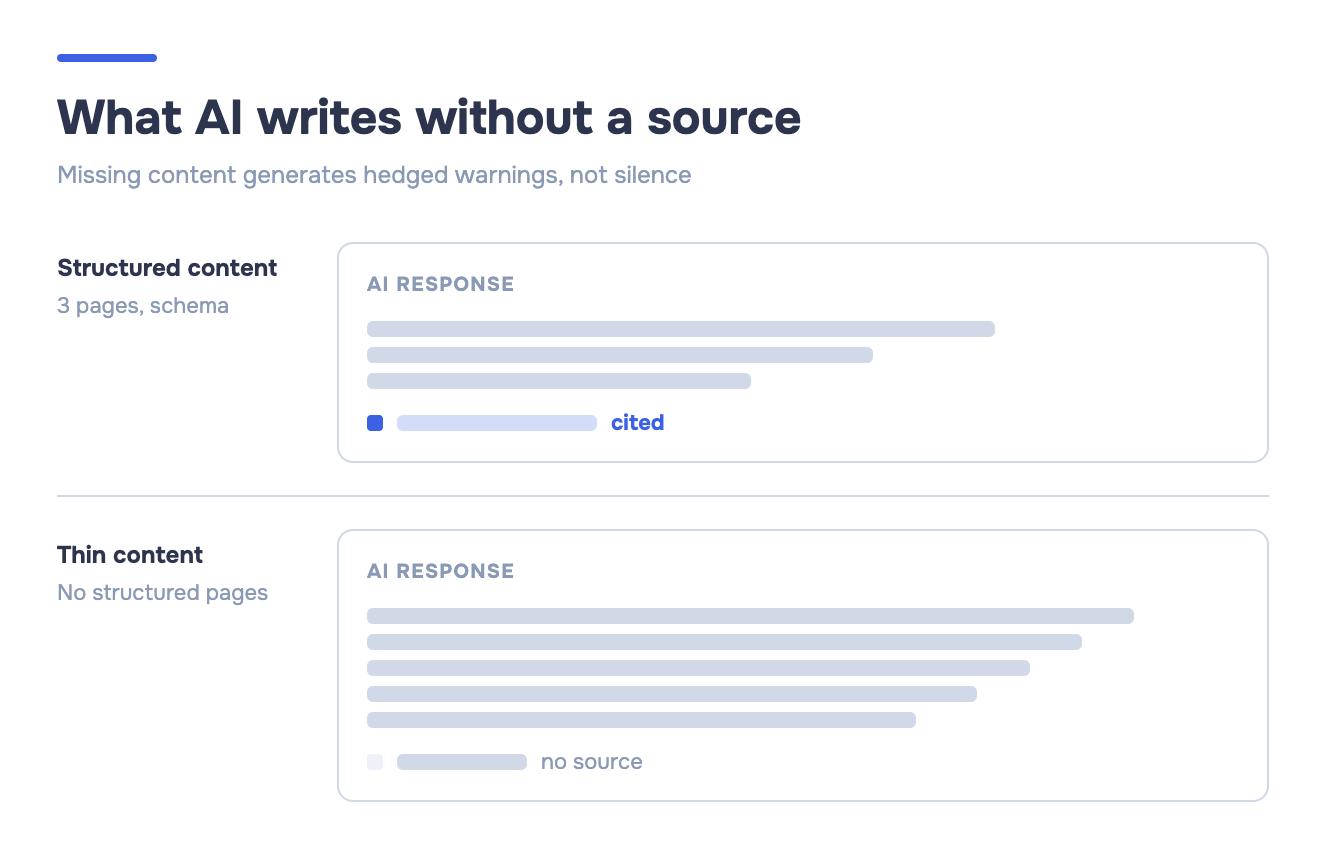
Before Perplexity or ChatGPT will cite a DeFi protocol with any confidence, four things need to be in place:
1. A crawlable product definition page. Not a whitepaper. Not a blog post about the vision. A page that answers directly: what does this protocol do, who is it for, how does it work? Indexable HTML — not a JavaScript-rendered SPA component that assembles after wallet connection.
2. Explicit risk disclosures. The standard “this is not financial advice” footer doesn’t count. AI systems look for on-page content addressing the specific risks of the protocol: liquidation thresholds, smart contract audit status, known limitations. Without it, AI systems write their own warnings, which crowd out actual recommendations.
3. Third-party corroboration. DeFiLlama for TVL, recognized audit firms (Certik, Trail of Bits, OpenZeppelin), established crypto media. These create the external validation signal that tells an AI system the protocol is real and its claims are checkable.
4. Structured schema data. FAQ schema, how-to schema, structured product definitions. Without schema, well-written content still competes harder for extraction than it should.
Publishing an audit PDF is not a marketing asset. It’s invisible to AI crawlers. A crawlable audit summary page with structured text — key findings, audit firm name, date, scope, remediation status — is citable. The PDF isn’t.
TVL data works the same way. A dynamic widget pulling from an API isn’t indexable in any stable form. A page contextualizing TVL — current figure, how to verify it on DeFiLlama, historical trend — can be. Most protocols have the data and skip the page.
Content That Gets DeFi Protocols Cited: Beyond Whitepapers and Tokenomics
Three to five well-structured pages outperform thirty narrative blog posts for AI citation. Counterintuitive for teams producing content volume — weekly updates, governance recaps, ecosystem partnership announcements. That content has community value, but it doesn’t extract well because it answers questions no one is actually asking an AI.
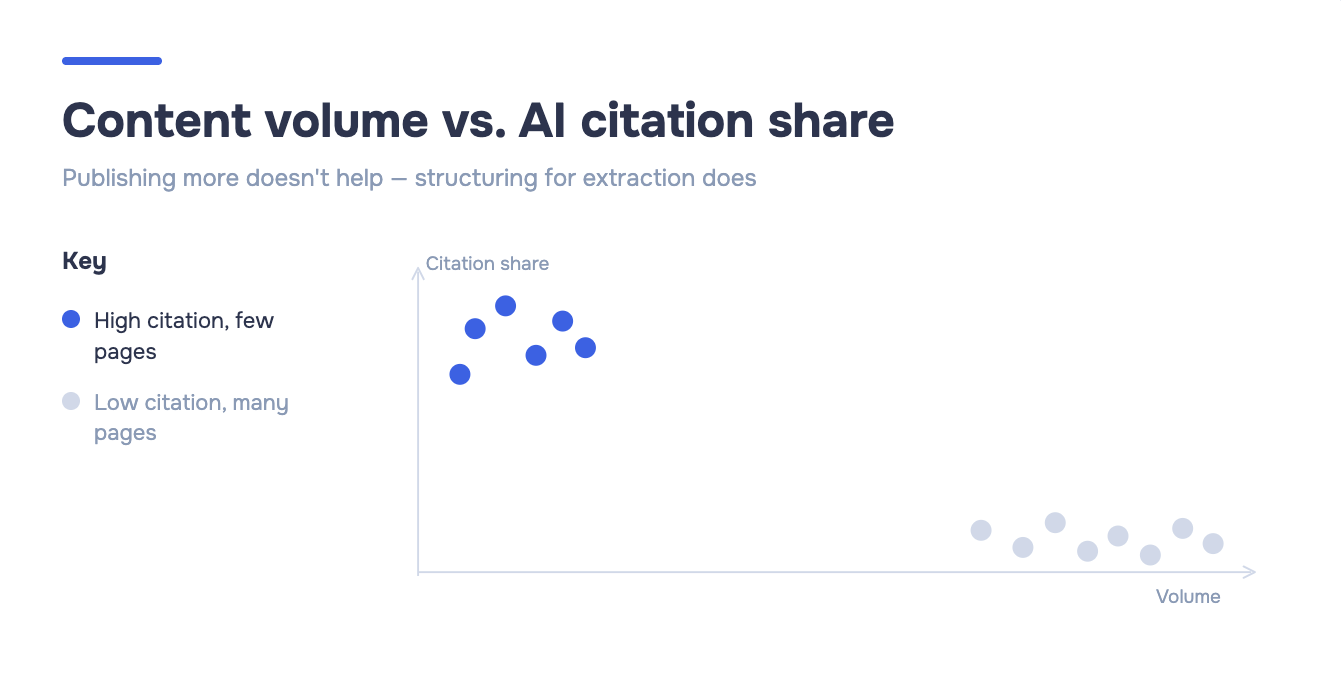
The content types that reliably earn DeFi citations are:
- Risk and liquidation mechanics pages. If your protocol has liquidation risk, there should be a dedicated page explaining how it works, at what thresholds, and what users can do to manage it. This is the single most important gap for lending and leveraged yield protocols — it directly addresses the safety concern that triggers maximum-caution caveats.
- Comparison pages. “Protocol X vs. Aave” or “How [Protocol] compares to Compound for stablecoin lending” — these signal that the protocol understands its competitive context and is confident enough to say so. They also capture comparison queries directly.
- Structured FAQ pages with schema markup. Each question answered in two to four sentences, self-contained, no setup. The answer should hold up pulled entirely out of context, because for AI citation purposes, it will be.
- Audit summary pages. A crawlable page per audit: firm name, date, scope, finding count by severity, remediation status. Structured as text. Linkable. Not the PDF.
- Use-case explainers. “How to earn yield on ETH with [Protocol]” is more citable than “Our Innovative Approach to Liquidity Provision.” One answers a real question. The other is marketing copy AI systems ignore.
Here’s how those content types compare on actual AI citability:
| Content type | AI citable? | Why |
|---|---|---|
| Risk / liquidation mechanics page | Yes | Addresses the exact safety concern that triggers AI caveats |
| Comparison page (vs. Aave, Compound) | Yes | Answers a specific query; signals competitive clarity |
| FAQ page with FAQPage schema | Yes | Self-contained Q&A maps directly to AI extraction format |
| Crawlable audit summary page | Yes | Verifiable third-party signal in indexable text |
| Use-case explainer (“earn yield on ETH”) | Yes | Matches intent queries verbatim |
| Audit PDF | No | Not crawlable; invisible to AI systems |
| Whitepaper | Rarely | PDF format, investor narrative structure — not extractable |
| Governance forum thread | No | Ephemeral, not reliably indexed, no structured format |
| Weekly blog update / ecosystem recap | No | Answers no specific user or AI query |
Format matters as much as topic. AI systems favor content that opens with a direct answer, provides a tight definition, and keeps each section self-contained. Narrative prose that builds to a conclusion is structurally hostile to extraction — the most precise information ends up at the bottom, where AI extraction rarely reaches.
A practical test: take any page on your protocol’s site and ask whether an AI could pull a clean, accurate two-sentence answer from it to a specific user query. If the answer requires reading the whole page in sequence, the page isn’t structured for citation.
Community Signals: Why Discord & X Don’t Feed AI Models Directly
A 50,000-member Discord server contributes zero directly to your AI citation share. This is probably the most important thing DeFi marketing teams need to recalibrate around.
Discord’s content is private, ephemeral, and unindexed. Whatever happens in your protocol’s Discord — debates, tutorials, governance discussions — is invisible to AI crawlers. It doesn’t train models. It doesn’t feed Perplexity’s live retrieval. It doesn’t touch Google AI Overviews. A Discord conversation, from an AI visibility standpoint, might as well not exist.
X is only slightly better. The platform is partially blocked from crawlers, tweet-length content falls below the extraction threshold AI systems use, and real-time social content isn’t where AI systems go for factual claims about financial products. A viral thread generates signal inside X’s ecosystem. It doesn’t produce a citable source for an AI recommendation.
None of this makes community useless — it makes it differently useful. A strong community drives word-of-mouth, keeps existing users engaged, creates social proof. But for AI visibility, Discord and X are the wrong layer to invest in.
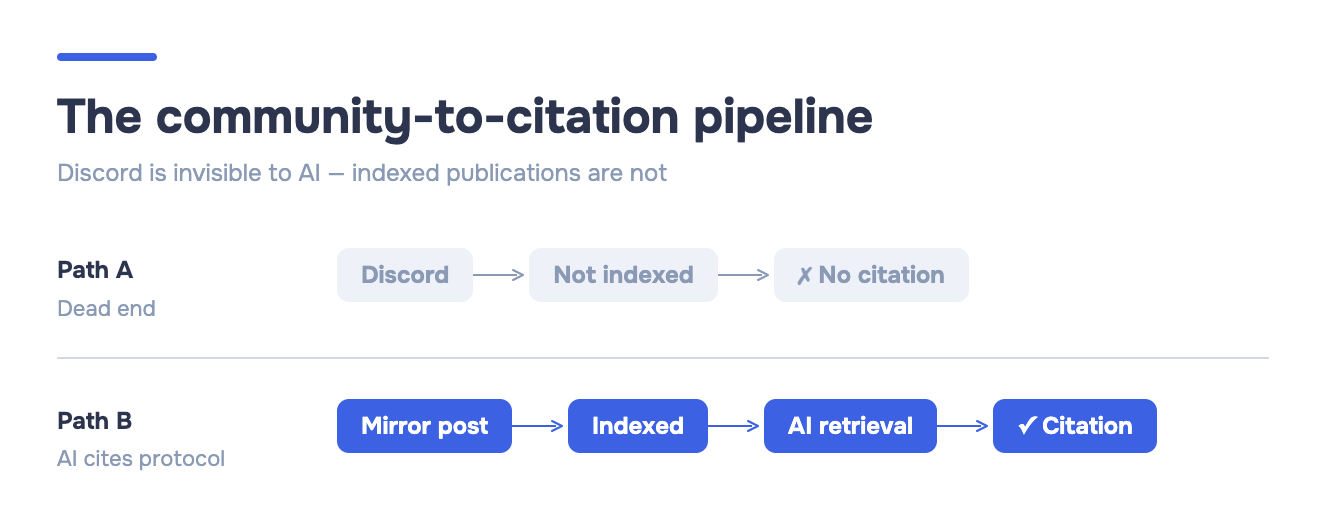
Community signals do reach AI models, just not through those channels natively. The ones that actually feed AI citation:
- Crypto media coverage (The Block, Decrypt, CoinDesk) — indexed, authoritative, cited with confidence by AI systems
- Reddit threads in relevant DeFi communities — crawlable, high-signal for Perplexity live retrieval
- DeFiLlama and DeFiPulse data inclusion — on-chain TVL corroborated by a source AI systems trust by default
- Mirror, Paragraph, or Substack posts — public, indexed alternatives that preserve community content in retrievable form
- Governance proposals on public forums — crawlable documentation of protocol decision-making that signals transparency and maturity
How it actually flows: a Discord conversation generates a signal, a community member publishes a thread on Mirror, that post gets indexed, and it feeds AI retrieval. The post is what matters. A thread in a private Discord channel creates nothing that survives past the conversation. The same content published on Mirror and picked up by one crypto journalist becomes a citable source.
How to Measure DeFi Protocol AI Visibility (and What to Fix First)
Before fixing an AI visibility problem, you need to know what you’re actually dealing with. Three metrics matter:
Citation share of voice — how often your protocol appears in AI responses relative to competitors, across category queries (“best DeFi lending protocol 2026”), comparison queries (“Aave vs [your protocol]”), and use-case queries (“how to earn yield on stablecoins 2026”).
Source URL inclusion — which specific pages on your site get cited when your protocol does appear. This tells you what’s working and what isn’t.
Description accuracy — when cited, how accurately is your protocol described? Inaccurate descriptions mean AI systems are working from thin or conflicting information.
Running the audit manually takes about two hours. Test ten to fifteen prompt variations across ChatGPT, Perplexity, and Google AI Overviews — category queries, head-to-head comparisons, use-case specifics. Log every appearance, every citation URL, every description. Compare your appearance rate against two or three direct competitors.
What comes back usually points to one of three root causes.
Technical crawlability. Most DeFi front ends are single-page applications, and search crawlers genuinely struggle with JavaScript rendering, especially when content assembles after wallet interaction. If your protocol’s core pages don’t render static content for crawlers, nothing else here matters until that’s fixed. Test with Google Search Console’s URL inspection tool — check what Googlebot actually sees, not what your browser renders.
Content structure. The information exists but it’s in the wrong format: PDFs, embedded widgets, narrative blog posts, SPA-rendered components. The fix is converting it into crawlable, schema-marked, self-contained pages.
Third-party corroboration. The protocol appears in indexed content but only in its own publications. The fix is earned media and DeFiLlama integration — AI systems need external validation before recommending a financial product with any confidence.
Crawlability comes first. Optimizing content structure for a page search engines can’t read accomplishes nothing.
How ICODA Approaches DeFi Protocol Marketing
We track one primary outcome: TVL growth. Not follower counts, not impressions, not Discord member growth. Protocols that have worked with ICODA on AI visibility have seen an average of 36% TVL growth downstream — because when AI systems recommend a protocol accurately and confidently, organic wallet activation follows.
The ICODA Checker maps protocols on two axes: Technical Infrastructure score (audit coverage, TVL data accessibility, tokenomics documentation, governance transparency) and Content Structure score (crawlability, schema implementation, content type coverage, third-party corroboration). Most protocols we audit sit high on the Technical Infrastructure axis and low on the Content Structure axis. The gap between the two scores is where the work happens.

One documented example: a DeFi protocol with a 16% APY stablecoin that read as suspicious to traditional investors — not because the mechanics were unsound, but because the content didn’t answer the three questions Web2 investors actually asked. ICODA rebuilt the content layer around those questions and added regionally adapted education funnels. The result was $0 to $340K in monthly fiat deposits within six months. The product didn’t change. The content structure did.
We track two metric sets in parallel: traditional DeFi KPIs (activated wallets, TVL inflow, retention rate) and AI visibility KPIs (citation share of voice, prompt coverage across query types, source URL inclusion). AI visibility work drives the traditional metrics, and the traditional metrics validate whether the AI visibility work actually landed.
| What we audit | What we fix | What we measure |
|---|---|---|
| Technical crawlability | Static page rendering, SPA fallback | Googlebot index coverage |
| Content structure | Schema markup, page format, content type gaps | AI citation share by query type |
| Third-party corroboration | Media outreach, DeFiLlama integration, indexed community content | External source inclusion in AI responses |
| TVL data accessibility | Contextual TVL pages with DeFiLlama references | Citation accuracy, TVL mention frequency |
From Technically Ready to AI-Visible: The Next Step for Your Protocol
Most DeFi protocols have strong on-chain infrastructure and almost no crawlable content layer. Strong audit coverage and live TVL data are necessary — they just aren’t sufficient. They don’t get cited if they can’t be read.
TVL growth and AI citation share aren’t separate concerns. AI visibility drives organic wallet activation, which drives TVL, which strengthens the corroboration signals AI systems need to cite a protocol with confidence. The feedback loop works — but only if the content structure is in place to start it.
The ICODA Checker maps exactly where your protocol sits on the Technical Infrastructure vs. Content Structure axis and shows which gap is costing the most AI citations. Before your next content investment, it’s worth knowing what you’re actually working with.
Frequently Asked Questions (FAQ)
DeFi protocol marketing is about building trust and visibility for a specific protocol — earning user deposits, TVL, and wallet activations — not promoting a token price or a broader brand. The audience is financially sophisticated users who read audit reports and verify TVL before depositing. Crypto marketing typically targets retail sentiment and token liquidity; DeFi protocol marketing is closer to fintech growth than to a token launch.
Both platforms restrict crypto and financial product advertising to limit fraud exposure. Most DeFi protocols fall into restricted or prohibited categories regardless of how established they are — this isn’t specific to small or unknown protocols. The practical result is that DeFi marketing has to be earned: organic search, editorial coverage, community-driven growth, and AI recommendation share.
A capable DeFi marketing agency combines traditional growth functions — content strategy, media outreach, community development — with AI visibility work: crawlability audits, content structure optimization, schema implementation, and citation share tracking. Agencies that only handle one of those layers are leaving most of the value on the table.
They evaluate protocols primarily through the quality and structure of crawlable content, combined with third-party corroboration from sources like DeFiLlama, audit firms, and crypto media. Protocols with thin or unstructured web content get hedged, cautious descriptions — or no mention at all — even when the on-chain fundamentals are strong.
Total Value Locked is the aggregate value of assets deposited into a protocol’s smart contracts. It’s the primary trust and traction signal for DeFi because it’s on-chain verifiable and publicly tracked by DeFiLlama. From a marketing standpoint, TVL growth is the downstream outcome that confirms the work is landing — more users discovering and trusting the protocol enough to deposit.
Share with


Rate the article