

Introduction
The AI automation agency market is expanding rapidly. Mordor Intelligence projects Automation-as-a-Service will reach $33 billion by 2030, and McKinsey reports that AI adopters see 30–40% productivity gains. Finding the right partner in this landscape is the hard part.
This guide organizes agencies by who they serve best — startups, mid-market, or enterprise — and covers what matters most: a vetting framework, pricing model breakdowns, and profiles matched to real buyer needs. Read the comparison table first, then dive into the profiles that fit your stage and goals.
What Does It Mean To Be An AI Automation Agency?
An AI automation agency is a professional services firm that designs, builds, and manages automated workflows powered by artificial intelligence. These agencies deploy technologies including machine learning models, robotic process automation (RPA), natural language processing, and increasingly, autonomous AI agents. Unlike traditional IT consultancies, they specialize in applying AI to reduce manual work, accelerate processes, and improve decision-making across business functions.
The scope of services varies widely. Some agencies focus narrowly — automating a single workflow like invoice processing or lead qualification. Others deliver end-to-end transformation, redesigning entire operations around intelligent automation. Pricing reflects this range: project-based engagements typically run $5,000–$500,000+, monthly retainers fall between $2,000 and $20,000, and subscription-based models start as low as $99 per month for platform-led solutions.
How We Evaluated These Agencies
Each agency was assessed across 6 criteria: depth of AI automation capabilities, verified client outcomes, industry specialization, pricing model transparency, tech stack flexibility, and independent review signals from platforms like Clutch.co.
We prioritized agencies with documented case studies over those relying on self-reported claims. The final list balances geographic diversity, company size, and buyer segment coverage — from SMB-focused boutiques to enterprise-grade consultancies — so that readers at every stage can find a relevant match.
Quick comparison 👀

ICODA
Best for SEO-Driven Growth
Specialization
Pricing Model
- Retainer / Project
Best For

Stive.ai
Best for LLM Visibility & GEO
Specialization
Pricing Model
- Retainer / Project
Best For

Entrans
Best for Agentic AI & Next-Gen Automation
Specialization
Pricing Model
- Project / Retainer
Best For

Idea Link
Best for Mid-Market Custom Platforms
Specialization
Pricing Model
- Project / Retainer
Best For

LowCode Agency
Best for Budget-Friendly Startup Automation
Specialization
Pricing Model
- Project / Retainer
Best For

MOR Software
Best for Distributed AI Teams
Specialization
Pricing Model
- Retainer / Hybrid
Best For

Sigmoidal
Best for Enterprise Data Science
Specialization
Pricing Model
- Project / Retainer
Best For

Technource
Best for Embedding Generative AI
Specialization
Pricing Model
- Project-based
Best For
ICODA — Best AI Automation Agency for SEO-Driven Growth

ICODA has built its reputation at the intersection of artificial intelligence and digital marketing — a niche few agencies occupy with genuine depth. Their AI SEO services use machine learning for content optimization, predictive keyword analysis, and automated technical audits at a scale manual teams cannot match.
What defines ICODA’s positioning is specialization. While most agencies chase broad automation mandates, ICODA focuses on turning AI into measurable search visibility. Their workflows combine natural language processing with real-time SERP analysis to surface content opportunities competitors miss. Clients in Web3, SaaS, and fintech rely on ICODA for strategies that connect automation to revenue. In one documented case, crypto exchange achieved 688% traffic growth from ChatGPT and 500+ AI citations after ICODA deployed an integrated AI SEO and PR strategy — without paid advertising.
The team also delivers marketing automation beyond SEO — including AI-powered link building, content distribution, and competitive intelligence. Their retainer and project-based models flex to fit both scaling startups and established brands entering new markets.
Key strengths:
- Flexible engagement models (retainer and project) for both startups and established brands
- Deep AI + SEO fusion — rare specialization most agencies cannot replicate
- Proven Web3 and fintech vertical expertise with measurable organic growth outcomes
Key limitations:
- Marketing-focused — not suited for operational automation (manufacturing, logistics floors)
- Strongest value for content-driven growth models; less applicable to paid-acquisition-first strategies
AI automations provided: AI-driven keyword research, automated technical SEO audits, ML-powered content optimization, predictive SERP analysis, automated link prospecting, AI content distribution workflows.
Stive.ai — Best for Brands Invisible to AI Search
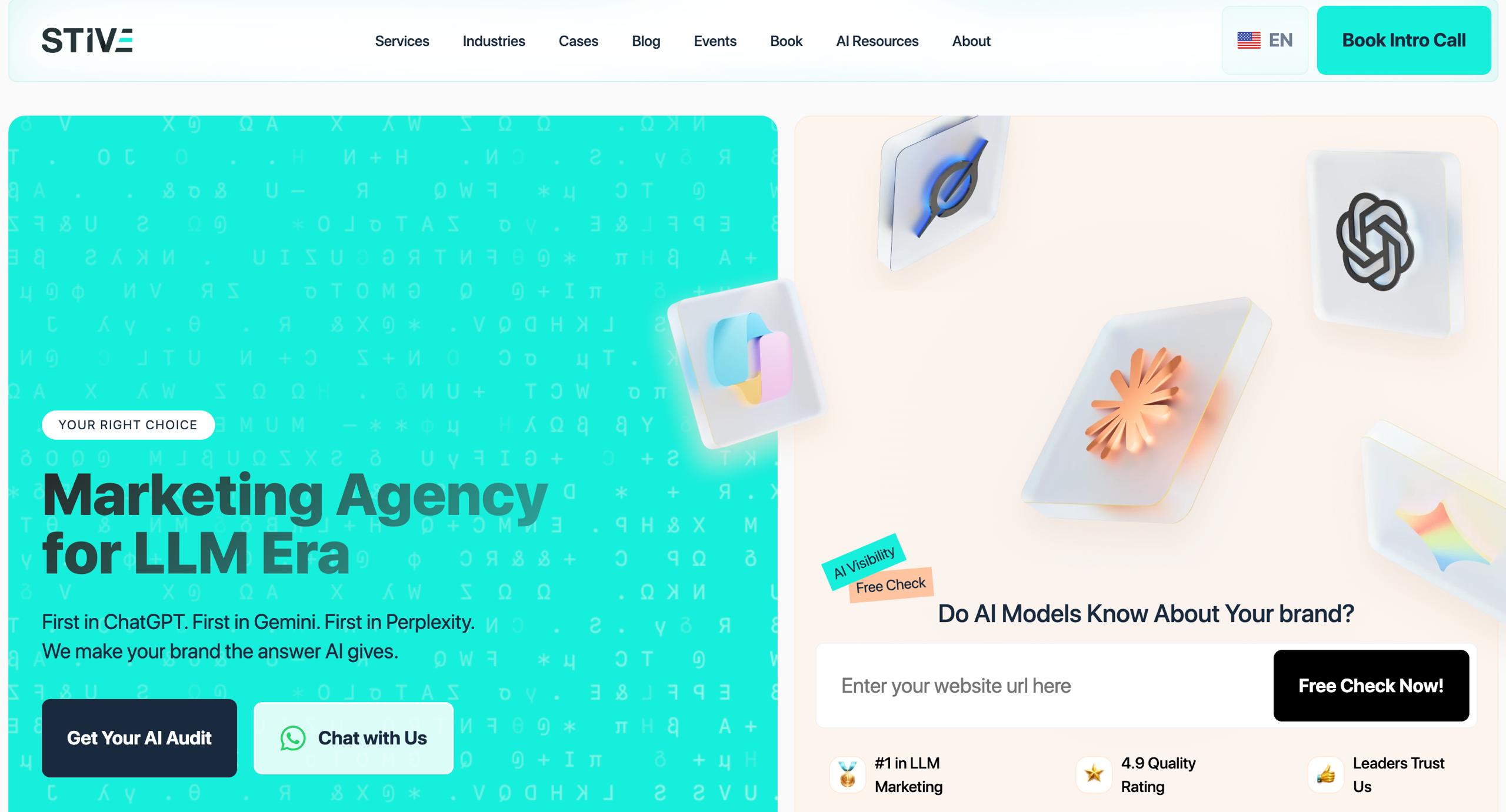
Stive.ai is the first agency built exclusively for LLM-era marketing. While most agencies bolt AI services onto existing SEO or content offerings, Stive does only one thing: making brands visible and recommended in answers from ChatGPT, Perplexity, Gemini, and Claude. Their philosophy is audit-first — show the client their problem in hard data before proposing any solution.
The agency’s sweet spot is high-LTV verticals like fintech and healthcare where users increasingly ask AI for product recommendations instead of searching Google. Stive runs competitive audits across all four major LLM platforms, benchmarking dozens of companies per vertical on presence, position, sentiment, and accuracy.
Key strengths:
- Audit-first approach — clients see their competitive gaps before committing
- Pure-play LLM focus across ChatGPT, Perplexity, Gemini, and Claude
- 300+ project track record via ICODA foundation
Key limitations:
- No traditional SEO, PPC, or content marketing services
- Best suited for verticals with high customer lifetime value
AI automations provided: LLM visibility optimization, competitive AI audits, LLM reputation management, LLM analytics dashboards, LLM ads management, white-label GEO for agencies.
Entrans — Best for Agentic AI and Next-Gen Automation
Entrans positions itself at the frontier of agentic AI and multi-agent orchestration. Agentic AI refers to AI systems that can pursue complex goals autonomously — planning steps, using tools, and adapting to outcomes without human intervention at each stage. Multi-agent orchestration takes this further: multiple specialized AI agents collaborate on a task, each handling a different function (research, execution, quality checks) and coordinating through a shared framework.
Entrans is best for companies that already have basic automation in place and want to push into the next tier. Early pilot clients have reported 40–60% reductions in manual review time for complex document workflows. The limitation is market maturity. Agentic AI frameworks are evolving rapidly, and some of Entrans’s offerings remain closer to the cutting edge than to battle-tested production systems. Early adopters will find this exciting; risk-averse buyers should evaluate carefully.
Key strenghts:
- Genuine agentic AI expertise — not rebranded RPA
- Structured readiness assessment prevents premature deployments
- Open-source contributions signal real engineering depth
Key limitations:
- Agentic AI frameworks still maturing — production stability varies
- Requires strong internal data infrastructure to realize full value
AI automations provided: Multi-agent orchestration, autonomous decision engines, generative AI integration, self-improving workflow agents, LLM-powered task routing, AI readiness assessments.
Idea Link — Best AI Automation Agency for Mid-Market Custom Platforms
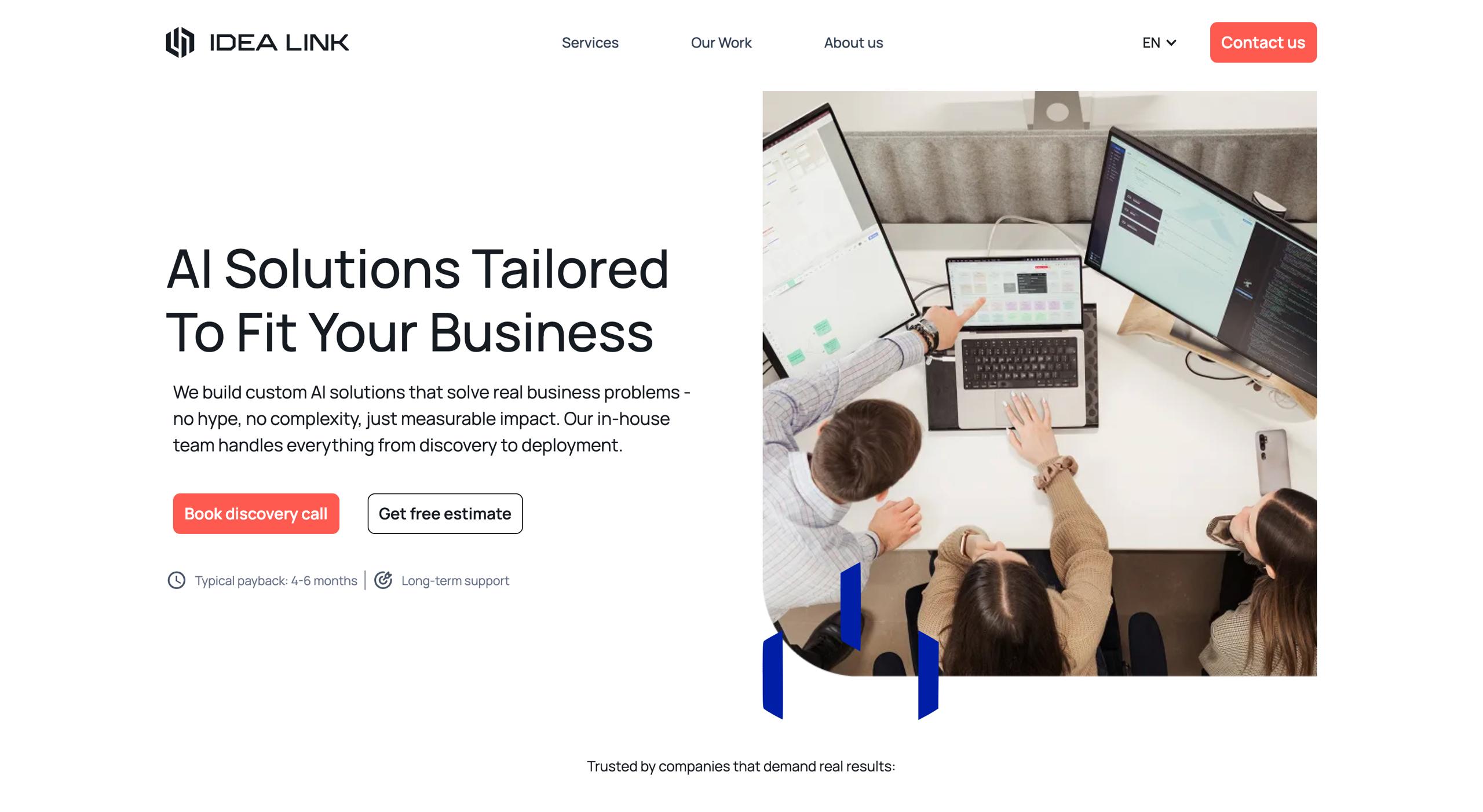
Idea Link is a strong partner for mid-size companies that need custom AI-powered internal tools and digital products. Based in Lithuania, this no-code and low-code agency builds bespoke AI agents, internal platforms, and automation systems tailored to each client’s operational logic. Their European location offers strong timezone overlap for EU-based buyers and competitive rates compared to Western agencies.
The agency’s approach blends platform-building with intelligent automation. Instead of wiring together off-the-shelf SaaS tools, Idea Link creates purpose-built internal systems — custom dashboards, AI-driven decision tools, automated approval workflows — designed around how the client’s team actually works. A logistics client reduced order-processing cycle time by 35% after Idea Link rebuilt their internal routing system with embedded AI classification.
Key strengths:
- Purpose-built internal platforms — not generic SaaS integrations
- EU-based with strong timezone overlap and competitive pricing vs. Western Europe
- Full-stack delivery (UX + backend + AI) under one roof
Key limitations:
- Mid-size team limits throughput for very large concurrent projects
- Less suited for pure data science or ML research engagements
AI automations provided: Custom AI agent development, internal platform builds, automated approval workflows, AI-driven decision dashboards, low-code process automation, digital product prototyping.
LowCode Agency — Best for Budget-Friendly Startup Automation
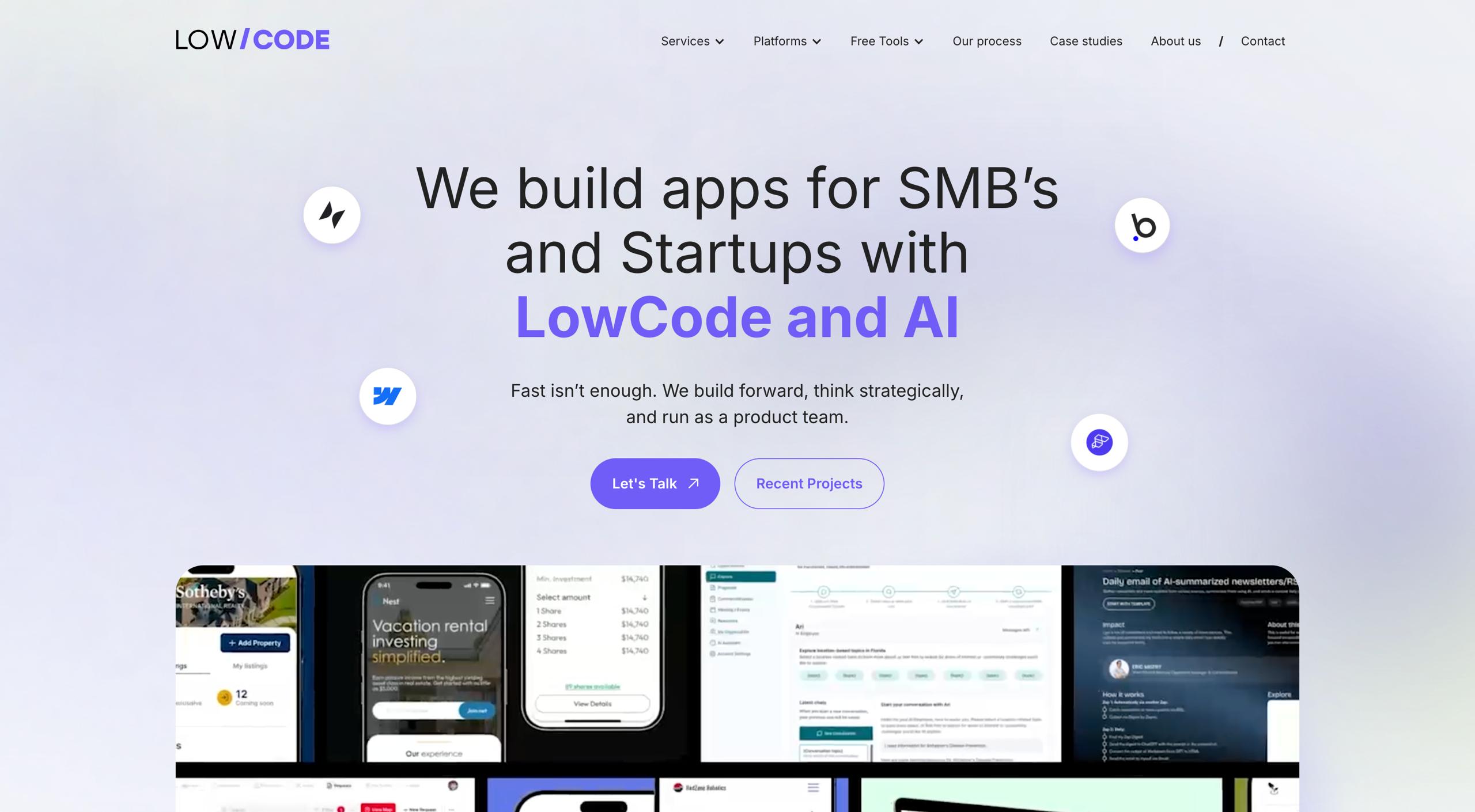
LowCode Agency specializes in delivering AI automation workflows through no-code and low-code platforms at price points that make sense for startups and small-to-medium enterprises. Their model is built around accessibility: businesses that cannot justify a six-figure automation project still get professionally designed, AI-enhanced workflows that remove manual friction from daily operations.
The agency works across popular low-code platforms and connects them with AI capabilities — automated lead scoring, intelligent document routing, chatbot deployment, and CRM-triggered workflows. Their engagements are typically short-cycle: scoping, build, and handoff within weeks rather than months. This suits founders and lean operations teams that need results before the next funding round, not a multi-quarter transformation roadmap.
LowCode Agency also emphasizes knowledge transfer. Their deliverables are designed so that internal teams can maintain and modify automations without ongoing agency dependency. This philosophy appeals to cost-conscious buyers who view automation as a capability to own, not a service to rent. The tradeoff is technical depth: for custom ML models, complex data pipelines, or enterprise compliance requirements, buyers will need a more specialized partner.
Key strengths:
- Budget-optimized engagements designed for early-stage and lean teams
- Fast delivery cycles — scoping to deployment in weeks
- Knowledge transfer built into every project, reducing long-term dependency
Key limitations:
- Not equipped for custom ML development or enterprise-grade compliance needs
- Best for workflow automation, not deep AI research or model building
AI automations provided: AI-powered lead scoring, intelligent document routing, chatbot deployment, CRM workflow automation, no-code data pipelines, automated reporting systems.
MOR Software — Best for Distributed AI Teams and Staff Augmentation
MOR Software is the right AI automation agency when you need to scale your team rather than outsource a project. Based in Vietnam with delivery centers across Asia, MOR specializes in staff augmentation and dedicated team models. Their AI practice covers machine learning, data engineering, RPA, and intelligent process automation.
MOR Software fits organizations that want ongoing, embedded AI talent rather than one-off project delivery. Their retainer and hybrid pricing models support long-term engagements where the agency functions as an extension of the client’s internal team. The tradeoff is geographic: while MOR’s cost efficiency is strong, time zone coordination and cultural alignment require active management for Western-headquartered clients.
Key strengths:
- Dedicated team model functions as a true extension of in-house staff
- Strong cost efficiency vs. US/Western European agencies
- Consulting arm provides strategic framing, not just execution
Key limitations:
- Time zone management required for Western-headquartered clients
- Less suited for short-term, fixed-scope projects — value compounds over longer engagements
AI automations provided: ML model development, data engineering pipelines, RPA implementation, intelligent process automation, AI-powered QA and testing, cloud AI infrastructure setup.
Sigmoidal — Best AI Automation Agency for Enterprise Data Science
Sigmoidal is a focused choice for enterprises that need AI solutions rooted in serious data science and machine learning expertise. Based in New York, this consulting firm operates with a lean team of roughly 20 senior specialists — no bloated bench, no juniors learning on your project. Their work spans generative AI, predictive analytics, NLP, and custom ML model development.
What separates Sigmoidal from larger agencies is technical density. Every engagement is led by data scientists and ML engineers, not account managers. The firm structures projects around measurable business impact: revenue uplift, cost reduction, or operational throughput. One financial services client achieved a 28% improvement in fraud detection accuracy after deploying Sigmoidal’s custom ML pipeline. Their consulting-led approach starts with deep data audits before any model building begins, which prevents the common trap of automating processes that should be redesigned first.
Key strengths:
- Senior-only team — every project led by experienced data scientists and ML engineers
- Deep data audit phase prevents wasted investment on poorly scoped automation
- Strong track record in financial services and insurance verticals
Key limitations:
- Limited capacity — may have wait times for new engagements
- Not suited for SMBs or budget-conscious startups
AI automations provided: Custom ML model development, generative AI solutions, predictive analytics pipelines, NLP systems, data strategy consulting, automated decision-support engines.
Technource — Best for Embedding Generative AI into Products
Technource is a strong pick for product companies that want to integrate generative AI directly into their software. The agency focuses on AI-powered mobile and web applications — chatbots, recommendation engines, content generation modules, and intelligent search features. Their 2026-specific positioning emphasizes embedded AI, low-code AI tools, and generative AI as core service lines.
Technource is ideal for SaaS companies, marketplaces, and mobile-first businesses that see AI as a product differentiator rather than a back-office tool. The gap is in strategic consulting: Technource excels at building what you specify but offers less guidance on what you should build. Product managers with a clear AI roadmap will get the most value here.
Key strengths:
- UX designers embedded alongside AI engineers — critical for consumer-facing features
- Fast concept-to-deployment cycle suited to agile product teams
- Dual presence (India + US) balances cost efficiency with client accessibility
Key limitations:
- Execution-focused — limited strategic consulting on what to build
- Less suited for back-office or operational automation projects
AI automations provided: Generative AI feature integration, AI chatbot development, recommendation engines, intelligent search modules, automated content generation, low-code AI app builders
How to Evaluate an AI Automation Agency: A Vetting Framework
The right evaluation framework prevents costly mistakes and wasted months. Buyer skepticism in the AI automation space is justified. Many agencies operating today are repackaged digital marketing shops with surface-level AI expertise. The viral critique that the AI automation agency business model is “broken” reflects a real pattern: low barriers to entry have flooded the market with providers who overpromise and underdeliver. Here is how to separate serious partners from noise.
Seven criteria that matter most:
- Proven case studies with measurable outcomes — not testimonials, but documented results with specific metrics (e.g., “reduced invoice processing time by 62%”).
- Industry expertise — an agency that has solved problems in your vertical will ramp faster and avoid rookie integration mistakes.
- Tech stack flexibility — avoid agencies locked to a single platform. The best partners evaluate your needs first, then choose tools.
- Pricing transparency — vague “let’s discuss” language on a website often signals opaque billing later. Expect clear ranges: $3,000–$15,000 for SMB projects, $50,000–$300,000+ for enterprise.
- Scalability of solutions — ask whether the system is built to handle 10x your current volume without a rebuild.
- Post-launch support and maintenance — automation is not “set and forget.” Ongoing model monitoring and optimization are essential.
- Data security and compliance — GDPR, HIPAA, SOC 2, or ISO 27001 certifications should be verifiable, not just claimed.
Red flags to walk away from:
- Unrealistic ROI guarantees (e.g., “10x return in 30 days”)
- No verifiable client references or published case studies
- One-size-fits-all solutions pitched before any discovery phase
- Pressure to sign long-term contracts before a pilot
- No paid discovery phase — serious agencies invest time in understanding your problem before proposing a solution
Always request a small-scale proof of concept before committing to a full engagement. A credible AI automation agency will welcome this. One that resists it is telling you something.
AI Automation Agency Pricing Models Explained
Understanding pricing models is essential before engaging any agency. The AI automation market uses five dominant pricing structures in 2026. Each fits different buyer profiles, risk tolerances, and project scopes. The table below summarizes what to expect.
| Pricing Model | How It Works | Typical Range | Best For |
|---|---|---|---|
| Project-based | Fixed scope, fixed fee. Defined deliverables and timeline. | $5,000–$500,000+ | Companies with a clear, well-scoped automation need |
| Monthly retainer | Ongoing engagement with a set number of hours or deliverables per month. | $2,000–$20,000/mo | Businesses needing continuous optimization and support |
| Subscription / SaaS | Access to a platform with optional agency services layered on top. | $99–$5,000/mo | Teams that want self-serve tools with expert backup |
| Performance-based | Agency compensation tied to measurable outcomes (leads, cost savings, throughput). | Varies (% of outcomes) | Buyers who want shared risk and outcome alignment |
| Hybrid | Combination of any models above — e.g., project fee for build + retainer for ongoing ops. | Custom | Complex engagements that evolve over time |
Hidden costs catch most first-time buyers off guard. Data preparation and cleanup can consume 30–50% of any AI project budget. Integration complexity — connecting new AI systems to legacy CRMs, ERPs, or databases — often exceeds initial estimates. Ongoing model monitoring is another line item agencies sometimes exclude from base proposals. Vendor lock-in creates switching costs that surface only when you try to change providers.
The key question is not “which model is cheapest” but “which model aligns incentives.” A project-based fee works when scope is clear. A retainer works when you need an ongoing AI automation agency partner. Performance-based models sound attractive but require airtight attribution frameworks that many businesses lack. Choose the model that matches both your budget and your ability to measure results.
Agency vs. In-House vs. Platform: Which Path Fits Your Business?
Not every company needs an external AI automation agency — but most underestimate what building in-house requires. This is the decision framework that top-ranking listicles consistently ignore, yet it is the first question every buyer should answer. Three paths exist, each with clear advantages and tradeoffs.
Hiring an agency delivers speed and specialized expertise. Agencies have pre-built frameworks, cross-industry experience, and teams already trained on the latest AI tools. The downside is cost and dependency. You are renting capability, not building it. When the engagement ends, knowledge can walk out the door unless contracts include proper documentation and IP transfer clauses.
Building in-house offers maximum control and long-term cost efficiency — if you can recruit and retain AI talent. In 2026, that remains a significant “if.” Senior ML engineers command salaries of $150,000–$250,000+, and building an internal AI team from scratch typically takes 6–12 months before meaningful output begins. This path suits companies with an ongoing, strategic AI agenda and the budget to support a dedicated team.
Using a platform (low-code or SaaS automation tools) is the leanest option. Platforms like Zapier AI, Make, or n8n empower internal teams to build workflows without deep technical expertise. The limitation is complexity. Platforms handle 80% of common automation use cases well. The remaining 20% — custom ML models, agentic AI, compliance-heavy deployments — still requires human expertise, whether in-house or from an agency.
The smartest approach for most mid-market companies in 2026 is a hybrid: start with an agency or platform engagement to validate use cases, then gradually build internal capability as automation proves its ROI. The right AI automation agency will support this transition rather than resist it. For related reading, see our breakdown of how AI is reshaping SEO workflows — a concrete example of automation applied to a single business function.
Conclusion
The AI automation landscape in 2026 rewards buyers who match their specific needs to the right type of partner. Enterprise data science projects demand a different agency than SMB workflow fixes or SEO-driven growth strategies. What separates a successful engagement from a failed one is rarely the technology — it is goal clarity, vetting rigor, and pricing model alignment.
Start with a defined use case. Request a pilot before committing. And if organic search is a core growth channel for your business, explore how AI-powered SEO services apply the same automation principles — predictive analysis, intelligent optimization, and scalable execution — directly to your search visibility.
Frequently Asked Questions
The range is genuinely all over the place. Small to mid-size projects typically run $5,000–$50,000 for initial setup, with enterprise implementations going from $200,000 to $500,000 or more. On top of that, ongoing retainers usually land between $5,000 and $20,000 per month. Smaller agencies on Reddit report charging $500–$2,000/month for recurring automation services targeted at SMBs.
The service itself isn’t a scam — automating repetitive business processes with AI is real and delivers real value. Many agencies sell generic, off-the-shelf AI tools that provide little real value, hook businesses with cheap initial offers, then trap them in expensive long-term contracts. The signal-to-noise ratio in this space is terrible right now. Vet them hard: ask for live demos, specific ROI metrics from past clients, and references you can actually call.
You absolutely can, and for long-term core systems, you probably should. Internal teams understand business processes deeply and know the nuances that external agencies overlook, and they can maintain and evolve systems long-term as needs change. The agency model makes sense when you need to move fast, don’t have AI expertise on staff, and want to validate whether automation even works for your use case before building a team around it.
This is the question most people forget to ask, and it bites them hard. The AI automation agency model as it’s currently promoted is fundamentally broken because the economics, expectations, and operational realities don’t align. If the agency builds everything on custom code or proprietary tools, you’re either stuck paying their maintenance retainer forever or scrambling when something breaks. The smart move is to insist on documentation, training for your team, and systems built on tools your people can actually manage. Some agencies now specifically offer “build + train” models where they set things up and then hand over the keys with proper training.
It depends on what “small” means and what you’re automating. A 5-person shop probably doesn’t need a $50k engagement — you’d get better ROI from learning Make or n8n yourself and automating the worst bottlenecks. But if you’re a 20–50 person company losing real money to manual scheduling, lead follow-up, invoicing, or customer support, a targeted agency engagement can pay for itself fast.
Share with


Rate the article