




Introduction
AI has fundamentally rewired how SEO works. What used to take teams of specialists months to execute now happens in days — sometimes hours. Content creation, technical audits, keyword research, and even link building have been supercharged by AI tools that didn’t exist two years ago.
But here’s the thing: having powerful AI tools doesn’t automatically translate into SEO success. You still need strategy, expertise, and execution. Which brings us to the decision that’s keeping marketing leaders up at night in 2026: should you build an in-house AI SEO team, or partner with an agency that specializes in this space?
Here’s a question worth asking yourself: If you hired an AI SEO team tomorrow, would you know what success looks like six months from now?
This isn’t a simple “build vs buy” decision anymore. The stakes are higher, the technology is evolving faster, and the cost structures are more complex than traditional SEO ever was. Let’s break down what each approach really means for your business, your budget, and your results.
The AI SEO Landscape in 2026
The SEO world has changed more in the past 18 months than in the previous five years combined. Search engines now prioritize content quality and user intent with unprecedented sophistication, thanks to their own AI advancements. Google’s AI overviews have reshaped SERPs entirely, making traditional ranking strategies obsolete.
AI SEO isn’t just about using ChatGPT to write blog posts anymore — that ship sailed in 2024. Today’s AI SEO involves complex workflows:
- Programmatic content generation that maintains brand voice across thousands of pages
- Automated technical optimization that identifies and fixes issues in real-time
- Predictive keyword trending that spots opportunities before competitors do
- AI-powered link prospecting that finds relevant partnerships at scale
- Real-time content performance optimization based on user behavior signals
- Semantic clustering that organizes content around topic authority rather than keywords
The barrier to entry has gotten weird. Tools are more accessible than ever, which sounds great. But the expertise required to use them effectively has skyrocketed. You need people who understand both traditional SEO fundamentals and how to architect AI systems that don’t produce generic garbage. That’s a rare combination.
This is why the in-house vs agency question has become so pressing. The skill sets required have multiplied, the technology stack has exploded, and the pace of change means what worked last quarter might be outdated today. Companies are realizing they need to make a strategic choice about how to approach this — and make it soon. Understanding where AI SEO is heading can help inform this decision (AI SEO: Future Predictions and What to Expect ↗).
🏢 In-House AI SEO Team: The Full Picture
What You’re Actually Building
Let’s talk about what an in-house AI SEO team actually looks like in 2026. You’re not hiring one person with a ChatGPT subscription — you’re assembling a cross-functional unit.
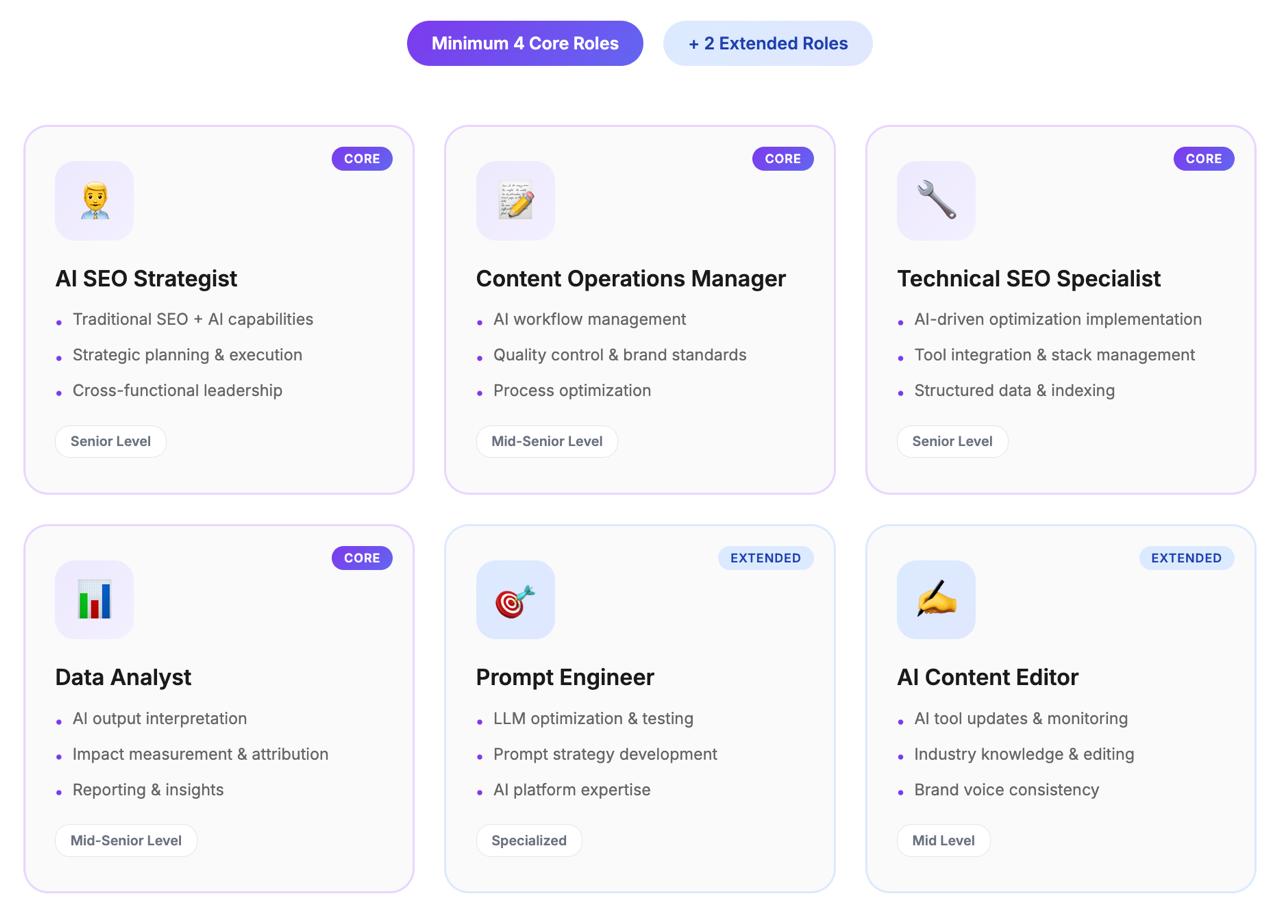
At minimum, you need an AI SEO strategist who understands both traditional SEO and AI capabilities. You need a content operations person who can manage AI workflows and maintain quality control. A technical SEO specialist who can implement AI-driven optimizations and integrate tools into your stack. Plus a data analyst who can interpret AI outputs and measure actual impact.
Depending on your scale, you might also need prompt engineers, AI content editors, and someone focused specifically on staying current with AI tool developments. That’s 4-6 specialized roles — not entry-level positions.
The Real Cost Structure
The financial commitment goes way beyond salaries. There’s the recruitment process itself, which for specialized AI SEO roles can take 3-6 months per position. Competitive salaries in this space have increased significantly as demand outpaces supply.
Then come the tools. Enterprise AI SEO tools often require substantial licensing fees. You’ll need subscriptions to content generation platforms, technical SEO suites, analytics tools, and probably several AI assistants or automation platforms. These stack up quickly, especially when you need multiple seats per tool.
Training is an ongoing expense that gets overlooked. AI tools update constantly. Your team needs continuous learning — courses, conferences, certifications. Budget for this or watch your team’s skills decay in real-time.
Infrastructure costs matter too. If you’re doing programmatic SEO at scale, you need development resources, hosting, and potentially custom integrations. These aren’t one-time costs — they’re recurring maintenance obligations.
Time Investment Reality Check
Here’s what nobody tells you: the time to value is longer than you think. Even after you hire someone great, they need 2-3 months just to understand your business, your audience, and your content ecosystem before they can make meaningful improvements.
Building effective AI workflows takes time. You’re not just implementing tools — you’re creating processes, establishing quality standards, and iterating until outputs meet your brand standards. Most teams underestimate this by a factor of three.
First results? Maybe 4-6 months after your first hire. Meaningful, sustainable results? You’re looking at 9-12 months minimum. That’s assuming everything goes right.
The Upside of Going In-House
When it works, in-house teams offer real advantages. You get complete control over strategy, execution, and priorities. Your team lives and breathes your product, understands your customers intimately, and can pivot immediately when business needs change.
There’s something powerful about having AI SEO deeply integrated into your company culture. Your team can collaborate seamlessly with product, sales, and customer success. They build institutional knowledge that compounds over time.
For companies with highly specialized or technical products, an in-house team can develop domain expertise that’s hard to replicate externally. They become genuine experts in your specific niche.
The Risks You’re Taking On
But let’s talk about what can go wrong. Talent turnover is brutal right now. Lose a key person and you’re back to square one, except now you’re also trying to backfill knowledge they took with them.
Your team’s expertise is limited to their collective experience. If they haven’t solved a particular type of SEO challenge before, they’re learning on your dime. There’s no bench of experienced specialists to pull from when you hit a roadblock.
The pace of AI development means your team can fall behind fast. While they’re executing this quarter’s strategy, new tools and techniques are emerging that they might not have time to explore or implement.
Here’s the table breaking down what building an in-house team actually involves:
| 👤 Role/Position | 🔍 Key Responsibilities | 🧠 Necessary Expertise Level | ⏳ Time to Hire & Onboard |
|---|---|---|---|
| AI SEO Strategist | Overall strategy, tool selection, workflow design, stakeholder management | Senior (5+ years SEO + AI proficiency) | 4-6 months to hire, 2-3 months to onboard |
| Content Operations Manager | AI content workflow management, quality control, brand voice consistency | Mid to Senior (3+ years content + AI tools) | 3-4 months to hire, 1-2 months to onboard |
| Technical SEO Specialist | AI tool integration, technical audits, site optimization, automation setup | Mid to Senior (3+ years technical SEO + dev skills) | 4-5 months to hire, 2-3 months to onboard |
| Data Analyst | Performance tracking, AI output analysis, ROI measurement, reporting | Mid-level (2-3 years analytics + AI literacy) | 2-3 months to hire, 1-2 months to onboard |
🚀 AI SEO Agency: What You’re Really Getting
The Agency Model Explained
Working with an AI SEO agency in 2026 means accessing an already-assembled machine. You’re not paying for individual people — you’re paying for a system that’s been refined across dozens or hundreds of client engagements.
Most agencies offer several engagement models. Retainer relationships provide ongoing strategic support and execution with a dedicated team slice. Project-based engagements tackle specific initiatives like technical overhauls or content campaigns. Some agencies now offer performance-based pricing tied directly to traffic or conversion improvements.
The key difference from traditional agencies? AI SEO specialists have typically invested heavily in proprietary workflows, custom tools, and automation that gives them execution advantages you can’t easily replicate in-house. Understanding what professional AI SEO services actually include can help you evaluate options more effectively (AI SEO Services Explained: What to Expect ↗).
What’s Included Out of the Box
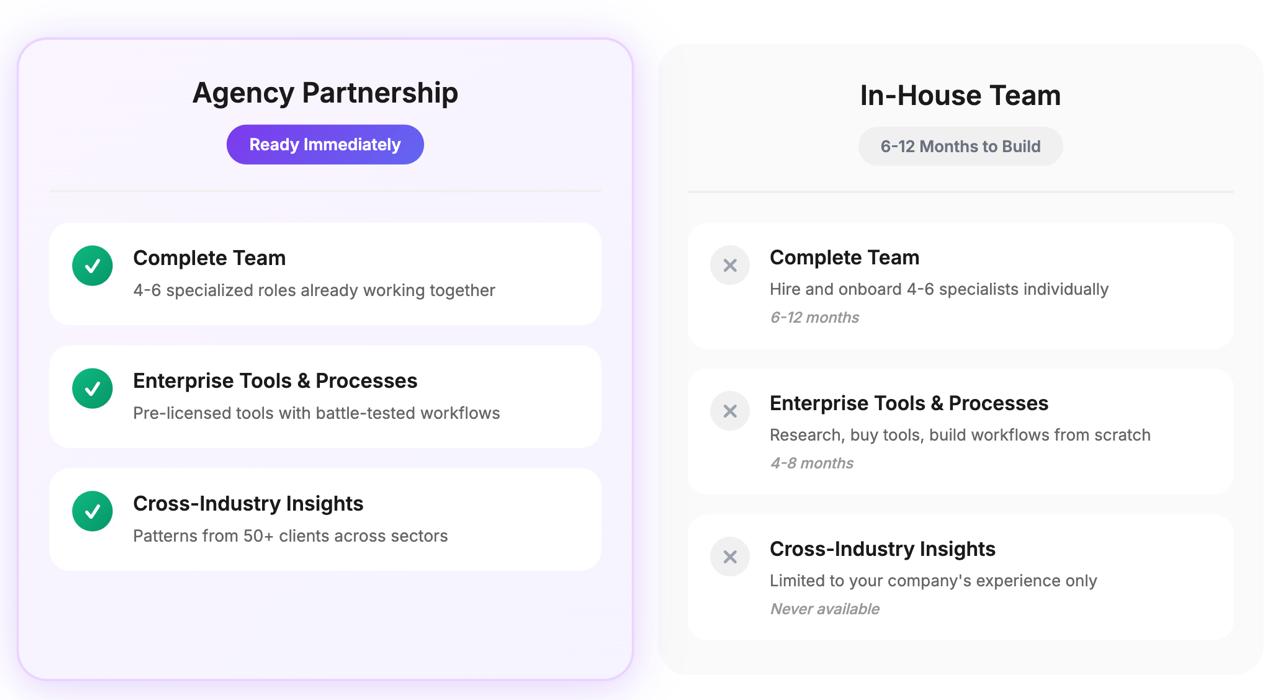
Here’s what you get immediately: a complete team with specialized roles already working together smoothly. Your strategy comes from people who’ve seen your exact problems before and know what actually works.
Access to enterprise-grade tools is built into the package. Agencies typically have relationships and licensing that would cost you significantly more to obtain independently. They’ve already done the work of testing and vetting tools, so you skip the expensive trial-and-error phase.
Established processes and quality control systems are perhaps the biggest advantage. Agencies have frameworks for content creation, technical optimization, and reporting that they’ve refined over time. You’re not starting from scratch.
The cross-industry perspective is underrated. Your agency sees patterns across different markets and can spot opportunities or threats you might miss. They bring best practices from other sectors that might be relevant to yours.
Speed and Scalability Benefits
Agencies can start delivering within weeks, not months. They already have the tools set up, the workflows documented, and the team trained. Your onboarding becomes their execution ramp-up.
When you need to scale up quickly — launching in new markets, responding to a competitor move, or capitalizing on a trend — agencies can deploy additional resources without the multi-month hiring process. When you need to scale down, you’re not dealing with layoffs.
This flexibility is especially valuable given how unpredictable AI SEO can be. Some initiatives require intense focus for a few months then maintenance mode. Agencies can modulate their involvement accordingly.
The Trade-offs
Control is the obvious sacrifice. You’re not making every tactical decision. While good agencies involve you in strategy, day-to-day execution happens outside your direct oversight. For some leaders, that’s uncomfortable.
You’re dependent on an external partner’s priorities, availability, and retention. If your account manager leaves the agency or they take on too many clients, your project can suffer. You need to actively manage the relationship.
Communication overhead is real. There’s always more friction working with an external team than walking down the hall to talk to someone. Misalignments happen. Expectations get crossed. You need processes to bridge this gap.
Deep product knowledge takes time to develop, regardless of the agency’s overall expertise. They won’t understand your business as intimately as an employee would — at least not initially.
Cost-Benefit Analysis: Breaking It Down
Let’s get practical about what you’re really comparing. This isn’t just about dollars out — it’s about what you get back and when.
| Factor | In-House | Agency | Ideal For |
|---|---|---|---|
| Initial Investment | Substantial upfront commitment for hiring, tools, and infrastructure before any results | Moderate to significant monthly retainer but immediate execution capability | In-House: Companies with strong hiring capacity and long time horizons; Agency: Businesses needing faster time-to-value |
| Time to Results | 6-12 months to build team and see meaningful impact | 1-3 months to initial improvements, 4-6 months for significant momentum | In-House: Long-term strategic initiatives; Agency: Competitive markets requiring rapid response |
| Scalability | Linear scaling requiring additional hires for capacity increases | Flexible scaling up or down based on business needs and seasonal demands | In-House: Predictable, steady-state needs; Agency: Variable demand or growth-stage companies |
| Expertise Depth & Breadth | Deep product knowledge but potentially narrow SEO experience scope | Broad SEO expertise across industries but requires time to develop product depth | In-House: Highly specialized or technical products; Agency: Companies needing diverse tactical capabilities |
| Control & Flexibility | Complete control over priorities, processes, and pivot speed | Shared control requiring communication and alignment | In-House: Companies with specific internal workflows or compliance requirements; Agency: Businesses comfortable with strategic partnerships |
| Long-term Sustainability | Dependent on retention and continuous upskilling of team | Dependent on agency stability and relationship management | In-House: Organizations with strong culture and retention; Agency: Companies wanting to de-risk talent dependencies |
| Risk Management | Concentrated risk in small team; single points of failure | Distributed risk across agency team; built-in redundancy | In-House: Large enterprises with resources for backup; Agency: Smaller companies needing reliability guarantees |
The Hidden Costs Nobody Mentions
Opportunity cost is the big one. The 6-12 months you spend building an in-house capability is 6-12 months your competitors might be executing with an agency. In fast-moving markets, that head start can be decisive.
There’s also the cost of mistakes. Your in-house team’s learning curve happens on your website, with your brand. Agencies make mistakes too, but they’re making them across many clients and learning faster collectively.
Management overhead gets overlooked. Someone senior needs to oversee your in-house team—set direction, resolve conflicts, make tool decisions. That’s leadership time not spent on other priorities. With an agency, much of this coordination happens within their organization.
The “unknown unknowns” are expensive. When you don’t know what you don’t know about AI SEO, you can’t even ask the right questions. Agencies have typically encountered and solved problems you haven’t thought about yet.
Strategic Value Considerations
Think about core competency. Is AI SEO a differentiator for your business, or is it table stakes? If you’re a SaaS company selling marketing tools, maybe in-house makes sense — it’s part of your DNA. If you’re selling industrial equipment, SEO is probably a means to an end.
Resource allocation matters. Those 4-6 headcount spots you’d use for SEO could instead go toward product development, customer success, or sales. What drives more value for your business?
The learning curve delta is significant. An agency brings accumulated knowledge from dozens or hundreds of implementations. Your in-house team starts fresh. That knowledge gap translates directly into results and efficiency.
First-Year Investment Comparison
Here’s a clearer picture of what you’re actually committing to in year one:
| Investment Category | In-House First Year | Agency First Year | Notes |
|---|---|---|---|
| Team/Service Costs | Salaries for 4-6 roles + benefits | Monthly retainer × 12 months | In-house includes payroll taxes, insurance, equity |
| Tools & Software | Enterprise licenses for full stack | Usually included in retainer | Agencies leverage multi-client licensing |
| Recruitment | Agency fees, job boards, interview time | None | Can represent substantial cost for specialized roles |
| Training & Development | Courses, conferences, certifications | Included in agency expertise | Ongoing expense for in-house |
| Setup & Infrastructure | Development, hosting, integrations | Minimal onboarding fee | One-time but significant for in-house |
| Management Overhead | 20-30% of leadership bandwidth | 5-10% for relationship management | Often underestimated for in-house |
| Total Time Investment | 9-12 months before ROI | 3-6 months to positive ROI | Critical difference in competitive markets |
When Each Approach Makes Sense
In-House Makes Sense When…
You’re a large enterprise with ongoing, substantial SEO needs and the budget to support a full team long-term. The scale justifies the investment, and you can weather the build-up period.
Your product or industry is so specialized that external partners would struggle to understand the nuances. Deep domain expertise becomes the primary driver of SEO success, not just tactical execution.
You have specific compliance, security, or process requirements that make external partnerships challenging. Some regulated industries simply need tighter control over content and data.
You’ve reached a maturity level where SEO has become a competitive differentiator and core to your business model. You’re not just doing SEO — you’re innovating in how SEO gets done in your space.
Agency Makes Sense When…
You’re in a growth phase and need results fast. Every month matters, and you can’t afford a 12-month ramp-up period while competitors gain ground.
Your SEO needs fluctuate seasonally or vary significantly based on product launches and market conditions. You need the flexibility to scale effort up and down without hiring and layoffs.
You lack the internal infrastructure or expertise to hire and manage specialized AI SEO talent effectively. Building that capability would distract from your core business.
You want to de-risk talent dependencies. Small teams are vulnerable to turnover, and agencies provide continuity that’s hard to replicate with a few employees.
Your market is competitive and fast-moving. You need access to cutting-edge techniques and tools that agencies are incentivized to discover and implement quickly. Being able to track AI search traffic effectively becomes critical for measuring agency performance (How to Track AI Search Traffic ↗).
The Hybrid Model
Some companies successfully combine both approaches. A small strategic in-house team (maybe 1-2 people) sets direction and manages vendor relationships, while an agency handles execution and specialized tactics.
This can work well when you want strategic control and product knowledge internal, but execution scale and specialized expertise external. The in-house team becomes more about orchestration than doing.
The downside? You’re managing complexity on two fronts. You need clarity about who owns what, and strong coordination between internal and external teams. Done poorly, you get the worst of both worlds — high costs with unclear accountability.
Making Your Decision
Look, there’s no universal right answer here. The honest truth is that the best choice depends entirely on your specific situation — your stage, your resources, your market dynamics, and your risk tolerance.
What’s become clear in 2026 is that doing nothing isn’t an option. AI has fundamentally changed the SEO game, and companies that treat it as optional are falling behind fast. The question isn’t whether to invest in AI SEO — it’s how to invest in a way that makes sense for your business.
Key Questions to Ask Yourself
Before making this decision, consider these critical factors:
- Timeline urgency: Do you need results in 3 months or can you wait 12-18 months?
- Budget flexibility: Can you absorb substantial fixed costs or do you need variable investment?
- Internal capability: Do you have the HR infrastructure to recruit and retain specialized talent?
- Market velocity: How fast are competitors moving in your space?
- Strategic importance: Is SEO a core differentiator or a necessary channel?
- Risk tolerance: Are you comfortable with dependency on key individuals or external partners?
For most businesses, though, the agency route offers a compelling value proposition. You’re getting speed to market, expertise that would take years to build internally, and flexibility to adjust as your needs evolve. The risk profile is generally more favorable—agencies have redundancy and systems that protect against the single points of failure that plague small in-house teams.
The financial equation often favors agencies too. When you factor in the full cost of building in-house — including opportunity cost, management overhead, and the mistakes your team will make while learning — the agency investment typically delivers better ROI, especially in the first 12-24 months.
That said, agencies aren’t a magic bullet. You still need to be an informed buyer, set clear expectations, and actively manage the relationship. The best agency partnerships feel like extensions of your team, not vendors you’re managing at arm’s length.
✅ Practical Next Steps
Here’s what you should do to move forward:
- Audit your current situation — Map out where your SEO stands today and where it needs to be in 6 months
- Calculate realistic timelines —Be honest about how long you can wait for meaningful results
- Assess internal capacity — Evaluate whether you have the bandwidth to build and manage a team
- Talk to both options —Interview agencies and scope what in-house would actually require
- Factor in opportunity cost — Consider what you’re giving up by choosing the slower path
- Make a decision — Choose based on your actual constraints, not aspirational thinking
The AI SEO landscape will keep evolving. The approach that works for you might change as your company grows and matures. Stay flexible, measure what matters, and be willing to adjust your strategy as circumstances change.
Frequently Asked Questions (FAQ)
Building an in-house AI SEO team typically requires investment in 4-6 specialized roles, enterprise software licenses, ongoing training, and infrastructure setup, with total first-year commitment often exceeding what you’d invest in a full-service AI SEO agency. Most companies underestimate hidden costs like recruitment fees, management overhead, and the 9-12 month timeline before seeing meaningful ROI.
AI SEO agencies can deliver initial improvements within 1-3 months and significant momentum by month 4-6, while building an in-house team typically requires 6-12 months before meaningful impact. The timeline difference stems from agencies having pre-built workflows, established tool stacks, and accumulated expertise from hundreds of implementations.
AI SEO in 2026 involves automated content optimization, real-time technical audits, predictive keyword analysis, and programmatic content generation at scale—capabilities that traditional SEO approaches can’t match. Modern AI SEO requires expertise in both search engine optimization fundamentals and AI system architecture to avoid generic, low-quality outputs that harm rankings.
Yes — many small businesses find AI SEO agency services more affordable than building in-house teams, since agencies offer flexible retainer models and eliminate costs like salaries, benefits, training, and enterprise software licenses. The variable cost structure of agency partnerships allows businesses to scale investment up or down based on seasonal needs and growth stages.
While technical SEO knowledge helps, working with an experienced AI SEO provider like ICODA means you don’t need coding expertise — the agency handles tool integration, automation setup, and technical implementation. However, if building in-house, you’ll need team members with development skills to integrate AI tools, build custom workflows, and maintain your optimization infrastructure.
Track key metrics including organic traffic growth, search visibility improvements, content production velocity, time-to-market for new pages, and conversion rates from organic channels. Compare the total cost of your AI SEO approach (whether agency fees or in-house expenses) against revenue generated from improved search performance, factoring in opportunity costs and time to meaningful results.
Share with


Rate the article