




Most comparisons of AI marketing versus traditional marketing treat them as two equally viable options. For crypto projects, that framing is wrong from the start. Traditional paid channels (Google Ads, Meta) are partially or fully closed to blockchain projects in most markets. The debate isn’t theoretical for a crypto founder. It’s a wall they hit on day one.
You’re not choosing between two tools you own. You’re choosing between one tool with hard restrictions and another that most of your competitors haven’t built yet. And there’s a number buried in recent conversion data that makes the choice less ambiguous: AI-referred visitors convert at 4.4x to 23x the rate of traditional organic search visitors. Most crypto projects have never measured this. Most are still spending budget on channels that won’t produce that return.
This comparison covers the full picture: paid restrictions, conversion data, where traditional methods still earn their budget, how to measure ROI in a Web3 context, and how to sequence both channels into a strategy that actually holds. The numbers throughout come from Semrush, Seer Interactive, CoinDesk, and documented Web3 marketing case studies.
Why Crypto Projects Can’t Rely on Traditional Paid Marketing Anymore
Google and Meta both require pre-approval for crypto-related advertising, and approval is inconsistent, jurisdiction-dependent, and frequently reversed. Projects promoting token sales, DeFi protocols, NFTs, or yield-bearing products are either banned outright or face campaign restrictions that make paid acquisition economically unworkable.
- Google Ads: Token sales, ICOs, and DeFi products are prohibited globally. Exchanges and wallets can advertise in approved countries with certification, but getting approved takes weeks with no guarantee of stable campaign status, and it doesn’t extend to most early-stage project types.
- Meta (Facebook/Instagram): Financial products including crypto require pre-approval. Targeting limitations mean even approved campaigns reach a restricted audience. Retargeting crypto visitors across Meta properties faces additional policy friction.
- Twitter/X: Crypto advertising is permitted in some markets but remains policy-volatile. What runs today may be pulled next quarter without warning.
The practical result: traditional agency playbooks built on paid media don’t transfer to crypto. An agency running performance marketing for SaaS or e-commerce operates under different rules entirely. The strategies don’t port over, and neither does the account history, lookalike audience data, or retargeting infrastructure they’ve built up.
There’s also the cost problem. For the categories that can advertise, CPCs for crypto finance terms run 3–5x the equivalent in general finance or SaaS. A project paying $40–80 per click while managing compliance uncertainty and campaign volatility is burning budget at a rate that most early-stage teams can’t sustain.
CoinGecko data from 2024 tracked 11.6 million crypto project failures. The vast majority didn’t collapse from technical failure. They died from obscurity, running out of runway before they built any organic visibility. Paid channels were either unavailable or too expensive to sustain, and many had nothing else.
For crypto projects, AI SEO and organic content aren’t alternative strategies. They’re the primary channel by necessity. Most projects haven’t built this layer yet, which means the organic and AI citation space is less competitive than it will be in two years.
AI Marketing vs Traditional Marketing — Head-to-Head Comparison
In crypto marketing, AI-driven organic strategies outperform traditional paid channels on 6 of 8 measurable ROI dimensions. The table below shows where each approach wins, with crypto-specific context on the rows where the dynamics differ most from Web2 marketing.
| Dimension | AI / Organic | Traditional / Paid | Crypto-Specific Note |
|---|---|---|---|
| Cost structure | Fixed production cost; builds over time | Variable; cost scales with volume | Paid CPCs for crypto terms run 3–5x general finance |
| Speed to market | 3–6 months to sustained returns | Immediate (if approved) | Approval delays make paid “speed” advantage unreliable |
| Targeting precision | Intent-based (query matching, AI citation) | Demographic + behavioral | Wallet-verified audiences not available on paid platforms |
| Compliance risk | Low | High; policy-volatile | Campaigns pulled without warning in regulated jurisdictions |
| Community building | Moderate (owned content, brand authority) | Low | Influencer-driven launches cause 68% attrition within 90 days of TGE |
| Content volume | 3–10x output advantage with AI tools | Limited by production cost | Needed: deep content for complex DeFi/blockchain concepts |
| Lead quality | High (46% conversion rate, AI traffic) | Moderate (29%, Google organic) | AI-referred visitors arrive with higher research intent |
| Scalability | High; content assets accumulate | Medium; budget-dependent | On-chain attribution favors traceable organic paths |
Traditional wins in specific areas: live events, high-ticket investor outreach, KOL relationship management, and exchange listings. These are covered below. They’re real advantages, not marginal ones.
ROI for Crypto: Specific Numbers
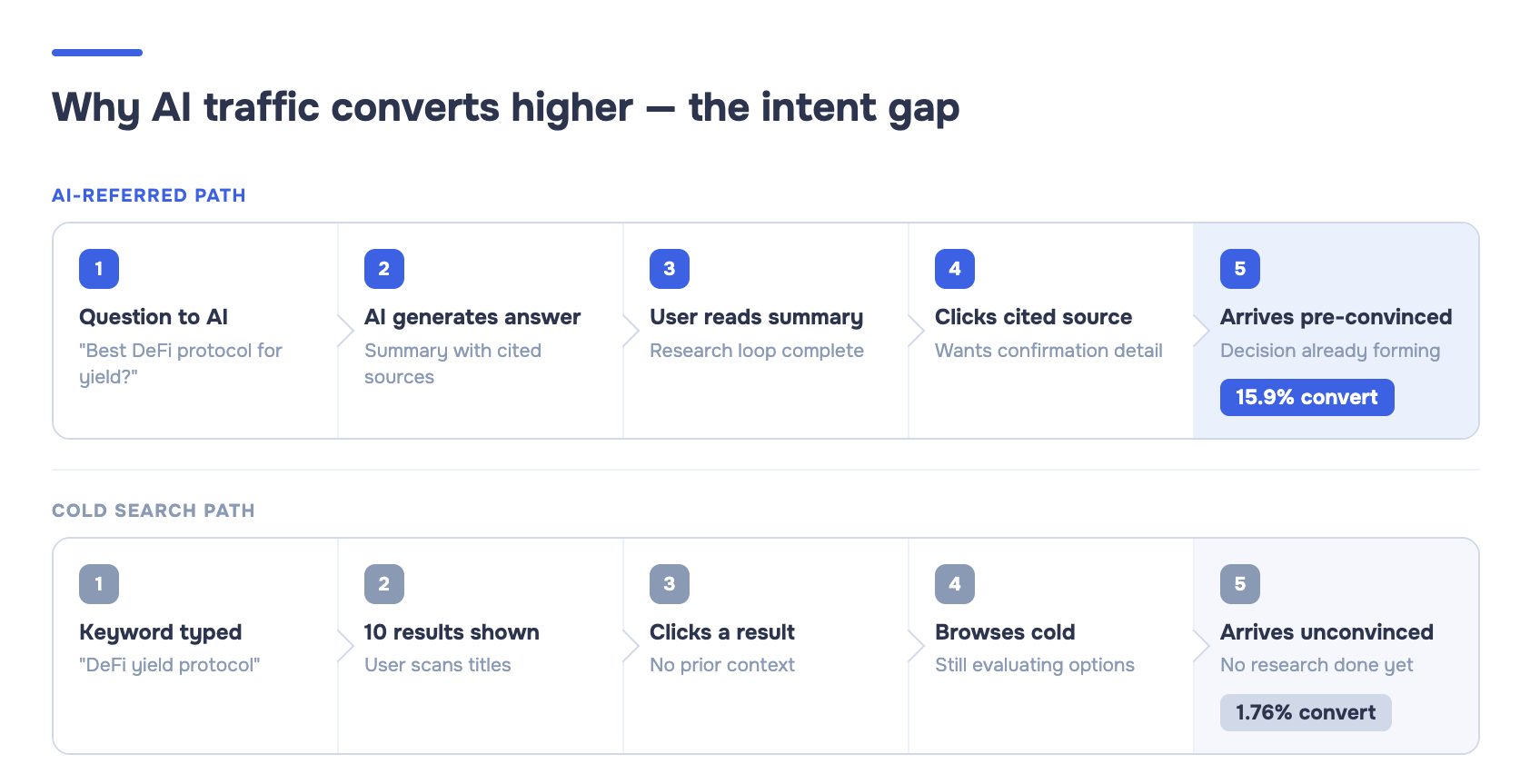
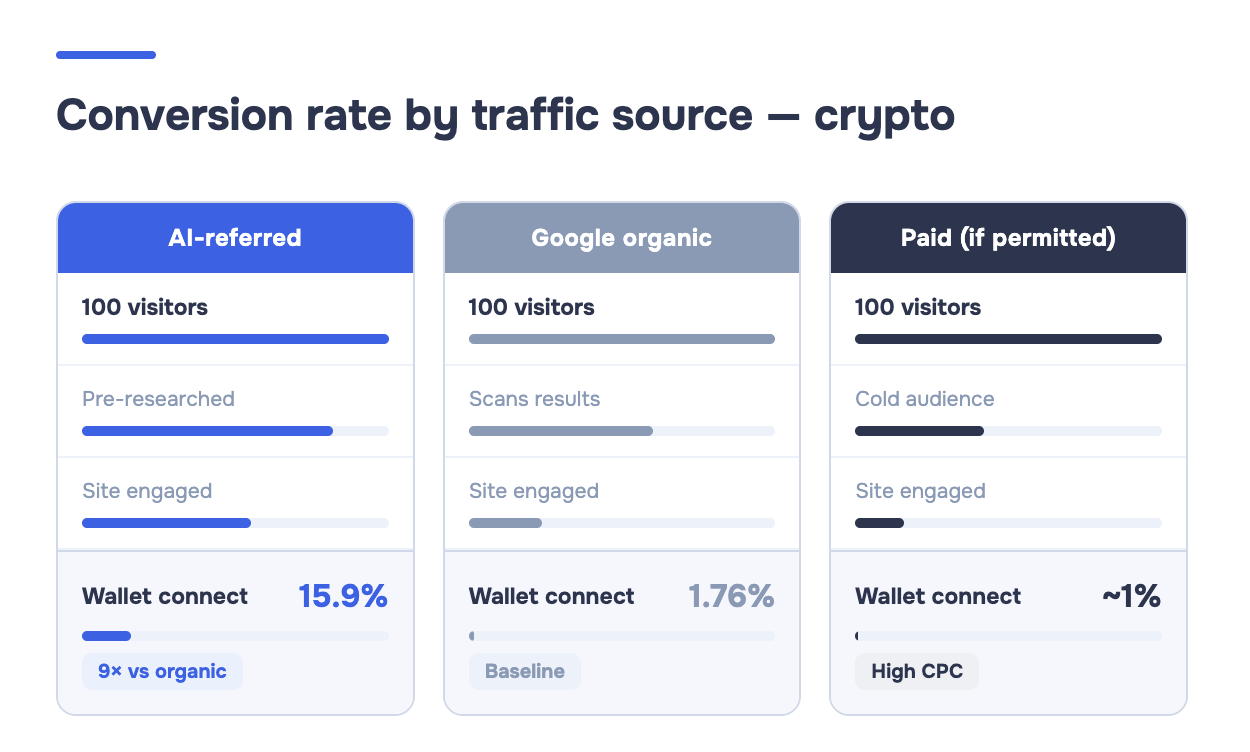
AI traffic quality: AI-referred visitors convert at 15.9% on ChatGPT versus 1.76% on Google organic, roughly a 9x difference. Across high-competition topics in digital marketing and SEO, AI search users convert 4.4x more frequently than traditional organic search visitors. The upper range of 23x applies to high-intent, research-heavy queries, which is exactly the profile of a crypto investor evaluating a protocol before connecting a wallet.
Why does this happen? Users arriving via AI have already been through a research loop. They asked ChatGPT or Perplexity a question, got a summary citing your content, and clicked through for confirmation on a specific point. They arrive further along in their decision with less convincing left to do. That’s a different person from someone who clicked a paid impression after typing a broad keyword.
Crypto case study: One crypto exchange applied an AI SEO strategy focused on content depth, structured data, and on-chain context. Results: 688% growth in ChatGPT referral traffic, 500+ AI citations across major LLM platforms, and a 3x increase in exchange volume attributable to organic and AI-referred acquisition. The relevant benchmark isn’t whether the traffic volume matches paid. It’s whether the revenue per visitor does.
Influencer-driven launches: 68% of influencer-led crypto projects saw 70%+ community attrition within 90 days of TGE (2025 Web3 marketing report). Influencer campaigns produce traffic spikes. They don’t produce communities. The lead quality difference between an AI-referred visitor who researched your protocol and a wallet that connected during a KOL’s sponsored post shows up in retention, governance participation, and TVL stability.
On-chain attribution: 72% of Web3 projects using on-chain attribution reported better ROI within two quarters of implementing it (CoinDesk 2026). When you connect wallet connections and on-chain actions back to content touchpoints, the AI SEO channel consistently looks better than surface-level analytics suggest. Projects tracking only off-chain metrics are misreading their own performance.
Cost per lead: AI SEO traffic converts at 46% versus 29% for Google organic for crypto-adjacent financial content. Add in cost-per-asset production with AI tooling, typically 40–60% below traditional content production costs, and the cost per qualified lead through organic channels is substantially lower over a 12-month period.
Traditional Crypto Marketing — Where It Still Wins
| Channel | Why it works | When to use it | How to measure |
|---|---|---|---|
| Live events and IRL community | Blockchain conferences (ETHDenver, Istanbul Blockchain Week, BlockDown) build real relationships that content can’t replicate. A founder who presents well at a side event carries more trust into community behavior than any blog post. It can’t be automated. | Pre-TGE credibility building; any milestone requiring in-person trust signals | Deal flow generated; community retention at 90 days post-event |
| High-ticket investor relations | VCs and family offices at any meaningful check size still respond to warm introductions over cold inbound. Content builds the authority that opens doors, but it doesn’t walk through them. That part stays human. | Fundraising rounds; Tier 1 exchange listing campaigns | Meetings sourced; term sheets; close rate |
| KOL partnerships | The 68% post-TGE attrition figure doesn’t mean KOLs are worthless — it means most projects use them wrong. A KOL with a genuinely engaged DeFi research community can produce quality acquisition through long-form reviews and deep-dives. | Pre-TGE awareness; product launches targeting a specific community | Retention rate at 90 days post-TGE, not launch-day engagement rate |
| PR and exchange listings | Tier 1 exchange relations and credibility-building coverage in CoinDesk or Decrypt are relationship-driven by definition. These aren’t won through organic SEO. | Pre-TGE legitimacy; institutional audience targeting | Share of voice in Tier 1 crypto media; exchange volume post-listing |
Allocate budget to traditional channels for pre-launch credibility building, investor rounds, exchange listing campaigns, and any milestone requiring trust signals to a specific institutional audience. Post-launch growth and community scaling is where AI SEO takes over.
How to Measure Marketing ROI for a Crypto Project
Standard Web2 metrics (page views, bounce rate, time on page) don’t map to crypto project health. The measurement framework has to be rebuilt around on-chain actions.
Set up AI traffic tracking in GA4. ChatGPT, Perplexity, Gemini, and Claude now appear as referral sources in Google Analytics. Create a custom channel group that captures AI-referred sessions separately from standard organic. Without this, you can’t compare conversion rates across channels and you’re flying blind on your best-performing source.
Define on-chain conversion events. Wallet connection, first transaction, governance vote, liquidity provision, token purchase. Map these to off-chain content touchpoints using Dune Analytics or attribution platforms like Spindl or Raleon. This is the step most teams skip, and it’s the one that makes everything else meaningful.
Track retention, not vanity metrics. Community size at TGE is noise. Active wallet count at 30/60/90 days, governance participation rate, and TVL stability are the numbers that tell you whether you acquired real users or just hype.
Calculate cost per wallet connect. Total channel spend divided by attributable wallets connected. This is the crypto equivalent of cost per lead and it lets you put influencer campaigns, paid acquisition, and organic/AI SEO on the same scale for comparison.
Track AI citation rate. How often your protocol appears in AI-generated answers to relevant queries is a leading indicator of future referral traffic. Citations show up before the traffic does, so tracking this early gives you a cleaner read on whether your content is working. Monitoring your AI visibility across ChatGPT, Perplexity, and Gemini is where that tracking starts.

On timeline: paid campaigns produce results in days to weeks. AI SEO produces sustained returns from Month 3–6 onward.
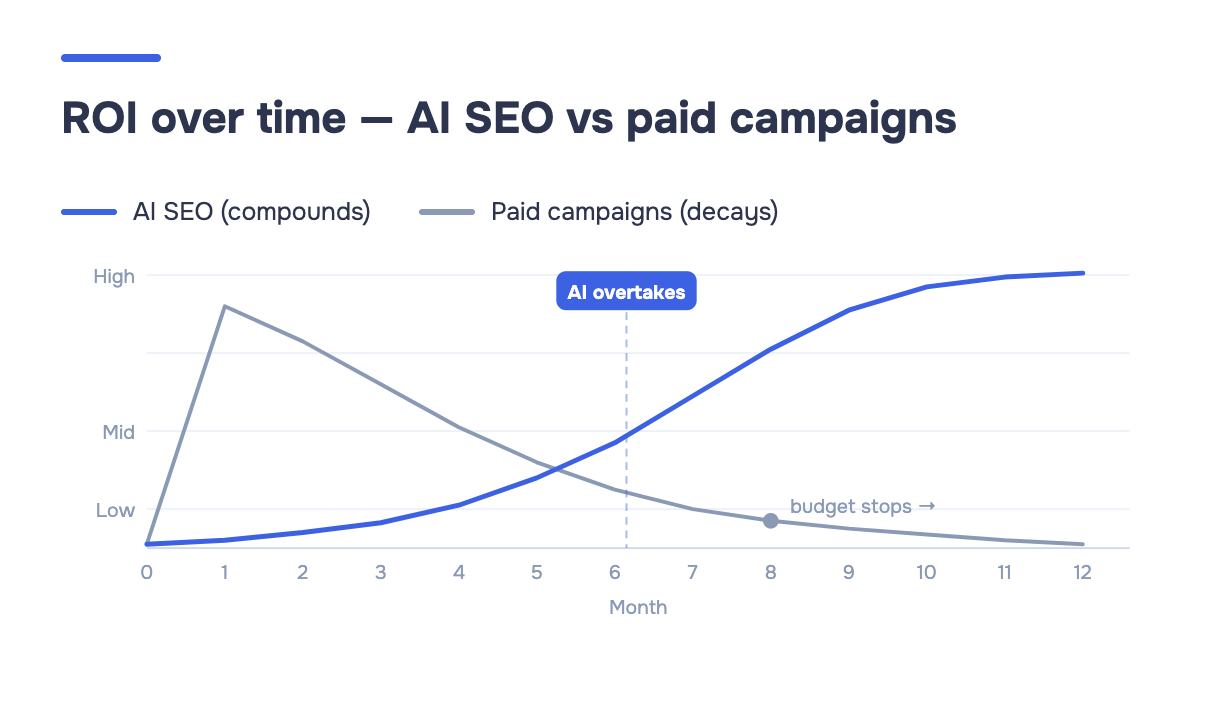
Teams that measure it on a 30-day window will consistently undervalue it. The right window is 6–12 months. Most crypto marketing post-mortems focus on what happened around TGE and miss the organic and AI-referred visitors who converted months later, after finding the project through content. That attribution gap is real and it skews channel decisions.
Building an AI + Traditional Hybrid Strategy for Crypto Projects
Most crypto projects that fail at marketing aren’t using the wrong channels. They’re using the right channels in the wrong order. Sequencing matters more than channel selection.
Layer 1 — Foundation (SEO + GEO + owned content): This is infrastructure, not a campaign. Comprehensive content covering your protocol’s core concepts, technical documentation written for human readability, structured data that AI systems can parse and cite, and a backlink profile built from Web3-native publications. This layer starts Day 1 and never stops. Projects that build it early get into AI citation before their competitors figure out the mechanic.
Layer 2 — Amplification (KOL + events + PR): Once the foundation exists, amplification channels have something real to point to. A KOL linking to substantive protocol documentation converts better than one pointing to a landing page. PR coverage linking to deep technical content produces both trust signals and SEO value.
Layer 3 — Paid (where permitted): Paid campaigns run on top of the organic foundation, not in place of it. Retargeting visitors who already engaged with Layer 1 content produces better results than cold acquisition at higher cost.
| Project Stage | Foundation (SEO/GEO) | Amplification | Paid |
|---|---|---|---|
| Pre-seed / stealth | 70% | 30% | 0% |
| Post-raise, pre-TGE | 50% | 40% | 10% |
| Post-TGE, growth | 40% | 35% | 25% |
Signs of over-reliance on traditional tactics: community count is high but active wallets are low; traffic spikes around influencer posts but doesn’t hold between campaigns; no organic keyword rankings after 6+ months of operation; all attribution flows through paid or referral with zero organic share; AI platforms show no citations for your protocol name or core use case. If three or more of these apply, the project has a channel dependency problem. Not because the traditional tactics failed, but because nothing was built underneath them.
Start AI SEO immediately. The 3–6 month lag means projects that start at launch are already behind projects that started in development. The space isn’t saturated yet. Most protocols in most categories don’t have comprehensive AI-optimized content, and the first project in a sub-vertical to build this layer will hold those citations for a long time.
From Comparison to Action — What Crypto Projects Should Do Next
AI marketing wins on cost, conversion quality, and long-term ROI. Traditional wins on relationships, events, and trust signals that can’t be automated. Crypto projects need both, sequenced correctly, with the foundation built before the amplification begins.
Projects ranking in the top 3 positions for high-intent crypto queries convert at 4–6x the rate of paid campaigns (ment.tech on-chain attribution data). Early movers in AI citation capture that real estate before the category matures, and most categories aren’t saturated yet. The protocols that dominate AI-generated answers to “best DeFi protocol for X” today will be difficult to displace in two years.
GEO isn’t a future consideration. It’s actively determining which protocols appear in AI-generated answers right now. Most projects haven’t built this layer. The window to be cited first is open, but it’s narrowing as more teams realize organic and AI visibility is the one acquisition channel that doesn’t depend on regulatory approval or campaign budget.
Building this foundation correctly takes 3–6 months of consistent execution: content strategy, technical SEO, structured data for AI parsing, and on-chain context that generic marketing agencies can’t produce because they don’t understand the product. If you want to see exactly what AI marketing built specifically for crypto and blockchain projects looks like in practice, that’s the starting point. The ROI calculator at the bottom of this page models what the AI SEO channel produces for your specific category and traffic baseline. Use it before deciding how to allocate next quarter’s marketing budget.
Frequently Asked Questions (FAQ)
For most crypto projects, yes — primarily because traditional paid channels (Google Ads, Meta) are restricted or banned for token sales, DeFi products, and ICOs. AI SEO and organic content are often the only scalable acquisition channel available. On conversion quality, AI-referred visitors convert at 9x the rate of Google organic visitors.
Both platforms classify most crypto products as high-risk financial products requiring pre-approval. Token sales, ICOs, and DeFi protocols are prohibited globally on Google Ads. Meta requires certification for any financial product including crypto, and even approved campaigns face targeting and retargeting restrictions. Approval is slow, inconsistent, and can be reversed without warning.
GEO (Generative Engine Optimization) is the practice of optimizing content to appear in AI-generated answers — ChatGPT, Perplexity, Gemini, Claude. When a user asks an AI assistant “what’s the best DeFi protocol for yield?” the answer cites specific sources. GEO is the work that gets your protocol cited. It matters for crypto because AI-referred visitors arrive pre-researched and convert at significantly higher rates than cold traffic.
Results vary by category and execution quality, but documented outcomes include 688% growth in ChatGPT referral traffic and a 3x increase in exchange volume for one crypto exchange using a dedicated AI SEO strategy. Projects ranking in the top 3 positions for high-intent crypto queries convert at 4–6x the rate of paid campaigns. The compounding period is typically 3–6 months before returns become measurable.
Traditional marketing earns its budget pre-TGE for credibility building, investor relations, exchange listing campaigns, and live events. AI SEO is the stronger channel for post-launch growth, community scaling, and sustained acquisition. The correct approach is sequential: build the AI SEO foundation first (Day 1), layer in traditional amplification once the content infrastructure exists.
Share with


Rate the article