




Introduction
Here’s a paradox worth pondering: 88% of marketers use AI daily, yet only 26% see real ROI from their investment. Where do the other 62% disappear to? Why does a technology promising revolution remain an expensive toy for most?
The AI marketing market has grown to $47.3 billion in 2025 and is racing toward $107.5 billion by 2028. This isn’t hype — it’s the new reality. But this reality has proven more complex than conference presentations promised. The experimentation phase is over. We’ve entered an era of pragmatic consolidation, where the question has shifted from “should we use AI?” to “how do we actually make it work?”.
In this article, we’ll break down what’s really happening in AI marketing right now: which technologies are genuinely changing the game, why most companies aren’t seeing returns, and what separates the 26% of winners from everyone else. Spoiler: it’s not about the size of your AI budget.
Agentic AI — Marketing on Autopilot
From Tools to Autonomous Agents
Remember 2023? Back then, “using AI in marketing” meant opening ChatGPT and asking it to write an email subject line. You’d prompt, AI would respond, you’d edit, repeat. The human remained the conductor, AI was just another instrument in the orchestra.
Fast forward to 2026, and we’re witnessing a fundamental shift. Agentic AI isn’t a tool you use — it’s a colleague that works independently. These systems can plan campaigns, execute them, analyze results, and optimize without you hovering over their shoulder.
The difference is qualitative, not quantitative. Traditional AI tools respond to instructions. Agentic AI understands context, makes decisions, and takes actions to achieve goals. It’s the difference between a calculator and an accountant.
The numbers reflect this shift: the global AI agents market was valued at $7.63 billion in 2025 but is projected to explode to $182.97 billion by 2033 — a staggering 49.6% annual growth rate. Deloitte projects that 25% of enterprises using generative AI will deploy autonomous agents in 2025, doubling to 50% by 2027.
What This Means in Practice
Imagine an AI agent that doesn’t just write ad copy but manages your entire paid media operation: analyzing performance data, reallocating budgets between channels, testing new creative variations, and pausing underperforming campaigns. All while you sleep.
This isn’t science fiction. Performance+ campaigns using agentic AI are already delivering more than 20% reduction in cost per acquisition compared to traditional setups. Customer interactions automated by AI agents are projected to grow from 3.3 billion in 2025 to over 34 billion by 2027.
The catch?
Agentic AI amplifies everything — including your mistakes.
Hand it a flawed strategy, and it will execute that flawed strategy at scale, 24/7, with impressive efficiency. This brings us to a crucial insight that will thread through this entire article: AI is a multiplier, not a solution. It scales both order and chaos.
Goodbye SEO, Hello GEO
The 25% Traffic Drop No One’s Talking About
Here’s a prediction that should make every SEO specialist nervous: traditional search traffic is expected to drop by 25% by the end of 2026. Not because people are searching less — because they’re searching differently.
ChatGPT now has 700 million weekly users. Referrals from large language models increased 800% year-over-year. When someone asks Perplexity or ChatGPT “best project management tools for startups,” they’re not clicking through ten blue links anymore. They’re getting a synthesized answer with maybe two or three citations.
This fundamentally breaks the SEO playbook that marketers have refined for two decades.
Enter GEO: Generative Engine Optimization
GEO — Generative Engine Optimization — is the emerging discipline of optimizing content to be cited by LLM-based search engines. It’s not about ranking on page one anymore. It’s about being the source that AI chooses to reference when answering questions.
The rules are different. Traditional SEO rewarded keyword density, backlinks, and technical optimization. GEO rewards being the authoritative, comprehensive, clearly-structured source that an AI would want to cite. Think less “gaming the algorithm” and more “becoming genuinely useful”.
| Traditional SEO | Generative Engine Optimization (GEO) |
|---|---|
| Optimize for keywords | Optimize for topics and questions |
| Build backlinks | Build authoritative, citable content |
| Target search rankings | Target AI citations and references |
| Focus on click-through rate | Focus on being the definitive source |
| Compete for page one | Compete to be the AI’s chosen answer |
This shift represents both threat and opportunity. Brands that adapt early can capture disproportionate visibility in the new AI-mediated search landscape. Those who keep optimizing for yesterday’s algorithms will watch their traffic evaporate.
The ROI Paradox — Why AI Isn’t Paying Off for Most
The Numbers Don’t Lie (But They Do Confuse)
Let’s look at two statistics that seem to contradict each other:
- Marketing teams implementing AI solutions see an average ROI of 300%
- Only 26% of companies using AI report high ROI
Both are true. The average ROI is spectacular — for those who get it right. But most don’t. The gap between AI adoption and AI results is the defining challenge of 2026.
The Embarrassingly Simple Explanation
Want to know why most AI investments fail? It’s not complicated.
Here’s the root cause: despite 76% of marketing teams using AI in core operations, only 17% of marketing professionals have received comprehensive AI training.
Read that again. We’ve handed powerful tools to people who don’t know how to use them, then wondered why results didn’t materialize.
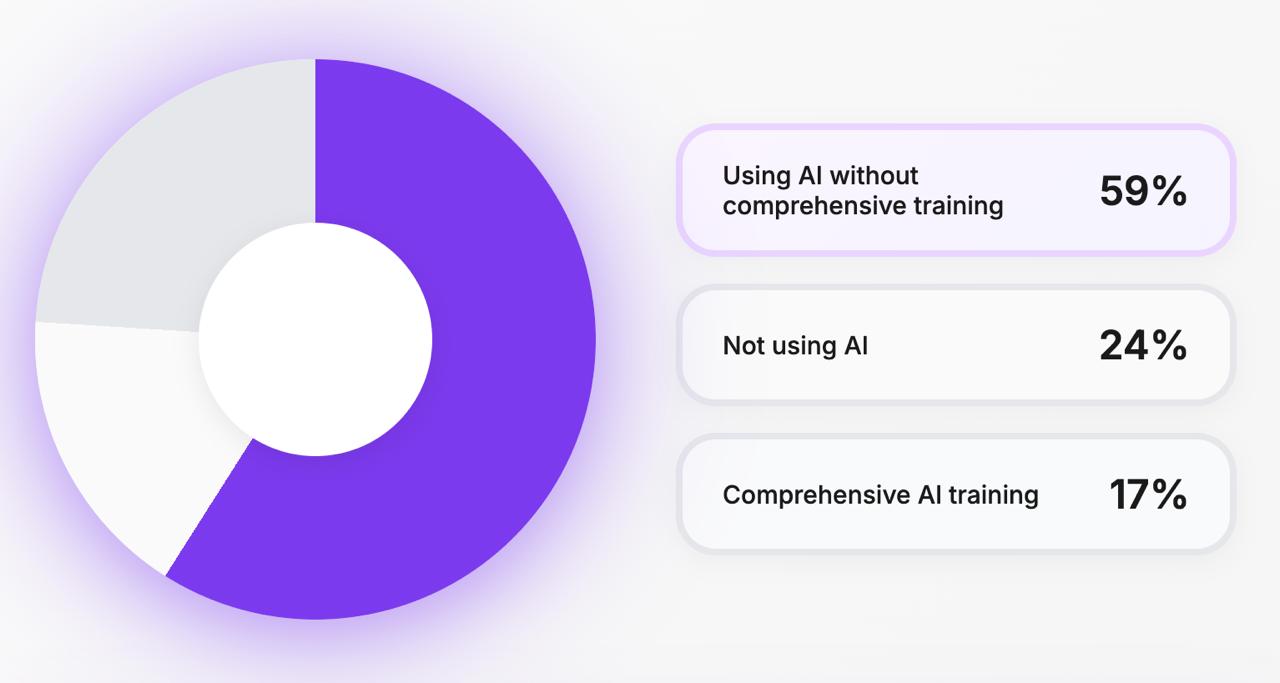
The chart below breaks it down: 59% of marketers use AI without any real training. Another 24% aren’t using AI at all. Only 17% — a small slice — have actually learned how to use these tools properly. That’s your ROI gap, visualized.
The Investment That Actually Matters
Companies that invest in structured AI education see 43% higher project success rates. This isn’t about sending your team to a one-day workshop. It’s about building genuine AI literacy across the organization.
The math is simple but often ignored: a $50,000 investment in AI tools with a $5,000 investment in training will underperform a $30,000 investment in tools with a $25,000 investment in training. Every time.
Here’s what effective AI training covers:
- Prompt engineering fundamentals — how to communicate with AI effectively
- Tool-specific workflows — not just features, but integration into daily processes
- Quality control protocols — catching hallucinations and errors before they go live
- Strategic thinking — knowing when AI helps and when it hurts
- Ethical frameworks — understanding bias, privacy, and responsible use
The 26% seeing high ROI aren’t using better AI. They’re using AI better.
The Centaur Wins — Why Human + AI Beats Both
The Counterintuitive Data
You might assume that as AI improves, pure AI approaches would dominate. The data says otherwise.
AI-powered campaigns deliver 32% more conversions than traditional campaigns. Impressive. But here’s the twist: human-created content receives 5.44 times more traffic than pure AI content.
Both statistics are true, and together they point to a clear conclusion: the optimal approach isn’t human or AI — it’s human and AI working together. The “Centaur model,” as some researchers call it.
Why Hybrid Outperforms
AI excels at scale, speed, and data processing. It can test a thousand ad variations overnight. It can personalize messages for millions of users simultaneously. It can spot patterns in data that humans would never notice.
Humans excel at strategy, creativity, and judgment. We understand nuance, cultural context, and emotional resonance in ways AI still can’t replicate. We can tell when something is technically correct but feels wrong.
| AI Strengths | Human Strengths |
|---|---|
| Processing speed | Strategic thinking |
| Scale and consistency | Creative intuition |
| Data pattern recognition | Cultural context |
| 24/7 availability | Ethical judgment |
| A/B testing at scale | Brand voice authenticity |
The Centaur model leverages both. AI handles the heavy lifting — data analysis, initial drafts, optimization loops, personalization at scale. Humans provide strategic direction, creative oversight, quality control, and the judgment calls that AI can’t make.
Netflix generates $1 billion annually from AI-powered personalized recommendations. But those recommendation algorithms are designed, tuned, and overseen by human teams who understand what Netflix is trying to achieve beyond just “more engagement.”
Human-in-the-Loop as Standard Practice
By 2028, projections suggest one out of five marketing roles will be held by AI workers. This doesn’t mean 20% unemployment in marketing. It means the other 80% will be managing, directing, and collaborating with AI colleagues.
The most effective model emerging is “human-in-the-loop” — AI does the work, humans approve the decisions. This captures AI’s efficiency while maintaining human judgment on things that matter.
Marketers save an average of 11 hours per week using AI tools. A typical 1,500-word blog post that previously required 8-10 hours now takes under 2 hours from concept to publication. That’s not replacement — that’s augmentation.
How to Work with AI in Marketing: The SCALE Framework
Theory is nice. But how does this human-AI collaboration actually work day to day?
Here’s a practical framework based on what separates winners from everyone else. It’s called SCALE — five principles that successful teams seem to follow, whether they realize it or not.
S — Supervise the Output, Not the Process
Let AI run. Don’t micromanage every prompt. But never publish without human eyes.
AI hallucinates. It makes stuff up with total confidence. That’s how your press release announces your CEO is retiring when she isn’t. That’s how wrong stats end up in your reports.
In practice: Build a 2-minute review checkpoint before anything goes live. Not editing — just sanity checking. Facts accurate? Tone right? Nothing weird? Green light.
C — Chunk the Work Strategically
Don’t hand AI your entire campaign and hope for the best. Break work into pieces where AI shines versus where humans must lead.
| Give to AI | Keep for Humans |
|---|---|
| First drafts, variations | Final creative direction |
| Data analysis, pattern spotting | Strategic interpretation |
| A/B test execution | Deciding what to test |
| Personalization at scale | Brand voice guidelines |
| Reporting and dashboards | “So what?” insights |
In practice: Map your workflow. For each step, ask: “Does this need judgment or just execution?” Execution goes to AI. Judgment stays human.
A — Audit for Bias Regularly
AI inherits biases from training data. One study found image generators associated “CEO” with white men 97% of the time. You won’t catch this if you’re not looking.
In practice: Monthly bias audit. Pull a sample of AI-generated content. Check representation in images. Check assumptions in copy. Check who’s being targeted and who’s being ignored. Fix what you find.
L — Layer Your Data Carefully
AI needs data to personalize. Customers expect privacy. Regulators keep tightening the rules. You need to balance all three.
In practice: Three-tier data approach. Tier 1: Anonymous behavioral data (feed freely to AI). Tier 2: Aggregated demographic data (use with care). Tier 3: Personal identifiable info (human approval required, minimize AI access).
E — Evolve Your Team’s Skills Continuously
Most teams buy AI tools without training people to use them. The numbers are stark: 76% of teams use AI in core operations, but only 17% have received proper training. That gap explains most failures.
In practice: Not one-time workshops. Monthly skill-building. Rotate who learns what. Share wins and fails in team standups. Budget 10% of AI tool spend on training — minimum.
The SCALE Framework Summary
| 🔑 Principle | 🎯 Core Question | ✅ Weekly Check |
|---|---|---|
| Supervise output | Did a human review before publish? | Spot-check 5 pieces |
| Chunk strategically | Is AI doing execution, humans doing judgment? | Review one workflow |
| Audit for bias | What assumptions slipped through? | Sample 10 outputs |
| Layer data | Is personal data protected? | Check one integration |
| Evolve skills | Who learned something new? | One team share |
None of this is complicated. But most teams skip it. They buy tools, plug them in, and wonder why magic doesn’t happen.
Conclusion
Let’s return to where we started: 88% using AI, 26% seeing results. The gap isn’t about technology — it’s about implementation.
AI marketing in 2026 has moved past the hype cycle into pragmatic reality. Agentic AI is genuinely transforming what’s possible. GEO is genuinely replacing SEO as the optimization priority. The market is genuinely growing at 36.6% annually.
But none of this matters if you’re in the 74% not seeing returns.
The pattern among winners is clear: they invest in people as much as technology. They embrace the Centaur model instead of chasing full automation. They build human-in-the-loop systems that capture AI’s efficiency while maintaining human judgment. They take risks seriously — hallucinations, bias, privacy, deepfakes — instead of hoping problems won’t happen to them.
AI is a multiplier, not a solution. It scales both order and chaos. If your marketing strategy is solid, AI will make it more solid. If your strategy is flawed, AI will execute those flaws at unprecedented speed and scale.
The question for 2026 isn’t whether to use AI. That ship has sailed. The question is whether you’ll be in the 26% who figure out how to use it well — or the 74% who invested in tools without investing in the wisdom to wield them.
The technology is ready. Is your team?
Share with


Rate the article