




The AI marketing market hit roughly $48 billion in 2026. Every major platform has AI features. Nearly every marketing team is “using AI” in some form. And yet only 6% of marketers have fully embedded AI into their workflows — with 74% of companies still struggling to get measurable value from their AI investments at all.
That’s not a tool problem. Enough tools exist. It’s a systems problem: most organizations adopt AI tactically, one task at a time, rather than building the interconnected architecture that actually drives campaign performance. The teams seeing 22% ROI improvements and 32% more conversions aren’t just using AI faster — they’re using it differently. They start with data. They map AI capabilities to specific goals. They govern outputs. They measure revenue signals, not engagement signals.
This guide walks through the complete launch sequence: from getting your data house in order through building agentic campaign workflows and closing the measurement loop.
What an AI Marketing Campaign Actually Is (and What It Isn’t)
An AI marketing campaign is a coordinated marketing effort in which artificial intelligence actively shapes targeting, content, and optimization decisions in real time — rather than executing a static plan. The distinction matters because “using AI tools in your marketing” and “running an AI marketing campaign” are not the same thing.
Most teams use AI at the production layer: generating copy faster, creating image variations, writing email subject lines. That’s useful. But it’s not an AI campaign. An AI campaign has AI embedded in the campaign logic — deciding who sees what, when, on which channel, at what bid price, with what message variant. The AI isn’t just producing; it’s operating.
Three types of AI work together in high-performance campaigns today:
Generative AI handles content creation — ad copy variations, personalized email bodies, landing page headlines, video scripts. This is the layer most teams have explored.
Predictive AI handles forecasting and targeting — identifying which audience segments are most likely to convert, predicting churn before it happens, scoring leads by pipeline fit, recommending the next best action for a given customer.
Agentic AI handles autonomous execution — managing budgets, selecting audiences, running A/B tests, reallocating spend across channels, and optimizing bids without waiting for human instruction at each step. This is the layer that separates the 6% from everyone else.
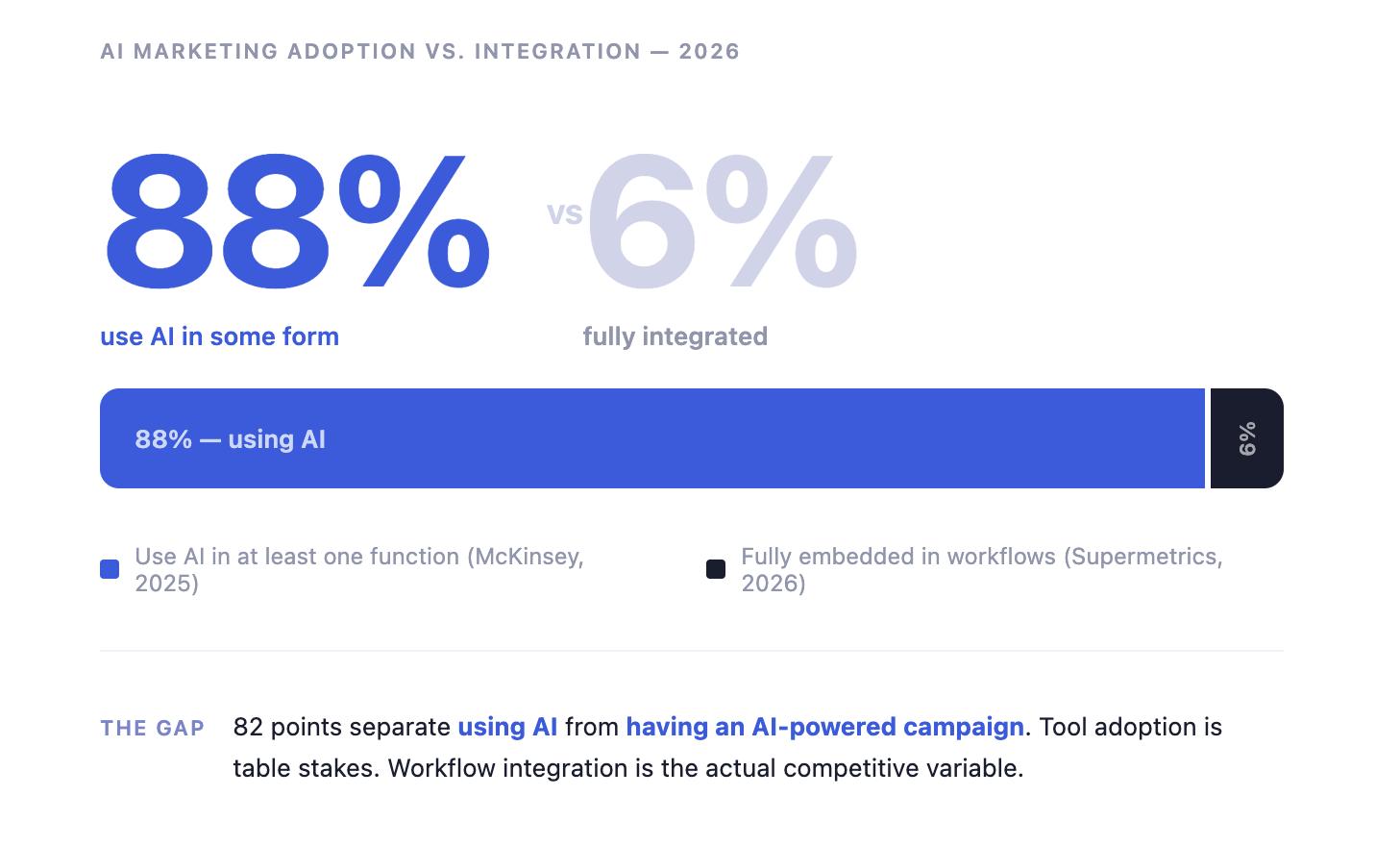
The difference between a high-performance AI campaign and a mediocre one comes down to whether these layers are connected. Generative AI producing content that predictive AI has already determined the audience wants, distributed by agentic AI that adjusts in real time based on performance — that’s the architecture. Most campaigns only have the first layer.
Build Your Data Foundation Before You Touch a Tool
Every credible source — from IBM to Gartner to Treasure Data — makes the same point: AI is only as good as the data it runs on. Yet 52% of marketing teams don’t own their own data strategy, and only 33% say they can activate their data effectively. These teams are buying AI tools and feeding them fragmented, unreliable inputs. The outputs are predictably poor.
The data hierarchy in 2026 looks like this: first-party data (behavioral signals from your owned properties — site visits, purchase history, email engagement, app activity) is the gold standard. Zero-party data — preferences and intentions explicitly declared by users through quizzes, preference centers, and onboarding surveys — is arguably even more valuable because it’s direct rather than inferred. Third-party data is largely unreliable as a targeting foundation now, with cookie deprecation, consent frameworks, and signal degradation making it a poor input for AI models that need clean, consistent signals.
“Clean data” for campaign readiness means: unified customer profiles (one record per person, not five fragmented views across your CRM, email platform, and ad accounts), identity resolution across devices, and real-time behavioral event streaming so AI can respond to actions as they happen rather than acting on yesterday’s signals.
Before launching any AI campaign, run an honest audit:
- Are your customer data sources mapped? Do you know where every signal comes from?
- Is there a unified profile layer, or is data living in silos?
- How fresh is your data? If the AI is segmenting audiences based on behavioral signals from six months ago, it’s optimizing against outdated intent.
- Is consent logged at the individual level? (More on this in the compliance section.)
The technology that connects these pieces is a Customer Data Platform (CDP). Organizations using a CDP report a 93% reduction in Customer Acquisition Cost — not because the CDP is magic, but because it gives AI systems a complete picture of each customer rather than partial fragments. Agentic AI, in particular, requires this foundation. As Treasure Data’s 2026 analysis puts it: partial data produces partial understanding. An agent managing your campaign budget across channels that doesn’t know a user already converted is going to waste spend. The CDP prevents that.
If you don’t have unified data, fix that before investing in more AI tools. More tools running on fragmented data creates more complexity and worse outcomes — organizations with 11–25 martech tools report nearly 90% unclear ROI, compared to 62% for those with 6–10 tools.
Define Your Goals and Map AI Capabilities to Each One
The most common and costly mistake in AI campaign planning is starting with tool selection. A team discovers Google’s Performance Max or Meta’s Advantage+ and builds a campaign around what the tool can do, rather than what the campaign needs to achieve. The result is disconnected tech stacks, diluted results, and a genuine inability to measure whether the investment worked.
Goals come first. AI capabilities serve goals, not the other way around.
| Campaign Goal | AI Capability | Key Tools/Approaches | Primary KPI |
|---|---|---|---|
| Awareness | Generative AI for content variation; GEO/AEO optimization | AI video production, LLM-structured content | Brand recall, AI citation rate, share of voice |
| Consideration | Predictive behavioral targeting; dynamic content personalization | Audience intelligence platforms, CDP-connected personalization | Time-on-site, content engagement, MQL rate |
| Conversion | Real-time bidding AI; automated lead scoring | Performance Max, Meta Advantage+, AI nurture sequences | CAC, ROAS, MQL-to-SQL conversion rate |
| Retention | Churn prediction; CLV-optimized offer generation | Predictive models, hyper-personalized loyalty programs | Churn rate, CLV, repeat purchase rate |
Before any of this, set your KPIs. The most important thing here is distinguishing between vanity metrics — impressions, CTR, content downloads, behavioral scores — and revenue-aligned KPIs — Customer Acquisition Cost (CAC), Customer Lifetime Value (CLV), Return on Ad Spend (ROAS), and MQL-to-SQL conversion rate.
This matters more than it sounds. DemandScience’s 2026 survey of 750 senior marketing leaders found that 87% of organizations are optimizing their AI campaigns against inflated intent signals that don’t predict revenue. Two-thirds of those leaders say their dashboards show success that doesn’t translate into pipeline. Setting revenue-signal KPIs before launch is what separates the teams that achieve 22% ROI improvement from those that achieve faster, prettier dashboards.
Document your performance baseline before activating AI. Without a pre-AI benchmark, you cannot calculate ROI. This sounds obvious and is consistently skipped.
Missing from AI search results?
ICODA runs AI visibility audits across 8 major LLms

Design the Campaign Architecture — Layers, Agents, and Guardrails
A 2026 AI marketing campaign has three interconnected layers. Understanding how they work together is what makes the difference between AI as a collection of disconnected tools and AI as a campaign system.
The Three-Layer AI Campaign Architecture
- The Data Layer — your unified CDP feeding real-time behavioral signals to the AI systems above it. Every campaign decision — which creative to serve, which bid to set, which audience to prioritize — runs on signals from this layer. Example: a returning visitor who abandoned a pricing page triggers a different creative sequence than a first-time visitor from organic search. If this layer is fragmented, everything above it performs at a fraction of its potential.
- The Agent Layer — where campaign execution happens autonomously. Specialized agents handle distinct functions: one manages content generation and variant testing, another handles audience segmentation and targeting, a third manages budget allocation and bid optimization. These agents don’t wait for human sign-off at each step — they operate within defined parameters and report anomalies when those parameters are approached. Example: a bid management agent that automatically shifts budget from underperforming ad sets to top performers in real time, without a human touching the dashboard.
- The Human Oversight Layer — where marketers live. Brand strategy, creative direction, ethical review, strategic pivots. This layer defines the guardrails the agent layer operates within: frequency caps, budget triggers, content restrictions, brand voice parameters. Example: a rule that no single audience segment receives more than five impressions per day, enforced automatically but set by a human. Governance decisions — who can change an agent’s parameters, what triggers a review — live here too.
The guardrails are not bureaucratic overhead. They are what makes agentic AI safe to deploy. Before launching any autonomous agent, define the non-negotiables: what topics AI cannot touch, what budget threshold requires human approval, what creative outputs require review before going live. Build a kill-switch protocol — a rapid shutdown mechanism if agents behave off-brand or outside expected parameters.
The multichannel synchronization challenge is where siloed AI tools consistently fail. If your email AI doesn’t know what your paid social AI is doing, and neither knows what your programmatic display AI is doing, you’ll serve conflicting messages to the same person across channels. High-performance campaigns have a unified orchestration layer — either a dedicated platform or a CDP-connected workflow — that ensures message consistency across email, paid social, programmatic display, and organic.
For practical implementation, platforms supporting agentic workflows include HubSpot Breeze, Salesforce Agentforce, Jasper, and Adobe Agent Orchestrator. The selection criteria that matter most: native CDP integration, configurable guardrail systems, transparent agent decision logging (so you can audit what an agent did and why), and human checkpoint design that doesn’t require approving every micro-decision.
Personalization at Scale — Hyper-Targeting Without Losing Brand Voice
AI’s most cited benefit in marketing is personalization — and the numbers support the enthusiasm. AI-driven personalization makes customers 2.3x more likely to complete a purchase. Personalized emails generate 29% higher open rates and 41% higher CTR. Starbucks’ Deep Brew system personalizes offers for 27.6 million loyalty members, increasing member spending by 34%.
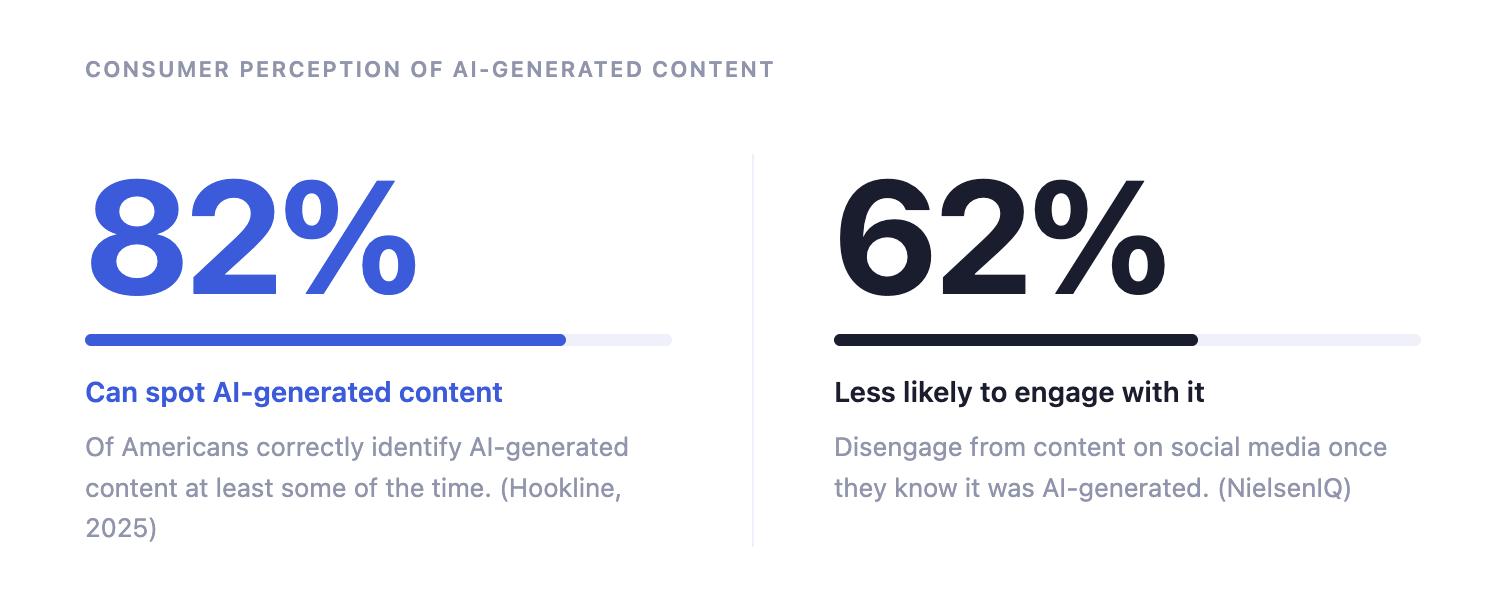
The practical challenge is doing this at scale while keeping brand voice coherent. AI can generate thousands of content variants, but undirected, those variants will drift from brand identity, contradict each other across channels, and — critically — produce content that consumers recognize as generic AI output. 82% of consumers can spot AI-generated content, and 62% are less likely to engage when they know it was machine-produced.
The solution is encoding brand voice upstream, not editing it downstream. Before scaling content generation, build: a comprehensive brand voice document that defines not just tone but what the brand specifically doesn’t sound like; a prompt library with pre-validated inputs for different content types and channels; and tone-of-voice parameters configured directly in AI platforms. Jasper’s IQ Layer approach is one implementation model — the brand’s voice constraints are baked into the AI’s generation parameters, not bolted on through human review.
AI personalizes across four levers simultaneously: messaging (what the content says), creative format (video vs. static vs. long-form vs. short-form), channel (where the content appears), and timing (when it’s delivered, down to time-of-day and recency-to-last-interaction). The shift isn’t just from demographic segmentation to behavioral segmentation — it’s from segment-level targeting to moment-level targeting, responding to where a specific person is right now in their journey.
One critical boundary: personalization triggers distrust when it feels like surveillance. Consumers distinguish between “this brand understands what I want” and “this brand is tracking everything I do.” Personalization built on first-party behavioral data from owned interactions — purchase history, content engagement, declared preferences — reads as the former. Personalization built on third-party inferred data about off-site behavior often reads as the latter. The performance variable here is consent: personalization that operates on data the user knowingly shared outperforms inferred personalization on both engagement and trust metrics.
Privacy-First Campaign Design — Compliance as a Competitive Advantage
Most marketing articles treat privacy compliance as a legal disclaimer section. In 2026, it belongs in campaign architecture from Day 1.
The regulatory landscape is active and expanding. GDPR’s enforcement has matured significantly, with the EDPB’s coordinated enforcement framework resulting in larger, more systematic fines rather than isolated penalties. CCPA/CPRA is in full effect in California, and 14 US states have active privacy laws with varying requirements around consent, data minimization, and opt-out rights. The EU AI Act’s high-risk provisions reach full force in August 2026, with specific implications for AI systems used in targeted marketing.
Privacy-first campaign design doesn’t mean asking for less data. It means designing data collection at the point of value exchange. Preference centers, loyalty enrollment, content gating, and onboarding quizzes that explicitly exchange a user’s declared preferences for a tangible benefit — personalization, recommendations, relevant content — generate zero-party data that is both higher quality and fully consented. This is simultaneously better data for AI models and lower risk for compliance.
On the technical side, server-side tagging is now the standard for maintaining measurement signal without relying on third-party cookies. Enhanced conversions, Google Click IDs (GCLIDs), and CRM data integration feed AI optimization systems with first-party signals that are more accurate than cookie-based proxies ever were.
Algorithmic bias audits belong in every AI campaign governance framework. AI models trained on historical campaign data perpetuate whatever biases existed in that data — showing certain ad creative primarily to certain demographic groups, underserving audiences that look different from historical converters, systematically underbidding on segments the model hasn’t seen perform. These audits are both an ethical requirement and a performance one: biased models leave revenue on the table.
Brief legal and compliance stakeholders as campaign participants from Day 1, not as reviewers after launch. When compliance is a late-stage gate, it creates expensive delays and sometimes requires fundamental campaign redesigns. When it’s part of the architecture conversation, the constraints become inputs to better design decisions.
The business case for this investment: research consistently shows consumers pay premium prices to brands they trust with their data, and privacy-first campaigns outperform opaque ones on customer lifetime value and repeat purchase rates. The trust dividend is real and measurable.
GEO and AEO — The Campaign Channel Most Teams Are Missing
Generative Engine Optimization (GEO) is the practice of structuring content so that large language models — ChatGPT, Perplexity, Google’s AI Overviews — select it as a cited source when generating answers. Unlike traditional SEO, which targets a ranked position on a results page, GEO targets inclusion in the answer itself. There is no position two.
Citation happens when a model determines a source is authoritative, specific, and directly answers the query. The signals that drive this are different from traditional ranking: named frameworks, structured data, clear H2/H3 hierarchies, and direct definitional openers carry disproportionate weight. A page that answers “what is an AI marketing campaign?” in its first sentence is more citable than one that buries the definition in paragraph four.
For campaign measurement, GEO visibility surfaces the touchpoints traditional attribution misses entirely — the Perplexity answer that introduced your brand, the AI Overview that shaped a purchase decision before any click happened. LLM citation rate and AI Overview appearance frequency are the metrics that make this layer visible. Structuring campaigns to perform in this environment is its own discipline — one that AI SEO services are built around, sitting at the intersection of campaign execution and AI discovery.
Measure, Optimize, and Prove ROI — The AI Campaign Intelligence Loop
Traditional attribution is broken for AI campaigns. When a consumer discovers your brand through a ChatGPT answer, reads a blog post that appears in a Perplexity response, then converts through a branded search — none of those AI-mediated touchpoints register as clicks in a standard analytics dashboard. Last-click attribution doesn’t just misattribute credit; in AI-mediated discovery environments, it makes whole channels invisible.
The KPI framework for AI campaigns needs three tiers:
Tier 1 — Revenue Impact: CLV, ROAS, marketing-attributed revenue, MQL-to-SQL conversion rate. These are the metrics that matter to the business. They’re also the hardest to measure and the most consistently skipped. Build these first.
Tier 2 — Operational Efficiency: CAC reduction over time, time-to-launch for campaign assets, content production cost per asset. These measure whether AI is actually making your team more productive — and the baselines you set before AI activation are what make these numbers meaningful.
Tier 3 — AI-Specific Signals: GEO/AEO visibility (how often does your brand appear in AI-generated answers?), LLM citation rate, and model learning velocity — is the AI’s performance improving over successive campaign cycles? A campaign where the AI isn’t getting smarter is a campaign that’s operating as a static rule system, not a learning one.
The continuous optimization loop works like this: AI analytics platforms (GA4, Adobe Analytics, AI-native dashboards) monitor campaign performance in real time, flag shifts that exceed defined thresholds, and surface recommendations before spend is wasted. The marketing team’s job is to review these signals on a regular cadence — weekly agent performance reviews, monthly strategic realignment against goals, quarterly ROI reporting — and make the strategic adjustments that agents can’t make on their own.
Multi-touch attribution for AI campaigns needs to weight touchpoints that don’t produce clicks: AI-generated answers, dark social shares, zero-click discovery. Marketing Mix Modeling (MMM) is gaining traction for this reason — it measures incremental impact at the channel level without requiring click-level tracking, making it compatible with consent-based, privacy-first data collection.
Holdout testing is the most underused measurement tool in AI campaign management. Running a percentage of your audience on the control (non-AI) version and measuring incremental revenue versus the AI-optimized group gives you the clearest possible signal of what AI is actually contributing. It requires discipline to hold back spend from a segment when AI optimization is available — and it’s the only way to produce truly credible ROI numbers.
The fundamental shift: high-performance AI campaigns measure revenue signals. Underperforming AI campaigns measure efficiency signals and mistake faster content production for better campaign results.
The Path Forward
The five disciplines that separate high-performance AI campaigns from average ones are sequential and interdependent: unified data foundation, strategic goal mapping, governed agentic architecture, privacy-first design, and revenue-signal measurement. Skipping any of them — most often the first and last — is why 74% of companies struggle to scale AI value despite near-universal tool adoption.
The competitive variable in 2026 isn’t who uses AI. It’s who governs, trains, and directs it with the most strategic clarity. The brands outperforming aren’t the ones with the most AI tools — they’re the ones that have built the cleanest data infrastructure, encoded the tightest brand parameters, and shifted their measurement from dashboards that feel good to metrics that connect to revenue.
As AI campaigns grow more sophisticated, they also expand into territory most campaign teams haven’t prepared for: the AI discovery layer. When consumers increasingly find brands through AI-generated answers rather than search results, campaign performance depends not just on how well your ads optimize but on whether your content is structured to be cited by the AI systems making those recommendations. That’s where the campaign execution layer and the AI visibility layer start to converge — and where the next wave of competitive differentiation is already taking shape.
Honestly, nothing and everything. Using AI to write copy or generate images is table stakes at this point — everyone’s doing it. The problem is that “using AI tools” and “running an AI-powered campaign” are completely different things. If AI isn’t actually making decisions about who sees what, when, at what bid price — you’re just producing content faster, not running smarter campaigns. Faster output doesn’t automatically mean better results.
This is exactly why you define guardrails before launch, not after. Frequency caps, budget triggers, content no-go zones, brand voice parameters — these need to be set in the agent’s configuration, not in a doc nobody reads. Build a kill-switch protocol too: a rapid shutdown mechanism if an agent goes off-script. The teams that get burned are the ones who deploy autonomous agents and then check in weekly. In agentic systems, anomaly detection needs to be near real-time.
Look, technically you can — but what you end up with is AI making decisions based on five different partial versions of the same customer. Your CRM has one view, your email platform has another, your ad accounts have a third. The AI isn’t stupid, it just works with what you feed it. Garbage in, garbage out. A CDP isn’t glamorous but it’s the difference between AI that personalizes and AI that guesses.
This is a fair objection and I get the frustration. But human oversight in a well-run AI campaign doesn’t mean approving every email subject line — it means setting the brand guardrails, defining what the AI can and can’t do, and reviewing anomalies. You’re an architect, not an operator. The data is actually pretty clear on this: AI content with human strategic direction outperforms fully automated output by 4.1x. Removing humans doesn’t save money — it costs performance.
Genuinely usable for specific, bounded use cases — bid management, email personalization, A/B test selection. Multi-agent orchestration across your entire campaign? Still early for most teams. The honest answer is: if you don’t have clean unified data and a governance framework, agentic AI will just make bad decisions faster. Start with one agent, one function, prove it works, then expand. Anyone selling you a full agentic marketing OS on day one is getting ahead of where the tech actually is for most orgs.
No, you’re in the majority. DemandScience surveyed 750 senior marketing leaders and 87% said their campaigns produce inflated signals that don’t predict revenue. Two-thirds said their dashboards show success that doesn’t translate to pipeline. The tool isn’t the problem — the measurement is. If you’re optimizing for CTR and impressions, you’ll always have green dashboards and flat revenue. The fix is brutally simple and rarely done: set revenue KPIs before launch, document your pre-AI baseline, and stop counting likes.
Share with


Rate the article