




88% of marketers use AI tools every day. And nearly 30% of them are watching their search traffic drop. Read that again. More AI usage. More content being published. Fewer people actually showing up.
That’s the tension nobody wants to talk about. Not the AI vendors. Not the agencies selling “AI-powered content” packages. Not the LinkedIn thought leaders posting their 47th “AI is transforming marketing” hot take.
The real issue? Most teams don’t have an AI content strategy. They have ChatGPT bookmarked and a vague sense that they should be “using AI more.” That’s not strategy. That’s anxiety with a subscription fee.
Meanwhile, the teams pulling ahead aren’t just writing faster. They’re building content systems that work across Google, ChatGPT, Perplexity, and AI Overviews — because that’s where their audiences actually are now. Not in one place. Everywhere, simultaneously, often in the same research session.
More Output, Fewer Results. Why?
Let’s do some uncomfortable math.
94% of marketers plan to use AI for content creation this year (HubSpot 2026 Marketing Statistics). Organizations using AI tools report 40% productivity gains (Stanford HAI AI Index Report 2025). So everyone’s shipping faster. Great.
Now here’s the other side.
Traditional search volume is projected to drop 25% by 2026 as AI chatbots eat into market share. We’re living inside that prediction now.
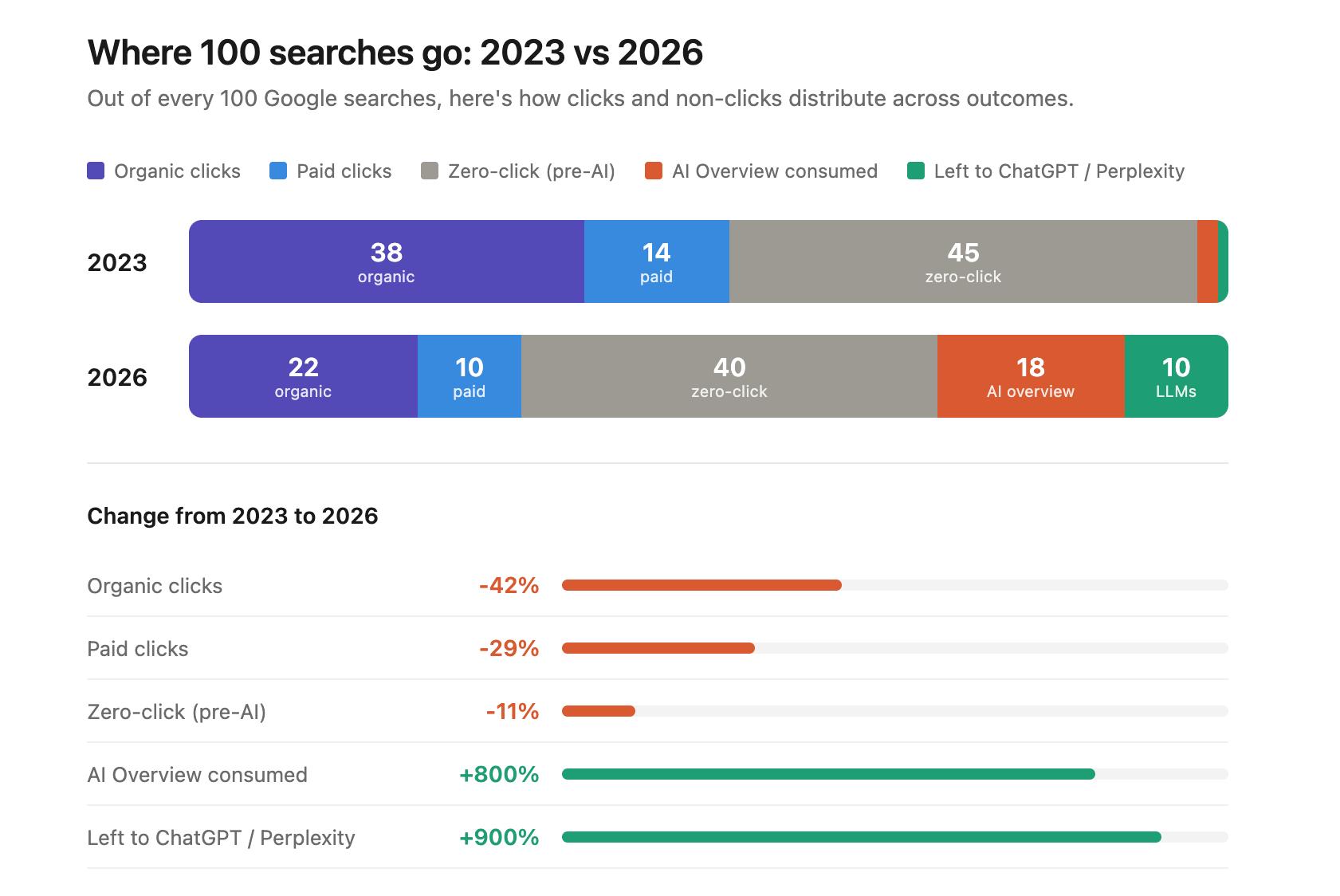
The latest large-scale CTR studies show AI Overviews cut organic click-through rates for position-one content by 58% (AI Overviews Reduce Clicks by 58%). Not position ten. Position one.
One of the most thorough analyses we’ve seen — 3,119 queries across 42 organizations tracked over 15 months — showed organic CTR dropping from 1.76% to 0.61% on queries where AI Overviews appeared. Roughly a two-thirds collapse.
The part that should really bother you: even queries without AI Overviews saw CTR fall 41%. People just click less now. Period. They ask ChatGPT (800 million weekly active users and counting). They skim the AI summary. They move on.
So your rankings hold. Your impressions look stable. And your traffic quietly bleeds out. If you’re only looking at keyword positions, your dashboard tells a cheerful lie while your pipeline thins.
The 2023 playbook — find keywords, prompt AI to draft, light edit, publish, repeat — feeds a machine that increasingly keeps the value for itself. A real AI content strategy in 2026 has to start with a different question: where do people actually find information now? Not where they used to.
Where Most Teams Get Stuck: Three Maturity Levels
It’s not about whether you use AI. Everyone uses AI. The question is whether you’ve built a system around it or you’re still winging it.
Level 1: AI as a Shortcut. This is roughly 70% of teams. Someone opens ChatGPT, writes a prompt, gets a draft, cleans it up, hits publish. Maybe they use AI for subject lines or social captions too. But the workflow itself? Same as 2022, just faster in spots.
You know you’re here when your “AI strategy” is a Google Doc of prompts. When different people on the team use different tools with zero shared standards. When nobody can tell you if AI-produced content performs better or worse than the old stuff — because nobody thought to check.
Level 1 feels productive. It isn’t strategic.
Level 2: AI Woven Into the Process. Around 20% of teams. AI generates the content brief from data. It handles first drafts while humans handle angle and differentiation. Performance metrics feed back into what gets produced next. There’s a style guide AI actually follows. There are quality checks.
Teams at Level 2 typically produce 3-4x more content at similar quality. They can measure the difference. But they’re still optimizing for one channel: Google organic. Which, as we just covered, is leaking value.
Level 3: AI-Native Operations. Under 10% of teams. These groups optimize simultaneously for Google, AI Overviews, ChatGPT citations, and Perplexity visibility. Their content is modular by design — built so AI systems can parse it, cite it, and surface it across every discovery channel. They’re not just creating content. They’re building a content architecture.
The gap between Level 1 and Level 3 isn’t budget. It isn’t team size. It’s whether you’ve built a system or you’re relying on individual people being clever with prompts.
Do this week: Count how many people on your team use AI tools. Then count how many follow a shared, documented process for using them. If the second number is less than half the first, you’re at Level 1. No judgment — but know where you stand.
Not showing up in AI answers?
ICODA runs AI visibility audits across 8 major LLms

The New Discovery Equation: SEO + AEO + GEO + AIO
This is the part most “AI content strategy” guides completely miss. And honestly, it’s the reason we wrote this piece.
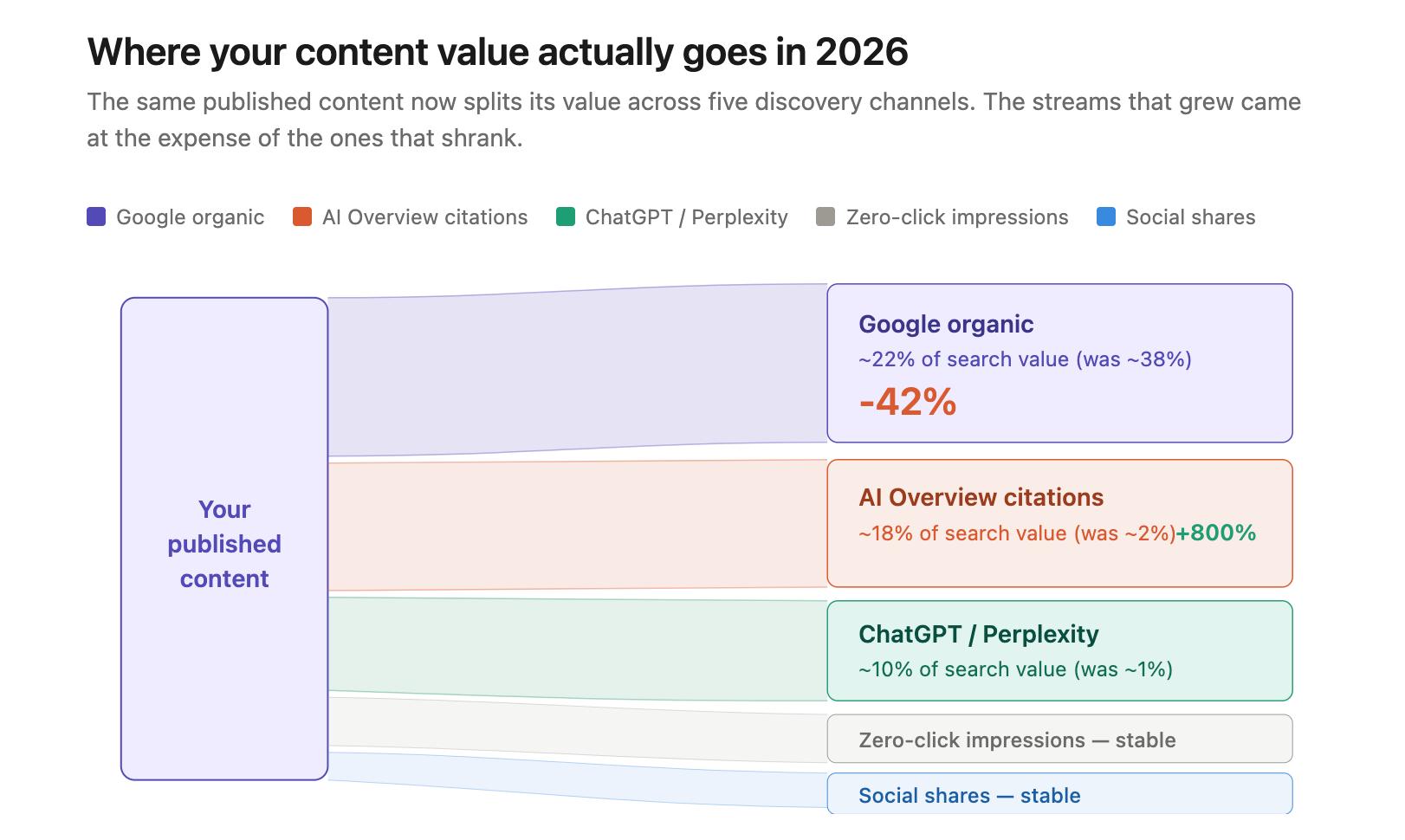
In 2026, your content needs to serve four different discovery systems. Not just Google.
SEO is still the foundation. Technical health, crawlability, keywords, links. Organic search drives nearly 47% of all web traffic. Don’t skip it. But don’t stop there either.
AEO (Answer Engine Optimization) is about making your content easy for AI-powered tools to grab and serve directly — Google’s AI Overviews, voice assistants, Siri. The move: put the straight answer in the first 40-60 words of each section. Use FAQ schema. Write paragraphs that work as self-contained units, because that’s exactly how these systems extract information.
GEO (Generative Engine Optimization) goes wider. AEO asks “how do I become the answer?” GEO asks “how do I get cited when ChatGPT or Perplexity builds a response?” These platforms run on retrieval-augmented generation — they chunk your content, embed it as vectors, and pull the most relevant pieces when generating answers. Academic research on GEO techniques shows they can boost AI visibility by up to 40%. Not a rounding error.
AIO (AI Overview Optimization) targets Google’s AI Overviews specifically — those summaries sitting at the top of more and more SERPs. Brands cited in AI Overviews see significantly higher CTR versus non-cited brands on the same queries. Getting into the AI Overview is becoming the new position zero.
Let’s make this concrete. Say you’re a crypto project launching a DeFi token and you’re building a cornerstone guide: “How DeFi Token Launches Work in 2026.”
For SEO, you target long-tail keywords and earn backlinks from crypto publications. Standard.
For AEO, you open with a clean 50-word definition and add FAQ schema answering “What is a DeFi token launch?” and “How do I participate?”
For GEO, you include original data — your own launch metrics, a proprietary analysis — that ChatGPT would want to cite. You structure paragraphs as standalone, quotable blocks. You build citational density by referencing other authoritative sources (and getting referenced back).
For AIO, you format claims with clean data in parsable HTML, use structured data markup, and make sure the page is technically flawless.
Same article. Four jobs done at once. We’ve watched brands go from invisible in AI answers to consistently cited within 90 days just by layering this structure onto their existing content.
Do this week: Take your top-performing blog post and query its main keyword in ChatGPT, Perplexity, and Google. Does your brand appear anywhere? If not, look at what does get cited. Note the differences in structure, data density, and formatting. That gap is your roadmap.
Building Your AI Content Strategy: The Moves That Matter Most
Forget 47-step frameworks. Here are the only five things that create real leverage.
1. Audit your discovery footprint — everywhere, not just Google.
Most teams audit SEO rankings. Almost nobody checks their AI visibility. Run your brand name and your top 10 keywords through ChatGPT, Perplexity, Google AI Mode, and Bing Copilot. Write down where you show up, where you don’t, and who shows up instead.
92% of marketers say they plan to optimize for both traditional and AI-powered search. Planning is nice. But actually running the queries is better.
Do this week: Block 90 minutes. Test 10 queries across 4 platforms. Build a simple spreadsheet — query, platform, your brand cited (yes/no), competitor cited, notes. That’s your new baseline. Ugly and imperfect is fine. It’s more than 90% of your competitors have.
2. Restructure content for how AI actually reads it.
AI platforms don’t read your beautifully crafted 2,000-word narrative from top to bottom. They chunk it. They pull the paragraph that best answers the query. They ignore everything else.
So every major section needs to work as a standalone unit. Lead with the answer. Add data. Close with context. If a section can’t be understood without reading the three sections before it, AI will skip it.
Practical move: go through your top 20 pages and rewrite the first two sentences under every H2. Make each one a direct, factual claim that could be pulled and cited on its own.
3. Build a content calendar for two audiences: humans searching Google and people querying AI.
These overlap a lot — but not completely. AI platforms favor conversational question framing, clear comparison structures, and sources with original data or named expertise. Your editorial calendar should map each piece to its Google keyword target and its AI citation potential.
The filter: “If someone asked ChatGPT this exact question, would our content be good enough to cite?” If the answer is no, the piece needs more original substance before you publish it.
4. Invest in proprietary data. This is the moat.
AI models need sources to reference. They lean toward content with original research, unique analysis, or first-hand expertise — because they literally cannot make that up themselves.
Most marketing teams haven’t received any structured AI training, let alone built the kind of data-rich content that AI wants to cite. If everything you publish is a rewrite of someone else’s research, you’re building on borrowed ground.
Do this week: Find one data source you already own but haven’t published — customer survey results, internal benchmarks, usage patterns, anonymized case data. Plan one piece of content around it. That single asset can become your most-cited page across AI platforms.
5. Start measuring what actually matters now.
Almost every marketing team plans to increase AI SEO investment this year. But barely one in five tracks any KPIs for generative AI. Let that sink in. Almost everyone is spending more. Almost nobody knows if it’s working.
Start tracking: how often your brand appears in AI answers, which pages get cited, branded search lift after AI mentions, and how AI-referred visitors convert compared to organic search visitors. The tools are still rough. That’s fine. Imperfect data now beats perfect data in 2028.
The Mistakes That Kill AI Content Strategies
Same patterns. Different companies. Over and over. Here’s the cheat sheet — then we’ll unpack the ones that hurt most.
| Mistake | What It Looks Like | Why It Kills You |
|---|---|---|
| Volume-first thinking | “AI lets us publish 5x more, so let’s do that” | Most orgs do the same thing. More commodity content = more noise, not more results |
| Google-only optimization | Entire strategy built around keyword rankings | 60% of searches end without a click; 77% on mobile. You’re all-in on a shrinking channel |
| Dropping the human layer | AI writes it, human skims it, publish | Under half of consumers trust AI-generated info. Readers can tell — and they bounce |
| No feedback loop | Never comparing AI content performance to pre-AI baseline | You’re not iterating. You’re just guessing at higher speed |
| Burying key insights | Best data point sits in paragraph six | AI models extract from the top of a section. If it’s not in the first two sentences, it doesn’t exist |
The two that do the most damage? Volume-first thinking and Google-only optimization. They tend to travel together.
A team decides AI means they can finally “scale content.” They spin up 30 blog posts a month instead of 8. Every post targets a Google keyword. Traffic goes up for a quarter — then flatlines, because the content is interchangeable with what everyone else is publishing. Meanwhile, they’ve invested zero effort into AI citation visibility, and their brand doesn’t appear in a single ChatGPT or Perplexity response for their core topics.
The fix isn’t complicated: publish fewer pieces with more original substance, and optimize each one across all four discovery layers. One well-structured, data-rich article that gets cited by AI platforms will outperform ten generic posts that rank on page two and get zero AI mentions.
On the human layer — this one’s worth emphasizing. AI handles research, structure, first drafts, data processing. That’s the 60% that scales. Humans add the angle, the voice, the opinion, the expertise that no model can fabricate. That’s the 40% that makes someone bookmark your article instead of skimming the AI summary and moving on.
What’s Coming: 2026–2027
Three things worth preparing for now, while it’s still early.
Agentic AI goes operational. Industry forecasts point to 80% of marketing teams using autonomous AI systems by 2030 — tools that handle campaigns from ideation through optimization with minimal human involvement. The bridge to get there is 2026-2027. Teams with solid content systems will layer agentic capabilities on top. Teams still at Level 1 won’t be ready when it arrives.
AI-driven commerce expands. Over 90% of AI Mode searches end without a click to an external site. As AI platforms weave purchase paths into conversational responses, brands already visible in those answers will grab a wildly disproportionate share of transactions. If you’re not inside the answer, you’re not in the consideration set.
Measurement catches up. Tracking AI visibility is clunky right now — manual queries, spreadsheets, gut feel. That changes within 12-18 months as major SEO platforms ship integrated AI citation tracking. The teams building baselines today will have the historical data to prove ROI when those tools arrive. Everyone else starts from zero.
Final Thoughts
An AI content strategy in 2026 is not about using ChatGPT to write more blog posts. It’s about building a content operation that captures value everywhere your audience discovers information — search results, AI summaries, generative platforms, and whatever new interface shows up next quarter.
That means auditing your AI visibility today. Restructuring content so machines can actually use it. Investing in original data that AI models want to cite. And measuring something beyond keyword rankings.
The brands that build this system in the next 12 months will compound their lead. The ones that keep treating AI as a drafting shortcut will spend 2027 trying to figure out why their content isn’t working anymore.
ICODA’s AI SEO services exist for exactly this problem — helping teams move from Level 1 to Level 3 without burning a year figuring it out on their own. If anything in this article made you realize your content isn’t showing up where it should, that’s the conversation worth having.
Frequently Asked Questions (FAQ)
A system for creating content that performs across Google, ChatGPT, Perplexity, and AI Overviews — not just traditional search.
Traditional SEO targets Google rankings. An AI content strategy adds three layers — AEO, GEO, and AIO — so your content also gets cited by generative AI platforms and surfaced in AI summaries.
Lead every section with a direct answer in 40-60 words, include original data, and structure paragraphs as standalone citable blocks. AI models pull single passages, not full articles.
Start by manually querying your top keywords across ChatGPT, Perplexity, and Google AI Mode. For scaling, Conductor and Ahrefs are building AI citation tracking. ICODA’s AI SEO audits provide structured visibility reports across all major AI platforms.
SEO targets search rankings. AEO optimizes for direct answers and featured snippets. GEO focuses on getting cited by ChatGPT and Perplexity. AIO targets inclusion in Google’s AI Overviews.
Monthly. About 70% of pages cited in AI Overviews change within a 2-3 month window, so quarterly audits miss too much.
Share with


Rate the article