




Introduction
Here’s something that might catch you off guard: AI-written pages now appear in over 17% of top search results — up from just 2.3% before the widespread adoption of large language models [1]. That’s not a prediction. That’s what’s happening right now in Google’s index.
And the adoption numbers tell an even more compelling story. Over 56% of marketers are already using generative AI in their SEO workflows, making it the most common AI use case in marketing — outpacing even customer service and video creation [2].
So why are so many SEO professionals still asking whether AI content actually works?
The short answer: it does. The longer answer involves understanding what “works” actually means, how Google really evaluates AI content, and what separates effective AI-assisted SEO from the spam-ridden failures that give this approach a bad reputation.
In this article, you’ll learn exactly how to make AI content a genuine competitive advantage — backed by data, not speculation.
What Does AI Content Actually Mean in the SEO Context?
Let’s clear up a common misconception. AI content doesn’t mean clicking a button and watching a robot spit out 2,000 words you publish unchanged.
In the SEO context, AI content exists on a spectrum. At one end, you have fully automated content farms — the kind that publish thousands of generic articles hoping something sticks. At the other end, you have sophisticated AI-assisted workflows where AI handles research, drafting, and optimization while human experts add expertise, fact-checking, and original insights.
The distinction matters because Google treats these approaches very differently.
AI content in modern SEO typically includes content outlines and structural frameworks generated by AI, first drafts that get heavily edited and enhanced by subject matter experts, AI-powered keyword research and topic clustering, automated optimization for readability and search intent, and programmatic content at scale for product pages or location-based landing pages.
What makes this approach relevant to AI SEO isn’t the technology itself — it’s the efficiency gains. Teams using AI report saving up to 50% of time previously spent on data analysis and content production. That time gets redirected toward strategy, original research, and the kind of expertise that actually moves rankings.
Why AI Content Works: The Logic and Evidence
The evidence supporting AI content effectiveness comes from three directions: Google’s own statements, real-world ranking data, and the practical outcomes marketers are reporting.
Google’s Explicit Position
Google has made its stance crystal clear. In their Search Central documentation, they state: “Rewarding high-quality content, however it is produced.” The emphasis is on quality, not origin.
This isn’t corporate hedging. Google explicitly permits AI-generated content as long as it genuinely helps users and isn’t created primarily to manipulate rankings. They’ve noted that automation has powered helpful content — weather forecasts, sports scores, financial reports — for years. AI simply extends these capabilities.
The Performance Data
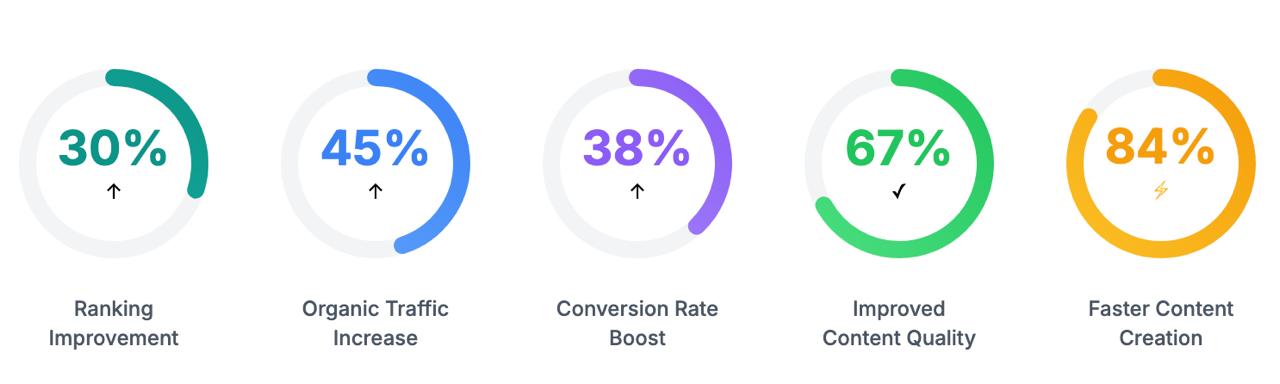
Beyond policy statements, the numbers tell a compelling story. Companies that integrated AI into their SEO strategies saw search rankings improve by an average of 30% within six months, according to recent industry research. AI-driven SEO campaigns have driven 45% increases in organic traffic and 38% improvements in conversion rates for e-commerce sites.
These aren’t isolated cases. With 67% of businesses reporting improved content quality when using AI, and 84% of marketers saying AI helps them create content faster, the efficiency-to-results pipeline is well established.
Why It Makes Strategic Sense
AI content works because it solves a fundamental resource problem. Most businesses can’t afford to produce the volume and depth of content needed to compete in modern search — at least not at the quality Google demands.
AI changes that equation. It handles the time-intensive groundwork: research synthesis, structural organization, first-draft writing, optimization suggestions. Human experts then add what AI cannot: genuine expertise, original perspectives, brand voice, and the judgment to know what actually serves readers.
This combination — AI efficiency plus human expertise — is the formula behind successful AI search optimization strategies.
How Google Really Treats AI Content: Debunking the Myths
Let’s address the elephant in the room. You’ve probably heard someone claim Google penalizes AI content. They’re wrong — but with an important caveat.
Myth № 1️⃣: Google Automatically Penalizes AI-Generated Content
This is flatly incorrect. Google’s March 2024 core update targeted low-quality, manipulative content — not AI content specifically. Sites that got hit were publishing thin, unhelpful content at scale. The fact that AI generated it was incidental; the same fate would befall human-written spam.
Google’s documentation explicitly states: “Using automation — including AI — to generate content with the primary purpose of manipulating ranking in search results is a violation of our spam policies.” Note the key phrase: “primary purpose of manipulating ranking.” Helpful AI content that serves users? Perfectly acceptable.
Myth № 2️⃣: Google Can Always Detect AI Content
Google hasn’t claimed — and doesn’t need — perfect AI detection. Their systems evaluate content quality, not authorship. Whether a machine learning model or a human wrote something, Google asks the same questions: Is this helpful? Is it accurate? Does it demonstrate expertise? Does it satisfy user intent?
Content that fails these tests gets demoted regardless of origin. Content that passes ranks regardless of origin.
Myth № 3️⃣: Human Content Always Outranks AI Content
Research analyzing top search results shows human-generated content still dominates at around 83% of top rankings. But that 17% AI presence is significant and growing.
More importantly, the best-performing content often combines both. AI-assisted content that includes human editing, expert review, and original insights can outperform purely human-written content that lacks optimization or depth.
What Google Actually Targets
The March 2024 update specifically addressed scaled content abuse (mass-producing low-quality pages), site reputation abuse (using established domains to publish spammy content), and expired domain abuse (buying domains with existing authority for manipulative purposes). These practices happen to correlate with AI misuse, but the enforcement targets behavior, not technology.
AI Content vs. Human Content: A Practical Comparison
Understanding when to use AI content — and when human expertise is essential — requires honest assessment of what each approach does well.
| Factor | 🧠 AI-Generated Content | 👤 Human-Created Content |
|---|---|---|
| Speed | High — drafts in minutes | Moderate to slow — hours or days per piece |
| Scalability | Excellent for volume production | Limited by writer availability and cost |
| Consistency | Uniform quality and structure | Variable depending on writer skill |
| Originality | Synthesizes existing information | Can provide genuinely new perspectives |
| Expertise Signals | Requires human enhancement | Natural when written by subject experts |
| Cost Efficiency | Lower per-piece cost | Higher but potentially more impactful |
| E-E-A-T Compliance | Needs expert oversight to verify | Inherent when authors have credentials |
| Emotional Resonance | Limited — tends toward generic | Strong when writers connect with audience |
| Factual Accuracy | Requires verification (may hallucinate) | Depends on writer research quality |
| Best Use Case | High-volume, research-based content | Thought leadership, opinion, complex topics |
The takeaway isn’t that one approach beats the other. It’s that strategic combination produces the best results. Use AI where it excels — research, structure, optimization, volume — and apply human expertise where it’s irreplaceable — accuracy, insight, authority.
What Makes AI Content Effective for SEO
Not all AI content performs equally. The gap between AI content that ranks and AI content that fails comes down to execution details.
Quality Input Produces Quality Output
AI content tools respond to the quality of instructions they receive. Vague prompts produce generic content. Detailed briefs incorporating target keywords, search intent analysis, competitive gaps, and specific expertise requirements produce content that actually competes.
Teams seeing strong results from AI SEO typically spend as much time on prompt engineering and content briefs as they would on writing instructions for human freelancers.
The Human Layer Isn’t Optional
Every successful AI content workflow includes human review. This isn’t just proofreading. It means subject matter experts verifying accuracy and adding genuine insights, editors ensuring the content matches brand voice and user expectations, SEO specialists confirming optimization aligns with strategic goals, and fact-checkers catching AI hallucinations before publication.
The human layer transforms AI drafts from “good enough” to “actually competitive.”
Original Value Must Be Added
AI synthesizes existing information. To rank well, your content needs something beyond what’s already indexed. That might be proprietary data or case studies, expert commentary or unique perspectives, original research or analysis, practical applications the source material doesn’t cover, or more comprehensive coverage than competing pages.
Content that simply reorganizes what AI could find elsewhere rarely performs well — regardless of how efficiently it was produced.
Technical Optimization Still Matters
AI doesn’t automatically handle technical SEO. Effective AI content workflows include proper heading structure and keyword placement, internal linking strategy, schema markup implementation, page speed and Core Web Vitals optimization, and mobile-first design considerations.
These fundamentals determine whether well-written content actually gets discovered.
Common Mistakes That Kill AI Content Performance
Understanding what fails helps you avoid the same traps. Here’s what separates AI content that ranks from AI content that wastes resources.
| Mistake | Why It Fails | How to Fix It |
|---|---|---|
| Publishing unedited AI output | Lacks expertise signals, may contain errors, feels generic to readers | Implement mandatory human review with subject matter experts |
| Ignoring E-E-A-T requirements | Google prioritizes content demonstrating Experience, Expertise, Authority, Trust | Add author bylines, expert quotes, credentials, and cite authoritative sources |
| Optimizing for keywords over intent | Rankings don’t convert if content doesn’t solve user problems | Start with search intent analysis before content creation |
| Producing at scale without quality control | Triggers spam signals, damages site authority | Establish quality thresholds — publish less if necessary |
| Skipping fact verification | AI hallucinations erode trust and risk penalties | Verify every claim, statistic, and recommendation |
| Using AI for topics requiring genuine expertise | Medical, legal, financial content needs real credentials | Reserve YMYL topics for credentialed human authors |
| Neglecting content freshness | AI can’t know what changed after its training cutoff | Schedule regular content audits and updates |
| Identical structure across all content | Pattern recognition makes scaled AI content obvious | Vary formats, structures, and approaches deliberately |
The pattern across these mistakes is treating AI as a replacement for strategy rather than a tool within strategy. AI accelerates execution; it doesn’t replace judgment.
Best Practices for AI-Optimized Content
Implementing effective AI search optimization requires deliberate process design. Here’s what works.
- Start With Strategy, Not Tools
Before any AI touches your content, clarify what you’re trying to achieve. Which keywords represent genuine business opportunities? What search intent drives those queries? What gaps exist in current SERP coverage? What unique value can you provide?
AI can’t answer these questions for you. But once you have answers, AI can execute against them efficiently.
- Build Quality Control Into the Workflow
Don’t bolt quality checks onto the end of your process. Integrate them throughout. Content briefs should specify accuracy requirements before AI generation begins. Draft reviews should happen before optimization. Expert review should precede publication — not follow it.
This approach catches problems early when they’re cheap to fix.
- Match AI Usage to Content Type
Some content categories benefit enormously from AI assistance. Product descriptions, location pages, how-to guides with established best practices, and listicle-style content all scale well with AI.
Other categories — original research, thought leadership, highly technical analysis, anything requiring personal experience — should remain primarily human-driven with AI playing only supporting roles.
- Invest in Proper Training
Teams produce better AI content when they understand how to write effective prompts, what AI limitations to watch for, how to evaluate AI output critically, and how to enhance AI drafts without rewriting from scratch.
This training investment pays dividends across every piece of content the team produces.
- Measure and Iterate
Track how AI-assisted content performs compared to purely human content. Look at rankings, traffic, engagement, and conversions — not just production metrics. Use this data to refine your approach continuously.
What works in your industry, for your audience, with your brand voice might differ from general best practices. Only measurement tells you what’s true for your specific situation.
The Competitive Reality of AI SEO in 2025
Here’s what makes this discussion urgent: your competitors are already using AI. With 56% of marketers integrating generative AI into SEO workflows, waiting to figure this out isn’t neutral — it’s falling behind.
The businesses gaining ground right now aren’t the ones debating whether AI content is legitimate. They’re the ones who’ve moved past that question and are focused on how to use AI content most effectively.
That means developing systematic workflows that combine AI efficiency with human expertise, building quality control processes that catch problems before they damage rankings, and continuously testing and refining their approach based on actual performance data.
The opportunity window for gaining competitive advantage through AI adoption is narrowing. As more organizations build these capabilities, the bar rises for everyone.
Looking ahead to 2026, industry projections suggest AI-assisted content will become the baseline expectation rather than a differentiator — meaning the competitive edge will shift from simply using AI to using it more strategically than your rivals. The businesses building robust AI content workflows now are positioning themselves to lead, not catch up, when that shift happens.
Conclusion: AI Content Works — When You Work at It
The question isn’t whether AI content works for SEO. The evidence confirms it does. The question is whether your organization will implement AI content strategically or haphazardly.
Strategic implementation means using AI where it adds genuine value — efficiency, scale, consistency — while preserving human expertise where it’s irreplaceable — accuracy, insight, authority. It means building quality into process design rather than hoping for good outcomes. It means measuring results and iterating continuously.
The businesses winning with AI SEO share a common characteristic: they treat AI as a powerful tool within a thoughtful strategy, not a replacement for strategy itself.
Done right, AI content doesn’t just work for SEO — it transforms what’s possible. It lets lean teams compete with larger organizations. It enables comprehensive content coverage that would be cost-prohibitive otherwise. It frees up human expertise for the high-value work that actually differentiates brands.
If you’re aiming to build a competitive, AI-driven content operation but aren’t sure where to begin, working with a specialized partner can make a significant difference. Experienced teams that focus on AI-powered SEO can blend the speed of modern tools with strategic oversight, helping you avoid common pitfalls and move faster toward measurable, sustainable results.
The future of SEO includes AI. The only question is whether you’ll lead that transition or follow it.
Sources:
- [1] Semrush – AI SEO Statistics, 2025
- [2] Capgemini/DemandSage – 61 AI SEO Statistics, 2025
Frequently Asked Questions (FAQ)
No. Google explicitly states it rewards “high-quality content, however it is produced.” AI content is only penalized if it’s low-quality, spammy, or created primarily to manipulate rankings —the same standards applied to human-written content.
Yes. AI content can rank on page one when it meets Google’s quality guidelines, demonstrates E-E-A-T signals, and genuinely helps users. The key is combining AI efficiency with human expertise to ensure accuracy and originality.
AI SEO is the practice of using artificial intelligence tools to research, create, and optimize content for search engines. It works by automating time-intensive tasks like keyword research, content structuring, and first-draft writing while humans add expertise and brand voice.
When properly optimized, AI content performs comparably or better. Studies show AI-integrated strategies deliver 30% ranking improvements and 45% traffic increases — results that match or exceed traditional content approaches.
Add genuine expertise, original insights, and accurate data that AI cannot generate alone. Ensure proper E-E-A-T signals, include authoritative sources, and align content with user intent rather than just keywords.
Focus on quality over volume, always have human experts review and enhance AI drafts, include original research or perspectives, and structure content for both traditional search and AI-powered answer engines. Agencies like ICODA specialize in developing AI search optimization frameworks that balance AI efficiency with human oversight.
No. AI handles research synthesis, structural organization, and draft creation, but human writers remain essential for expertise, judgment, brand voice, and the creative thinking that differentiates content in competitive markets.
Share with


Rate the article