




Over 80% of marketing teams now use AI-powered tools in their workflows. Yet most platforms labeled “AI-powered” are rule-based systems with a chatbot bolted on. The real challenge in 2026 is not finding automation software. It is separating genuinely intelligent platforms from AI-washed ones.
This guide cuts through the noise. You will get a clear definition of what AI marketing automation actually means today, an honest comparison of the eight best platforms on the market, and a decision framework to match the right tool to your business. No filler. No recycled feature lists. Just research-backed analysis designed to help you choose with confidence.
What AI Marketing Automation Actually Means in 2026 (And Why It’s Not Just “Automation + AI”)
Marketing automation is not new. Drip sequences, triggered emails, and lead scoring have existed for over a decade. What has changed is the intelligence layer underneath.
Traditional marketing automation follows static rules. If a lead opens an email, send the next one in three days. If a visitor hits a pricing page, tag them as “high intent.” These if-then workflows are powerful, but they do not learn. They execute exactly what a human programmed — nothing more.
AI marketing automation replaces rigid logic with systems that observe patterns, predict outcomes, and adapt without manual intervention. The difference is not cosmetic. It is structural.
Three Tiers of Marketing Automation Intelligence
Understanding where a tool falls on the intelligence spectrum is critical before evaluating features or pricing.
Tier 1: Rule-Based Automation. The classic approach. Workflows fire based on predefined triggers and conditions. A marketer builds every path manually. The system never deviates from the script. Tools at this tier handle volume well but cannot optimize themselves. Examples include basic drip campaigns, static lead scoring models, and time-delay sequences.
Tier 2: Predictive AI. Machine learning models analyze historical data to forecast future behavior. The system identifies which leads are most likely to convert, when each subscriber is most likely to open an email, and which content resonates with specific segments. Marketers still set strategy, but the platform makes data-driven micro-decisions in real time. Predictive churn scoring, send-time optimization, and dynamic product recommendations all operate at this tier.
Tier 3: Agentic AI. The 2026 frontier. Autonomous agents do not wait for instructions. They plan campaigns, generate content, execute across channels, test variations, and self-optimize based on results — all with minimal human input. A marketing agent might analyze your engagement data, identify a re-engagement opportunity, build the campaign, write the copy in your brand voice, select the optimal send window, and iterate based on performance. Gartner predicts that 33% of enterprise software will include agentic AI capabilities by 2028. In marketing automation, the shift is already underway.
The AI-Washing Litmus Test
Not every tool that claims AI capabilities delivers genuine intelligence. Here is a quick diagnostic to separate substance from marketing spin.
Does the platform learn from your data over time, or does it apply generic models? Can it make autonomous decisions, or does it only suggest actions for human approval? Does it optimize across channels simultaneously, or does it treat each channel as an isolated workflow? Is the AI embedded in the core product, or is it a bolt-on feature gated behind the highest pricing tier?
If a tool adds a subject-line optimizer and calls itself “AI-powered,” that is a Tier 1 product with a Tier 2 feature. Genuine AI marketing software embeds intelligence into every layer — from data ingestion and segmentation to content creation, delivery, and optimization.
Key Technologies Driving the Shift
Several underlying technologies power the evolution from rule-based to intelligent automation.
Machine learning enables platforms to detect patterns in customer behavior that humans cannot identify manually. Purchase propensity, churn risk, and lifetime value predictions all rely on ML models trained on first-party data.
Natural language processing (NLP) allows tools to understand customer intent from unstructured text — support tickets, survey responses, social mentions — and trigger relevant automation based on sentiment or topic.
Generative AI produces campaign content at scale. Email copy, ad variations, product descriptions, and even visual assets can be generated, personalized, and iterated without a creative bottleneck.
Predictive analytics turns historical patterns into forward-looking forecasts. Instead of reacting to what happened, marketers anticipate what will happen and position campaigns accordingly.
The platforms that combine these technologies into a unified system — rather than offering them as disconnected features — are the ones worth evaluating in 2026.
AI Marketing Automation Tools Overview 👀

HubSpot Marketing Hub
All-in-One CRM Automation
Key Channels
Best For
Starting Price

ActiveCampaign
Smart Automation, SMB Price
Key Channels
Best For
Starting Price

Klaviyo
Autonomous Ecommerce CRM
Key Channels
Best For
Starting Price

Braze
Real-Time Agentic Engagement
Key Channels
Best For
Starting Price

Salesforce Marketing Cloud
Enterprise Full-Funnel Automation
Key Channels
Best For
Starting Price

Customer.io
Behavioral-First AI Journeys
Key Channels
Best For
Starting Price

Mailchimp
Easiest AI Automation Start
Key Channels
Best For
Starting Price

Lindy AI
No-Code Marketing Agents
Key Channels
Best For
Starting Price
1. HubSpot Marketing Hub
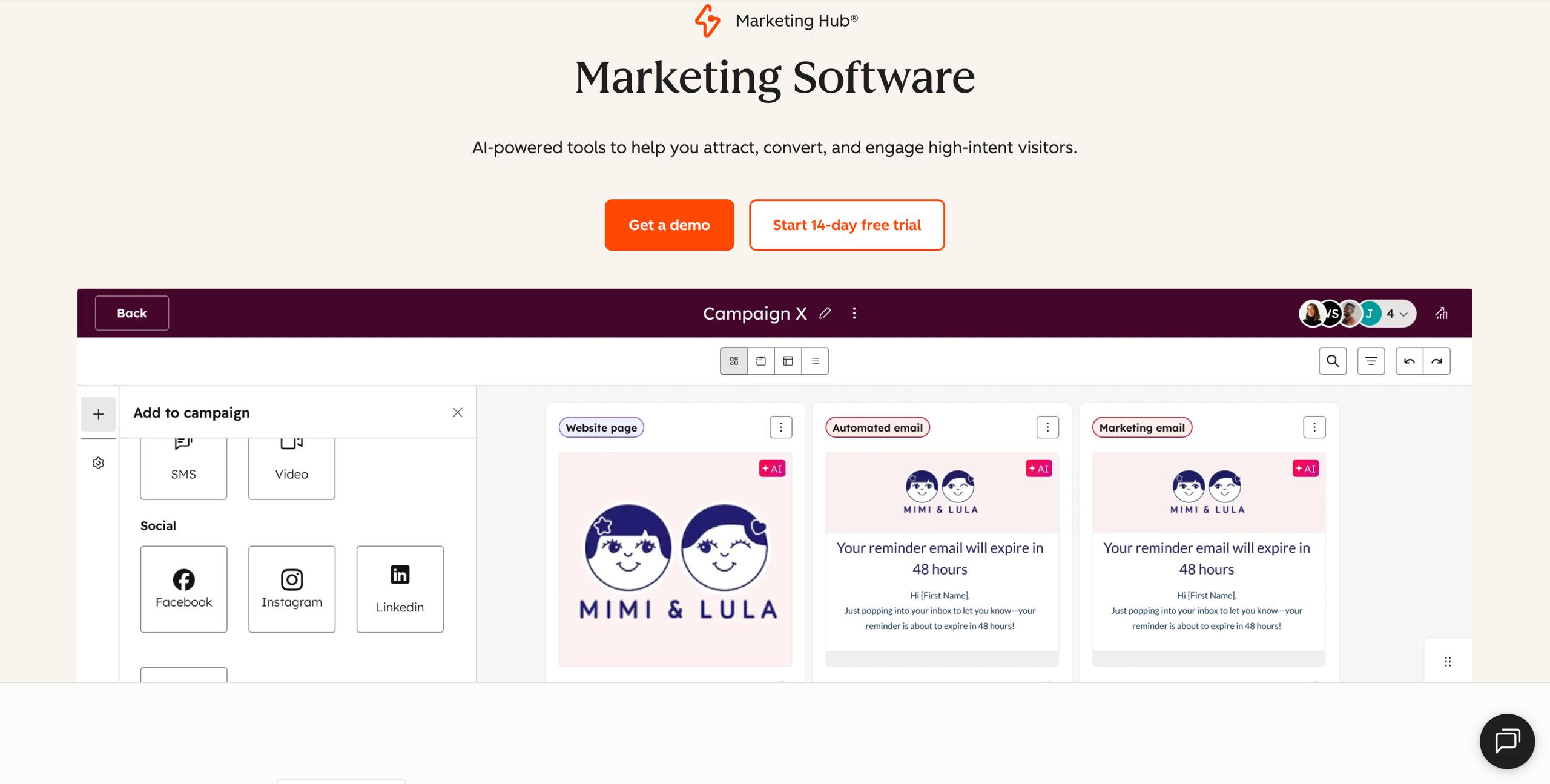
HubSpot remains the default choice for mid-market teams that want marketing automation, CRM, sales tools, and service in a single platform. Its AI capabilities have matured considerably. The Customer Agent now resolves over 65% of support conversations autonomously with a 39% improvement in ticket resolution speed.
The platform supports up to 300 automated workflows across 10 teams on the Professional tier. AI-powered lead scoring prioritizes contacts based on behavioral signals rather than static demographic criteria. Social media management handles up to 50 connected accounts, and omni-channel automation orchestrates campaigns across email, ads, web, and chat from a unified dashboard.
Where it excels: Teams that value a single source of truth for marketing, sales, and service data. The ecosystem integration is unmatched — every tool talks to every other tool natively.
Where it falls short: The Professional tier requires a $3,000 onboarding fee, and pricing scales aggressively with contact volume. HubSpot’s AI is strong for CRM-adjacent tasks but does not optimize for emerging channels like AI-engine visibility or generative search citations.
Ideal user profile: B2B mid-market companies with 10–200 employees that need an all-in-one platform and can invest in the ecosystem long-term.
2. ActiveCampaign
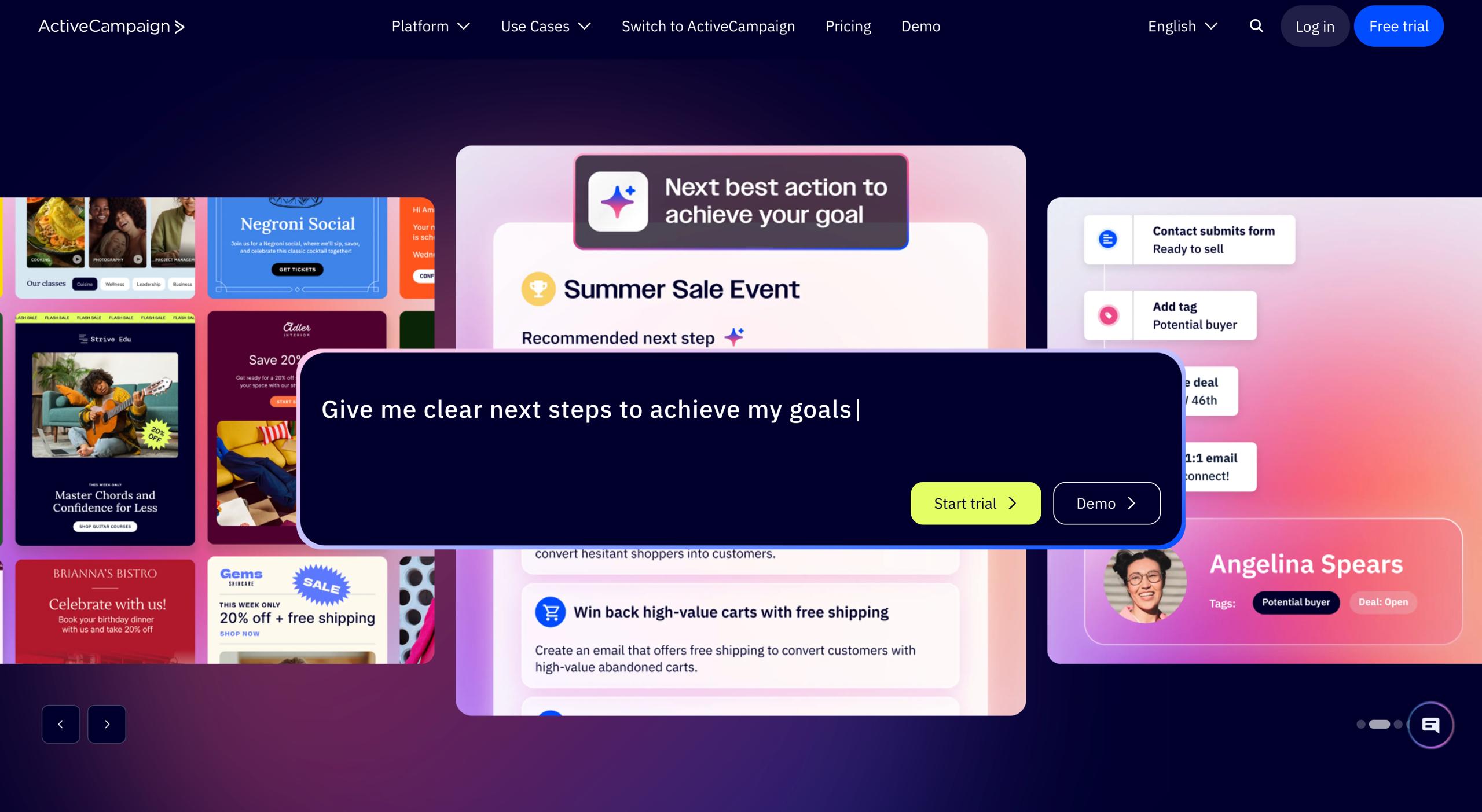
ActiveCampaign occupies a sweet spot between simplicity and sophistication. It delivers enterprise-grade automation logic at SMB-friendly pricing. The standout AI feature is its conversational chatbot: describe a campaign in plain English, and the system builds the full automation sequence — triggers, conditions, email content, and follow-up actions.
Generative AI for copy and image creation starts at the Plus tier. Predictive sending — which determines the optimal delivery time for each individual contact — is available at the Pro tier. All plan levels include AI-assisted automation building, which is notably more accessible than competitors that gate AI features behind top-tier plans.
Where it excels: Automation depth relative to price. The visual workflow builder handles complex branching logic without requiring technical skills. CRM functionality bridges marketing and sales teams naturally.
Where it falls short: Predictive sending is locked to Pro tier, which increases costs for teams that need it. The platform has more features than some small teams will use, which can create a learning curve.
Ideal user profile: SMBs and growing B2B teams that need sophisticated automation without the price tag or complexity of enterprise platforms.
3. Klaviyo
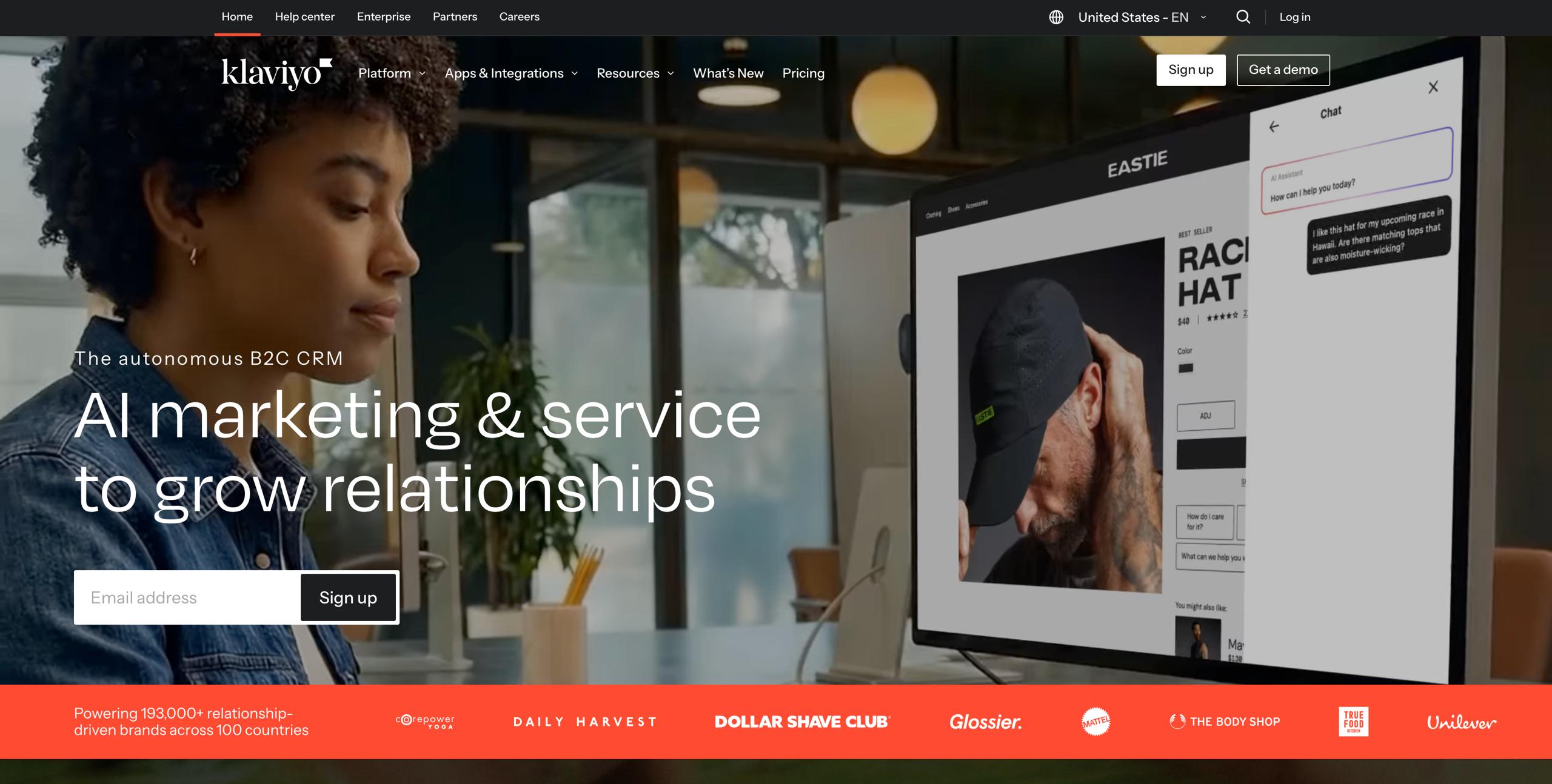
Klaviyo has positioned itself as the AI-first B2C CRM, and its 2026 feature releases validate that ambition. The Marketing Agent learns from your website and creates fully designed, on-brand campaigns with just three clicks. No prompts required. It generates weekly campaign ideas based on historical performance and seasonal patterns, then builds the creative and copy automatically.
The platform’s predictive analytics are deeply embedded — not optional add-ons. Customer lifetime value predictions, next-order-date forecasting, churn risk scoring, and smart send-time optimization run continuously on your first-party data. Klaviyo now supports email, SMS, RCS, WhatsApp, and mobile push, with a Customer Agent that resolves 65% of service inquiries autonomously and actively upsells during support interactions.
Where it excels: Ecommerce retention and lifecycle marketing. The depth of Shopify, WooCommerce, and BigCommerce integrations means product catalog data, purchase history, and browsing behavior flow directly into AI-driven segmentation and personalization.
Where it falls short: Pricing scales with contact count, which can become expensive for brands with large but low-engagement lists. The platform is heavily optimized for B2C ecommerce — B2B teams and non-retail businesses may find it less relevant.
Ideal user profile: Ecommerce brands generating $1M–$50M+ in annual revenue that prioritize retention, lifecycle automation, and revenue-per-recipient metrics.
4. Braze
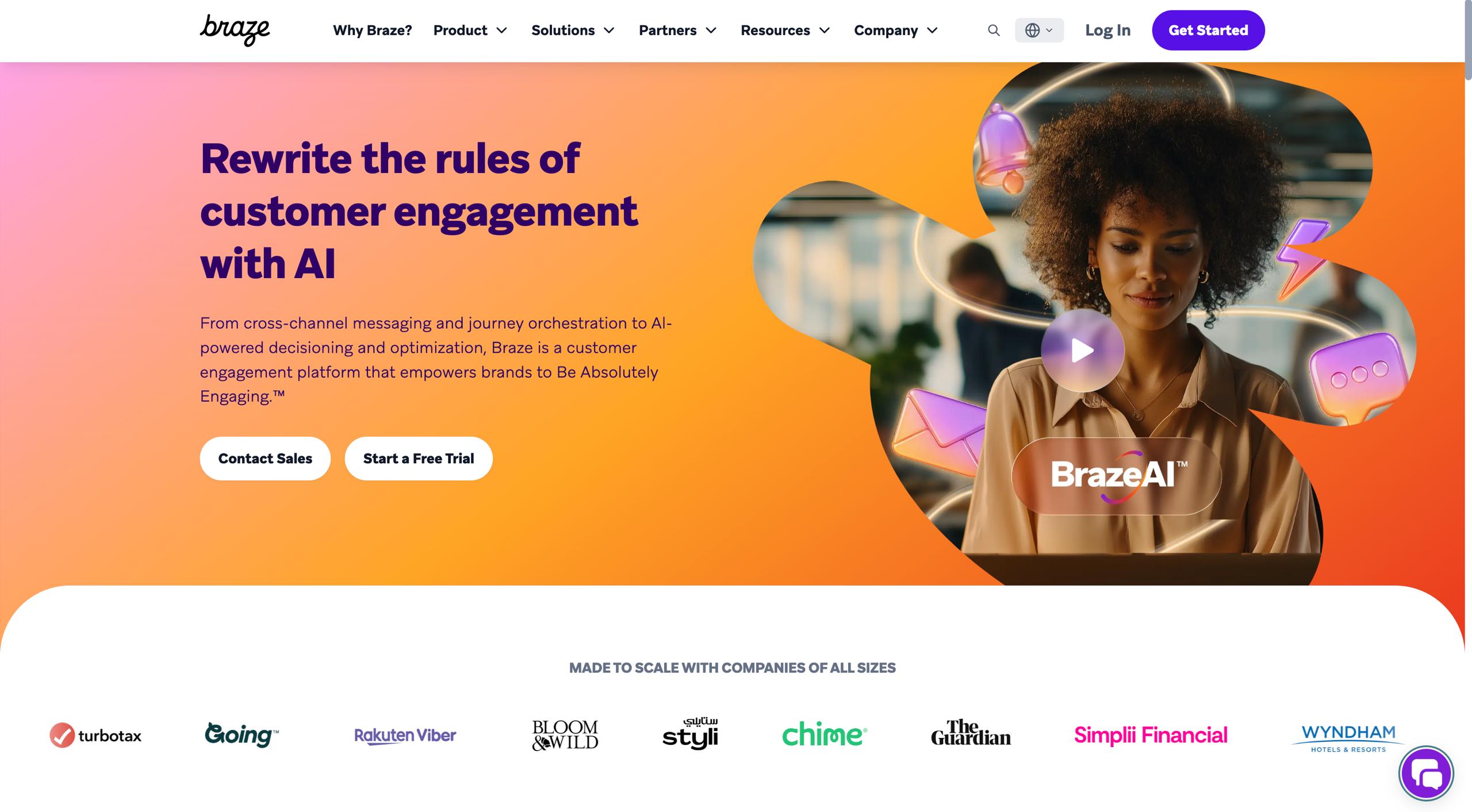
Braze operates at the enterprise end of customer engagement, and its AI capabilities reflect that scale. BrazeAI™ is embedded at every layer of the platform — not bolted on as a separate module. The Decisioning Studio uses reinforcement learning and contextual bandits to continuously optimize journey paths, offers, and message variations in real time.
Action Paths allow marketers to define a goal (completed purchase, feature activation) and let the AI dynamically select the best message, channel, and timing based on live user behavior. BlaBlaCar used this approach to achieve a 30% increase in bookings and a 48% uplift in click rates. The platform also includes an AI Copywriting Assistant, an AI Image Generator, and predictive churn and purchase models.
Where it excels: Real-time, cross-channel orchestration at scale. Braze handles billions of messages monthly and is a Gartner Magic Quadrant Leader for Multichannel Marketing Hubs. The composable AI architecture means teams can mix predictive, generative, and agentic intelligence across any journey.
Where it falls short: This is an enterprise tool with enterprise pricing and implementation requirements. Small and mid-market teams will find it overbuilt and cost-prohibitive. SQL-based segmentation is limited compared to some competitors.
Ideal user profile: Enterprise B2C brands with large, active user bases across mobile, web, and messaging channels — particularly in media, fintech, QSR, and retail.
5. Salesforce Marketing Cloud
Salesforce Marketing Cloud is the largest marketing automation ecosystem on the market, and its 2026 evolution centers on Agentforce — autonomous AI agents that generate content, build audience segments, and develop campaign strategies without manual input.
The platform leverages a unified customer data layer that connects marketing, sales, service, and commerce data. Real-time personalization adapts campaigns dynamically across segments. Machine learning models power predictive audience building, content recommendations, and journey optimization. The breadth of native integrations within the Salesforce ecosystem is unmatched for organizations already invested in the platform.
Where it excels: Multi-brand, multi-region enterprises that need a centralized automation platform integrated with Salesforce CRM, Commerce Cloud, and Service Cloud. The data infrastructure and AI agent capabilities are designed for massive-scale operations.
Where it falls short: Complexity and cost. Implementation timelines are measured in months. The pricing structure involves multiple products, add-ons, and contact-tier calculations that make total cost difficult to predict upfront. Smaller teams will find the platform overwhelming.
Ideal user profile: Enterprise organizations with 500+ employees, dedicated marketing ops teams, and existing Salesforce CRM investments.
6. Customer.io
Customer.io takes a fundamentally different approach to AI marketing automation. Instead of layering AI onto traditional campaign tools, it embeds intelligence directly into the behavioral data layer. The platform’s new AI Agent understands your workspace — attributes, segments, campaigns, and performance history — and builds campaigns grounded in your actual setup rather than generic templates.
LLM Actions operate as a step inside journey workflows, firing at runtime for each individual customer. These actions can generate personalized content, score intent, translate messages, or make routing decisions automatically. The MCP server integration allows marketers to connect Customer.io directly to Claude, Cursor, and other AI tools, creating segments and pulling analytics without switching platforms.
Where it excels: Product-led companies that trigger automation based on what users actually do, not who they are demographically. The API-first architecture makes it highly flexible for technical teams. The “AI as co-pilot, not autopilot” philosophy appeals to marketers who want control over strategy while automating execution.
Where it falls short: The platform is less suited for teams without technical resources. It is not an all-in-one CRM — you will need separate tools for sales pipeline management. Visual design capabilities are more limited than competitors with drag-and-drop email builders.
Ideal user profile: SaaS, fintech, and product-led companies with engineering support that prioritize behavioral triggers and first-party data over demographic segmentation.
7. Mailchimp
Mailchimp remains the most accessible entry point into marketing automation. For small businesses, solo marketers, and early-stage startups, the platform offers a free tier with essential email marketing capabilities and a gentle learning curve.
AI features include a content optimizer that scores email campaigns before sending, predictive segmentation that groups contacts by engagement likelihood, and smart product recommendations for ecommerce stores. The platform also supports social media posting, landing page creation, and basic ad management — making it a functional all-in-one for teams that need simplicity.
Where it excels: Ease of use and accessibility. Mailchimp requires zero technical knowledge to get started. The free plan supports up to 500 contacts, and the email editor is one of the most intuitive on the market. For businesses just beginning their automation journey, the onboarding friction is minimal.
Where it falls short: AI depth is limited compared to dedicated platforms. Automation logic caps out at relatively simple branching. As contact lists grow, Mailchimp’s pricing becomes less competitive, and advanced features require higher tiers. Sophisticated behavioral automation and real-time personalization are not its strengths.
Ideal user profile: Solo entrepreneurs, freelancers, and small businesses with fewer than 5,000 contacts that need a simple, affordable starting point for email marketing and basic automation.
8. Lindy AI
Lindy represents the emerging agentic category — platforms where AI does not just assist with marketing tasks but autonomously executes them. Unlike traditional automation tools that follow if-then rules, Lindy’s agents use large language models to understand context, make decisions, and adapt to changing conditions.
With Lindy 3.0 and its agentic reasoning capabilities, the platform can navigate web browsers, interact with 5,000+ business applications, and execute complex multi-step workflows without human intervention. The AI CMO template, for example, analyzes your market positioning, identifies differentiation opportunities, and develops messaging strategies — tasks traditionally reserved for agency consultants or senior marketing leaders.
Where it excels: Teams that want to automate entire marketing processes, not just individual tasks. The no-code agent builder lets non-technical users create sophisticated automation in minutes using natural language. GDPR, SOC 2, HIPAA, and PIPEDA compliance make it enterprise-ready despite its startup origins.
Where it falls short: As an emerging platform, Lindy lacks the channel-specific depth of dedicated email or CRM tools. The credit-based pricing model can become unpredictable for heavy users. Complex marketing operations still require integration with specialized tools for email delivery, analytics, and CRM.
Ideal user profile: Marketing teams and solo operators who want autonomous AI agents handling research, outreach, content creation, and workflow coordination — and are comfortable integrating Lindy with specialized channel tools.
How to Choose the Right AI Marketing Automation Platform (A Decision Framework)
Listing features is easy. Choosing the right platform for your specific business is the hard part. Most comparison articles stop at the feature list and leave the decision to you. This section provides a structured framework so you can make that decision systematically.
Step 1: Audit Your Current Stack
Before evaluating new tools, document what you already have. Map every tool that touches your marketing workflow — CRM, email platform, analytics, ad management, content tools, and customer data sources. Identify overlaps, gaps, and integration pain points. The goal is not to replace everything at once but to understand where AI automation will deliver the highest ROI.
Step 2: Define Your Automation Goals
What specific outcomes do you need? Increased lead-to-customer conversion? Reduced churn? Higher email engagement? More efficient content production? Autonomous campaign execution? The answer narrows your shortlist dramatically. A team focused on ecommerce retention needs a different platform than one optimizing B2B lead nurture.
Step 3: Assess Your Data Readiness
AI is only as good as the data it learns from. If your customer data is fragmented across disconnected systems, inaccurate, or incomplete, even the best AI platform will underperform. Before committing to a tool, evaluate whether you have clean, unified customer profiles, consistent event tracking across channels, sufficient historical data for ML models to learn from, and a process for maintaining data quality over time.
Platforms like Customer.io and Klaviyo that operate on first-party behavioral data require robust event tracking. Enterprise tools like Braze and Salesforce need a mature data infrastructure to deliver on their AI promises.
Step 4: Match Platform to Business Profile
Different business types need different automation architectures.
Solo operators and micro-businesses (1–5 people): Start with Mailchimp or ActiveCampaign Starter. Layer in Lindy AI for agentic task automation. Avoid overbuying platform capabilities you will not use for 12+ months.
SMBs (5–50 people): ActiveCampaign or HubSpot Professional. Both offer CRM integration with automation, and their AI features scale with your team. Evaluate whether you need sales and service tools bundled (HubSpot) or prefer best-of-breed flexibility (ActiveCampaign + integrations).
Mid-market ecommerce (50–200 people): Klaviyo for retention and lifecycle, potentially combined with Gumloop or Zapier for cross-platform orchestration. The depth of ecommerce-specific AI features outweighs generalist platforms at this stage.
Enterprise (200+ people): Braze or Salesforce Marketing Cloud, depending on your existing technology ecosystem. If you run Salesforce CRM, Marketing Cloud is the natural extension. If you need real-time mobile-first engagement, Braze is the stronger fit.
Product-led SaaS: Customer.io for behavioral automation triggered by product usage data. The API-first architecture and LLM Actions in journeys are specifically designed for this model.
Step 5: Watch for Red Flags
Not all AI marketing tools deliver on their promises. Several warning signs should trigger deeper scrutiny during evaluation.
Opaque pricing. If you cannot estimate your monthly cost within 20% accuracy before signing, the pricing model is designed to create lock-in, not transparency. Ask for a detailed cost projection at 2x your current contact volume.
Feature gating. AI capabilities locked behind the highest pricing tier mean the vendor views AI as an upsell, not a core product. Platforms with AI embedded at every level (Klaviyo, Braze) tend to deliver more consistent value than those that sprinkle AI features across tiers.
Data lock-in. Can you export your data easily? Can you switch platforms without losing audience segments, historical performance data, and automation logic? If the answer is unclear, proceed with caution.
Limited integration. A tool that does not connect with your existing stack creates silos. Check for native integrations with your CRM, analytics, and ad platforms before committing.
Step 5: Run a 30-Day Pilot
Never commit to an annual contract based on a demo. Run a controlled pilot with a specific use case — one automated journey, one audience segment, one channel. Measure lift against your current baseline. Evaluate not just the results but the operational experience: how long did setup take, how intuitive was the AI, how responsive was support.
The right platform should demonstrate measurable improvement within 30 days. If it requires six months of configuration before delivering value, it is likely overbuilt for your needs.
Future-Proofing Your Marketing Stack with AI
The trajectory is clear. Marketing automation is moving from rule-based workflows to predictive systems to fully autonomous agents. The platforms evaluated in this guide sit at different points on that spectrum, and the right choice depends on where your business is today and where you need to be in 12–18 months.
One principle holds regardless of which tool you select: the platform should follow your strategy, not dictate it. AI marketing automation removes execution friction. It does not replace strategic thinking about positioning, audience, messaging, and channel mix.
There is also a dimension most tool comparisons overlook entirely. Choosing the right automation platform is step one. Ensuring your brand is visible where AI systems source their answers — Google AI Mode, ChatGPT, Perplexity, and other generative engines — requires a dedicated strategy that sits above any individual tool.
This is where AI SEO services bridge the gap between automation and discoverability. As search evolves from ten blue links to AI-generated summaries and citations, the brands that invest in both intelligent automation and AI-optimized visibility will capture disproportionate market share. The tools handle execution. The strategy ensures you are found in the first place.
The 2026 marketing stack is not about having more tools. It is about having the right intelligence layer — one that learns, adapts, and acts on your behalf while you focus on the decisions that matter most.
Frequently Asked Questions (FAQ)
Many tools add a chatbot and call themselves AI-powered. Genuinely intelligent platforms use machine learning for predictive scoring, adaptive content, and autonomous decisions based on first-party data. The test: does the platform learn from your data over time, or follow static rules? If the vendor cannot explain what model powers the feature, the AI claim is likely superficial.
They reliably improve efficiency — less manual segmentation, faster launches, optimized timing. Whether that translates to revenue depends on your offer and funnel quality. AI amplifies what already works. Weak fundamentals automated at scale just produce underperforming campaigns faster.
It can, when AI writes entire messages without human editing. The effective approach uses AI for decisions — send time, segment logic, subject line variants — while keeping human-written copy in the message. Relevance without sacrificing brand voice.
Traditional automation follows rules you define. Agentic AI sets sub-goals, selects channels, runs experiments, and adjusts without waiting for manual workflow updates. Major platforms shipped agentic features in 2025–2026. The requirement: clean data and a specific business objective.
Yes, but with reduced effectiveness. Lead scoring, churn prediction, and predictive segmentation degrade on inconsistent data. Start with low-data features like send-time optimization while running cleanup in parallel. Waiting for perfect data means never starting.
AI reduces repetitive execution — scheduling, segmentation, reporting. Demand is growing for marketers who define strategy and correct models optimizing toward the wrong goal. Purely operational roles are most affected. Teams treating AI as infrastructure and focusing on judgment calls benefit most.
Share with


Rate the article