




You published a thoroughly researched, well-structured piece of GEO content. It earned citations across ChatGPT, Perplexity, and Google AI Overviews. Three months later, it’s gone from all of them — not because the information changed, but because the AI systems that cited it found something newer.
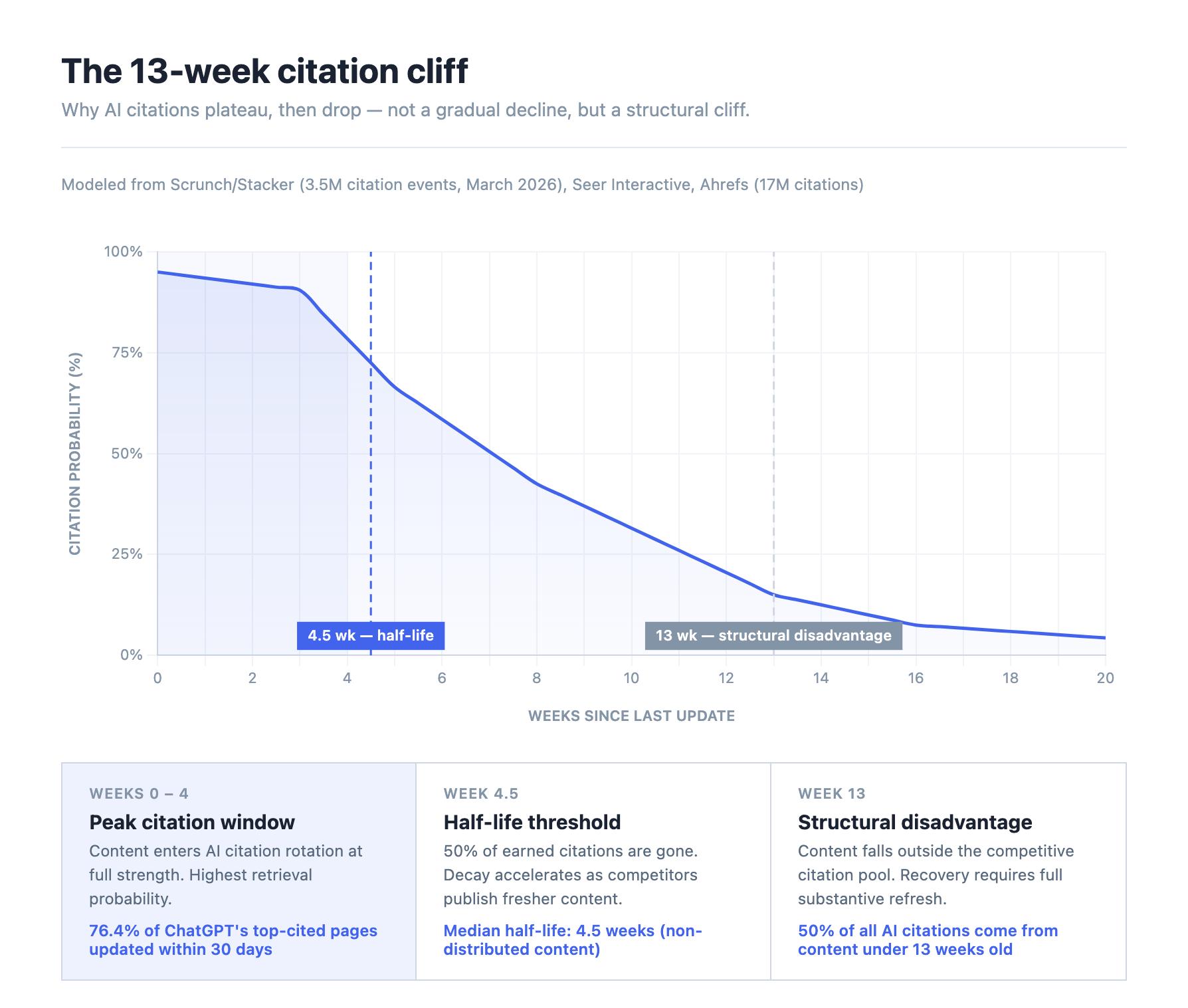
This isn’t a quality problem. It’s a structural one. Roughly 50% of all AI citations come from content published or updated within the last 13 weeks. The median citation half-life — the point at which half your earned citations disappear — is just 4.5 weeks, according to Scrunch and Stacker’s analysis of 3.5 million citation events across 120,000+ domains. Your content doesn’t age out gracefully. It falls off a cliff.
And the consequences compound. Fewer citations mean lower visibility, which means even fewer citations. What starts as a slow fade becomes a self-reinforcing spiral that hands your competitors the visibility you built.
Key takeaways
- Your AI citations have an expiration date. Content doesn’t slowly fade from AI answers — it holds steady, then drops off a cliff. Most earned citations disappear within weeks, not months.
- The highest-traffic AI platform is also the least forgiving. ChatGPT sends the vast majority of AI referral traffic, but burns through sources faster than any other platform. Monthly publishing is too slow for it.
- Thirteen weeks is the cutoff, not a suggestion. Content older than that competes at a structural disadvantage — the bias is baked into how retrieval systems work, regardless of content quality.
- AI search isn’t a ranking — it’s a rotation. A huge share of cited sources get replaced every single month. Staying visible means staying in the rotation, not climbing to a fixed position.
- Distribution is the strongest durability lever. Publishing across multiple trusted domains extends citation life more than any single content update or refresh tactic.
- Every lost citation is lost revenue. AI-referred visitors convert at dramatically higher rates than standard organic traffic. Citation decay is a business problem, not just a content problem.
Key statistics (as of Q1 2026)
Median citation half-life (non-distributed content)
Share of AI citations from content under 13 weeks old
Monthly citation source rotation across platforms
AI-referred visitor conversion rate vs. organic
What AI Citation Decay Is and Why It Matters Now
AI citation decay is the measurable decline in how frequently AI platforms cite a specific piece of content over time. It’s not a vague trend — it’s a documented pattern with hard numbers behind it.
The Scrunch/Stacker study (March 2026) tracked over 3 million citation events across eight industries and six AI platforms over 26 weeks. Using cohort-based survival analysis with 200 bootstrap simulations, they found the median citation half-life for non-distributed, single-domain content is 4.5 weeks. That means half the citations your content earns vanish within roughly a month.
A separate but reinforcing data point from Seer Interactive found that approximately 50% of AI citations across all platforms come from content that’s 13 weeks old or newer. The 13-week mark isn’t a soft guideline — it’s the rough boundary of the competitive citation pool.
If you’re coming from traditional SEO, this timeline feels aggressive. Traditional organic rankings hold for months or years with minimal maintenance. AI citations operate on a completely different clock — Ahrefs’ analysis of 17 million citations found AI-cited content is 25.7% fresher on average than organic SERP content, a gap of roughly 368 days.
Here’s the part that catches most content teams off guard: even factually correct, well-written content loses citations. Your foundational guide can be perfectly accurate and still get replaced in ChatGPT’s answers by a competitor’s piece that was updated last week. The AI search content lifespan is measured in weeks, not quarters.
The decay compounds from there. Once your content drops out of citation rotation, it loses the signal reinforcement that kept it visible. Competitors who maintain their content build citation momentum — a compounding advantage that becomes harder to displace over time.
The Technical Mechanics Behind Citation Decay — How AI Retrieval Actually Works
Understanding why citations decay makes it much easier to build a strategy that prevents it. The mechanism isn’t mysterious, but most GEO guides skip it entirely.
How RAG Systems Retrieve and Cite Content
Most AI platforms that cite external sources use some form of Retrieval-Augmented Generation (RAG). The process works roughly like this: a user submits a query, the system converts that query into a mathematical representation (a vector embedding), then searches a database of content embeddings to find the closest matches using cosine similarity. The highest-similarity results get pulled into the AI’s context, and the model generates a response that cites those sources.
The critical thing to understand is that the “ranking factor” here isn’t domain authority or backlinks in the traditional sense. It’s vector similarity — how closely your content’s embedding matches what the AI system considers the current best representation of a topic.
Semantic Drift: Why Good Content Falls Out of Alignment
This is where decay enters the picture. Language around any topic shifts over time. New terminology emerges. Industry benchmarks get updated. The way practitioners frame problems evolves. When this happens, the vector representation of “what a good answer looks like” for a given query shifts — but your content’s embedding stays anchored to the language and data you used when you published.
Think of it like a dartboard where the bullseye slowly moves. Your dart (content) landed perfectly when you threw it, but the target drifted. Your content didn’t get worse — the definition of “best match” changed.
This semantic drift operates across three layers that AI systems evaluate. First, factual accuracy: statistics and data points become outdated. Second, semantic currency: the terminology and framing your content uses falls behind current usage. Third, intent alignment: what users actually want from a query evolves as the landscape changes. A content piece can decay on any of these dimensions independently, and decay on all three simultaneously is common for content older than a quarter.
Why Changing the Date Doesn’t Work
A common shortcut is updating the publish date without changing the content. AI systems see right through this. Google’s John Mueller has explicitly confirmed that changing the date without substantive content changes provides no freshness benefit. AI platforms compare current page content to cached versions and can detect these “ghost updates.” Quattr’s 2026 analysis reinforced that cosmetic updates without meaningful content changes rarely improve AI citations.
Substantive freshness means replacing outdated statistics with current-year data, adding new examples or case studies, updating claims where facts have changed, and refreshing outbound links. It means the content itself is different — not just the metadata.
Platform-by-Platform Decay Rates — Where Your Citations Die Fastest
One of the most counterintuitive findings in recent citation research: the AI platform that sends the most traffic is also the one where your citations expire fastest. A one-size-fits-all refresh strategy is guaranteed to underperform because each platform treats freshness differently.
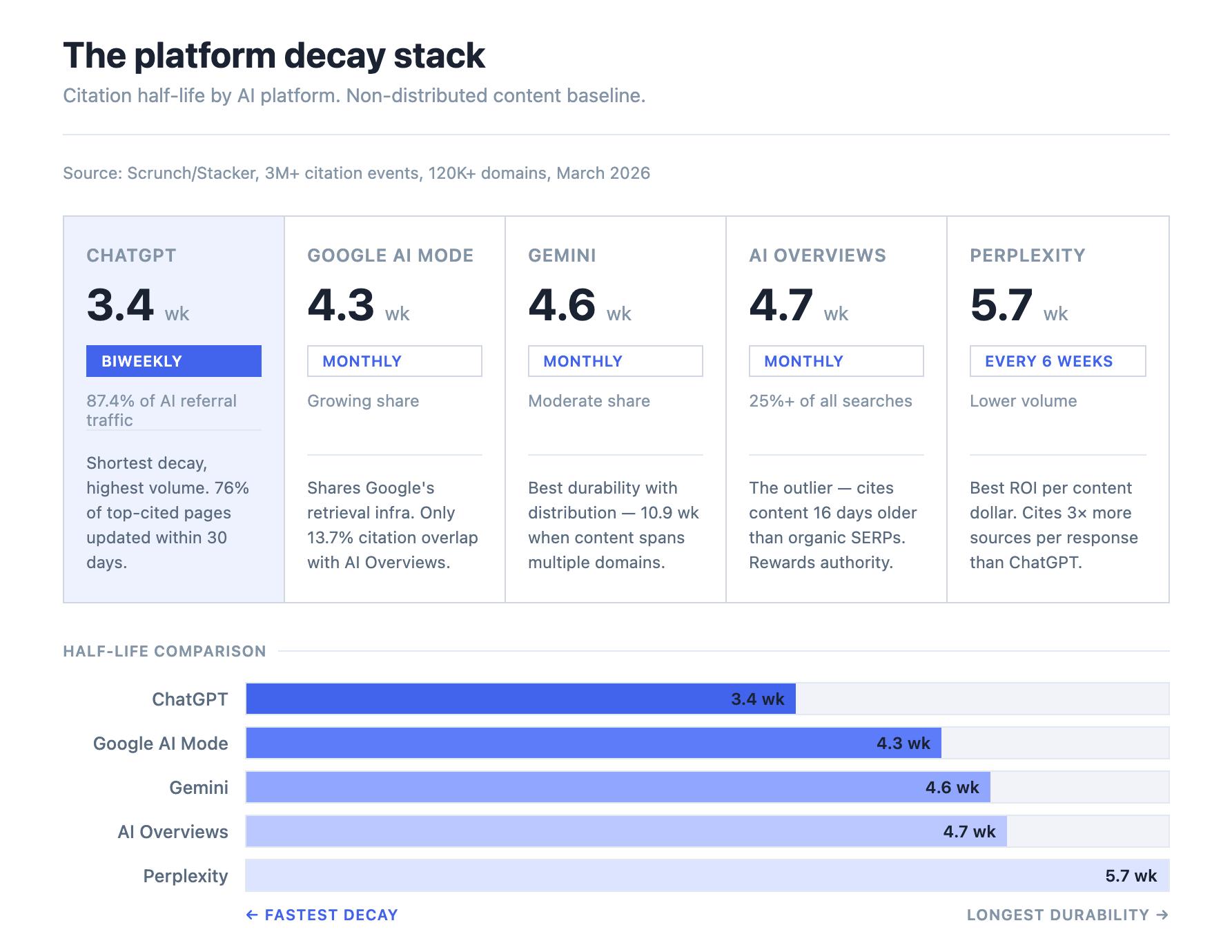
ChatGPT has the shortest citation half-life at approximately 3.4 weeks — yet it’s the dominant source of AI referral traffic at 87.4% of all AI-referred sessions (Conductor, Q1 2026). It cites content 393–458 days newer than standard organic Google results, and 76.4% of its most-cited pages were updated within the last 30 days. If your audience primarily uses ChatGPT, biweekly content touches are the baseline.
Perplexity offers the best durability with a half-life of roughly 5.7 weeks — 68% longer than ChatGPT. It cites nearly three times more sources per response, making it the best return per content dollar for high-investment pieces like deep research and technical comparisons. A six-week refresh cycle works here.
Google AI Overviews is the outlier. It actually cites content that is, on average, 16 days older than what appears in standard organic SERPs — behaving more like traditional Google search. Authority signals still carry weight. Monthly refreshes aligned with your existing SEO workflow are the right approach.
Gemini sits mid-pack at approximately 4.6 weeks, with the highest citation durability when content is distributed across multiple domains (10.9 weeks). Monthly refreshes work well.
The strategic tension is real: ChatGPT gets the most traffic but demands the most maintenance. Perplexity holds citations longest but has smaller total volume. If your refresh bandwidth is limited, prioritize the platform where your specific audience spends the most time — and accept faster decay elsewhere.
Industry also plays a role. Healthcare and retail content tends to turn over faster (4.0–4.1 week half-lives) than insurance and financial services content (4.6–4.8 weeks). But platform choice has more leverage on citation durability than industry vertical. A healthcare brand on Perplexity outlasts an insurance brand on ChatGPT.
AI Citation Decay by Platform: Quick-Reference Comparison
| Platform | Citation Half-Life | Recommended Refresh Cadence | Share of AI Referral Traffic | Key Characteristic |
|---|---|---|---|---|
| ChatGPT | 3.4 weeks | Biweekly | 87.4% | Shortest decay, highest volume; 76.4% of top-cited pages updated within 30 days |
| Perplexity | 5.7 weeks | Every 6 weeks | Lower | Best durability ROI; cites 3x more sources per response than ChatGPT |
| Google AI Overviews | N/A (cites 16 days older than organic SERPs) | Monthly | Varies (25%+ of searches) | Outlier — rewards traditional authority signals over freshness |
| Gemini | 4.6 weeks | Monthly | Moderate | Best durability with multi-domain distribution (10.9 weeks with distribution) |
How to Detect Citation Decay Before It Kills Your Traffic
Most content teams discover AI citation decay the worst way — by noticing a traffic drop and working backward. A better approach is building a detection system that catches decay signals early, before you’ve lost the citation entirely. Reclaiming a lost citation is harder than defending an existing one.
Leading Indicators
The first signs of decay usually show up in your existing analytics before they’re visible in AI responses. Watch for CTR declining while impressions remain steady in Google Search Console — this often signals that an AI Overview has appeared above your organic result and you’re not cited in it. Position drift from top-3 to page two on key queries is another early warning. And reduced appearances when you manually test your target queries across AI platforms is the most direct signal available.
Manual Monitoring
For your highest-value content, there’s no substitute for regular spot-checks. Run your top 10–15 target queries across ChatGPT (with web search enabled), Perplexity, and Google AI Overviews weekly. Note which queries return your content, which don’t, and which competitors have replaced you. This takes 30–45 minutes per week and gives you the most accurate picture of your citation health.
Track the results in a simple spreadsheet: query, platform, cited (yes/no), competitor cited instead, date checked. Over four to six weeks, patterns emerge that no automated tool currently replicates with full accuracy.
For broader coverage, emerging tools like Scrunch, Semrush’s AI Visibility Toolkit, and Peec AI now track AI citation performance across platforms. When direct citation tracking isn’t feasible, proxy metrics fill the gap: brand search volume trends, direct traffic changes, and AI referral traffic in GA4 (look for chatgpt.com and perplexity.ai referral sources).
The Citation Cliff Pattern
Citations don’t decline in a smooth curve. The typical pattern is a plateau followed by a sharp drop. Your content maintains steady citation rates for several weeks, then falls off abruptly — often when a competitor publishes or updates content on the same topic. This is the “citation cliff,” and it’s why calendar-based monitoring alone misses the signal. By the time your quarterly review comes around, the cliff may have already passed.
Event-Driven Triggers
Beyond regular monitoring, certain events should trigger an immediate citation check: a competitor publishes new content on your target query, industry data makes your statistics outdated, or a product/regulatory change affects your content’s accuracy. These are the moments when citation displacement happens fastest.

The Tiered Content Refresh Framework — What to Update, How Often, and What to Prioritize
Knowing that AI citations decay is useful. Knowing exactly what to refresh, how often, and in what order is what actually moves the needle. The right cadence depends on the type of content, the platforms you’re targeting, and the business value at stake.
Refresh Cadences by Content Type
Tier 1 — Monthly or more frequent: Product and feature comparison pages, pricing content, tool roundups, statistics posts, trend analysis, and anything that references rapidly changing data. In fast-moving verticals like AI, SaaS, and fintech, these may need biweekly attention. This is the content most vulnerable to competitive displacement because competitors in these spaces are also updating frequently.
Tier 2 — Quarterly: Strategy guides, industry analysis, comprehensive tutorials, and research recaps. This is the backbone of most content libraries — high-value pages that drive consistent traffic but aren’t tied to daily data shifts. A quarterly refresh that updates statistics, swaps in current examples, and closes gaps against newly published competitor content keeps these pages in the citation pool.
Tier 3 — Semi-annually: Evergreen concept explainers, foundational definitions, and process how-tos in stable domains. These pages have naturally slower decay because the underlying information doesn’t change frequently. A semi-annual review that checks for terminology drift and ensures the content still aligns with current framing is typically sufficient.
One important multiplier: if your content operates in AI, SaaS, crypto, or fintech, shift every cadence one tier faster. A strategy guide that might survive quarterly refreshes in a stable industry needs monthly attention in these verticals.
Prioritizing What to Refresh First
Not all content deserves equal refresh investment. When resources are limited — and they always are — prioritize using a simple formula: Business Value × Decay Risk = Refresh Priority.
Business value is the combination of traffic, revenue influence, and strategic importance of a page. Decay risk is determined by how time-sensitive the content is, how many competitors are actively publishing on the topic, and how long since the last substantive update.
The mistake most teams make is refreshing by staleness alone — updating whatever is oldest first. That’s backwards. A product comparison page that drives demo requests and hasn’t been updated in eight weeks should jump the queue ahead of a thought leadership piece with low conversion value that’s six months old.
Apply the 80/20 rule aggressively: focus refresh efforts on your top 20% of pages by traffic and revenue impact. For most content libraries, these pages generate the vast majority of business value from AI citations.
What Counts as a Substantive Update
AI platforms evaluate whether your content actually changed, not just whether you claimed it did. A substantive update means adding meaningful new content — aim for 500+ new words per refresh cycle that address current developments, replace outdated statistics with current-year data, swap in fresh examples, and update terminology to match current industry usage.
A 20–30 minute statistics sweep — replacing every outdated percentage, figure, and study reference with current data — is the single fastest path to measurable citation improvement. Practitioners consistently report visible citation gains within six weeks of a focused data refresh.
Also verify: are your outbound links still live and pointing to current resources? Have your H2s and H3s been updated with answer capsules (40–60 word direct answers)? Does your dateModified schema reflect the actual update date? These details matter at the retrieval level.
Decay-Resistant Content Architecture — How to Build for Longevity From Day One
Every piece published so far in this space focuses on what to do after content starts decaying. Almost nobody talks about building content that resists decay from the start. This is the highest-leverage shift a content team can make — addressing the root cause rather than perpetually treating symptoms.
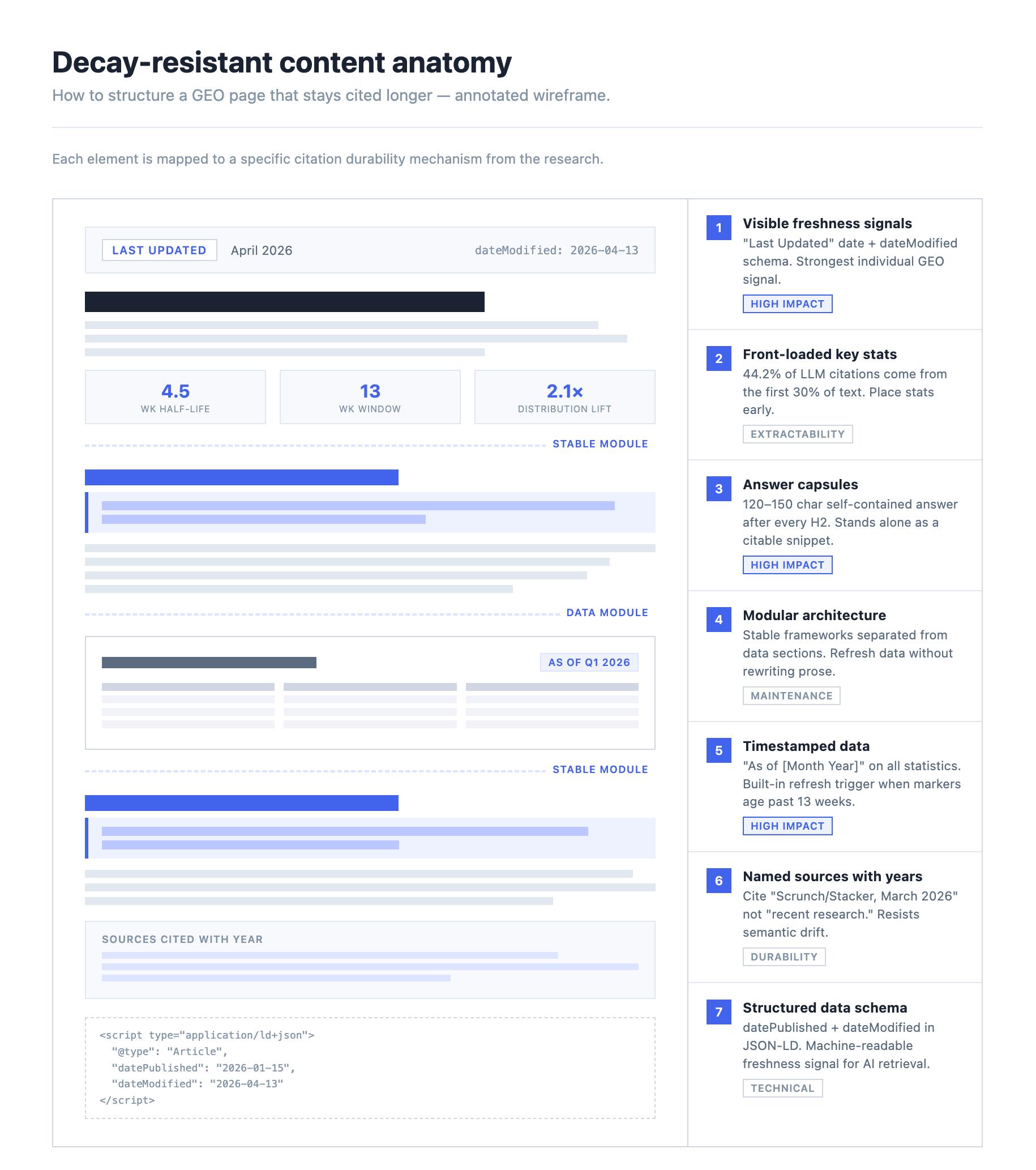
Modular Content Architecture
The biggest structural mistake in GEO content is mixing timeless frameworks with time-sensitive data in the same sections. When your statistics are woven into every paragraph, refreshing the data means rewriting the entire piece.
Build content in modules instead. Keep your strategic frameworks, process explanations, and conceptual models in stable sections. Isolate all statistics, benchmarks, tool references, and platform-specific details in clearly separated data sections. This way, a quarterly data refresh takes 30 minutes instead of a full rewrite — and the stable sections continue earning citations between updates.
Answer Capsules
Place a concise, self-contained answer of 120–150 characters immediately after every question-based H2 or H3. These “answer capsules” dramatically increase the probability that AI systems will extract and cite your content — 44.2% of LLM citations come from the first 30% of text. Front-load your best answers in the position AI retrievers are most likely to look.
The capsule should answer the heading’s question directly and completely enough to stand alone as a citation. Expand with depth and examples in the paragraphs that follow.
Timestamped Data Sections
Use explicit “As of [Month Year]” markers on every statistic and data-dependent claim. This does two things: it signals to AI systems that the data is current (or clearly dated), and it creates a built-in refresh trigger for your team. When your “As of January 2026” markers start aging past the 13-week window, you know exactly which sections need attention without auditing the full article.
Embedded Freshness Signals
Implement schema markup for both datePublished and dateModified on every page. This is the single strongest individual GEO signal according to recent framework research. Add visible “Last Updated” dates near the top of the page. Some teams also include brief revision notes (“Updated April 2026: refreshed all platform half-life data with Scrunch/Stacker March 2026 findings”) that serve double duty as a freshness signal and a trust marker for human readers.
Content That Resists Semantic Drift
Use current terminology, not legacy phrasing. Cite named sources with publication years rather than vague references. Connect your advice to current platform capabilities rather than generic principles. Content that’s tightly coupled to the present — with specific, dated, verifiable claims — stays semantically aligned with current query patterns longer than content written in timeless but vague language.
Structural Extractability
AI retrieval systems favor content that’s easy to parse. Clear H2/H3 hierarchies, question-and-answer formatting, short paragraphs of two to three sentences, comparison tables, and summary boxes all increase the probability of retrieval and extend citation life. Pages with structured data formats — comparison tables, for example — earn measurably more citations. Content with three or more comparison tables earns roughly 25% more citations, and validation pages with multiple list sections see similar gains.
Build for extraction from the start, and your content stays citable longer with less maintenance.
From Decay to Durability — Building a Citation Maintenance Engine
The fundamental operating model shift for content teams is moving from “publish and forget” to “publish and maintain.” GEO visibility is not a ranking you achieve once — it’s a rotation you stay in through continuous monitoring, strategic refreshes, and structural content design. The data backs this up: content updated within three months averages nearly twice the AI citations of outdated pages, and quarterly refreshes yield 42% better results than annual ones.
There’s a compounding advantage here that’s easy to underestimate. Teams that maintain freshness build citation momentum. Their content stays in the rotation pool, earns continued brand impressions (even from the 93% of AI sessions that don’t produce a click), and becomes progressively harder for competitors to displace. Citation maintenance isn’t just defensive — it compounds into a durable competitive moat.
The distribution layer amplifies everything. Editorial distribution across trusted domains extends citation half-life by 2.1x — from 4.5 weeks to approximately 10 weeks. That multiplier holds across every industry and platform tested. Earned media isn’t just a PR tactic anymore; it’s a GEO durability strategy.
Running this system at scale — monitoring decay signals across multiple AI platforms, prioritizing which pages to refresh based on business impact, executing substantive updates on a biweekly-to-quarterly cadence, and maintaining distribution relationships — is operationally demanding. It’s where specialized AI SEO services become a force multiplier, handling the monitoring, prioritization, and refresh execution that would otherwise burn out an in-house content team trying to keep pace with a 4.5-week half-life.
The brands that figure out this maintenance engine first won’t just keep their citations. They’ll compound their advantage while competitors are still wondering why their best content disappeared from ChatGPT.
Frequently Asked Questions (FAQ)
Tracking citation rates across ChatGPT, Perplexity, and Gemini shows content loses citation frequency around the 90-day mark. It’s not a hard threshold — it’s an observed average. Fast-moving topics decay faster; deep technical references last longer. Treat 13 weeks as a reliable review interval, not a fixed expiration.
It is measurable. Practitioners tracking URLs across AI platforms document clear drop-off curves as retrieval-augmented models deprioritize older sources. No platform publishes an official decay metric, but the pattern — recency bias in AI responses — is reproducible and well-established.
The decline is gradual. First, your content appears alongside alternatives. Then it gets paraphrased without attribution. Eventually it drops from responses entirely, replaced by newer material. This is most visible on Perplexity and Bing Chat, where source links are displayed.
Retrieval-augmented models demonstrably favor recent sources. However, changing only the publication date without substantive content modifications does not restore citation frequency. The retrieval layer evaluates actual content changes, not metadata alone.
Smaller publishers hold a structural advantage in narrow verticals. AI models prioritize specificity and completeness — if a single source provides the most detailed, current answer on a niche topic, it gets cited regardless of domain size. The determining factor is update consistency, not brand recognition.
Volume without substance does not work. AI retrieval systems weigh authority alongside recency. Between two equally authoritative sources, the fresher one wins. The effective strategy is maintaining fewer, higher-quality pieces on a defined refresh schedule rather than increasing output volume.
Share with


Rate the article