




Introduction
Last year, you could type “best running shoes” into Google and scroll through a familiar parade of blue links. Today, you might never scroll at all. An AI-generated summary sits above everything, synthesizing answers from dozens of sources before you’ve finished reading the query you typed. The click you would have made? It never happens.
This shift isn’t theoretical. According to SparkToro and Similarweb research, roughly 60% of Google searches now end without a single click to any website [1]. That’s up from just 26% in 2022. For marketers who’ve spent years optimizing for keywords, this raises an uncomfortable question: does any of it still matter?
The answer is yes — but not in the way you think.
The AI Search Landscape: 2026 Benchmarks
Before diving into strategy, it helps to understand the scale of change. These numbers define the current search environment:
| Metric | Value | What It Means |
| AI Overview appearance rate | 30-50% | Share of U.S. queries triggering AI-generated summaries |
| Zero-click rate when AI Overviews trigger | 80-83% | Most users stop at the AI answer |
| First organic result position | 1,600px down | AI Overviews push traditional results below the fold |
| Transactional queries with AI Overviews | 1.2% | Purchase-intent searches remain largely unaffected |
| ChatGPT share of AI referral traffic | 77% | Dominant source of clicks from AI platforms |
| Perplexity monthly queries (May 2025) | 780 million | 3x growth in nine months |
| Informational intent in AI Overviews | 99% | Research queries hit hardest |
The AI Search Shift in 3 Numbers:
of Google searches now end without a click. The zero-click era isn’t coming — it’s here. Most users get their answers directly from AI summaries, featured snippets, and knowledge panels without ever visiting a website.
average CTR drop when AI Overviews appear. When Google’s AI summaries trigger, individual sites lose more than a third of their potential clicks. The traffic you expected is being absorbed by the answer box above your listing.
of AI Overview citations come from top 10 results. Here’s the opportunity: AI systems cite sources that already rank well. Traditional SEO fundamentals still matter — they’re now the prerequisite for AI visibility, not the end goal.
📊 These benchmarks reveal a clear pattern: informational content faces the steepest disruption, while transactional and branded queries remain relatively protected. The strategic response should match this reality — doubling down on content types that still drive clicks while adapting measurement for content that builds visibility without direct traffic.
The Rise of Answer Engines
Google’s AI Overviews now appear in approximately 30-50% of U.S. search queries, depending on the study and timeframe. The trajectory is undeniable: generative AI is becoming the default interface between users and information.
🔍 And it’s not just Google. Perplexity AI processed 780 million search queries in May 2025 alone — up from 230 million just nine months earlier. ChatGPT now reaches 800 million weekly active users, processing over 2 billion prompts daily [2]. These platforms don’t match keywords to pages; they understand questions and synthesize responses. When someone asks “how do I improve my website’s search rankings,” these systems don’t return a list of links — they answer the question directly, citing sources as footnotes.
The implications are stark:
- Over 99% of keywords triggering AI Overviews have informational intent — the exact queries that once drove massive organic traffic
- When AI Overviews appear, individual site click-through rates drop by an average of 34.5%
- The first organic result now sits 1,600 pixels below the fold — pushed down by AI-generated summaries
Understanding exactly how these AI features operate is essential for any serious SEO strategy. For a deeper technical breakdown, check out our guide to Google AI Overviews that covers how these systems source, rank, and display information — and what that means for content creators.
From Keyword Matching to Semantic Understanding
The rules of search have fundamentally changed. What worked in 2015 can actually hurt you in 2026. Here’s how the shift from keyword matching to semantic understanding has transformed every aspect of SEO:
| Aspect | Old Approach (Pre-2019) | 🆕 New Reality (2026) |
| Primary focus | Exact keyword matching | Intent and meaning interpretation |
| Content strategy | Keyword density and repetition | Comprehensive topic coverage |
| Domain tactics | Exact-match domains ranked higher | Brand authority and E-E-A-T signals dominate |
| Algorithm behavior | Scanned for specific word patterns | Maps relationships between concepts |
| Query processing | Literal word matching | Understanding context, synonyms, related ideas |
| Example query | “running shoes” → pages with that exact phrase | “best running shoes for bad knees” → pages covering cushioning, joint support, orthopedic options |
| What ranks | Pages optimized for single keywords | Resources demonstrating genuine topical expertise |
| Key Google updates | Pre-Hummingbird keyword matching | Hummingbird (2013) → RankBrain (2015) → BERT (2019) → LLM integration |
| User behavior | Click through to find answers | 80% rely on zero-click results for 40%+ of searches |
📉 The bottom line: keyword-stuffed pages now underperform against comprehensive resources that demonstrate genuine expertise. When AI Overviews trigger, zero-click rates climb to 80-83% — users get their answers without ever visiting your site. Search engines no longer reward precision matching; they reward semantic depth and relevance.
How AI Expands a Single Search: Query Fan-Out
When you type a question into an AI search system, something invisible happens before you see results. The system doesn’t just search your exact words — it expands your query into dozens of related searches simultaneously. This is called query fan-out.
🔀 Type “best CRM for small business” into an AI-powered search, and the system might internally generate:
- “CRM software pricing comparison 2025”
- “easiest CRM for beginners”
- “CRM features small businesses need”
- “HubSpot vs Salesforce for startups”
- “free CRM tools for small teams”
- “CRM implementation time and cost”
- “small business CRM reviews”
The AI synthesizes answers from all these expanded queries into one comprehensive response. Your single question triggered a dozen searches you never typed.
This changes everything about keyword strategy. You’re no longer optimizing for one query — you’re trying to appear across the entire fan-out. A page that only answers “best CRM for small business” gets outperformed by a resource that covers pricing, features, comparisons, implementation, and reviews. The AI pulls from the comprehensive source because it answers more of the invisible expanded queries.
Key insight — Your content needs to answer questions users didn’t even know they had.
Why Keywords Still Matter
None of this means keywords are irrelevant. They’ve evolved from being the destination to being the starting point.
✅ Keywords remain essential as intent signals. When someone types “buy running shoes online,” the word “buy” signals transactional intent that differs fundamentally from “best running shoes for beginners” (informational) or “Nike store near me” (local). Understanding these intent categories — and the keywords that signal them — is foundational for content strategy. Search engines use keywords to categorize intent even when they interpret meaning more broadly.
✅ Keywords provide structural scaffolding. They help organize content in ways both humans and algorithms can parse. Headers containing relevant terms, natural keyword integration within explanatory paragraphs, and strategic placement in meta descriptions all contribute to discoverability. The difference is that these placements now serve semantic context rather than density requirements.
✅ Keywords connect user language to your content. People still type words into search boxes. Those words — and the concepts they represent — need to appear in your content for any system, AI or otherwise, to make the connection. The shift is from repetition to relevance: using keywords to signal topic coverage rather than gaming frequency metrics.
For transactional and local queries, keywords retain significant direct impact. AI Overviews appear in only about 1.2% of purely transactional queries and essentially 0% of local searches. When someone is ready to buy or needs a nearby service, traditional keyword optimization still drives the majority of outcomes.
The New Paradigm: Topical Authority and Semantic Coverage
If keywords are the starting point, what’s the destination? Topical authority.
Modern SEO success requires demonstrating comprehensive expertise on subjects rather than optimizing individual pages for isolated terms. This means building content clusters — interconnected resources that cover topics from multiple angles, addressing related questions, subtopics, and adjacent concepts.
🎯 Consider how AI Overviews select sources. Over 99% of AI Overview citations come from pages already ranking in the top 10 organic results. This represents a significant shift from early AI Overview testing, when citations came from a much broader pool. The implication: traditional ranking factors still matter for AI visibility, but they’re now prerequisites rather than guarantees.
Content that earns AI citations tends to share certain characteristics:
- It directly answers specific questions
- It uses clear, structured formatting that systems can parse
- It demonstrates expertise through depth rather than keyword frequency
- It addresses user intent comprehensively rather than superficially
The technical requirements are evolving too. Structured data markup helps systems understand content organization. Schema implementation for FAQs, how-tos, and articles improves the likelihood of citation. Page speed and mobile optimization — always important — become even more critical when AI systems evaluate source quality at scale.
This is where specialized expertise becomes valuable. The intersection of traditional SEO fundamentals with AI optimization requirements is complex and rapidly changing. For organizations navigating this transition, working with agencies that understand both domains can accelerate results. Our overview of leading AI SEO companies provides a starting point for evaluating partners with demonstrated capabilities in this emerging specialty.
Beyond Google: Optimizing for ChatGPT, Perplexity, and Emerging Platforms
Google still commands 80% of desktop searches, but the discovery landscape is fragmenting. ChatGPT drives over 77% of all AI referral traffic to websites. Perplexity captures nearly 20% of AI-driven traffic in the U.S. These platforms operate differently than traditional search — and require different optimization approaches.
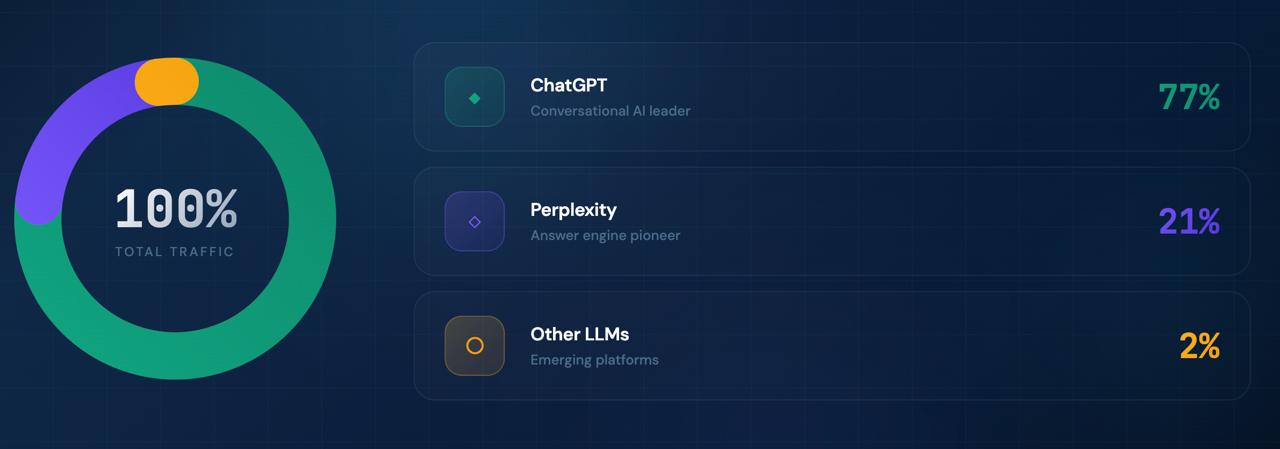
🌐 ChatGPT and conversational AI pull information from training data and, increasingly, real-time web access. Getting cited means being authoritative enough to appear in training datasets and structured enough for retrieval systems to extract relevant answers. Clear, factual content with obvious expertise signals performs best. Conversational formatting helps — these systems are designed to answer questions, so content structured as Q&A or direct explanations gets prioritized.
🔎 Perplexity and answer engines function more like research assistants than search engines. They synthesize multiple sources into comprehensive responses, citing specific pages. Winning here means being the source that answer engines trust. That requires the same E-E-A-T signals that matter for Google, plus formatting that makes extraction easy: clear headers, concise paragraphs, factual statements that stand alone.
The strategic implication is diversification. Relying solely on Google organic traffic — already risky given zero-click trends — becomes even more precarious as users shift to alternative discovery channels. Smart brands are monitoring where their audience actually finds information and optimizing presence across platforms, not just search engines.
What This Means for Different Business Models
The impact of AI search varies dramatically by business type. Understanding where your model sits helps prioritize the right response.
- 📰 Content publishers and media face the steepest challenge. Informational queries — their bread and butter — are exactly what AI Overviews target. Traffic declines of 30-50% for some publishers have already occurred. Survival strategies include developing subscription models, focusing on analysis and opinion that AI can’t replicate, and building direct audience relationships through newsletters and communities.
- 🛒 E-commerce and transactional businesses remain relatively protected. AI Overviews rarely appear for purchase-intent queries. Traditional keyword optimization for product pages, category structures, and transactional terms still drives results. The risk is upstream — losing the informational content that builds awareness before purchase intent forms.
- 💼 B2B and professional services occupy middle ground. Complex services requiring consultation don’t get replaced by AI summaries. But the research phase — where prospects learn about problems and solutions — increasingly happens within AI interfaces. Brands need visibility in those early-stage conversations even if the final conversion happens through direct contact.
- 🏪 Local businesses may actually benefit. Local search remains largely untouched by AI Overviews, and AI assistants still direct users to physical locations for services that require presence. The fundamentals — Google Business Profile optimization, local citations, review management — continue working as expected.
Practical Strategies for an AI-First Search Landscape
Understanding the shift is one thing. Adapting to it requires specific tactical changes.
1️⃣ Think topics, not just terms. Start with keyword research, but expand immediately to topic mapping. What related questions do people ask? What subtopics deserve their own content? What expertise would a genuine authority on this subject demonstrate? Build content ecosystems rather than isolated pages.
2️⃣ Optimize for answer extraction. AI systems pull specific snippets to construct responses. Structure content with clear headers that match question patterns. Front-load answers in paragraphs rather than burying conclusions. Use formatting — lists, tables, step-by-step structures — that systems can easily parse and cite.
3️⃣ Prioritize E-E-A-T signals. Experience, Expertise, Authoritativeness, and Trustworthiness have always influenced rankings. In an AI context, they become even more important as systems evaluate source credibility. Author bylines with demonstrated expertise, clear editorial standards, citations to authoritative sources, and transparent organizational information all contribute.
4️⃣ Measure what matters. Traditional traffic metrics become less meaningful when visibility doesn’t always translate to clicks. Track brand mentions, citation appearances, and engagement quality alongside volume. Monitor impressions in Search Console even when clicks decline — visibility without clicks still contributes to awareness and authority.
5️⃣ Accept that some traffic is gone. Informational queries that once drove visits now get answered on the results page. This isn’t a problem to solve — it’s a new reality to accept. Shift strategic focus toward queries with higher click intent: transactional terms, comparison queries, long-tail searches requiring nuanced responses that AI summarization can’t adequately address.
The Path Forward
💡 The brands that succeed in this environment will be those that stop thinking about SEO as a game to optimize and start thinking about it as a discipline for training AI systems to recognize their authority. Every piece of content you publish is now training data for the models that will answer tomorrow’s questions. The question isn’t just “will this rank?” — it’s “will AI systems learn to cite us as a trusted source?”
This requires a different skillset than traditional SEO. Understanding how LLMs process and retrieve information, how AI Overviews select sources, how ChatGPT and Perplexity decide what to cite — these are emerging specializations that most marketing teams haven’t developed yet. We’ve built our practice around exactly this intersection: applying deep knowledge of how AI systems work to help brands earn visibility in the new search landscape.
For founders and marketers evaluating their digital strategy, the practical takeaway is this: invest in AI-native SEO expertise. Superficial content optimized for yesterday’s algorithms won’t cut it. Deep, well-structured resources that demonstrate genuine authority — formatted for LLM extraction, optimized for AI citation, built on E-E-A-T signals that machines can verify — that’s what earns both traditional rankings and AI visibility.
Keywords matter. But they matter as the vocabulary for expressing topics you genuinely understand, structured in ways that AI systems can parse, extract, and cite. That distinction makes all the difference.
Sources:
- [1] Sparktoro – 2024 Zero-Click Search Study: For every 1,000 EU Google Searches, only 374 clicks go to the Open Web. In the US, it’s 360, 2024
- [2] Rebecca Bellan – Sam Altman says ChatGPT has hit 800M weekly active users, 2025
Share with


Rate the article