




How We Increased Organic Traffic by 80% in 3 Months for a Crypto Token Creation Platform
Categories:
Organic Traffic (Google / US)
Positions for Core Commercial Queries
Keywords in Top 10
Growth in New Users

About Client
20lab.app is a web-based platform that enables users to create ERC-20 tokens without manually coding smart contracts. The product is designed for Web3 founders, startups, NFT communities, and entrepreneurs looking to launch a cryptocurrency quickly and without deep technical complexity.
The primary focus market was the United States, one of the most competitive regions for crypto-related search queries.
At the beginning of the project, the platform had visibility and traffic, but lacked stable Top 3 rankings for high-intent commercial keywords. Organic search was not yet a predictable growth channel.
Services Performed

Buyers can’t find you in Google?
Get a free search audit and make sure your brand is the one being recommended.
Project Goals
Rank in Google US for high-intent keywords like “create a crypto token” and “crypto coin maker.”
Grow transactional organic traffic from the United States.
Expand semantic coverage around ERC-20 tokens and token creation mechanics.
Increase engagement rate and support ranking stability through UX improvements.
Turn SEO into a scalable long-term acquisition channel.
🎯 The Challenge
The crypto token generator niche is highly competitive. Established platforms already dominated the majority of high-commercial intent queries.
Although 20lab had a functional and technically solid product, the main generator page lacked deep semantic coverage and full alignment with both informational and transactional search intent. Competitors had broader keyword footprints and stronger internal SEO structures.
To compete in the US market, we needed more than basic optimization — we needed to turn the generator page into a high-authority commercial asset.
🚀 Our Approach
Commercial Cluster Domination
Instead of spreading efforts across multiple topics, we focused on a single high-value semantic cluster centered around token creation:
- create a crypto token
- create cryptocurrency
- create a crypto coin
- create a coin
- crypto coin maker
- make your own cryptocurrency
The /generate/ page became the strategic growth driver.
We rebuilt its heading structure (H1–H3), expanded semantic depth around ERC-20 tokens, smart contracts, gas fees, token supply mechanics, and added FAQ blocks targeting long-tail queries. Metadata was optimized to improve click-through rate for competitive commercial keywords.
Rather than creating multiple thin landing pages, we consolidated authority into one powerful, highly relevant commercial page.
🔥 Why this works: instead of chasing hundreds of keywords, we built one unbeatable page that owns the entire commercial intent around token creation.
Intent Alignment & UX Optimization
Ranking in competitive crypto niches requires strong behavioral signals.
We improved clarity of the token creation process, simplified explanations for non-technical users, and enhanced trust elements across the page. The user flow from landing to token generation was streamlined to reduce friction and increase interaction.
The page evolved from a simple tool interface into a conversion-oriented landing page capable of satisfying both informational and transactional intent.
Structural SEO Enhancements
To strengthen topical authority:
- Internal linking toward the generator page was improved
- Crawlability and structural clarity were enhanced
- Supporting pages (including burn-related tools) were added
- Contextual relationships across the site were reinforced
This helped search engines better interpret the domain’s expertise in token creation.
✅ Results
Top Rankings in Google US
Within three months, we achieved:
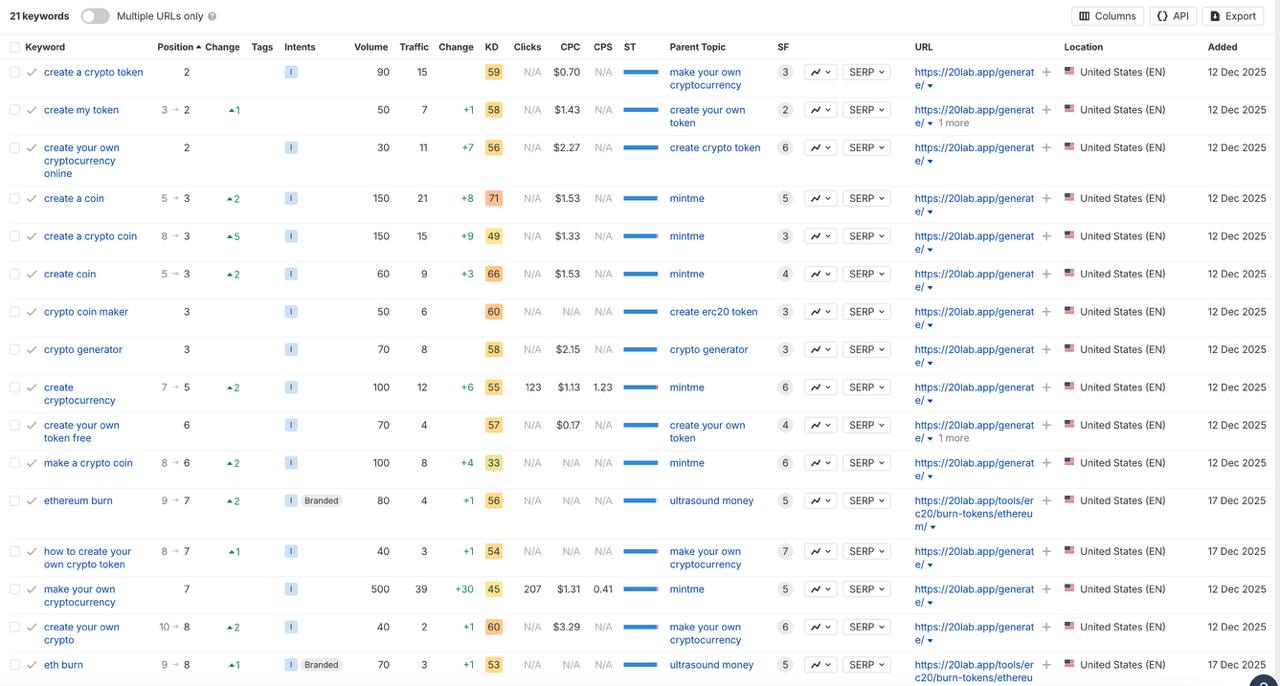
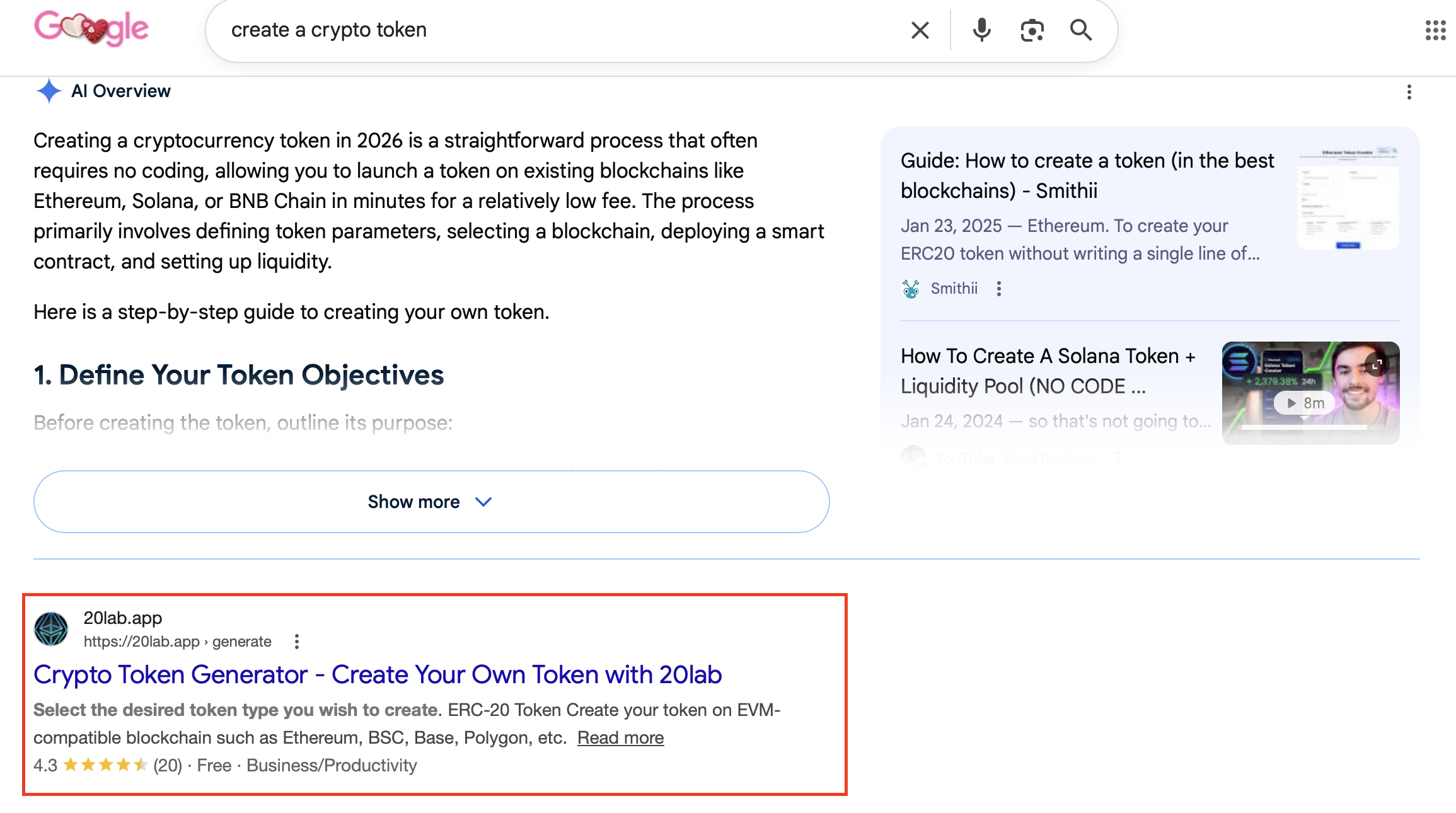
- “create a crypto token” — Position #1 (US)
- “create your own cryptocurrency online” — Position #2
- “create a crypto coin” — improved from 8 → 3
- “create a coin” — improved from 5 → 3
- 20+ commercial keywords ranking in Top 10
The platform successfully entered Top 3 positions against established competitors in the token generator niche.
+80% Organic Traffic Growth
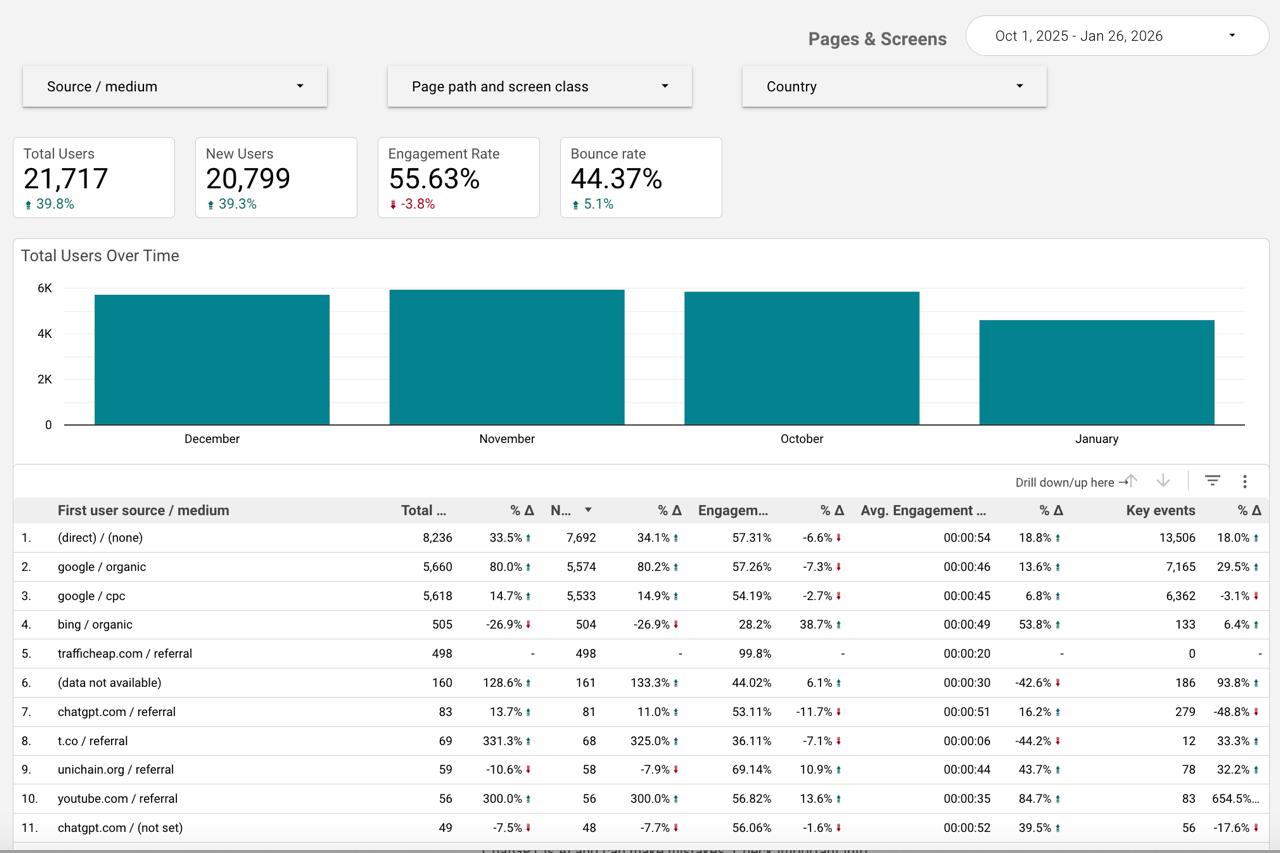
According to GA4 data (Oct 1 – Jan 26):
- Google / organic traffic increased by 80%
- 5,660 organic users
- 21,717 total users
- +39% new users
- 55.63% engagement rate
- 44.37% bounce rate
Organic traffic became one of the primary acquisition channels within just three months.
Conclusion
This case demonstrates that even in a highly competitive Web3 niche, focused semantic strategy can deliver fast and measurable results.
By concentrating on a high-intent commercial keyword cluster, aligning the core page with multiple search intents, and reinforcing it through structural SEO improvements, we transformed organic search into a scalable acquisition channel.
Within three months, 20lab.app secured Top 3 rankings in Google US for its core transactional queries and achieved 80% organic growth — significantly strengthening its competitive position in the crypto token creation market.
🌟 Key insight for your business: you don’t need a massive content operation to win — you need the right cluster, the right page, and the right strategy behind it.
Frequently Asked Questions
It cuts into them, yes. AI Overviews reduce CTR on position #1 across niches. But here’s the thing: ranking #1 is how you get inside the AI Overview to begin with. The screenshot in the case study shows 20lab directly below the AI box — that’s a citation candidate, not a traffic victim. Being invisible below page two is the bad outcome. The zero-click problem is real; not ranking is worse.
Because separate pages for “create a crypto token,” “crypto coin maker,” and “make your own cryptocurrency” create cannibalization. Google has to pick one, and it might pick none. These keywords share the same intent — someone wants to build a token now, not next week — so a single deep page captures every variation. Split the intents when they’re actually different. Here they aren’t.
Crypto is YMYL territory, so it gets harder scrutiny. The sites that get hit by core updates are usually thin affiliate pages and anonymous review farms — not functional product pages with real user engagement. A page people actually use is harder to penalize. That said, nothing holds forever without maintenance. Keep the content updated, keep the tool working well, keep the behavioral signals strong. Let it go stale and a better-resourced competitor will eventually overtake it.
Crypto ads aren’t completely blocked — they require platform certification and restrict certain claims, but a token creation tool can run compliant Google campaigns with the right account approval. Before SEO compounded, most crypto products grow through organic social, Discord and Telegram, and developer forums. The case study says 20lab already had “visibility and traffic” before the engagement — a working product with some audience, just no stable rankings for the queries that actually drive conversions.
The case study doesn’t say explicitly. But the pattern is predictable: simplify the tool explanation for non-technical visitors, reduce the clicks between landing and doing something, add trust signals. The engagement rate of 55% with a 44% bounce rate is solid for a crypto tool — most visitors interacted rather than immediately leaving. Google uses those behavioral signals as a ranking factor. A page that confuses people and sends them back to search actively hurts your position.
Buyer intent, pretty clearly. “What is a crypto token” is informational. “Create a crypto token” is someone who wants to build something today. The +39% new users and 55% engagement rate in GA4 back this up — pure curiosity traffic shows up as 80% bounce rates and 20-second sessions. That’s not what the data shows. The audience stayed and used the tool.
Winning the most competitive market first does the most structural work. Domain authority and link signals built on US search carry across regions. The use case here — token creation for Web3 founders — also maps heavily to US startup culture. And practically: a page that holds a top-3 position in the US is a genuinely strong page. Something half-optimized might rank in a smaller market. It won’t hold here, so you end up building something that travels.
Three channels work: editorial coverage in crypto media (CoinDesk, Decrypt, The Block), listings in Web3 directories and developer resource lists, and organic mentions in Reddit threads where someone recommends the tool. The case study language — “supporting pages,” “reinforced contextual relationships” — is internal linking talk, not external. But crypto sites usually have thin link profiles, which means a handful of quality placements actually move rankings. The bar is lower than in mature niches, which cuts both ways.
Testimonials








Yevhen Nehuliayev
LinkedIn Profile

Valerii Brizhatiuk
LinkedIn Profile

Sergei Beliaev
LinkedIn Profile

Laura Geng
LinkedIn Profile

Bahram Ahmedzade
LinkedIn Profile

Aaron Tsai
LinkedIn Profile

Irene C.
LinkedIn Profile

Shenshen Hu
LinkedIn Profile

Hannah Kang
LinkedIn Profile

James O'Connor
LinkedIn Profile

Dmitriy Dervoed
LinkedIn Profile

Vid David Mihelic
LinkedIn Profile

Jia Yung
LinkedIn Profile

Charlie Bussat
LinkedIn Profile

Terry Na
LinkedIn Profile

Arabdha Sudhir
LinkedIn Profile

Henning Rokling
LinkedIn Profile
Feel free to contact us
We are the team of experts that will support your business at all stages