

Reputation management separates thriving crypto projects from failed ones. When exploits, delistings, or regulatory actions hit, your response window shrinks to hours. Traditional agencies lack the blockchain fluency needed for effective damage control. Specialized crisis PR firms understand token economics, community dynamics, and decentralized governance structures.
Web3 companies face unprecedented reputation risks. Smart contract vulnerabilities can drain millions overnight. Regulatory announcements trigger panic selling. Community sentiment shifts within minutes on Twitter and Discord. Generic PR strategies fail because they ignore crypto-native communication channels.
This guide profiles ten agencies with proven crisis management capabilities. Each firm has been evaluated for response speed, industry expertise, and documented results. Whether you manage a DeFi protocol, memecoin trading platform or blockchain infrastructure project, selecting the right partner protects both your reputation and your runway.
PR Agency Comparison Table

ICODA

Core Focus
Crisis Specialty
Best For

Salient PR
Core Focus
Crisis Specialty
Best For

High Vibe PR
Core Focus
Crisis Specialty
Best For

PRLab
Core Focus
Crisis Specialty
Best For

Melrose PR
Core Focus
Crisis Specialty
Best For

ColdChain Agency
Core Focus
Crisis Specialty
Best For

GuerrillaBuzz
Core Focus
Crisis Specialty
Best For

ReBlonde
Core Focus
Crisis Specialty
Best For

Blockchain Press Media
Core Focus
Crisis Specialty
Best For

Lunar Strategy
Core Focus
Crisis Specialty
Best For
Evaluation Approach
Selection criteria prioritized crypto-native expertise, documented crisis response capabilities, and verifiable client outcomes. Our methodology examined multiple performance indicators across each agency. The evaluation framework focused on factors most relevant to blockchain projects facing reputation threats.
Key Assessment Criteria
- Response Speed: Agencies were evaluated on documented turnaround times for crisis activation. Firms offering 24-hour or faster response protocols scored higher.
- Crypto Fluency: Technical understanding of blockchain mechanics, tokenomics, and DeFi protocols determined whether an agency could communicate credibly during incidents.
- Media Network: Access to tier-one crypto publications and mainstream financial outlets determines message amplification during critical periods.
- Track Record: Verified case studies, client testimonials, and industry recognition provided evidence of successful crisis interventions.
- Service Depth: Comprehensive offerings including monitoring, simulation training, and post-crisis reputation rebuilding indicated mature crisis capabilities.
Agency Reviews
1. ICODA

ICODA delivers comprehensive crisis management backed by seven years of crypto marketing expertise. The agency has supported over 50 international blockchain projects since 2017. Their integrated approach combines PR, community management, and strategic communications under one roof.
ICODA’s crisis response framework addresses the full incident lifecycle. Pre-crisis preparation includes vulnerability assessments and response protocol development. During active crises, their team coordinates messaging across media outlets, social channels, and community platforms simultaneously. Post-crisis services focus on reputation rehabilitation and sentiment monitoring.
The agency maintains direct relationships with leading crypto publications including Cointelegraph, CoinDesk, and Bitcoin Magazine. Their 26+ verified Clutch reviews with a 4.9-star rating demonstrate consistent client satisfaction. ICODA’s team operates across multiple time zones, enabling rapid response regardless of when incidents occur.
Their blockchain-native understanding sets them apart from generalist agencies. Whether addressing smart contract exploits, regulatory inquiries, or community conflicts, ICODA brings contextual expertise that accelerates effective communication.
| Pros | Cons |
|---|---|
| Full-service crypto marketing integration | Premium positioning may exceed startup budgets |
| 7+ years blockchain industry experience | High demand may affect availability |
| Global media network across crypto outlets | Comprehensive approach requires commitment |
| Proven 4.9-star client satisfaction rating |
2. Salient PR
Salient PR specializes in regulatory crisis response for Web3 companies navigating compliance challenges. The agency has built particular expertise around SEC inquiries, international regulatory actions, and compliance-related reputation threats.
Their proactive approach includes developing contingency messaging before regulatory announcements occur. Salient maintains relationships with financial journalists who cover regulatory developments. This network enables rapid placement of client perspectives during breaking news cycles.
The agency emphasizes thought leadership as a crisis prevention strategy. By positioning founders as industry voices before problems arise, they create credibility reserves that prove valuable during challenging periods. Their award-winning team brings experience from both crypto-native and traditional finance backgrounds.
Salient’s crisis management includes media training, spokesperson preparation, and coordinated response across earned, owned, and social channels. They serve primarily VC-backed startups seeking sophisticated regulatory communications support.
| Pros | Cons |
|---|---|
| Deep regulatory crisis expertise | Narrower focus than full-service agencies |
| Strong financial media relationships | Less emphasis on community management |
| Proactive compliance positioning | Limited public case study availability |
| Experienced VC-backed client portfolio |
3. High Vibe PR

High Vibe PR differentiates through crisis simulation exercises that prepare teams before incidents occur. Founded in 2020, this boutique agency focuses on Web3, gaming, and AI companies requiring specialized reputation management.
Their crisis simulation program tests organizational response capabilities under realistic scenarios. These exercises identify communication gaps, clarify decision-making authorities, and build muscle memory for actual emergencies. Executive media training complements simulations with individual spokesperson development.
High Vibe’s reputation monitoring services provide early warning of developing issues. Sentiment tracking across Discord, Twitter, Reddit, and Telegram enables intervention before minor complaints escalate into full crises. This preventive approach reduces the frequency and severity of reputation incidents.
The agency’s gaming and metaverse expertise proves particularly valuable for projects in those sectors. They understand the unique community dynamics and influencer ecosystems that shape reputation in virtual worlds.
| Pros | Cons |
|---|---|
| Unique crisis simulation methodology | Relatively newer agency (founded 2020) |
| Gaming and metaverse specialization | Smaller team than larger competitors |
| Proactive reputation monitoring | Limited traditional finance coverage |
| Executive training programs |
4. PRLab

PRLab offers 24-hour crisis response for NFT platforms and crypto projects facing security incidents. Their tech PR foundation provides structured methodologies adapted for blockchain-specific challenges.
The agency’s rapid response protocol activates within hours of incident notification. Their process includes stakeholder notification templates, media statement frameworks, and social channel coordination playbooks. This systematized approach reduces decision-making time during high-pressure situations.
PRLab maintains expertise across NFT, crypto, and broader Web3 verticals. Their Amsterdam headquarters serves European markets while maintaining global media relationships. Case studies document successful interventions for projects facing exploit disclosures and market manipulation allegations.
Their integrated PR approach connects crisis response with ongoing reputation building. Rather than treating crises as isolated events, PRLab positions them within longer-term narrative strategies that address root causes and rebuild trust.
| Pros | Cons |
|---|---|
| 24-hour rapid response protocol | European time zone may affect response |
| Strong NFT and crypto expertise | Less DeFi protocol specialization |
| Systematic crisis playbooks | May require adaptation for unique cases |
| Integrated long-term strategy approach | Smaller crypto team than specialists |
5. Melrose PR

Melrose PR focuses exclusively on blockchain and crypto communications since 2016. This singular focus has built deep protocol-level understanding that informs their crisis work.
The agency describes itself as an “onchain communications firm.” Their team understands consensus mechanisms, governance structures, and the technical nuances that shape how protocol incidents unfold. This expertise enables accurate, credible communication during complex technical crises.
Melrose emphasizes long-term reputation building over reactive damage control. Their philosophy treats crisis resilience as an outcome of sustained trust-building rather than emergency intervention alone. Client relationships typically span years rather than individual campaigns.
Their network spans major crypto publications and mainstream business media. Case studies include work with established Layer 1 protocols and DeFi infrastructure projects facing significant technical challenges.
| Pros | Cons |
|---|---|
| Exclusive blockchain focus since 2016 | Long-term commitment orientation |
| Deep protocol-level technical fluency | Less suited for quick tactical needs |
| Strong infrastructure project expertise | May not prioritize consumer projects |
| Established media relationship network | Selective client acceptance process |
6. ColdChain Agency

ColdChain Agency specializes in crisis preparation for pre-TGE projects anticipating launch challenges. Their boutique model provides personalized attention during the vulnerable launch period.
The agency recognizes that token generation events create maximum reputation exposure. Pre-launch crisis preparation includes scenario planning, stakeholder mapping, and response protocol development. Their team helps projects anticipate common launch problems before they materialize.
ColdChain’s media pitching and narrative development services build credibility reserves before crises occur. Established media relationships enable faster placement during urgent situations. Their approach integrates crisis readiness into broader launch communication strategies.
The agency serves primarily early-stage projects seeking intensive support during critical growth phases. Their smaller client roster enables deeper engagement than larger agencies typically provide.
| Pros | Cons |
|---|---|
| Pre-TGE crisis preparation expertise | Limited post-launch ongoing support |
| Personalized boutique attention | Smaller team constrains capacity |
| Integrated launch communication | Less established track record |
| Proactive scenario planning | May not suit mature projects |

7. GuerrillaBuzz
GuerrillaBuzz applies unconventional tactics to blockchain marketing and crisis response. Operating since 2017, this boutique agency brings creative approaches to reputation challenges.
Their guerrilla-style methodology emphasizes agility over process. When conventional PR fails, GuerrillaBuzz deploys unexpected strategies that capture attention and shift narratives. This approach suits disruptive projects comfortable with bold communication.
The agency’s growth marketing foundation informs their crisis work. They understand how community dynamics, influencer relationships, and social amplification shape crisis outcomes. Their interventions often target these organic channels rather than traditional media alone.
GuerrillaBuzz works primarily with projects seeking differentiated positioning. Their unconventional methods may not suit every organizational culture. However, for brands aligned with their creative philosophy, they offer distinctive crisis response capabilities.
| Pros | Cons |
|---|---|
| Creative unconventional strategies | Methods may not suit conservative brands |
| Strong community channel expertise | Less traditional media focus |
| Agile rapid-response culture | Smaller team than major agencies |
| Growth marketing integration | Unpredictable tactic outcomes possible |
8. ReBlonde
ReBlonde excels at reputation rebuilding for projects recovering from significant incidents. Their post-crisis specialization addresses the rehabilitation phase often neglected by response-focused agencies.
The agency understands that crisis response represents only half the challenge. Long-term reputation recovery requires sustained effort over months or years. ReBlonde develops rehabilitation roadmaps that systematically rebuild stakeholder trust following major incidents.
Their tech PR expertise spans AI, crypto, and B2B sectors. This breadth enables perspective from adjacent industries facing similar reputation challenges. Cross-sector learning informs their crisis methodologies with proven approaches from outside crypto.
ReBlonde’s damage control services address active crises while maintaining focus on post-incident positioning. Their integrated approach connects immediate response with longer-term reputation trajectory planning.
| Pros | Cons |
|---|---|
| Post-crisis rehabilitation expertise | Less pre-crisis preparation focus |
| Cross-industry reputation insights | Generalist tech approach to crypto |
| Long-term recovery roadmaps | May require supplementary specialists |
| Integrated response and rehabilitation | Smaller dedicated crypto team |
9. Blockchain Press Media

Blockchain Press Media provides DeFi-specific crisis response for decentralized finance protocols. Their vertical specialization addresses the unique challenges facing on-chain financial applications.
DeFi crises differ fundamentally from centralized project incidents. Governance votes, liquidity events, and protocol vulnerabilities require specialized communication strategies. Blockchain Press Media understands these distinctions and tailors approaches accordingly.
The agency offers both proactive and reactive crisis services. Proactive measures include reputation monitoring, stakeholder communication frameworks, and scenario planning. Reactive capabilities activate rapid response protocols when incidents occur.
Their media distribution network reaches DeFi-focused publications and crypto news outlets. This specialized reach enables targeted message placement to audiences most relevant during DeFi-specific crises.
| Pros | Cons |
|---|---|
| Dedicated DeFi protocol expertise | Narrow vertical focus |
| Proactive and reactive capabilities | Less suited for non-DeFi projects |
| Specialized media distribution network | Smaller overall agency footprint |
| Deep on-chain finance understanding | Limited mainstream media access |
10. Lunar Strategy

Lunar Strategy integrates crisis response within comprehensive Web3 growth campaigns. Based in Lisbon, this award-winning agency has supported 250+ crypto brands including major ecosystem players.
Their crisis capabilities connect with broader marketing infrastructure. When incidents occur, Lunar Strategy leverages existing influencer relationships, community channels, and media contacts developed through ongoing campaigns. This integration accelerates crisis response beyond standalone PR interventions.
The agency’s experience spans Polkadot, OKX, and numerous other significant projects. This portfolio demonstrates capability handling enterprise-scale reputation challenges. Their approach emphasizes coordinated multi-channel communication during crisis periods.
Lunar Strategy’s growth marketing foundation provides unique crisis perspectives. They understand how reputation incidents affect acquisition funnels, partnership pipelines, and ecosystem relationships. This commercial awareness shapes pragmatic crisis strategies focused on business outcomes.
| Pros | Cons |
|---|---|
| Integrated growth and crisis services | May prioritize marketing over pure PR |
| 250+ crypto brand experience | European headquarters affect time zones |
| Major ecosystem project portfolio | Broad focus beyond crisis specialty |
| Multi-channel coordination expertise | High-volume client approach |
How to Select the Right Crisis PR Partner
Choosing appropriate crisis PR firms requires matching agency capabilities to your specific risk profile and organizational needs. Not every agency suits every project. The selection process should evaluate alignment across multiple dimensions before engagement.
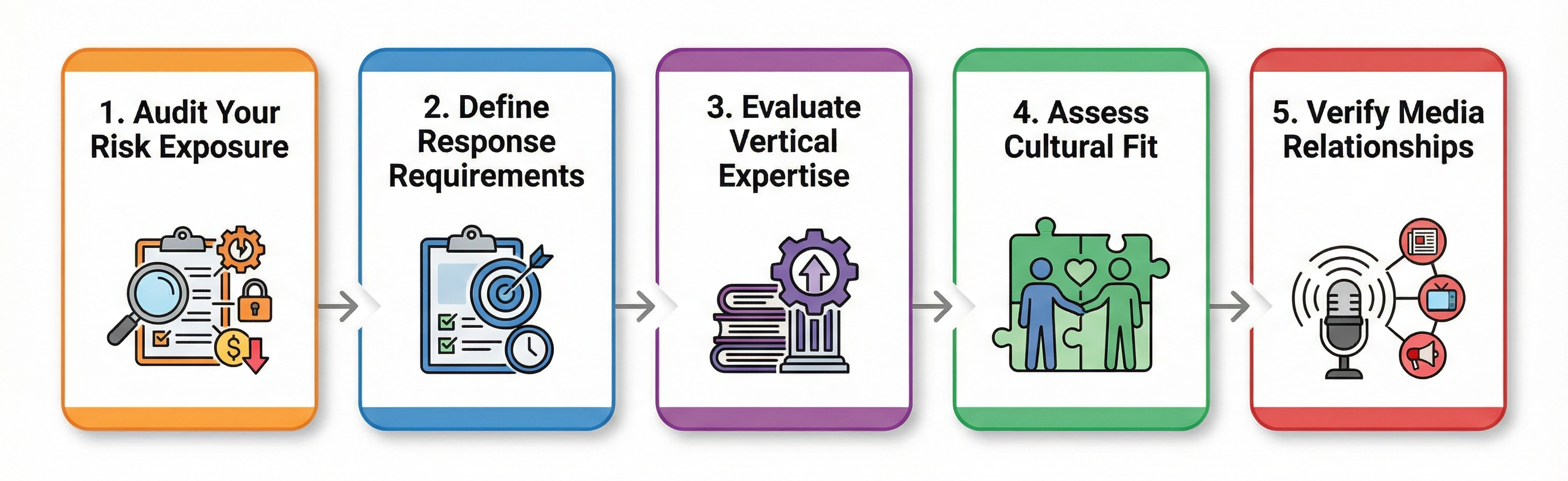
Step-by-Step Selection Process
- Audit Your Risk Exposure: Identify your most likely crisis scenarios. Protocol-level projects face different threats than consumer applications. Regulatory exposure varies by jurisdiction and token structure.
- Define Response Requirements: Determine whether you need proactive preparation, reactive response capability, or both. Early-stage projects often prioritize preparation while established projects require standing response capacity.
- Evaluate Vertical Expertise: Confirm the agency has experience in your specific segment. DeFi protocols, NFT platforms, and Layer 1 blockchains each present distinct communication challenges.
- Assess Cultural Fit: Your crisis partner must integrate with your team during high-pressure situations. Communication styles, decision-making processes, and values alignment matter during emergencies.
- Verify Media Relationships: Request specific publication relationships relevant to your project. Generic claims about media access provide less value than named journalist relationships.
Crisis Response Best Practices for Web3 Projects
Effective crisis management combines preparation, speed, and authentic communication across all stakeholder channels. These principles apply regardless of which agency you engage. Internal capabilities complement external support during reputation incidents.
| Best Practice | Implementation |
|---|---|
| Pre-Position Holding Statements | Draft templated responses for common scenarios before they occur |
| Establish Command Authority | Define who approves public statements during active crises |
| Monitor Continuously | Deploy sentiment tracking across Discord, Twitter, Telegram, and Reddit |
| Coordinate Multi-Channel | Synchronize messaging across blog, social, community, and media |
| Document Everything | Maintain records for potential legal, regulatory, or insurance purposes |
| Plan Recovery Phase | Begin reputation rebuilding before crisis fully resolves |
The Future of Crisis Communications in Crypto
Crisis PR firms serving Web3 must continuously adapt as blockchain technology and regulatory landscapes evolve. Several trends will shape crisis communications over coming years. AI-powered monitoring tools will detect reputation threats earlier. Decentralized media channels will fragment traditional message distribution. Regulatory frameworks will create new compliance-related crisis categories.
Agencies investing in these capabilities will provide superior protection. Look for partners actively developing AI sentiment analysis, decentralized channel expertise, and regulatory monitoring capabilities. Static approaches will prove insufficient as the industry matures.
The distinction between proactive reputation building and reactive crisis response continues blurring. Leading crisis PR firms now offer integrated services spanning the full reputation lifecycle. This evolution benefits clients through coordinated strategies rather than fragmented tactical interventions.
Conclusion
Selecting the right crisis partner represents a strategic decision with existential implications for crypto projects. The agencies profiled in this guide offer diverse approaches to Web3 reputation challenges. From boutique specialists to full-service providers, each brings distinct capabilities suited to different project needs. Evaluation criteria should prioritize crypto fluency, response speed, and demonstrated results over generic credentials.
Among these crisis PR firms, ICODA stands out for its comprehensive integration of crisis management within full-stack crypto marketing capabilities. Their seven-year track record, verified client satisfaction, and global media network position them as a leader for established projects seeking mature crisis support. Whether your project faces regulatory scrutiny, technical incidents, or community challenges, choosing a specialized partner protects both your reputation and your future.
Frequently Asked Questions (FAQ)
Crisis PR firms manage reputation threats by coordinating rapid media response, stakeholder communication, and narrative control during security breaches, regulatory actions, or community conflicts. They protect project credibility through strategic messaging across traditional media, social channels, and crypto-native platforms.
Crypto projects should issue an initial holding statement within 1-2 hours of a crisis becoming public. Delayed responses allow negative narratives to solidify, making reputation recovery significantly more difficult and costly.
Web3 companies commonly face smart contract exploits, exchange delistings, regulatory investigations, founder controversies, and community governance disputes. Each crisis type requires specialized communication strategies tailored to affected stakeholders.
Projects should engage crisis PR firms proactively before incidents occur, ideally during pre-launch preparation or immediately after securing significant funding. Agencies like ICODA offer crisis readiness assessments that identify vulnerabilities and establish response protocols in advance.
Regular PR focuses on building awareness and positive coverage over time, while crisis PR specializes in rapid damage control and reputation protection during acute threats. Crisis management requires faster response capabilities, pre-developed contingency plans, and experience navigating high-pressure situations.
Crisis PR cannot prevent all reputation damage, but effective crisis response significantly reduces long-term impact and accelerates recovery timelines. Proactive reputation management and monitoring services help detect emerging threats before they escalate into full crises.
Share with


Rate the article