




Introduction
Everyone’s still obsessing over page one rankings. But something weird is happening — brands that barely show up on Google are now getting recommended by ChatGPT, Perplexity, and Claude. According to Ahrefs research, 80% of URLs cited by major AI platforms don’t even rank in Google’s top 100 for those queries [1].
Turns out, AI engines don’t care about your keyword strategy. They’re looking at completely different signals: whether they recognize your brand as an entity, how you show up in knowledge graphs, technical stuff most SEO guides never mention.
And this matters more than people realize. AI-referred sessions jumped 527% year-over-year in the first five months of 2025 alone [2]. That shift is already underway — and McKinsey found that 44% of AI-powered search users now say it’s their primary source for making decisions, outpacing traditional search at 31% [3].
This guide reveals exactly what AI engines look for when deciding who to cite — and gives you the complete framework to start showing up in those answers for free.
💎 Get the Complete AI SEO Ranking Factors Framework
To help you grow faster, we’ve compiled 220+ AI SEO ranking factors into a comprehensive, actionable spreadsheet — organized by category, priority level, and implementation difficulty. This is the same framework ICODA uses to help clients achieve visibility across ChatGPT, Perplexity, Claude, Gemini, and other AI platforms.
Get Your Free AI SEO Ranking Factors Framework Right Now!
Drop your email and receive the complete 220+ factor checklist in your inbox within seconds.

What Are AI SEO Ranking Factors
AI SEO ranking factors are the criteria that large language models (LLMs) and AI-powered search engines use to determine which sources to cite, reference, or recommend in their responses. These factors influence whether your brand appears when someone asks ChatGPT for recommendations, queries Perplexity for research, or uses Google’s AI Overviews.
While traditional SEO focuses on ranking in a list of ten blue links, AI SEO determines whether you’re mentioned at all — and how prominently — in conversational AI responses.
How AI Ranking Factors Differ from Traditional SEO
Traditional SEO and AI SEO share common ground, but the differences are significant enough to require a distinct strategy.
| Factors | Traditional SEO | 🌟 AI SEO |
| Primary Goal | Rank on page one of search results | Get cited or mentioned in AI responses |
| Content Focus | Keyword optimization, meta tags | Semantic depth, entity clarity, direct answers |
| Authority Signals | Backlink quantity and quality | Brand mentions, citations, knowledge graph presence |
| User Intent | Match keywords to search queries | Answer conversational questions completely |
| Success Metric | Rankings, organic traffic, CTR | Citations, mentions, referral traffic from AI |
The key insight: AI engines don’t just crawl and index — they understand, synthesize, and recommend. This requires a fundamentally different approach to optimization.
Does AI search optimization actually deliver results?
✅ Absolutely — and we have the data to prove it.
When Defiway came to us, the goal was clear: dominate AI-powered search and convert. Here’s what we achieved in just 30 days:
| Metric | 🚀 ChatGPT Traffic | Google Organic |
| Conversion rate | 46% | 29% |
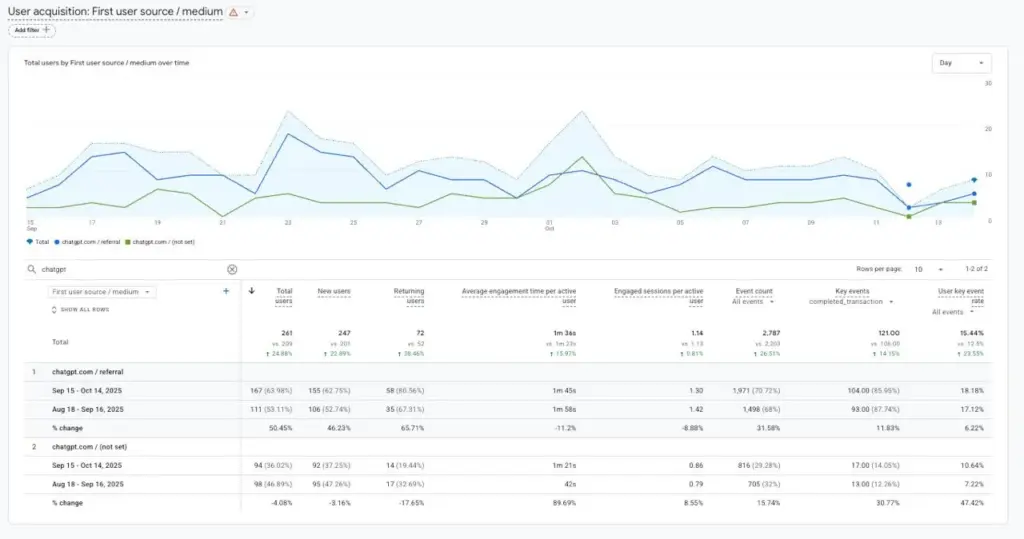
That’s a 1.6x conversion advantage in just one month.
Why do AI-referred visitors convert better? By the time they click through, ChatGPT has already answered their questions.
This doesn’t mean AI optimization is simple.
Like traditional SEO, it requires technical precision, authoritative content, and consistent effort. But for brands willing to invest in GEO now, the rewards are substantial — while competitors are still fighting over saturated Google rankings.
Why AI Ranking Factors Matter Now
The shift toward AI-powered search is accelerating faster than most businesses realize. Consider the data:
weekly users on OpenAI products
of organic traffic shifting to AI by 2026
Stack Overflow traffic drop post-ChatGPT
of Millennials use social media for search
Businesses that understand and optimize for AI ranking factors now will capture visibility that compounds over time — as AI models learn which sources to trust.
The 5 Categories of AI SEO Ranking Factors
Based on extensive analysis of how AI engines select and cite sources, we’ve identified 220+ ranking factors organized into five major categories. Here’s an overview of what matters most.
1️⃣ Technical Infrastructure & AI Readiness
This category covers everything happening behind the scenes — the foundation that makes your content discoverable and understandable to AI systems.
It includes:
- Backend setup and system architecture
- AI crawler access and content indexability
- Specific optimizations that help LLMs process your information effectively
- Brand entity recognition across the web (presence in knowledge graphs, reference databases like Wikipedia and Wikidata, major data aggregators that feed information to AI systems)
Without a solid technical foundation, even the best content remains invisible to AI engines.
2️⃣ Content Quality, Structure & Optimization
Content remains king — but the rules have changed. AI engines evaluate content differently than traditional search algorithms.
This category encompasses:
- Overall content strategy and information structure
- Formats and quality standards that resonate with AI systems
- On-page elements optimized for how LLMs process and extract information
- Optimization for featured snippets and AI-generated overviews
Generic content that anyone could produce gets ignored. Specific, well-structured, authoritative content gets cited.
3️⃣ Authority, Trust & Brand Signals
AI engines need to determine which sources are trustworthy before citing them. This category focuses on the credibility signals that establish your brand as a reliable source.
It includes:
- Presence and completeness on professional platforms
- Recognition through industry awards, certifications, and trust indicators
- Reputation management across review platforms
These signals help AI systems confidently recommend your brand when users ask for suggestions or advice. Trust takes time to build but is essential for consistent AI visibility.
4️⃣ Visibility, Distribution & External Signals
Your owned content is only part of the equation. AI engines also evaluate how your brand appears across the broader web ecosystem.
This category covers:
- Media coverage and PR mentions
- Presence on user-generated content platforms where people discuss and recommend brands
- Link-building strategies adapted for the AI era
- Social signals that indicate brand relevance and engagement
The more your brand is mentioned, discussed, and linked across authoritative external sources, the more confident AI engines become in citing you.
5️⃣ Performance, Measurement & Geo Strategy
What gets measured gets improved. This category focuses on tracking your AI visibility and optimizing for specific markets.
It encompasses:
- Metrics and KPIs that indicate AI SEO success
- Traffic and conversion outcomes tied to AI referrals
- Content performance indicators
- Specific AI visibility measurements
- For businesses operating across regions (multi-language optimization, building regional authority, geographic targeting strategies that influence location-specific queries)
Only 4 letters: TAAR — track, analyze, adjust, repeat. The brands that measure their AI performance are the ones that improve it.
How AI Engines Evaluate and Select Sources
Understanding the mechanics behind AI citation decisions helps prioritize optimization efforts. Here’s what happens when someone asks an AI engine a question:
- Query Understanding: The AI parses the question to understand intent, entities involved, and information needs.
- Knowledge Retrieval: The model draws from training data and (for some engines) real-time web searches.
- Source Evaluation: Multiple signals determine which sources are authoritative and relevant.
- Response Synthesis: The AI generates a response, deciding which sources to cite explicitly.
- Citation Decision: Based on confidence, specificity, and relevance, sources are either cited, mentioned, or used without attribution.
The goal of AI SEO is to be the source the AI trusts enough to cite explicitly.
What Makes AI SEO Challenging
Optimizing for AI engines presents unique challenges that don’t exist in traditional SEO:
1) Multiple Platforms, Multiple Algorithms Unlike traditional SEO where Google dominates, AI SEO requires optimization across ChatGPT, Perplexity, Claude, Gemini, Meta AI, and Microsoft Copilot — each with different underlying models and behaviors.
2) Limited Tracking Tools There’s no Google Search Console equivalent for AI. Tracking citations and mentions requires manual monitoring or specialized (and expensive) tools.
3) Non-Deterministic Responses The same query can produce different responses — and different citations — each time. This makes testing and optimization more complex.
4) Training Data Lag AI models have knowledge cutoffs. Content needs to be visible long enough to be incorporated into training data, which can take months.
A Step-by-Step Introduction to AI SEO Ranking Factors
✅ Ready to Optimize for AI Visibility? Here’s a Practical Starting Point!
Getting your content noticed by AI systems isn’t about gaming algorithms — it’s about making yourself genuinely discoverable and useful. The good news? There’s a clear path forward, and you can start today.
The visual below illustrates how an AI crawler navigates your website — from first discovering whether you exist in its responses, all the way to understanding your structured data. Think of it as a journey with five checkpoints. At each stop, the crawler either moves forward (you’re optimized) or hits a wall (you’re invisible). Use this as your roadmap while working through the steps that follow.
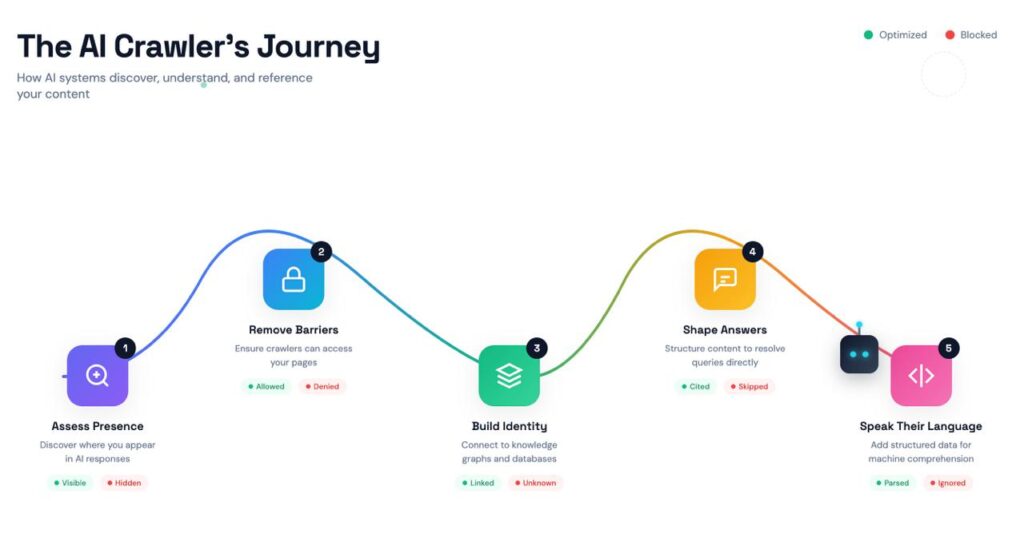
01 Audit Your Current AI Visibility
This baseline assessment reveals where you stand before investing resources — you might be surprised to find you’re already being cited in some contexts but completely invisible in others.
02 Check Technical Accessibility
A surprisingly common oversight — many sites unknowingly block AI crawlers with legacy robots.txt rules, essentially making themselves invisible to the very systems they want to appear in.
03 Strengthen Entity Signals
AI models rely heavily on structured knowledge bases like Wikidata to disambiguate entities and establish authority — consistency here builds the foundation that content alone can’t provide.
04 Create Answer-Optimized Content
This is the shift from “rank for keywords” to “be the definitive answer” — AI systems are looking to cite sources that directly resolve user questions, not pages optimized for clicks.
05 Implement Schema Markup
Schema acts as a translation layer between your content and AI understanding — it explicitly tells systems what your content means, not just what it says.
Conclusion
AI-powered search is changing how people discover brands. And the signals AI engines look for aren’t the same ones traditional SEO taught us to optimize.
We’ve covered a lot of ground here — from what AI ranking factors actually are, to the key categories that influence whether you get cited or ignored.
The key takeaway? Start with the basics. Audit your current AI visibility, make sure crawlers can access your content, strengthen your entity signals, and create content that directly answers questions. If you want to move faster and skip the guesswork, working with experts gives you a proven strategy and hands-on execution from day one.
Grab the checklist below and start working through it at your own pace.
Sources:
- [1] Ahrefs – Research on AI citation patterns, 2025
- [2] Previsible 2025 AI Data Study – LLM traffic analysis, 2025
- [3] McKinsey AI Discovery Survey – New front door to the internet, 2025
Share with


Rate the article