


Every week, thousands of people make a decision about which crypto exchange to trust. They don’t read whitepapers. They don’t compare fee tables. They open Reddit, type a name, and read what other people say.
At ICODA we did the same thing, but with social listening tools, 268 mentions, and 72 hours of data. What we found about Crypto.com and Coinbase is something no marketing dashboard would show you.
The Snapshot
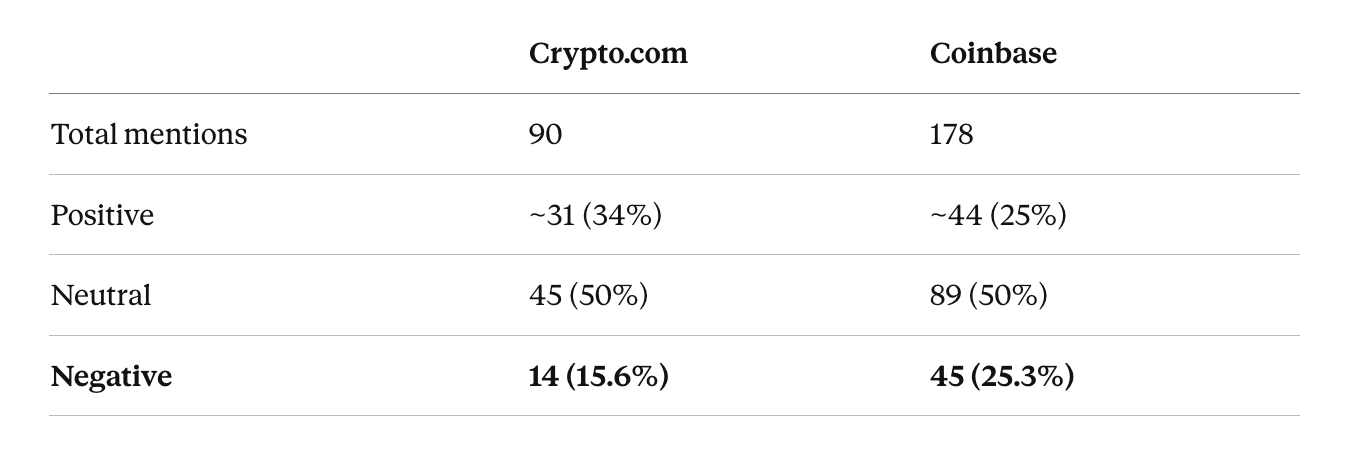
| Metric | Crypto.com | Coinbase |
|---|---|---|
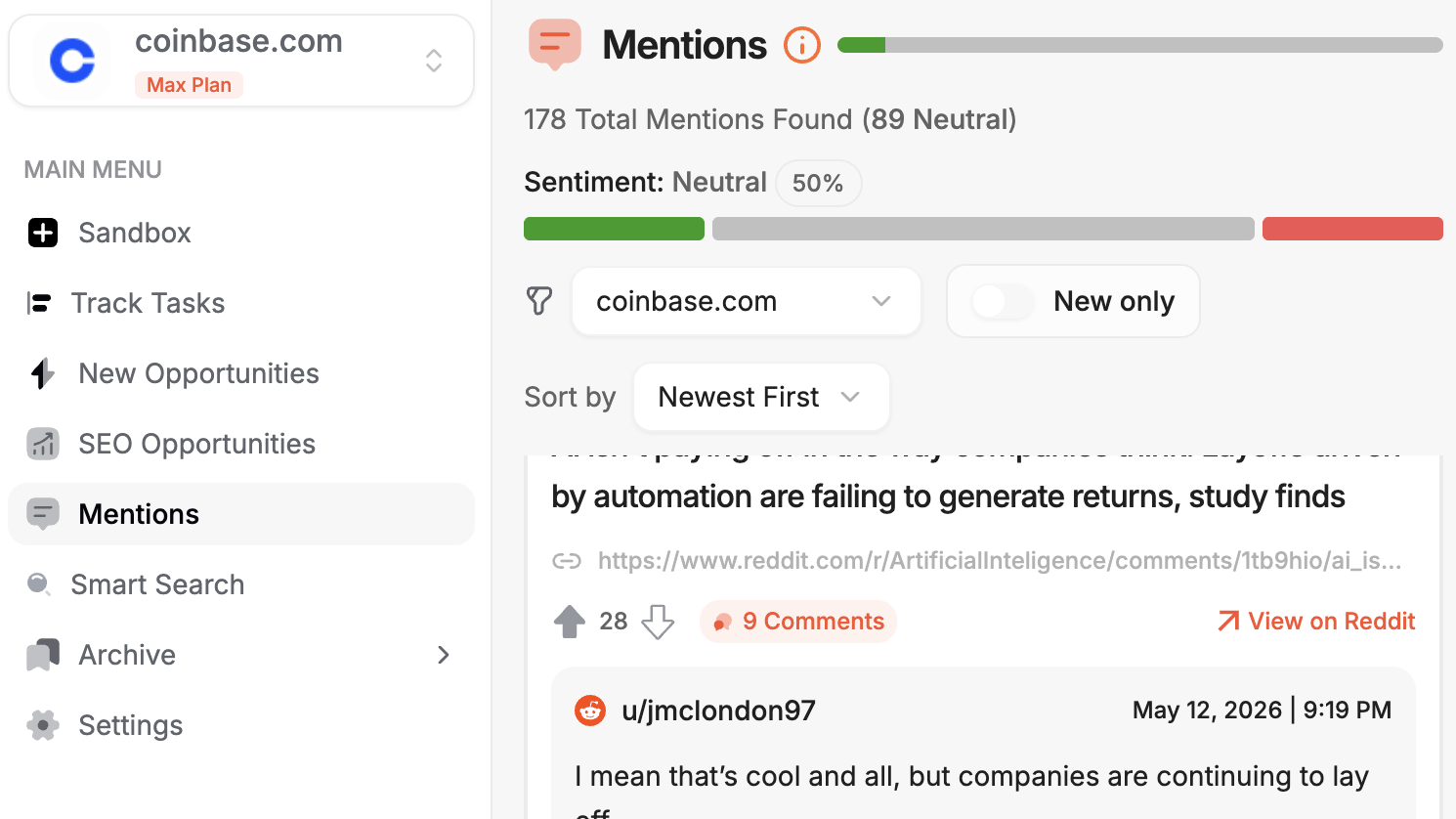
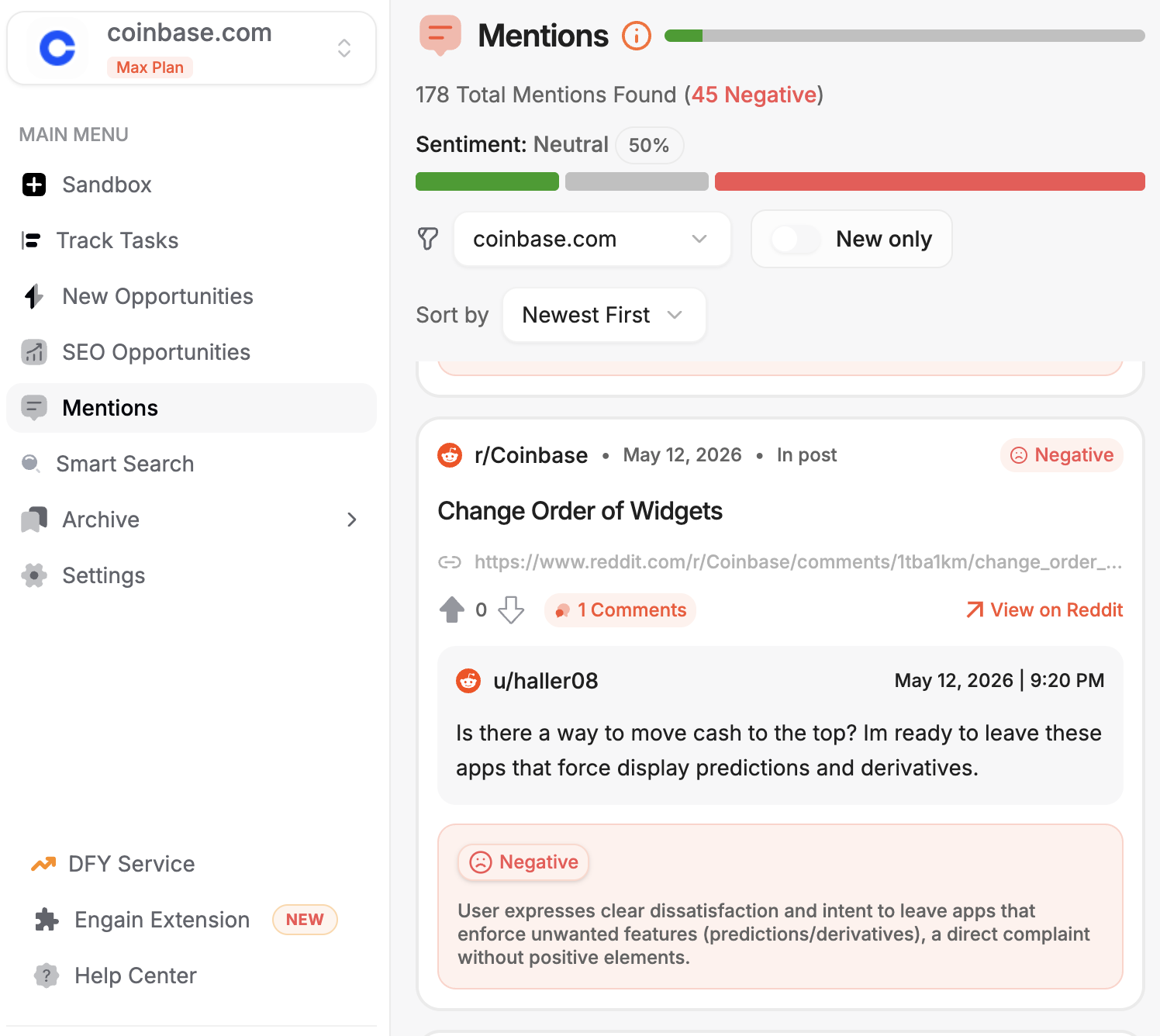
| Total mentions | 90 | 178 |
| Positive | ~31 (34%) | ~44 (25%) |
| Neutral | 45 (50%) | 89 (50%) |
| Negative | 14 (15.6%) | 45 (25.3%) |
Same dashboard score. Coinbase carries a negative rate 60% higher than Crypto.com — with twice the volume to spread it. 50% neutral for both. But not all neutrals are created equal.
Why Coinbase’s "Neutral" Is More Dangerous
Here’s something most sentiment tools won’t tell you: neutral is not harmless.
Crypto.com’s neutral mentions are mostly naming noise — Crypto Arena events, UFC broadcasts, posts where the brand appears but isn’t the subject. Strip those out and you have a manageable signal.
Coinbase’s neutral mentions sit alongside 45 negatives, many of them high-engagement threads with 100+ comments, posted directly into product subreddits, fully indexed by Google. That content is intercepting potential users right now.
Reddit isn’t a social network. It’s a permanent reputation archive with a search engine built on top of it.
Cost of ignoring it: A single high-engagement negative thread can deter 500+ signups. At typical crypto CAC, that’s $20K–$50K per thread. Coinbase has several live right now.
1. Crypto.com: The Sponsorship Trap
90 mentions | 34% positive | 15.6% negative
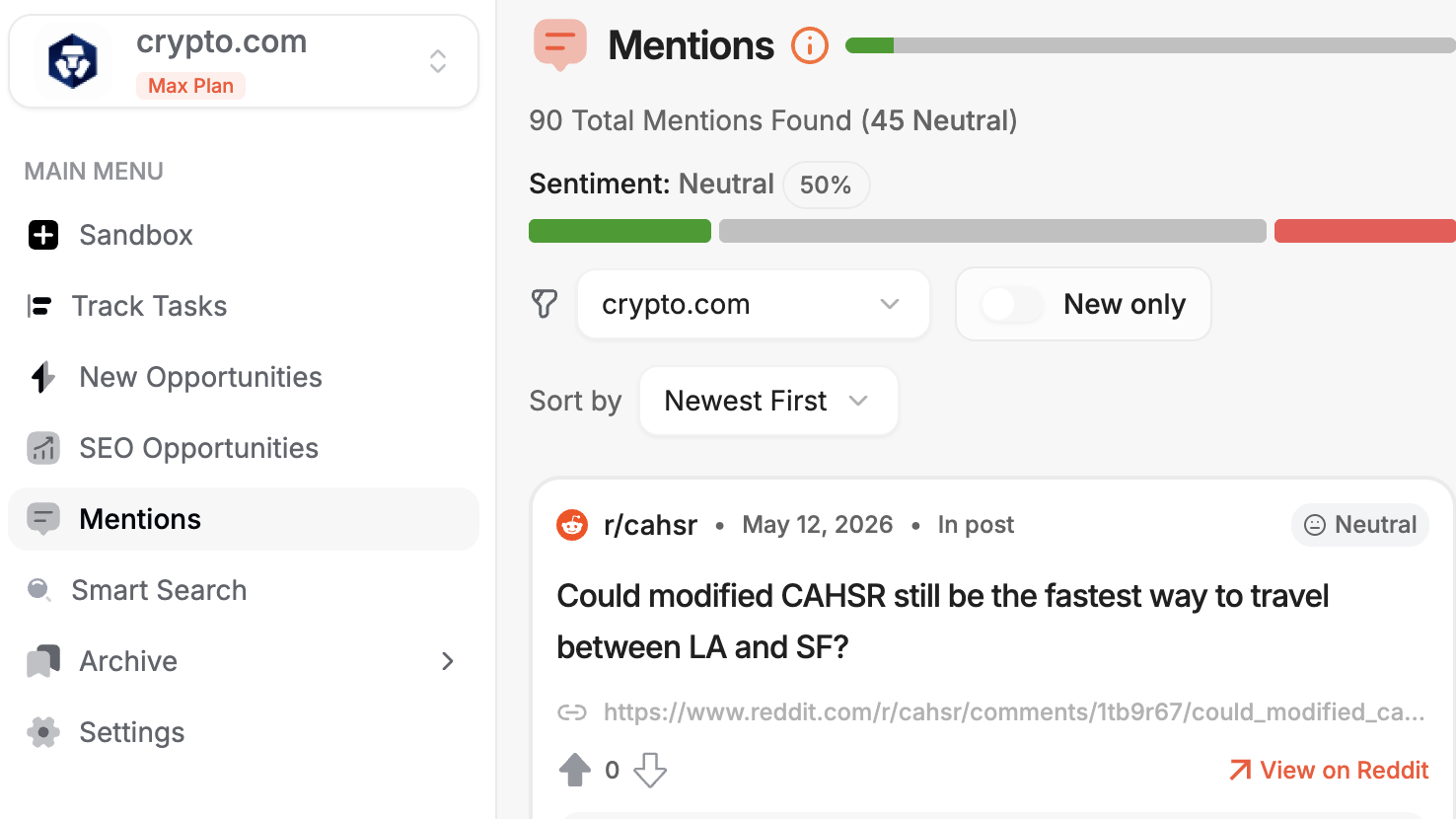
Crypto.com has a brand problem. Not a product failure, a brand adjacency problem. And it’s self-inflicted.
The most-upvoted negative content this week didn’t come from a bad product experience. It came from r/UFC.
A thread about new UFC 250 gear — 837 upvotes, 278 comments — turned into an extended roast of the Crypto.com logo on the apparel. Nobody was warning people away from the exchange. They were using the logo as shorthand for everything people distrust about crypto advertising.
"Nothing says AMERICA like a big crypto.com logo…. well actually yeah crypto scams are a big part of the admin."
"Gotta make sure that crypto.com logo is FRONT AND CENTER lmao."
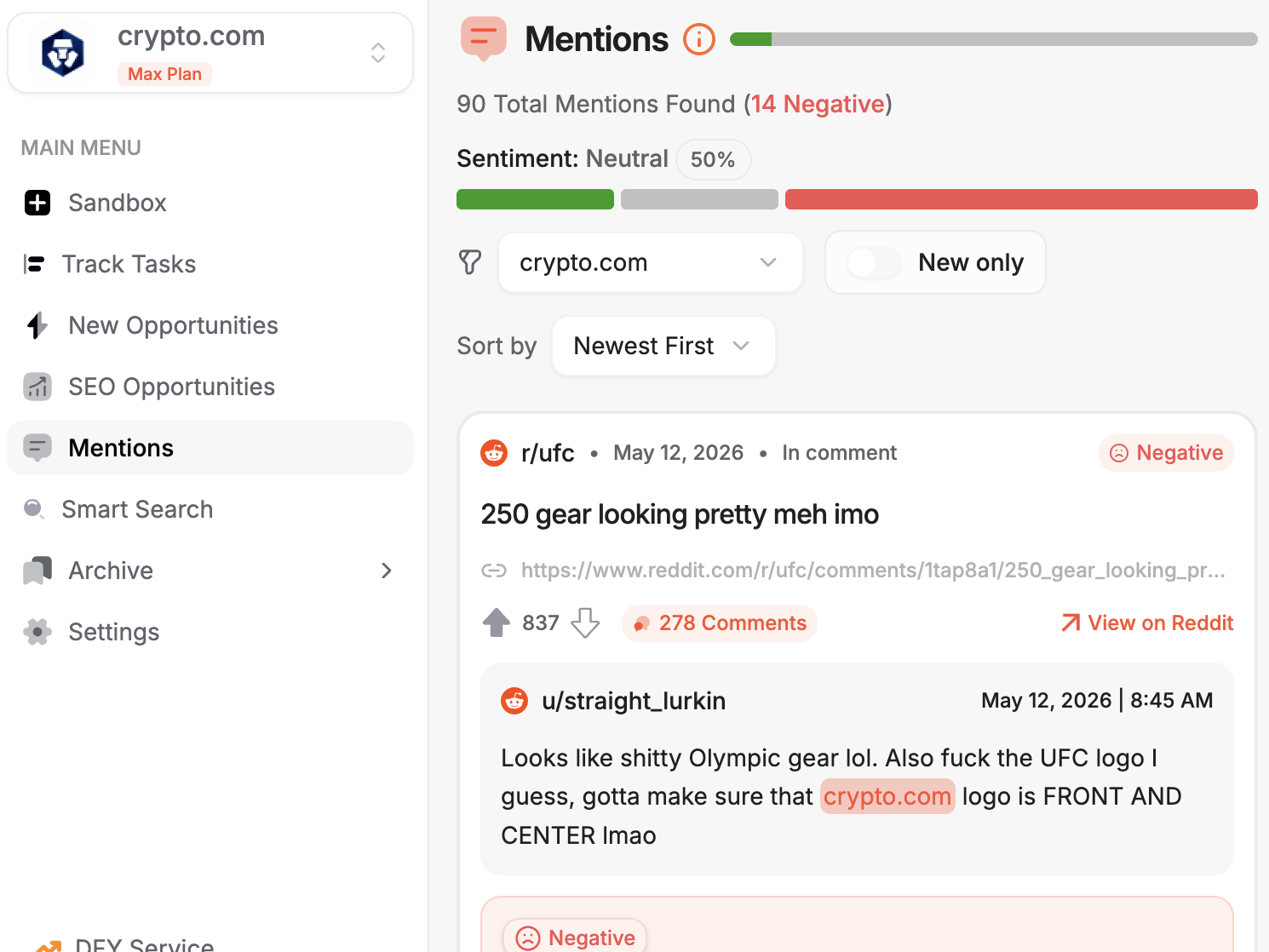
This is the tax on mass-market sponsorship in a sector that’s still rebuilding trust. The Crypto Arena deal and the UFC partnership deliver enormous reach, but they also make the brand a target in every conversation where someone wants to make a point about crypto’s credibility problem.
What Reddit Actually Wants Fixed
Two specific product complaints are generating shareable, specific frustration — and both are fixable:
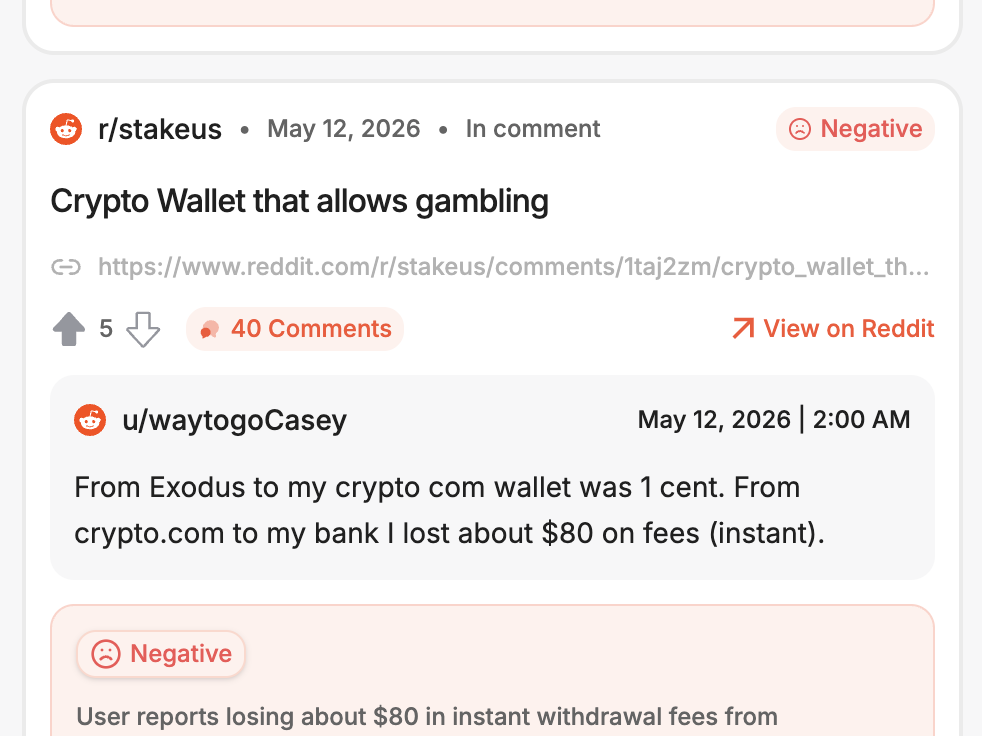
The fee shock. One user moved funds from Crypto.com to their bank and lost ~$80 in instant withdrawal fees. Eighty dollars. On top of a 1-cent transfer from Exodus to the wallet. That gap between what the ads imply and what the product charges is exactly the kind of story people share.
Dead DeFi rewards. A user flagged that Crypto.com is still listing rewards for a project the community considers essentially dead. "Project is pretty much dead. Quite strange that crypto.com still offers it as DeFi awards." Small thread. Big signal about curation quality.
What Crypto.com Should Do Next
The brand association issue takes time to shift. The product complaints don’t.
- Publish a transparent fee structure. One clear page that answers "how much does it actually cost to move money out" before users find out the hard way in r/stakeus.
- Audit active DeFi listings quarterly. Surfacing rewards for failed projects is the kind of detail that tells experienced users everything they need to know about your curation standards.
- Invest in community credibility alongside mass-market reach. Technical “advocates” who show up in UFC threads and answer real questions do more brand repair than any sponsorship renewal.
Goal: Reduce the specific, shareable product complaints. The ambient brand noise becomes easier to manage when it has less to attach itself to.
2. Coinbase: When the Product Becomes the Problem
178 mentions | 25% positive | 25.3% negative
Coinbase’s problem isn’t brand adjacency. It’s product failures documented in public, in subreddits built around the product itself, by users who trusted the platform with real money.
The Trust Funnel with a Hole in It
Here’s the user journey Coinbase is currently paying to interrupt:
- User sees Coinbase ad in the App Store
- Googles "Coinbase review Reddit" before downloading
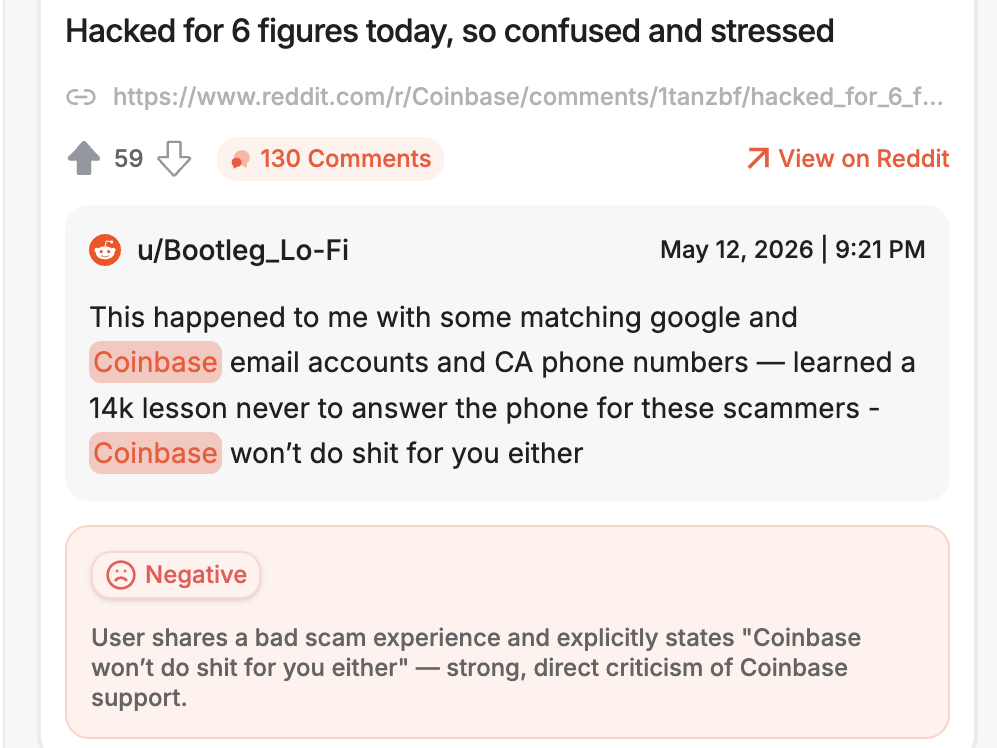
- First result: "Hacked for 6 figures today, so confused and stressed" — r/Coinbase, 59 upvotes, 130 comments
- Reads a reply from someone who lost $14k and concluded: "Coinbase won’t do shit for you either"
- Doesn’t download the app
Every dollar spent on CAC is being partially negated by that thread. It was posted this week. It will rank for months.
The Two Product Decisions Making It Worse
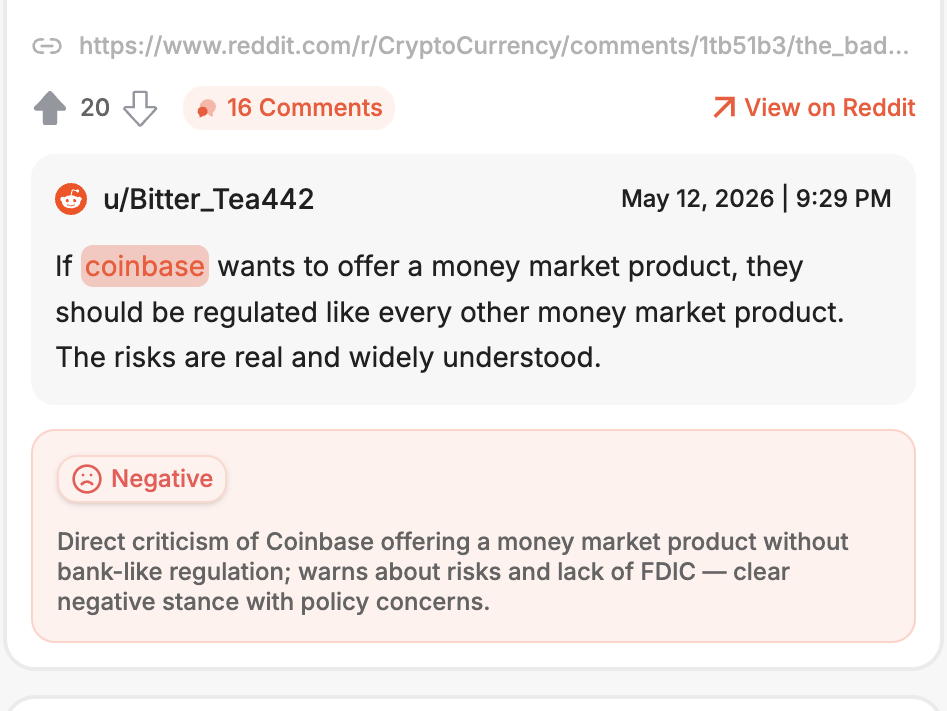
Unregulated financial products. A financially literate user in r/CryptoCurrency called out Coinbase for offering a money market product without FDIC-equivalent protections. "The risks are real and widely understood." This isn’t fringe skepticism. It’s a specific policy argument from an influential audience, and it will grow louder as Coinbase expands its product suite.
Interface friction pushing users out the door. A user in r/Coinbase posted asking whether they could move cash to the top of their dashboard. Ended with: "I’m ready to leave these apps that force display predictions and derivatives."
That’s not a feature request. That’s expressed churn intent, over a UI decision, not a competitor’s offer.
The Stepping Stone Problem
Coinbase has real positive sentiment, and it clusters around one thing: beginner-friendliness.
"For starting out, Coinbase is pretty beginner-friendly and easy to set up."
Great. Except the same comments consistently add: "once you’re comfortable, explore other platforms." Coinbase is being recommended as a training wheel, not a destination. The brand equity is real, but it has a built-in expiration date, and every friction point above is accelerating it.
What Coinbase Should Do Next
- Implement Reddit-first support. Official, visible responses in high-engagement incident threads. One thread that ends with "Coinbase support came through and resolved this" creates durable positive search content that works against the existing negatives for years. That thread doesn’t currently exist.
- Communicate regulatory risk proactively. Don’t wait for users to raise it in r/CryptoCurrency. Get ahead of it with clear, plain-language risk disclosure.
- Add a personalization layer to the interface. Let users configure their default view. This single product decision eliminates an entire category of expressed churn intent.
Goal: Turn the one high-trust asset, beginner accessibility, into long-term retention, instead of watching it quietly convert into churn at the "exploration" stage.
The Verdict
| Crypto.com | Coinbase | |
|---|---|---|
| Problem type | Brand perception | Product failures |
| Negative driver | Sponsorshim backlash | Security + UX + regulations |
| Most urgent fix | Fee transparency | Reddit-first support |
| Hardest fix | Mass-market brand associations | Structural support response |
| Retention risk | Medium | High |
Crypto.com is paying a tax on visibility. It can be managed with the right product decisions and community investment.
Coinbase is watching its best asset, beginner trust, quietly erode through product choices it’s making every day.
Both brands have time to respond. But Reddit doesn’t wait, and neither do the users searching your brand name before they decide whether to sign up.
Frequently Asked Questions (FAQ)
Yes, and the mechanism is simple: someone Googles "[exchange name] Reddit" before downloading the app, and the first result is often an unresolved complaint thread with 100+ comments. That thread sits there for months, intercepting signups. A single high-engagement negative thread has measurable conversion impact, it’s not just venting, it’s permanent indexed content.
Aggregate sentiment scores mask what actually matters: the distribution and placement of negative content. Coinbase has twice the mention volume and 60% more negative sentiment than Crypto.com, concentrated in product-specific subreddits that rank on Google. Same headline score, very different reputation exposure.
Coinbase has robust technical security, but their support response to account compromises is the real failure — users report losing five and six figures with no resolution. The platform will rarely reverse unauthorized transactions, and support threads go unanswered for weeks. If you’re storing serious money there, use a hardware wallet for anything you’re not actively trading.
Yes, instant withdrawal fees on Crypto.com are genuinely high and not clearly communicated upfront. The standard transfer is cheaper but slower. If you’re moving funds regularly, always use the standard withdrawal option and check the fee before confirming — the instant option can quietly cost you on every transaction.
Some of the DeFi rewards Crypto.com lists are for projects with little to no active development, and the platform is slow to remove them. The staking rewards that are tied to CRO are more reliable. Treat any third-party DeFi listing there as something to research independently before committing funds.
Reddit skews toward people with problems, so the sample is biased — but that bias is useful. The complaints you see repeatedly, from multiple users, in product-specific subreddits, are real signals about consistent platform failures, not random bad luck. One-off rants in general crypto subs carry less weight than recurring themes in r/Coinbase or r/stakeus.
공유


기사 평가하기