


500개 이상의 암호화폐 & Web3 사이트 A...
귀하의 암호화폐 사이트는 약한 콘텐츠 때문이 아니라 WAF 기본 설정으로 인해 ChatGPT 및 Perplexity에...
AI 트래픽은 유기적 검색보다 전환율이 11배 더 높습니다. 본 보고서는 ChatGPT, Perplexity 및 Google ...
Google과 Meta는 대부분의 크립토 광고를 차단합니다. 2026년 Web3 프로젝트의 실제 수치를 통해 AI SEO...
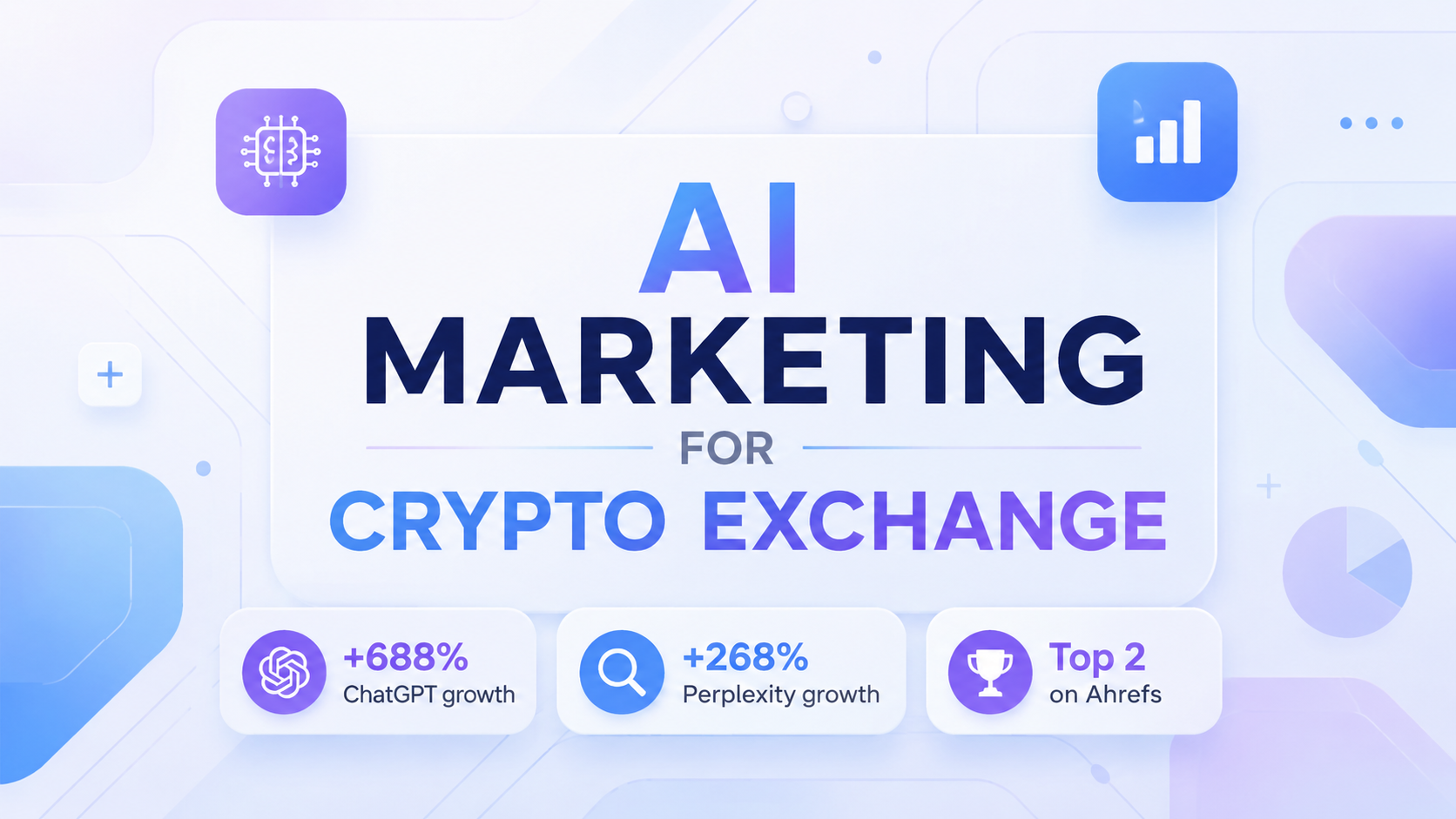
유료 광고가 없다고요? 문제 없습니다. AI SEO와 PR만으로 암호화폐 거래소가 ChatGPT, Perplexity, Goo...
AI is changing how people discover brands, make purchase decisions, and engage with businesses online. Over 40% of product discovery queries now happen in ChatGPT, Perplexity, Gemini, and similar platforms — and traditional digital marketing doesn’t work there. AI Marketing is about getting your brand recommended, cited, and trusted in these AI-generated responses — while simultaneously using AI to plan, execute, and optimize every stage of your marketing funnel.
LLMs don’t show ads. They don’t rank pages. They synthesize information from sources they trust and deliver direct answers. Your campaign budget and keyword bids don’t matter here. What matters is how your brand is represented across the sources AI systems learn from, how authoritatively you’re described, and whether AI platforms see you as citation-worthy when users ask questions in your category.
Early movers are seeing 3–5× more qualified traffic from AI referrals, with conversion rates 40% higher than traditional organic. The opportunity is real, and most marketing teams aren’t even tracking it yet.
The AI marketing field lacks standardized terminology — different agencies and platforms use these terms inconsistently. Here’s how we define and apply these concepts at ICODA, based on our hands-on experience running AI marketing campaigns across industries.
GEO is the practice of optimizing your brand and content to get cited, quoted, or recommended in AI-generated responses from platforms like ChatGPT Search, Perplexity, and Google AI Overviews. Unlike traditional SEO that targets keyword rankings, GEO aims to make your brand the source AI systems pull from when users ask questions in your category. This requires content structured for extraction, clear entity definitions, and authority signals that LLMs recognize and trust.
AEO is the practice of optimizing content to appear in direct answer formats — featured snippets, knowledge panels, and AI-synthesized responses. The goal is to become the definitive source that AI platforms pull from when users ask questions. This involves structuring content around specific queries, providing concise definitions, and formatting information in ways that AI systems can easily extract and present as authoritative answers.
LLM Marketing addresses how to optimize your brand for the underlying AI models powering modern search and discovery — GPT-4o, Claude, Gemini, and others. This discipline focuses on understanding how LLMs process, evaluate, and recommend brands during inference. Key factors include training data representation, retrieval-augmented generation (RAG) patterns, and the signals that cause models to prefer certain brands over others when generating responses.
AI Marketing Automation goes beyond rule-based email sequences and CRM workflows. It uses LLM inference to create genuinely dynamic marketing experiences — campaigns that reason about audience context, landing pages that adapt messaging in real time, and sales conversations that run without human intervention. Brands deploying AI marketing automation see 2–4× improvement in conversion rates across digital channels.
Generative AI Marketing is the use of AI models to produce marketing outputs — text, images, video, ad copy, email sequences, and landing pages — at scale and with a level of personalization impossible to achieve through manual production. It is one layer of a broader AI marketing strategy, not the whole picture.
| Term | Full Name | Primary Focus |
|---|---|---|
| GEO | Generative Engine Optimization | AI search citations & brand recommendations |
| AEO | Answer Engine Optimization | Direct answers & featured snippets |
| LLM Marketing | Large Language Model Marketing | Model behavior & brand preference signals |
| AI Marketing Automation | — | Dynamic, AI-driven campaign execution |
| Generative AI Marketing | — | AI-produced marketing content at scale |
AI Marketing is arguably the most significant shift in digital marketing since the rise of Google — yet the industry knowledge base remains dangerously thin. Most agencies and in-house teams are applying outdated frameworks to a fundamentally different challenge.
AI platforms answer user queries directly, eliminating the need to visit source websites. When ChatGPT explains your product category without mentioning your brand, you lose discovery opportunities you never knew existed. Traditional marketing metrics show stable campaign performance while actual brand visibility in AI conversations evaporates.
LLMs were trained on content published years ago. New brands don’t exist in their world. Pivoted companies appear frozen in time. Emerging product categories get explained through outdated competitive frameworks. Worse still, inaccurate brand descriptions become nearly impossible to correct once embedded in model weights.
Review sites, comparison platforms, and media publications dominate AI citations — not because they know your product best, but because they’ve accumulated authority signals over years. The result: when users ask "what’s the best X," AI recommends whoever these aggregators rank highest. Your brand’s quality doesn’t matter if AI systems can’t see your brand clearly.
Google Analytics can’t track when ChatGPT recommends your competitor. Attribution tools don’t monitor AI citation frequency. Most marketing teams operate with zero visibility into whether AI platforms mention them, how accurately they’re described, or how often they lose consideration to better-optimized rivals. AI Marketing solves this — but only if you start measuring it.
When a user asks an LLM "best AI marketing software," the model doesn’t run a single search. It fans out across dozens of sub-queries — "what is AI marketing," "compare AI marketing tools," "how does AI improve marketing ROI," "AI marketing automation vs traditional" — before synthesizing an answer. Your brand needs to be present across this entire retrieval network, not just optimized for one keyword.
Everything that performs well in traditional content marketing — engagement hooks, storytelling, brand voice — becomes invisible to LLMs seeking structured, extractable information. Marketing content optimized for human readers often fails AI extraction entirely. The content strategy that built your blog traffic may actively hurt your AI visibility.
At ICODA, we don’t speculate about AI Marketing — we test it. Our team runs controlled experiments across 200+ brand campaigns, measuring actual citation rates, AI referral traffic, and brand mention frequency across major LLM platforms. When we identify new patterns in how AI systems recommend brands, our readers learn about them within days, not months after they’ve become common knowledge.
Research-Backed Analysis — Every article draws from direct testing, client campaigns, and proprietary research. No republished press releases. No algorithm speculation. We validate AI marketing strategies through controlled experiments before sharing them publicly.
Platform-Specific Expertise — ChatGPT prioritizes conversational authority. Perplexity emphasizes recency and sourcing transparency. Gemini leverages Google’s knowledge graph. Our coverage addresses each platform’s unique recommendation factors, ensuring strategies translate to measurable results regardless of which AI tool your audience uses.
Why Practitioners, Not Theorists?
ICODA operates as an active AI Marketing agency serving clients across Web3, fintech, iGaming, and enterprise sectors. The strategies we share come from campaigns generating real ROI. We publish what works because we’ve made it work — and we’ve made it measurable.
Continuous Updates
AI recommendation algorithms evolve rapidly — platforms update citation logic weekly. Our editorial calendar matches this pace: new articles published multiple times per week, existing guides revised whenever significant changes occur, and deprecated tactics flagged and removed within days.
This resource hub serves as your comprehensive guide to AI-era marketing strategy. We’ve built the knowledge base the industry is missing — continuously updated, rigorously tested, and immediately actionable.
Deep-dive articles covering GEO, AEO, LLM Marketing, AI content strategy, and AI marketing automation. From foundational concepts to advanced platform-specific tactics, each guide provides step-by-step frameworks you can implement immediately. Topics include entity optimization, citation building, AI-first content structuring, brand visibility measurement, and generative AI for marketing teams.
| Component | What You’ll Find |
|---|---|
| Baseline metrics | Where the brand’s AI visibility started |
| Implementation details | Exactly what we changed |
| Timeline | How long results took to appear |
| Outcomes | Measurable impact across AI platforms |
Real campaigns. Real clients. What worked, what didn’t, and the specific tactics that moved the needle on AI brand recommendations.
We maintain curated rankings of the best AI marketing agencies worldwide — evaluated on proven results, methodology transparency, platform expertise, and client outcomes. Updated quarterly.
Comprehensive reviews of tools for monitoring AI brand visibility, tracking citations, measuring share of AI voice, and automating marketing execution with LLMs. We test each tool ourselves before recommending it.
Original research examining AI recommendation behavior across fintech, Web3, iGaming, SaaS, e-commerce, and more. Understand how AI platforms perceive your specific industry and what it takes to become the brand they recommend.
Know where you stand. Our industry benchmarks cover AI citation rates, referral traffic from LLM platforms, and brand mention frequency — giving you meaningful standards to measure progress against competitors.
AI models determine which brands to recommend based on perceived authority within specific topic clusters. Building this authority requires consistent, expert-level content that establishes your brand as a definitive resource in your category. Focus on creating comprehensive guides, original research, and thought leadership that LLMs recognize as citation-worthy when users ask related questions.
Structure your content for extraction, not engagement.
LLMs process information differently than human readers. What works:
AI platforms rely heavily on cross-referenced information from multiple authoritative sources. Earn mentions in industry publications. Maintain updated profiles on Wikipedia and Crunchbase. Ensure your brand description is consistent across all digital properties. The more frequently AI models encounter your brand associated with specific topics — during both training and retrieval — the more likely they are to recommend you.
Brands that deploy AI marketing automation early build compounding advantages: more personalized campaigns, faster creative iteration, and lower cost-per-acquisition than competitors still running manual workflows. AI automation isn’t just efficiency — it’s the mechanism that lets smaller teams outmarket larger ones.
Move beyond traditional marketing KPIs. Track brand mention frequency in AI responses, referral traffic from AI platforms (chatgpt.com, perplexity.ai), citation accuracy, and sentiment of AI-generated descriptions. Use these insights to continuously refine your strategy, prioritizing content updates for topics where competitors currently dominate AI responses.
ChatGPT leads today by volume. But Perplexity’s growth rate and Google’s Gemini integration could reshape market share within quarters. Smart AI marketing strategy diversifies investment across multiple platforms rather than over-indexing on any single channel.
Unlike traditional marketing with mature analytics tools, AI-driven discovery attribution remains imperfect:
Build measurement capabilities now, even as the tooling ecosystem matures.
LLM recommendation logic is less transparent than traditional marketing algorithms. Platform providers rarely publish optimization guidelines. Ranking logic changes with each model update. Winning requires rapid hypothesis testing and willingness to adapt — which is exactly why we test every hypothesis and document every result.
AI-referred traffic currently converts at higher rates than traditional organic, and competition for AI citations remains relatively low. Early investment compounds as platforms grow and user habits shift. Brands that establish AI authority now will be significantly harder to displace later.
The window won’t stay open forever.
Our AI Marketing Blog delivers the actionable intelligence you need to capture visibility in conversational AI platforms. From foundational GEO strategies to advanced AI marketing automation, each article provides immediately applicable tactics backed by real campaign data.
Whether you’re establishing initial AI brand visibility or scaling an existing program, our coverage ensures you stay ahead of LLM algorithm changes and emerging best practices. Bookmark this page, subscribe to updates, and start building your brand’s presence in the AI-driven discovery ecosystem that increasingly determines which companies get recommended — and which get ignored.
AI Marketing (also called GEO, LLM Marketing, or generative AI marketing) is the practice of using artificial intelligence to plan, execute, and optimize marketing campaigns — and ensuring your brand gets cited and recommended in AI-generated responses from platforms like ChatGPT, Perplexity, and Gemini. It focuses on authority signals, content structure, and citation-worthiness alongside traditional marketing execution.
Traditional digital marketing targets keyword rankings, paid traffic, and engagement metrics measured through tools like Google Analytics. AI Marketing targets brand citations in LLM-generated responses, share of AI voice against competitors, and referral traffic from conversational AI platforms. The content formats, authority signals, and measurement frameworks are fundamentally different — though complementary.
Prioritize ChatGPT (highest user volume), Perplexity (highest B2B engagement, strongest citation transparency), and Google AI Overviews (largest reach via existing Google traffic). Gemini and Microsoft Copilot are growing rapidly and should be included in any long-term AI marketing strategy.
Generative AI marketing is the use of AI models to produce marketing content — blog posts, ad copy, email sequences, landing pages — at scale. It is one component of a broader AI marketing strategy. The more impactful layer is optimizing that content to get cited and recommended by the same AI models that produce it.
Track brand mention frequency in AI responses, citation accuracy across platforms, referral traffic from chatgpt.com and perplexity.ai, share of AI voice relative to competitors, and query coverage — which fan-out sub-queries return results that include your brand. These metrics replace or supplement traditional SEO KPIs.
Results on retrieval-augmented platforms like Perplexity and ChatGPT Search can appear within weeks of publishing well-structured content that earns fresh citations. Influencing an LLM’s base training data is a longer process — measured in months to a year — tied to model update and fine-tuning cycles.
Yes. AI citation is based on content quality, entity clarity, and cross-source authority — not domain authority or ad spend. A well-structured, authoritative page from a small brand can outperform a Fortune 500 company’s generic content in AI recommendations. This is one of the most significant leveling forces in the history of digital marketing.
AI-referred traffic converts at significantly higher rates than traditional organic — users who find your brand through an AI recommendation arrive with intent already shaped by the LLM’s endorsement. Combined with relatively low competition for AI citations compared to Google rankings, the ROI case for early AI marketing investment is stronger than almost any other channel available in 2026.