




The Two Companies That Sold the Same Thing
Two DeFi protocols launched within weeks of each other last year. Similar features. Similar tokenomics. Nearly identical target audiences.
Six months later, one had captured $340K in monthly TVL from Web2 investors who’d never touched crypto before. The other? Still grinding for traction, watching competitors pull ahead despite having objectively better technology.
The difference wasn’t their product. It wasn’t their ad spend. It wasn’t even their Google rankings—both sat comfortably on page one for their target keywords.
The difference was this: when potential users asked ChatGPT "What are the best DeFi platforms for beginners?" one protocol showed up in the answer. The other didn’t exist.
This isn’t a hypothetical. At ICODA, we tracked this exact pattern across dozens of crypto and fintech clients throughout 2024 and 2025. And here’s what makes it alarming: the invisible protocol had no idea they were losing. Their analytics showed healthy traffic. Their rankings looked strong. Their traditional SEO was working exactly as designed.
But beneath the surface, intent-driven visibility was shifting—and they weren’t part of the conversation. They just couldn’t see the customers who never arrived—the ones who got their answer from an AI and never needed to click.
You have to know — the majority of B2B companies are in the same position right now.
The good news? We’ve turned those hard-won insights into a battle-tested framework for 2026. It’s not theory. It’s built on real data from real projects navigating this exact transition.
The Problem You Can’t See in Your Dashboard
AI search optimization isn’t about chasing a new trend. It’s about understanding a fundamental shift in how your buyers actually find solutions — and why your current metrics might be hiding a growing blind spot.
| 📊 Metric | 🖥️ What Your Dashboard Shows | 🔎 What’s Actually Happening |
|---|---|---|
| Traffic sources | Google, Direct, Social, Referral | AI search traffic often misattributed or invisible |
| Frequenza di rimbalzo | Appears normal | Users who never arrived aren’t counted |
| Conversion path | Multi-touch journey tracked | AI compresses journey into one conversation |
| Lost opportunities | Shows as "0″ | Buyers formed shortlists without visiting your site |
| Competitor analysis | Your rankings vs. theirs | No visibility into who AI recommends |
Here’s what’s actually happening: 77% of Americans now use ChatGPT as a search engine, according to Adobe Express research. More striking, 24% turn to it
These aren’t casual browsers. They’re buyers with budget authority making six-figure decisions.
The problem? Your analytics can’t see them.
When someone asks Perplexity "What’s the best enterprise blockchain solution for supply chain?" and gets an answer that doesn’t mention your brand, that’s not a bounce. That’s not an impression you lost. That’s a potential customer who never entered your funnel at all.
We call this the "dark funnel" problem. Traditional attribution models assume a discoverable path: someone searches, clicks, lands on your site, maybe converts later. But AI search compresses that entire journey into a single conversation. The user gets their answer, forms their shortlist, and moves forward—sometimes without visiting a single website.
This compression is accelerating. The 6sense 2025 Buyer Experience Report found that B2B buying cycles dropped from 11.3 months to 10.1 months in just one year—a full six weeks shorter. Buyers are reaching decisions faster because AI does the legwork that used to require multiple site visits and demo requests.
Le metriche mentono perché misurano solo ciò che possono vedere.
Considera cosa è successo quando abbiamo verificato la visibilità dell’AI per un cliente di Web3 Payments. Si sono classificati nella top five di Google per 23 delle loro parole chiave. Solida autorità del dominio. Traffico organico in crescita mese dopo mese.
Ma quando abbiamo testato il loro marchio su ChatGPT, Perplexity e Gemini utilizzando 50 query pertinenti, sono apparsi esattamente in tre risposte. Il loro principale concorrente, che si posiziona più in basso su Google per la maggior parte delle stesse parole chiave, è apparso in 31 risposte.
Il concorrente invisibile di Google stava conquistando i clienti che contavano di più: quelli che si convertivano senza mai cliccare su un risultato di ricerca.
Non si tratta di un caso isolato. Una ricerca di Semrush conferma che le pagine citate da ChatGPT spesso si posizionano nelle tradizionali posizioni organiche 21 o più in basso, il che suggerisce che i fattori che determinano le citazioni dell’IA differiscono in modo significativo da quelli che determinano il posizionamento su Google. Puoi vincere una partita e perderne un’altra.
Perché questo colpo è diverso in cripto e tecnologia B2B
Se stai commercializzando un progetto di criptovaluta, un protocollo DeFi o un prodotto SaaS B2B, il cambiamento di ricerca dell’IA non è solo rilevante per te, ma è esistenziale. Il tuo settore è sottoposto a pressioni uniche che rendono la visibilità dell’IA di valore sproporzionato.
I tuoi acquirenti sono già lì.
I decisori della Gen Z e dei Millennial rappresentano oggi il 71% degli acquirenti B2B, in crescita rispetto al 64% del 2022. Secondo la ricerca di TrustRadius, gli acquirenti della Gen Z utilizzano l’intelligenza artificiale in misura quasi doppia rispetto alla media generale (15% contro l’8%). Gli acquirenti aziendali che acquistano prodotti da oltre 100.000 dollari mostrano un’adozione dell’intelligenza artificiale ancora più elevata.
Non si tratta di clienti futuri. Sono il tuo mercato attuale. E secondo l’analisi di Luxid, fino al 90% degli acquirenti B2B utilizza strumenti come ChatGPT per effettuare ricerche sui fornitori prima di rivolgersi alle vendite.
Advertising restrictions make organic discovery essential.
Crypto and fintech companies face advertising limitations that traditional SaaS doesn’t. Google, Meta, and most major platforms restrict or prohibit cryptocurrency advertising. When your paid channels are limited, organic discovery becomes your primary growth lever.
AI search represents a paid-restriction-free channel where your brand can appear as a recommendation—not an ad—based purely on authority and relevance. When ChatGPT tells a user "Uniswap is the most popular decentralized exchange," that carries weight no display ad could match.
The "become the example" opportunity is still open.
Right now, AI models are forming their default associations. When users ask about DEXs, Uniswap gets mentioned. When they ask about crypto wallets, MetaMask appears. These aren’t random selections—they’re the result of consistent, authoritative content that trained the models to recognize these brands as category leaders.
A Q2 2025 analysis revealed a major visibility gap for TON DeFi: ChatGPT excluded TON platforms in 87% of DeFi-related responses, while Gemini’s SGE mentioned TON projects only once across 50 relevant queries. The issue wasn’t product quality—it was a failure to adapt to AI-first discoverability standards that Ethereum and Solana projects had already embraced.
This matters because AI models develop citation patterns that reinforce over time. The brands establishing themselves as default recommendations now will be exponentially harder to displace later. Early movers don’t just win first-mover advantage—they build compounding authority that creates durable competitive moats.
The purchase cycle has compressed.
Google’s 2025 survey of 2,063 B2B buyers found that nearly three-quarters now complete their purchasing journey in 12 weeks or less. The 6sense Buyer Experience Report shows average cycle length dropped from 11.3 months in 2024 to 10.1 months in 2025.
Buyers are moving faster because AI accelerates research. They arrive at vendor conversations already informed, often with a preferred choice in mind. 6sense found that the vendor ranked first at the end of the selection phase wins about 80% of the time—and that selection typically happens before sellers are even contacted.
Se non sei nella risposta generata dall’intelligenza artificiale, non sei nella lista dei candidati. E se non sei nella rosa dei candidati, le tue probabilità di vittoria diminuiscono drasticamente.
Cosa funziona davvero
L’ottimizzazione della ricerca AI richiede un approccio fondamentalmente diverso rispetto alla SEO tradizionale. Noi di ICODA abbiamo sviluppato una struttura basata su ciò che abbiamo visto funzionare in decine di clienti del settore crypto e B2B tech. Ecco la ripartizione pratica:
Passo 1️⃣: Controlla dove appari effettivamente (non dove sei in classifica)
Il monitoraggio tradizionale del rank ti dice dove appari su Google. Non ti dice nulla sulla visibilità dell’AI.
Inizia a testare sistematicamente il tuo marchio sulle principali piattaforme di AI - ChatGPT, Perplexity, Gemini e Claude - utilizzando le query che i tuoi acquirenti effettivamente chiedono. Non le parole chiave del tuo target. Le domande di conversazione che qualcuno digita in un’interfaccia di chat.
Invece di "piattaforma blockchain aziendale", prova "Qual è la migliore soluzione blockchain per un’azienda di logistica di medie dimensioni?". Invece di "DeFi yield farming", prova "Come posso guadagnare un reddito passivo con le mie criptovalute senza troppi rischi?".
Documenta quali query fanno emergere il tuo marchio, quali i concorrenti e quali restituiscono risposte generiche senza nominare nessuno. Questa base rivela la tua reale posizione competitiva nella ricerca AI, che spesso non assomiglia affatto alle tue classifiche su Google.
Passo 2️⃣: Ristrutturare i contenuti per il consumo dell’intelligenza artificiale
I laureati in Lettere non scorrono i titoli alla ricerca di un’attrattiva per i clic. Analizzano i contenuti alla ricerca di risposte chiare e autorevoli da poter estrarre e citare.
Conduci con risposte dirette. La prima frase di ogni sezione dovrebbe rispondere direttamente a ciò che quella sezione promette. I sistemi di intelligenza artificiale le estraggono per ottenere le risposte. Se la tua apertura nasconde la risposta sotto il contesto e le avvertenze, stai ottimizzando la pazienza umana, non l’estrazione automatica.
Usa formati espliciti di domande e risposte. Le sezioni FAQ, le strutture "come fare" e le coppie dirette domanda-risposta segnalano ai sistemi di intelligenza artificiale esattamente dove trovare le risposte citabili. Quando abbiamo ristrutturato i contenuti didattici della DeFi di un cliente, trasformandoli da articoli narrativi a Q&A, la frequenza delle citazioni di Perplexity è aumentata di oltre il 200% in sei settimane.
Fornisci chiarezza sull’entità. I sistemi di intelligenza artificiale devono capire esattamente cosa sei, cosa fai e perché sei autorevole. Descrizioni generiche come "soluzione innovativa per la blockchain" non danno ai modelli nulla su cui lavorare. Descrizioni specifiche come "una soluzione di scalabilità Layer 2 che elabora 4.000 TPS per applicazioni DeFi basate su Ethereum" forniscono loro fatti concreti.
Passo 3️⃣: Costruire segnali di autorità e fiducia nei sistemi di intelligenza artificiale
I backlink sono ancora importanti per la SEO tradizionale. Ma i sistemi di intelligenza artificiale valutano l’autorità in modo diverso: cercano menzioni coerenti tra le fonti affidabili, non solo la link equity.
Ottieni una copertura mediatica che menzioni il tuo marchio con il suo nome. Quando pubblicazioni autorevoli parlano della tua categoria e ti includono nella conversazione, i modelli di intelligenza artificiale imparano ad associare il tuo marchio a quella categoria. Una menzione su CoinDesk è importante. Una menzione nella "top 10″ generale di un sito di notizie sulla crittografia è importante. Anche le discussioni nei forum in cui gli utenti ti consigliano per nome contribuiscono al segnale.
Prioritize third-party validation. Research from arXiv on generative engine optimization found that AI search exhibits systematic bias toward earned media—third-party authoritative sources—over brand-owned content. Your own blog claiming you’re the best matters far less than industry analysts, reviewers, and users saying so.
Maintain consistent brand naming. If you’re called "Protocol X" in some places, "ProtocolX" in others, and "The X Protocol" elsewhere, AI models may treat these as separate entities. Consistency helps models build a coherent picture of your authority.
Step 4️⃣: Optimize for Platform Differences
ChatGPT, Perplexity, Gemini, and Claude don’t operate identically. A strategy that works for one may underperform on another.
| Piattaforma | Primary Strength | Optimization Focus |
|---|---|---|
| ChatGPT | Largest user base, conversational queries | Comprehensive educational content, clear entity definitions |
| Perplessità | Citation transparency, research-focused users | Fact-rich content, statistics, quotable statements |
| Gemelli | Google integration, shopping/comparison queries | Product specifications, comparison-ready formatting |
| Claude | Technical accuracy, nuanced responses | Detailed technical documentation, expert-level content |
Perplexity explicitly shows its sources, making citation-ready content essential. ChatGPT rewards content that answers follow-up questions comprehensively. Gemini integrates with Google’s knowledge graph, making structured data and schema markup more impactful.
A Before/After Example:
One of our Web3 wallet clients was invisible across all AI platforms despite ranking well on Google. Their content was technically accurate but written in marketing-speak: "revolutionary self-custody solution transforming the future of digital asset management."
We restructured their core pages to lead with specific, quotable claims: "A non-custodial wallet supporting 12 EVM chains with built-in cross-chain bridging and hardware wallet integration."
Within eight weeks, they appeared in ChatGPT responses for 7 of their 10 target query categories—up from zero. No change in Google rankings required. Same product, different content architecture.
Real Numbers — What Optimized Brands Are Seeing
The business case for AI search optimization isn’t theoretical. Here’s what the data shows:
Conversion rates that change the math entirely.
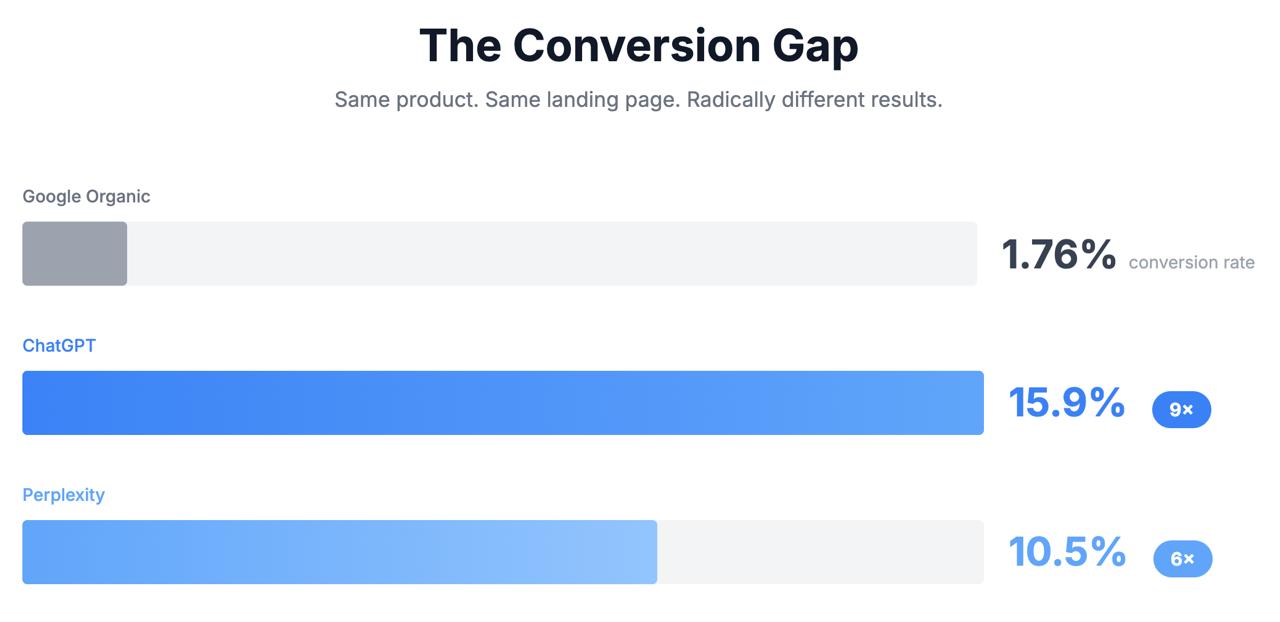
Seer Interactive tracked AI traffic across client sites and found ChatGPT converting at 15.9% compared to Google Organic at 1.76%. That’s not a marginal improvement—it’s a 9x difference. Their analysis revealed why: by the time users click through from an AI response, they’ve already completed their comparison phase within the conversation itself.
Semrush’s research found AI search visitors are 4.4x as valuable as traditional organic visitors based on conversion rate. Writesonic documented that their ChatGPT traffic converted 2.08x better than Google Organic despite dramatically lower volume. Superprompt’s analysis of 12 million website visits across 350+ businesses found AI traffic converting at 14.2% compared to Google’s 2.8%—a 5x difference.
These numbers align with what we’ve observed across crypto and fintech clients. AI traffic is fundamentally different—users arrive having already compared options, understood the value proposition, and made a preliminary decision. They’re not browsing. They’re buying. The AI essentially pre-qualifies them before they ever reach your site.
Volume is growing faster than most realize.
AI traffic grew from 0.02% of global internet traffic in 2024 to 0.15% in 2025—a 7x increase, according to SE Ranking’s analysis of nearly 64,000 websites. ChatGPT alone dominates with nearly 78% of AI referral traffic, followed by Perplexity at 15%.
Perplexity processed 780 million queries in May 2025, up from 230 million in mid-2024—more than tripling in under a year. ChatGPT reached 400 million weekly users by February 2025 and reportedly doubled that by March.
The Window
Here’s what most brands miss about timing: AI models aren’t updated continuously. They’re trained in cycles. Content that establishes authority now gets incorporated into model knowledge that persists for months or years.
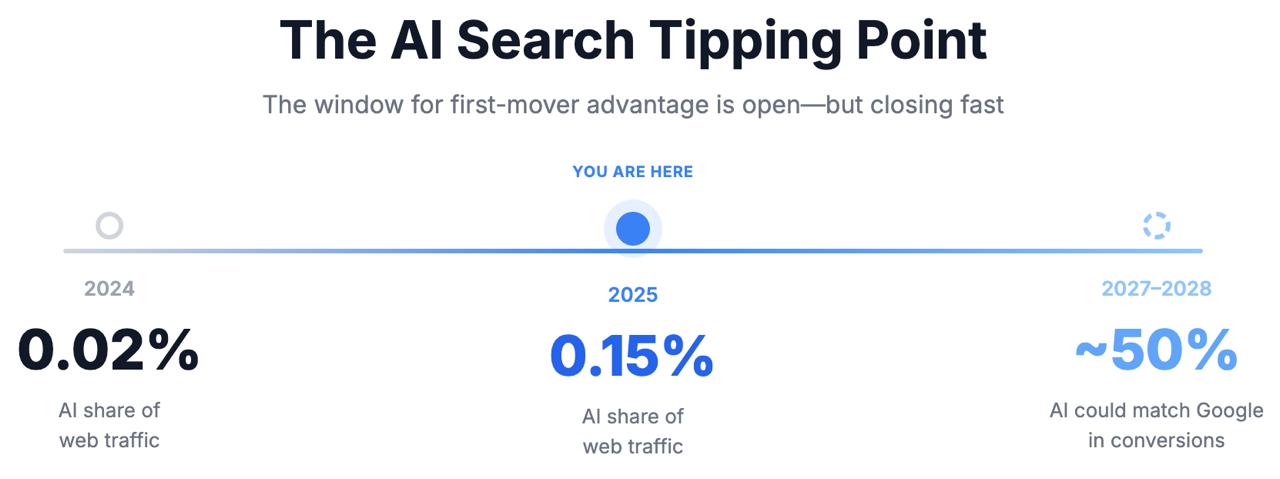
The brands being cited today trained the models on their authority yesterday. The brands wanting to be cited tomorrow need to be building that authority now.
First-mover advantages in AI citation are real and durable. Once ChatGPT learns to recommend Uniswap as the default DEX example, displacing that association requires not just matching their authority—but exceeding it enough to override established patterns.
The competitive gap is widening every month. According to 10Fold’s research, only 11% of B2B companies claim to have the majority of their content ready for AI discovery. That means 89% are still playing catch-up while early movers compound their advantage.
The question isn’t whether AI search matters for your business. The data makes that unambiguous. The question is whether you’ll be visible when your buyers ask their next question—or invisible while competitors capture demand you never knew existed.
Your buyers are already searching in AI. The only question is whether they’re finding you.
Domande frequenti (FAQ)
AI search optimization for B2B is the practice of structuring your content and brand presence to appear in AI-generated responses when buyers research vendors using ChatGPT, Perplexity, and Google AI Overviews. Unlike traditional SEO that targets rankings, AI search optimization focuses on earning citations and recommendations during the B2B buyer journey.
Traditional SEO optimizes for click-through from search results pages, while AI for SEO optimizes for being cited as a trusted source in AI-generated answers. AI systems prioritize authoritative, clearly structured content that directly answers user questions — not keyword density or backlink volume alone.
AI search traffic converts 4-9× better because users arrive pre-qualified — they’ve already compared options and formed preferences within the AI conversation. By the time they click through to your site, they’re ready to buy, not browse.
Test your brand visibility by asking ChatGPT, Perplexity, and Gemini the questions your B2B buyers actually ask during vendor research—then note whether you’re mentioned, recommended, or absent. Agencies like ICODA offer AI visibility audits that systematically track citation frequency across all major AI platforms and identify gaps versus competitors.
Generative engine optimization (GEO) is the strategic process of optimizing content for citation in AI-powered search engines. GEO focuses on entity clarity, answer-first content structure, and building authority signals that large language models trust when generating recommendations.
Most brands see measurable improvements in AI citation frequency within 8-12 weeks, with compounding effects over 3-6 months. Results depend on content restructuring, authority building, and how quickly AI platforms incorporate new training data into their models.
Condividi


Valuta l'articolo