




The Two Companies That Sold the Same Thing
Two DeFi protocols launched within weeks of each other last year. Similar features. Similar tokenomics. Nearly identical target audiences.
Six months later, one had captured $340K in monthly TVL from Web2 investors who’d never touched crypto before. The other? Still grinding for traction, watching competitors pull ahead despite having objectively better technology.
The difference wasn’t their product. It wasn’t their ad spend. It wasn’t even their Google rankings—both sat comfortably on page one for their target keywords.
The difference was this: when potential users asked ChatGPT "What are the best DeFi platforms for beginners?" one protocol showed up in the answer. The other didn’t exist.
This isn’t a hypothetical. At ICODA, we tracked this exact pattern across dozens of crypto and fintech clients throughout 2024 and 2025. And here’s what makes it alarming: the invisible protocol had no idea they were losing. Their analytics showed healthy traffic. Their rankings looked strong. Their traditional SEO was working exactly as designed.
But beneath the surface, intent-driven visibility was shifting—and they weren’t part of the conversation. They just couldn’t see the customers who never arrived—the ones who got their answer from an AI and never needed to click.
You have to know — the majority of B2B companies are in the same position right now.
The good news? We’ve turned those hard-won insights into a battle-tested framework for 2026. It’s not theory. It’s built on real data from real projects navigating this exact transition.
The Problem You Can’t See in Your Dashboard
AI search optimization isn’t about chasing a new trend. It’s about understanding a fundamental shift in how your buyers actually find solutions — and why your current metrics might be hiding a growing blind spot.
| 📊 Metric | 🖥️ What Your Dashboard Shows | 🔎 What’s Actually Happening |
|---|---|---|
| Traffic sources | Google, Direct, Social, Referral | AI search traffic often misattributed or invisible |
| Absprungrate | Appears normal | Users who never arrived aren’t counted |
| Conversion path | Multi-touch journey tracked | AI compresses journey into one conversation |
| Lost opportunities | Shows as "0″ | Buyers formed shortlists without visiting your site |
| Competitor analysis | Your rankings vs. theirs | No visibility into who AI recommends |
Here’s what’s actually happening: 77% of Americans now use ChatGPT as a search engine, according to Adobe Express research. More striking, 24% turn to it before Google. When G2 surveyed over 1,100 B2B decision-makers in 2025, they found that 29% now start vendor research via LLMs more often than traditional search.
These aren’t casual browsers. They’re buyers with budget authority making six-figure decisions.
The problem? Your analytics can’t see them.
When someone asks Perplexity "What’s the best enterprise blockchain solution for supply chain?" and gets an answer that doesn’t mention your brand, that’s not a bounce. That’s not an impression you lost. That’s a potential customer who never entered your funnel at all.
We call this the "dark funnel" problem. Traditional attribution models assume a discoverable path: someone searches, clicks, lands on your site, maybe converts later. But AI search compresses that entire journey into a single conversation. The user gets their answer, forms their shortlist, and moves forward—sometimes without visiting a single website.
This compression is accelerating. The 6sense 2025 Buyer Experience Report found that B2B buying cycles dropped from 11.3 months to 10.1 months in just one year—a full six weeks shorter. Buyers are reaching decisions faster because AI does the legwork that used to require multiple site visits and demo requests.
The metrics lie because they only measure what they can see.
Consider what happened when we audited AI visibility for a Web3 payments client. They ranked in Google’s top five for 23 of their target keywords. Solid domain authority. Growing organic traffic month over month.
But when we tested their brand across ChatGPT, Perplexity, and Gemini using 50 relevant queries, they appeared in exactly three responses. Their main competitor—ranking lower on Google for most of those same keywords—showed up in 31.
The Google-invisible competitor was winning the customers that mattered most: the ones who converted without ever clicking a search result.
This isn’t a edge case. Research from Semrush confirms that pages cited by ChatGPT often rank in traditional organic positions 21 or lower—suggesting that the factors driving AI citations differ meaningfully from those driving Google rankings. You can be winning one game while losing another entirely.
Why This Hits Different in Crypto and B2B Tech
If you’re marketing a crypto project, DeFi protocol, or B2B SaaS product, the AI search shift isn’t just relevant to you — it’s existential. Your industry faces unique pressures that make AI visibility disproportionately valuable.
Your buyers are already there.
Gen Z and Millennial decision-makers now represent 71% of B2B buyers, up from 64% in 2022. According to TrustRadius research, Gen Z buyers use AI extensively at nearly double the rate of the overall average—15% versus 8%. Enterprise buyers purchasing products over $100K show even higher AI adoption.
These aren’t future customers. They’re your current market. And according to Luxid’s analysis, up to 90% of B2B buyers now use tools like ChatGPT to research vendors before engaging sales.
Werbebeschränkungen machen eine organische Entdeckung unerlässlich.
Krypto- und Fintech-Unternehmen unterliegen Werbebeschränkungen, die für traditionelle SaaS nicht gelten. Google, Meta und die meisten großen Plattformen beschränken oder verbieten Werbung für Kryptowährungen. Wenn Ihre bezahlten Kanäle begrenzt sind, wird die organische Entdeckung zu Ihrem wichtigsten Wachstumshebel.
Die KI-Suche ist ein kostenpflichtiger Kanal, in dem Ihre Marke als Empfehlung - und nicht als Anzeige - erscheinen kann, die ausschließlich auf Autorität und Relevanz basiert. Wenn ChatGPT einem Nutzer sagt: "Uniswap ist die beliebteste dezentrale Börse", dann hat das ein Gewicht, das keine Anzeige erreichen kann.
Die Möglichkeit "Werden Sie zum Vorbild" ist noch offen.
Im Moment bilden die KI-Modelle ihre Standard-Assoziationen. Wenn Benutzer nach DEXs fragen, wird Uniswap erwähnt. Wenn sie nach Krypto-Geldbörsen fragen, erscheint MetaMask. Das ist keine zufällige Auswahl, sondern das Ergebnis von konsistenten, maßgeblichen Inhalten, die die Modelle darauf trainiert haben, diese Marken als Marktführer in ihrer Kategorie zu erkennen.
Eine Analyse des 2. Quartals 2025 ergab eine große Sichtbarkeitslücke für TON DeFi: ChatGPT schloss TON-Plattformen in 87% der DeFi-Antworten aus, während die SGE von Gemini TON-Projekte bei 50 relevanten Abfragen nur einmal erwähnte. Das Problem war nicht die Produktqualität, sondern die fehlende Anpassung an die Standards für die KI-gestützte Auffindbarkeit, die die Ethereum- und Solana-Projekte bereits übernommen hatten.
Das ist wichtig, weil KI-Modelle Zitationsmuster entwickeln, die sich mit der Zeit verstärken. Die Marken, die sich jetzt als Standardempfehlungen etablieren, werden später exponentiell schwieriger zu verdrängen sein. Wer früh dabei ist, hat nicht nur einen Erstanbietervorteil, sondern baut eine Autorität auf, die dauerhafte Wettbewerbsvorteile schafft.
Der Kaufzyklus hat sich verkürzt.
Die Google-Umfrage 2025 unter 2.063 B2B-Einkäufern ergab, dass fast drei Viertel der Einkäufer ihren Einkaufsprozess in 12 Wochen oder weniger abschließen. Der 6sense Buyer Experience Report zeigt, dass die durchschnittliche Zykluslänge von 11,3 Monaten im Jahr 2024 auf 10,1 Monate im Jahr 2025 gesunken ist.
Einkäufer sind schneller, weil KI die Recherche beschleunigt. Sie kommen bereits informiert zu den Gesprächen mit den Anbietern und haben oft schon eine bevorzugte Wahl im Kopf. 6sense hat herausgefunden, dass der Anbieter, der am Ende der Auswahlphase an erster Stelle steht, in etwa 80 % der Fälle den Zuschlag erhält - und diese Auswahl erfolgt in der Regel, bevor die Verkäufer überhaupt kontaktiert werden.
If you’re not in the AI-generated answer, you’re not on the shortlist. And if you’re not on the shortlist, your odds of winning drop precipitously.
What Actually Works
AI search optimization requires a fundamentally different approach than traditional SEO. At ICODA, we’ve developed a framework based on what we’ve seen working across dozens of crypto and B2B tech clients. Here’s the practical breakdown:
Step 1️⃣: Audit Where You Actually Appear (Not Where You Rank)
Traditional rank tracking tells you where you show up on Google. It tells you nothing about AI visibility.
Start by systematically testing your brand across major AI platforms—ChatGPT, Perplexity, Gemini, and Claude—using the queries your buyers actually ask. Not your target keywords. The conversational questions someone would type into a chat interface.
Instead of "enterprise blockchain platform," test "What’s the best blockchain solution for a mid-size logistics company?" Instead of "DeFi yield farming," test "How can I earn passive income on my crypto without too much risk?"
Document which queries surface your brand, which surface competitors, and which return generic responses without naming anyone. This baseline reveals your actual competitive position in AI search—which often looks nothing like your Google rankings.
Step 2️⃣: Restructure Content for AI Consumption
LLMs don’t skim headlines looking for click appeal. They parse content looking for clear, authoritative answers they can extract and cite.
Lead with direct answers. Every section’s first sentence should directly answer what that section promises. AI systems extract these for responses. If your opening buries the answer under context and caveats, you’re optimizing for human patience, not machine extraction.
Use explicit Q&A formats. FAQ sections, "how-to" structures, and direct question-answer pairs signal to AI systems exactly where to find quotable responses. When we restructured a client’s DeFi education content from narrative articles to Q&A format, their Perplexity citation frequency increased by over 200% within six weeks.
Provide entity clarity. AI systems need to understand exactly what you are, what you do, and why you’re authoritative. Generic descriptions like "innovative blockchain solution" give models nothing to work with. Specific descriptions like "a Layer 2 scaling solution processing 4,000 TPS for Ethereum-based DeFi applications" give them citable facts.
Step 3️⃣: Build Authority Signals AI Systems Trust
Backlinks still matter for traditional SEO. But AI systems evaluate authority differently—they’re looking for consistent mentions across trusted sources, not just link equity.
Earn media coverage that mentions your brand by name. When reputable publications discuss your category and include you in the conversation, AI models learn to associate your brand with that category. A mention in CoinDesk matters. A mention in a general "top 10″ listicle on a crypto news site matters. Even forum discussions where users recommend you by name contribute to the signal.
Prioritize third-party validation. Research from arXiv on generative engine optimization found that AI search exhibits systematic bias toward earned media—third-party authoritative sources—over brand-owned content. Your own blog claiming you’re the best matters far less than industry analysts, reviewers, and users saying so.
Maintain consistent brand naming. If you’re called "Protocol X" in some places, "ProtocolX" in others, and "The X Protocol" elsewhere, AI models may treat these as separate entities. Consistency helps models build a coherent picture of your authority.
Step 4️⃣: Optimize for Platform Differences
ChatGPT, Perplexity, Gemini, and Claude don’t operate identically. A strategy that works for one may underperform on another.
| Plattform | Primary Strength | Optimization Focus |
|---|---|---|
| ChatGPT | Largest user base, conversational queries | Comprehensive educational content, clear entity definitions |
| Perplexität | Citation transparency, research-focused users | Fact-rich content, statistics, quotable statements |
| Zwillinge | Google integration, shopping/comparison queries | Product specifications, comparison-ready formatting |
| Claude | Technical accuracy, nuanced responses | Detailed technical documentation, expert-level content |
Perplexity explicitly shows its sources, making citation-ready content essential. ChatGPT rewards content that answers follow-up questions comprehensively. Gemini integrates with Google’s knowledge graph, making structured data and schema markup more impactful.
A Before/After Example:
One of our Web3 wallet clients was invisible across all AI platforms despite ranking well on Google. Their content was technically accurate but written in marketing-speak: "revolutionary self-custody solution transforming the future of digital asset management."
We restructured their core pages to lead with specific, quotable claims: "A non-custodial wallet supporting 12 EVM chains with built-in cross-chain bridging and hardware wallet integration."
Within eight weeks, they appeared in ChatGPT responses for 7 of their 10 target query categories—up from zero. No change in Google rankings required. Same product, different content architecture.
Real Numbers — What Optimized Brands Are Seeing
The business case for AI search optimization isn’t theoretical. Here’s what the data shows:
Conversion rates that change the math entirely.
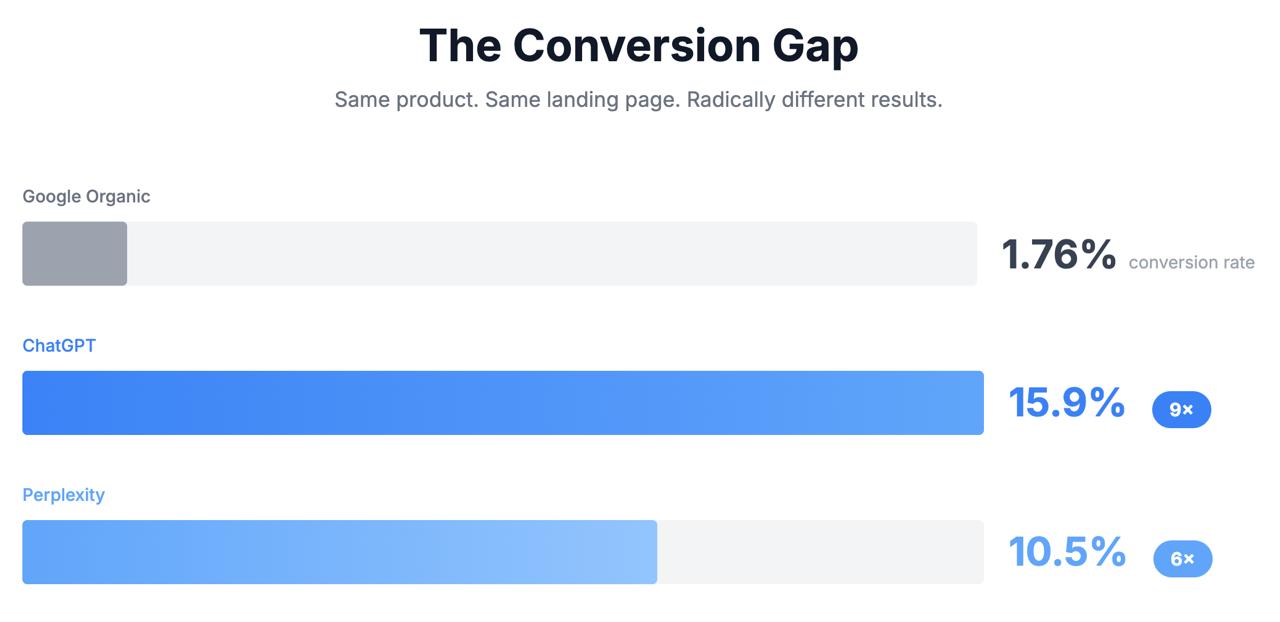
Seer Interactive tracked AI traffic across client sites and found ChatGPT converting at 15.9% compared to Google Organic at 1.76%. That’s not a marginal improvement—it’s a 9x difference. Their analysis revealed why: by the time users click through from an AI response, they’ve already completed their comparison phase within the conversation itself.
Semrush’s research found AI search visitors are 4.4x as valuable as traditional organic visitors based on conversion rate. Writesonic documented that their ChatGPT traffic converted 2.08x better than Google Organic despite dramatically lower volume. Superprompt’s analysis of 12 million website visits across 350+ businesses found AI traffic converting at 14.2% compared to Google’s 2.8%—a 5x difference.
These numbers align with what we’ve observed across crypto and fintech clients. AI traffic is fundamentally different—users arrive having already compared options, understood the value proposition, and made a preliminary decision. They’re not browsing. They’re buying. The AI essentially pre-qualifies them before they ever reach your site.
Volume is growing faster than most realize.
AI traffic grew from 0.02% of global internet traffic in 2024 to 0.15% in 2025—a 7x increase, according to SE Ranking’s analysis of nearly 64,000 websites. ChatGPT alone dominates with nearly 78% of AI referral traffic, followed by Perplexity at 15%.
Perplexity processed 780 million queries in May 2025, up from 230 million in mid-2024—more than tripling in under a year. ChatGPT reached 400 million weekly users by February 2025 and reportedly doubled that by March.
The Window
Here’s what most brands miss about timing: AI models aren’t updated continuously. They’re trained in cycles. Content that establishes authority now gets incorporated into model knowledge that persists for months or years.
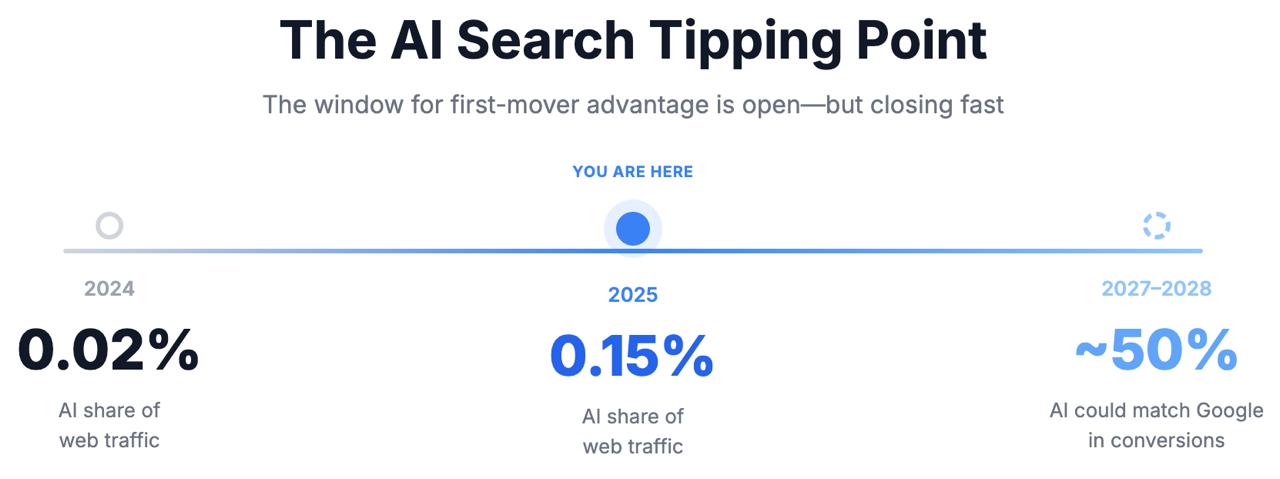
The brands being cited today trained the models on their authority yesterday. The brands wanting to be cited tomorrow need to be building that authority now.
First-mover advantages in AI citation are real and durable. Once ChatGPT learns to recommend Uniswap as the default DEX example, displacing that association requires not just matching their authority—but exceeding it enough to override established patterns.
The competitive gap is widening every month. According to 10Fold’s research, only 11% of B2B companies claim to have the majority of their content ready for AI discovery. That means 89% are still playing catch-up while early movers compound their advantage.
The question isn’t whether AI search matters for your business. The data makes that unambiguous. The question is whether you’ll be visible when your buyers ask their next question—or invisible while competitors capture demand you never knew existed.
Your buyers are already searching in AI. The only question is whether they’re finding you.
Häufig gestellte Fragen (FAQ)
AI search optimization for B2B is the practice of structuring your content and brand presence to appear in AI-generated responses when buyers research vendors using ChatGPT, Perplexity, and Google AI Overviews. Unlike traditional SEO that targets rankings, AI search optimization focuses on earning citations and recommendations during the B2B buyer journey.
Traditional SEO optimizes for click-through from search results pages, while AI for SEO optimizes for being cited as a trusted source in AI-generated answers. AI systems prioritize authoritative, clearly structured content that directly answers user questions — not keyword density or backlink volume alone.
AI search traffic converts 4-9× better because users arrive pre-qualified — they’ve already compared options and formed preferences within the AI conversation. By the time they click through to your site, they’re ready to buy, not browse.
Test your brand visibility by asking ChatGPT, Perplexity, and Gemini the questions your B2B buyers actually ask during vendor research—then note whether you’re mentioned, recommended, or absent. Agencies like ICODA offer AI visibility audits that systematically track citation frequency across all major AI platforms and identify gaps versus competitors.
Generative engine optimization (GEO) is the strategic process of optimizing content for citation in AI-powered search engines. GEO focuses on entity clarity, answer-first content structure, and building authority signals that large language models trust when generating recommendations.
Most brands see measurable improvements in AI citation frequency within 8-12 weeks, with compounding effects over 3-6 months. Results depend on content restructuring, authority building, and how quickly AI platforms incorporate new training data into their models.
Teilen Sie


Den Artikel bewerten